




















• Five killed, homes and businesses razed as boundary dispute reignites tensions in Anambra East
By The Advocate
On a day when Nigerians were celebrating the country’s 66th Independence Anniversary on October 1, 2026, two neighbouring communities in Anambra State were engulfed in violence, turning what should have been a moment of national reflection and celebration into a nightmare of bloodshed, destruction and displacement.

Aguleri and Umuoba Anam, both in Anambra East Local Government Area, became the scene of a deadly confrontation over a disputed boundary, leaving at least five people dead, several others injured and property worth millions of naira destroyed.
The violence was particularly disturbing because the two communities share geographical proximity, economic interests and a history that ought to encourage peaceful coexistence. Instead, disagreement over where one community ends and the other begins degenerated into an armed confrontation that forced residents to flee their homes and traders to abandon their businesses.
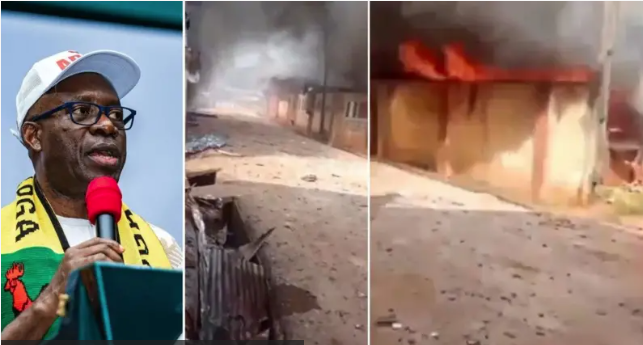
As the fighting escalated, parts of the sprawling palace of the traditional ruler of Aguleri, Igwe Mike Idigo, were set ablaze. Residential buildings, shops, rice mills and warehouses containing hundreds of bags of rice were also reportedly destroyed. Large quantities of agricultural produce, including rice and yam, were lost in the violence.

The destruction was especially painful in an area widely regarded as one of the food-producing centres of Anambra State, where agriculture and trading sustain thousands of households.
Smoke billowed from residential neighbourhoods as traders struggled to salvage whatever remained of their investments. Several buildings, including those reportedly belonging to Chief Nonso Ozemene, Chief Nnaluo Ebunu and Chief Okonkwo Umebe, were among the structures affected. Shops around the Timber Market in Aguleri were also reportedly destroyed.
A viral video from the area captured the atmosphere of fear and hostility, with voices heard issuing commands to armed men to shoot at sight. The ever-busy Otuocha-Umuoba Anam road was deserted as residents and commuters sought safety.
For many people in the affected communities, the immediate concern was no longer the ownership of a disputed piece of land but the preservation of lives, homes and livelihoods.
A signpost that triggered bloodshed
At the centre of the latest confrontation was a disagreement over the erection of a signpost and the installation of Closed-Circuit Television (CCTV) cameras at a disputed boundary between the two communities.
Reports from the area indicated that Aguleri intended to mount the signpost and install surveillance cameras to mark or monitor the boundary. Umuoba Anam residents reportedly objected, insisting that the location chosen for the installation fell within their territory.
The disagreement soon escalated. Youths from Umuoba Anam allegedly pulled down the signpost, arguing that it had been erected on their land. What might ordinarily have been resolved through consultation, mediation or recourse to the appropriate authorities subsequently degenerated into violence, with dangerous weapons and firearms reportedly deployed.
By the time the fighting subsided, at least five people had reportedly lost their lives, while several others sustained injuries.
Although the precise circumstances surrounding the initial confrontation require thorough investigation, the incident highlights the danger of allowing unresolved communal grievances to be settled through unilateral actions, intimidation or force.
A boundary marker, however contentious, should never become a reason for the loss of human lives.
The weight of history
Beneath the immediate dispute lies a deeper disagreement over land, historical ownership and the interpretation of past arrangements between the communities.
Accounts from residents suggest that Aguleri historically controlled portions of the area now associated with Umuoba Anam but subsequently ceded or transferred land to the Anam people. One resident, defending the position of Umuoba Anam, argued that the community had occupied the land peacefully for generations following an arrangement with Aguleri ancestors.
According to the resident, the present disagreement reflects tensions over land that Umuoba Anam people believe was acquired legitimately in earlier times.
Such claims, however, must be examined against historical records, documentary evidence, recognised boundary descriptions, previous agreements and any relevant judicial or administrative decisions. Oral accounts can provide valuable historical context, but they cannot, on their own, conclusively settle a disputed boundary.
The central question is therefore not simply what either community claims, but what a fair, transparent and legally recognised process can establish.
Where different generations interpret history differently, the responsibility rests with community leaders and the relevant government authorities to establish the facts before disagreements become violent.
The latest crisis also raises questions about whether previous efforts to address the boundary issue were sufficient and whether the communities had effective channels for resolving disagreements before tensions reached boiling point.
A painful reminder of the Aguleri-Umuleri war
The bloodshed has revived painful memories of the devastating communal conflict between Aguleri and Umuleri, another neighbouring community in Anambra East Local Government Area.
The conflict, which lasted from 1999 to 2002, claimed more than 300 lives, according to the historical account cited in reports about the area. It left behind destroyed homes, displaced families and deep social wounds that took years to begin healing.
The scars of that conflict remain visible in parts of the local government area, serving as a reminder of how quickly a dispute between neighbouring communities can develop into a prolonged cycle of violence and retaliation.
The Aguleri-Umuleri conflict demonstrated that communal wars rarely produce clear winners. Even when one side believes it has defended its territory or achieved a tactical advantage, the wider consequences often include deaths, ruined investments, interrupted education, disrupted farming and trading activities, and lasting distrust among neighbours.
The danger is that the current Aguleri-Umuoba Anam crisis could follow a similar trajectory if the underlying grievances are not addressed fairly and decisively.
The two disputes are distinct and should not be treated as identical. Nevertheless, the history of violence in the area makes an urgent and credible intervention imperative.
The lessons of the past are clear: early intervention, impartial fact-finding, responsible leadership and sustained dialogue are essential to preventing another prolonged communal conflict.
Soludo moves to contain the crisis
The Anambra State Government moved swiftly to contain the violence, apparently conscious of the danger that the confrontation could spread and become more difficult to control.
Governor Chukwuma Soludo dispatched his deputy, Dr Onyekachukwu Ibezim, who chairs the state’s boundary commission, alongside the Commissioner of Police, CP Nnanna Oji Ama, to the affected area.
During the intervention, Ibezim ordered the suspension of further activities at Otuocha Market pending the completion of the necessary investigations and the determination of appropriate measures by the state government.
He stressed that neither community leaders nor local government chairmen had the authority to unilaterally determine boundaries between communities without the knowledge and involvement of the state government.
The position underscored the government’s insistence that boundary disputes must be handled through established institutions rather than through unilateral declarations or confrontations on the ground.
The suspension of market activities, however, carries its own economic consequences. Otuocha Market and the surrounding trading network are important to the livelihoods of traders, farmers, transport operators and other small-business owners. A prolonged shutdown could compound the losses already suffered during the violence.
The challenge before the government is therefore twofold: to prevent further bloodshed and to establish a credible process that will allow economic activities to resume safely once the necessary security and administrative conditions have been met.
A commission of inquiry and the search for lasting peace
Beyond the immediate security intervention, Governor Soludo established a Commission of Inquiry to investigate the crisis.
The Judicial Commission of Inquiry was mandated to examine petitions, complaints and historical grievances relating to the dispute and submit a comprehensive report within four months.
The commission offers an opportunity to move beyond competing allegations and establish a clearer account of the issues that fuelled the confrontation.
Its effectiveness will depend on the independence and thoroughness of its proceedings, the quality of evidence considered and the willingness of all parties to cooperate with the investigation.
The commission must be able to hear the concerns of both communities, examine relevant historical and documentary records, identify the immediate triggers of the violence and make recommendations that can be implemented.
Equally important is the need to distinguish between the peaceful expression of a community’s claims and criminal conduct. No community should be collectively blamed for the actions of individuals, but anyone found to have participated in unlawful killings, arson or other criminal acts must be held accountable in accordance with the law.
At a peace summit convened at the Government House in Awka, traditional rulers, Presidents-General and community leaders from Aguleri, Umueri and Umuoba Anam met with government officials to discuss the crisis. Traditional rulers from Anambra South and Central Senatorial Districts and the chairman of the Anambra State Traditional Rulers Council were also in attendance.
The gathering was intended to build consensus around the restoration of peace and the prevention of further hostilities.
Governor Soludo condemned the loss of lives and the destruction of property, declaring that lawlessness had no place in his administration. He directed security agencies to maintain a round-the-clock presence in the affected areas to protect residents and prevent a resurgence of violence.
The stakeholders agreed on measures that included an immediate ceasefire, the prosecution of perpetrators, accountability among community leadership and the rebuilding of the palace of Igwe Idigo.
The attack on the traditional ruler’s palace was particularly troubling because the institution represents more than a private residence. It is also a symbol of traditional authority, communal identity and cultural heritage.
Governor Soludo consequently announced that the state government would assist in rebuilding the destroyed palace.
He also directed that grievances, claims and representations relating to the dispute be channelled through designated stakeholders and the appropriate government processes.
These measures are important, but their success will ultimately be determined by implementation. Security deployments must be sustained for as long as necessary, investigations must proceed impartially, and the findings of the commission must lead to practical steps capable of addressing the dispute.
Traditional rulers and the responsibility of leadership
The traditional rulers of both communities, Igwe Mike Idigo of Aguleri and Igwe George Ekwealor of Umuoba Anam, have appealed to their subjects to maintain peace and allow the government to handle the matter.
Their intervention is significant because traditional rulers remain influential figures in community affairs and can help persuade residents, particularly youths, to reject violence.
However, appeals for peace must be accompanied by consistent efforts to discourage incitement, prevent retaliatory attacks and encourage cooperation with lawful investigations.
Community leaders also have a responsibility to ensure that disputed claims are not presented in ways that provoke hostility or encourage residents to take the law into their own hands.
The involvement of youths in communal conflicts is especially concerning. Young people, who should be building their communities through education, agriculture, entrepreneurship and civic engagement, can become instruments of violence when historical grievances are manipulated or when lawful avenues for resolving disputes are disregarded.
Preventing a recurrence will require more than a temporary ceasefire. It will demand sustained engagement with young people, community-based peace initiatives and a shared understanding that the future of both communities depends on peaceful coexistence.
Peter Obi’s appeal: Choose dialogue over destruction
Former Anambra State governor and Labour Party presidential candidate, Mr Peter Obi, has also appealed to Aguleri and Umuoba Anam to end the hostilities and embrace peace.
Obi expressed sadness over the reports of violence, warning that communal conflict only deepens the economic and social difficulties already confronting ordinary Nigerians.
He called on both communities to cease hostilities immediately, stressing that no grievance was worth the loss of lives, the destruction of homes and livelihoods, or the suffering inflicted on families.
Obi urged the people to choose dialogue over violence, reconciliation over revenge and peace over destruction.
His appeal reflects a broader concern about the consequences of communal violence at a time when many households are struggling with economic pressures and the rising cost of living.
For farmers and traders in the affected communities, the consequences of the crisis could extend well beyond the immediate destruction. Damaged rice mills, burnt shops and lost agricultural produce represent lost income, disrupted supply chains and uncertainty for businesses that depend on regular trading activities.
For families who have fled their homes, the priority is immediate safety and the ability to return without fear. For those who have lost relatives, no political statement or government intervention can erase the pain of bereavement.
These human consequences should remain central to every effort to resolve the crisis.
Beyond a ceasefire: The challenge of a durable settlement
The immediate restoration of calm is essential, but peace cannot be measured merely by the absence of gunfire.
A lasting settlement must address the substance of the boundary dispute, the grievances of both communities and the institutional weaknesses that may have allowed the disagreement to escalate.
First, the boundary must be established through a transparent, evidence-based process involving the relevant government authorities and all affected parties. The outcome should be clearly communicated, properly documented and implemented in accordance with the law.
Second, the government must ensure that the inquiry into the violence is thorough and impartial. Allegations of murder, arson, assault and destruction of property should be investigated on their individual merits, with suspects treated in accordance with due process.
Third, the government and community leaders should establish a credible mechanism for resolving future disagreements before they escalate. Regular consultations, joint peace committees and clear procedures for handling boundary-related complaints could help reduce the risk of unilateral actions.
Fourth, attention must be given to the victims. Residents who lost homes, traders whose shops were destroyed and farmers whose produce was burnt will require support to rebuild their lives. The government should assess the extent of the damage and explore appropriate measures for relief and recovery.
Finally, peacebuilding must continue after the immediate crisis has passed. The communities need sustained dialogue, confidence-building measures and opportunities for cooperation in areas of shared economic and social interest.
The success of these efforts will depend on whether both sides are willing to accept a fair process, even where its eventual findings differ from their preferred positions.
A common future that must not be sacrificed
The crisis between Aguleri and Umuoba Anam is a sobering reminder that geographical proximity does not automatically guarantee peaceful coexistence. Neighbours can share roads, markets, farms and economic interests while remaining divided by unresolved questions of history and territory.
But those divisions need not end in bloodshed.
The destruction of homes, shops and rice mills, the reported loss of five lives and the burning of the palace of a traditional ruler demonstrate the enormous price communities pay when disputes are allowed to escalate into violence.
Neither community can secure a prosperous future through the destruction of its neighbour. Farmers need peace to cultivate their land, traders need security to conduct business, children need stable homes to pursue their education, and families need assurance that ordinary disagreements will not expose them to gunfire.
The government now has an opportunity to demonstrate that impartial investigation, credible institutions and responsible leadership can resolve even deeply rooted communal disputes.
For Aguleri and Umuoba Anam, the way forward must be anchored in truth, justice, restraint and mutual respect. Those responsible for criminal acts must face the law, legitimate grievances must be heard, and the disputed boundary must be addressed through a process that commands public confidence.
The memories of the Aguleri-Umuleri conflict should serve as a warning, not a prophecy. The latest crisis must not become another chapter in a cycle of communal bloodshed.
Ultimately, the test of leadership will not be how forcefully the government condemns the violence or how quickly security personnel restore order. It will be whether the people of Aguleri and Umuoba Anam can return to their homes, farms and businesses with confidence that the dispute will no longer threaten their lives.
The boundary between the two communities may remain a matter for investigation and lawful determination. But one boundary should be beyond dispute: the line that separates legitimate grievance from the deliberate destruction of human life.
That is the line both communities, their leaders and the government must now defend.