Politics
Enugu APC Targets Total Victory as Campaign Council Unveils 2027 Strategy


The Enugu State chapter of the All Progressives Congress (APC) has unveiled an operational framework to coordinate its 51 directorates and mobilise support for President Bola Tinubu, Governor Peter Mbah and other party candidates ahead of the 2027 general elections.
The strategy was unveiled on Tuesday, November 3, 2026, following a high-powered meeting of the campaign council’s directors, three zonal secretaries and three Deputy Directors-General representing the senatorial zones.
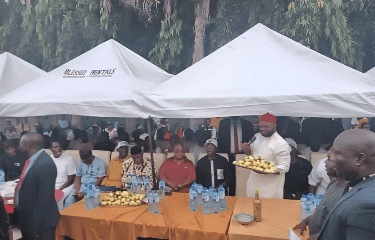
Those in attendance included Deacon Okey Ogbodo (Enugu East), Dr. Dan Shere (Enugu North) and SKE Udeh-Okoye (Enugu West). The meeting was presided over by the council’s Director-General, Chief Dr. Charles Mbah, while the Secretary-General, Dr. Eric Oluedo, was also in attendance.

Addressing journalists after the meeting, the council’s spokesperson, Barr. Steve Oruruo, said the gathering was convened to define the responsibilities of each directorate, eliminate operational overlaps and establish a coordinated structure for the campaign.

According to him, Chief Mbah used the meeting to motivate members and emphasise the importance of commitment, discipline and effective coordination in achieving the council’s objectives.
“The template provided at the meeting is intended to streamline the responsibilities of each directorate, prevent overlaps and avoid unnecessary friction. Each directorate will have clearly defined functions and be accountable for delivering results through regular feedback, monitoring and checks and balances,” Oruruo said.
He explained that the council was deliberately expanded to accommodate a broad spectrum of stakeholders across the state, including influential political leaders, elders, youths, professionals and individuals from different political backgrounds who have embraced Governor Mbah’s leadership.
He said the objective was to build a formidable campaign structure capable of reaching every part of the state and sustaining widespread support for the APC through effective communication of the achievements of the Tinubu and Mbah administrations.
“The intention is to build a massive campaign structure capable of reaching every part of the state. Members are expected to trigger robust and overwhelming dominance of the political space through informed conversation on the flawless performance status of Mbah’s administration in support of the APC,” he said.
Oruruo added that the council was determined to secure victory across all elective positions, stressing that its ambition extended beyond the presidential and governorship contests to include the Senate, House of Representatives and State House of Assembly elections.
“The ultimate objective is to bring the different contributions together towards securing a massive and unprecedented electoral victory for the APC at all levels,” he stated.
He said the council would prioritise direct engagement with voters, urging members to communicate the achievements of the Tinubu and Mbah administrations using facts, documented evidence and measurable results rather than emotional appeals.
On the performance of the Mbah administration, Oruruo said the governor’s achievements in economic development and other critical sectors had strengthened public confidence in his leadership and attracted growing interest from investors, including those in the diaspora.
He maintained that the administration’s performance, as reflected in rankings by the National Bureau of Statistics and other credible institutions, had provided the campaign council with compelling evidence to present to voters.
The council comprises 51 directorates covering key areas such as administration, finance, fundraising, public communication, media, new media and strategic communication, research and strategy, election planning and coordination, security, legal services, mobilisation, logistics, welfare, medical services, voters’ education, inter-party affairs, peace and reconciliation, trade unions and market associations, persons with disabilities and non-indigene coordination.
Other directorates focus on corporate and private-sector coordination, parliamentary mobilisation, event management and venue management, among other responsibilities.
Oruruo said the various units were expected to work collaboratively through effective communication, monitoring and accountability to ensure that the size and diversity of the council did not undermine its operational efficiency.
Among those who attended the meeting were the Secretary to the State Government, Prof. Chidiebere Onyia; Enugu State APC Chairman, Dr. Martins Chukwunweike; Chairman of the Enugu State Tourism Board, Rita Mbah; Commissioner for Transport, Ricky Agu; Commissioner for Culture and Tourism, Barr. Ugochi Madueke; and Commissioner for Women Affairs, Ngozi Eni.
Other political leaders and stakeholders included Barr. Charles Egumgbe, the party’s pioneer state chairman in 1998 and current Commissioner for Chieftaincy Affairs; former Peoples Democratic Party (PDP) Chairman, Vita Abba; the state APC Secretary, Chukwudi Nnadozie; Ogbo Asogwa; and Joe Mammel.
The council’s Director of Non-Indigenes, Chief Cosmas Agagbo (Okpoka N’Abba), reaffirmed the community’s commitment to the APC and Governor Mbah, pledging massive mobilisation for the party ahead of the 2027 elections.
He said the governor’s performance had strengthened their confidence in his administration and provided compelling reasons for the community to rally behind him and the APC.
The meeting was attended by directors and representatives of the various campaign units, who deliberated on the operational framework, coordination mechanisms and the council’s target of delivering an across-the-board APC victory in Enugu State.




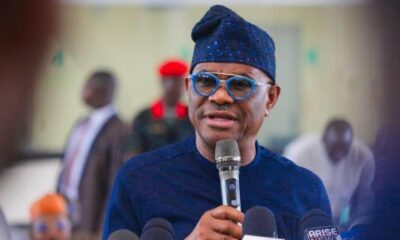


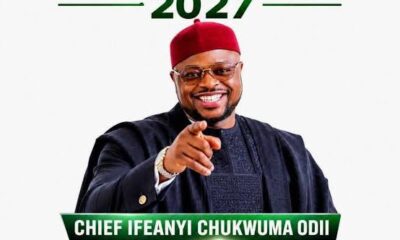



The Director-General of the Anyi Chuks Campaign Organisation, Amb. Nwannebuike Ominyi, has urged the people of Ebonyi State to prioritise competence, experience and leadership capacity over ethnic sentiments and zoning arrangements in choosing the state’s next governor ahead of the 2027 governorship election.
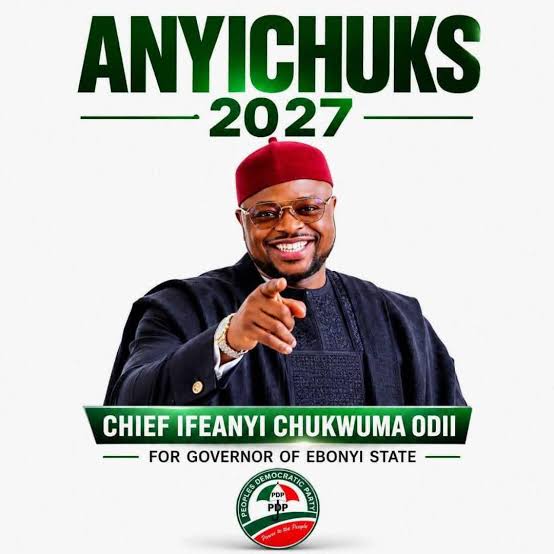
Ominyi made the call while delivering his acceptance speech following his appointment as Director-General of the campaign organisation of the Peoples Democratic Party (PDP) governorship candidate, High Chief Dr. Ifeanyi Chukwuma Odii.
He said Ebonyi needed an informed, visionary and development-oriented leader capable of reversing what he described as years of missed opportunities, poor governance and misplaced development priorities.
Expressing concern over the state of infrastructure, education, healthcare, sanitation and the business environment, the campaign DG alleged that the past three and a half years had been characterised by poorly prioritised projects and limited development.
He particularly lamented what he described as the absence of completed landmark projects, deteriorating public infrastructure and an unfavourable business environment.
“In the league of states, Ebonyi appears to be standing alone in the category of zero project completion within a four-year tenure, alongside poorly conceived and misplaced project priorities, including white-elephant projects with little or no economic value,” he said.
Ominyi further alleged that unfavourable business conditions had forced some business owners to relocate from the state while discouraging prospective investors from establishing businesses there.
He also expressed concern over poor electricity supply in Abakaliki, refuse accumulation across the state capital and local government headquarters, declining educational standards, challenges in the healthcare sector and inadequate access to water and sanitation.
“Ebonyi State deserves better than what we have witnessed over the past three and a half years,” he declared, warning against another four years of what he described as wasted opportunities.
According to him, the state requires a governor with a clear understanding of wealth creation, investment promotion, disciplined resource management and equitable distribution of public resources to transform its predominantly rural economy into an industrial and commercial hub.
He identified investment attraction, mechanised agriculture, industrialisation, improved internally generated revenue and citizen empowerment as critical areas requiring urgent attention.
“For a state to experience progress, prosperity, development and improved welfare, it must be led by an informed leader with a strong understanding of wealth creation, disciplined resource management, equitable distribution of public resources and deliberate citizen empowerment.
“Such a leader must possess investment knowledge and a strong network capable of attracting local and foreign investors,” he stated.
The campaign DG urged Ebonyians to look beyond ethnic affiliations and zoning arrangements, insisting that leadership should be determined by competence, capacity and demonstrable performance rather than political entitlement or incumbency.
“This is the time to set aside ethnic considerations and support a leader with the capacity and competence to build a state that thrives in progress and prosperity,” he said.
Explaining his decision to accept the appointment, Ominyi said he had assessed Odii’s business achievements, humanitarian interventions, scholarship programmes and healthcare initiatives before concluding that the PDP candidate possessed the experience and capacity to lead the state.
He particularly cited Odii’s reported provision of houses for indigent residents across the local government areas of Ebonyi, describing the initiative as evidence of his commitment to improving the welfare of the people.
“Dr. Odii has the capacity, networks and leadership skills to deliver good governance and help move our state from its present challenges towards a prosperous and progressive society,” he added.
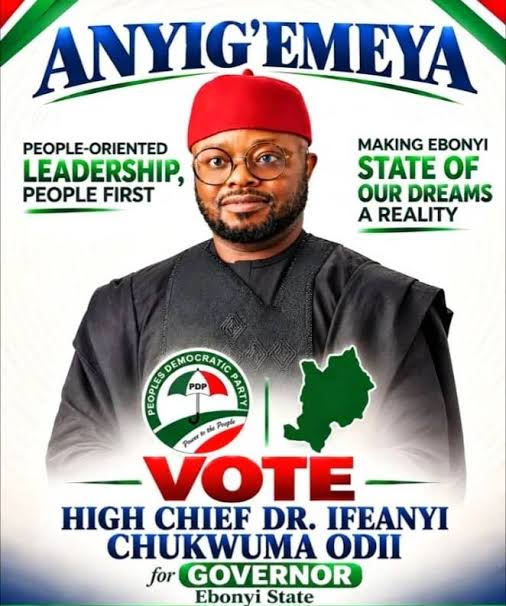
Ominyi also explained that the Anyi G’Emeya project was designed to promote competence, shared prosperity, accountable governance, quality education, industrial development and functional public institutions.
Addressing members of the newly inaugurated campaign council, he urged them to build an organised, disciplined, inclusive and effective political structure capable of translating the campaign’s vision into concrete action.
He stressed that the success of the council would not be determined by its numerical strength or the grandeur of its inauguration but by the functionality of its structures, quality of leadership, effective communication and commitment of members.
“Our inauguration today must therefore mark the beginning of work, not the conclusion of preparations,” he said.
The campaign DG pledged to discharge his responsibilities with diligence, loyalty, integrity and commitment, while appreciating Odii, party leaders, stakeholders and members of the campaign council for the confidence reposed in him.
He called on Ebonyi residents to support Odii’s governorship ambition, promising that an administration under the PDP candidate would prioritise job creation, skills acquisition, affordable education, reliable water supply, good roads, improved healthcare and the protection of citizens’ property rights.
He concluded with a call for support for the PDP candidate under the campaign slogan: “Vote PDP! Vote Anyi Chuks Anyi G’Emeya!”
By Tony Edike
• As PDP governorship candidate unveils 180,000-job target, promises free education, industrialisation, agricultural transformation and a new approach to governance
The future of Ebonyi State is once again at the centre of an important political conversation as the race for the 2027 governorship election gathers momentum. At the heart of this conversation is Chief Dr Ifeanyi Chukwuma Odii, the Peoples Democratic Party (PDP) governorship candidate, who says his ambition is driven by a desire to rebuild the state’s economy, expand opportunities for its people and place Ebonyi on a new path of sustainable development.
With the declaration, “Ebonyi will rise again,” Odii is presenting his aspiration as more than a quest for political power. He is seeking to sell a vision of economic recovery, social inclusion and institutional transformation, anchored on the belief that Ebonyi has the human resources, natural endowments and entrepreneurial capacity to become a stronger economic player in the South-East and Nigeria.
His message, delivered during a media parley in Enugu on Wednesday, November 25, 2026, and reinforced by his manifesto, Anyi G’emeya: A Promise of Possibility, is built around a central proposition: that Ebonyi can achieve more if its enormous economic potential is properly harnessed and governance is directed towards the needs of ordinary citizens.

Dr Ifeanyi Odii
For a state blessed with agricultural land, solid mineral resources, a hardworking population and a strategic position in the South-East, the question of how to translate these advantages into prosperity remains fundamental.
Odii believes the answer lies in moving beyond an economy largely dependent on federal allocations towards one driven by productive industries, agriculture, private investment, entrepreneurship and value addition.
Beyond political promises: An economy driven by productivity
One of the most ambitious proposals in Odii’s manifesto is the creation of more than 180,000 jobs if elected governor.
The proposal reflects an understanding of one of the most pressing challenges confronting Ebonyi and Nigeria at large: the need to create sustainable employment opportunities for a growing population of young people.
Rather than relying exclusively on government recruitment, the PDP candidate is proposing an economic structure in which agriculture, manufacturing, mining, trade, quarrying and tourism become major sources of employment and revenue.
The thinking is that government should not only employ people directly but also create an environment in which businesses can grow, industries can operate and private investors can generate jobs.
This approach, if properly implemented, could provide opportunities for graduates, artisans, farmers, technicians, traders and entrepreneurs across the state’s 13 local government areas.
However, the 180,000-job target will require more than political commitment. It will demand a clear implementation framework, investment mobilisation, sector-by-sector employment targets and a transparent monitoring mechanism to establish how many sustainable jobs are actually created.
The strength of the proposal will ultimately be measured not by the number announced during campaigns but by the number of Ebonyi residents who secure decent and lasting employment.
Agriculture: Turning Ebonyi’s strength into economic wealth
Agriculture remains one of Ebonyi’s greatest economic advantages. Yet, for many farmers, production is still constrained by limited access to modern equipment, improved seedlings, irrigation, financing, storage facilities and reliable markets.
Odii’s proposed agricultural transformation seeks to address these challenges by moving farmers from subsistence production to commercial and technology-driven agriculture.
His manifesto proposes mechanisation, improved agricultural inputs, irrigation systems, accessible financing and stronger market connections.
It also envisages specialised agro-industrial processing zones across strategic locations in the state, where agricultural produce can be processed, packaged and prepared for wider markets.
This is particularly important because the economic value of agriculture does not end with harvesting. The real opportunity lies in processing, packaging, preservation, distribution and export.
For instance, rather than allowing farmers to sell their produce at low prices because of limited storage or processing facilities, an agro-industrial system could create opportunities for food processing companies, transporters, packaging businesses and other supporting enterprises.
Odii also proposes identifying between 400 and 500 hectares of suitable land for commercial agriculture and agro-industrial investments, subject to feasibility studies and consultations with host communities.
Smallholder farmers would be integrated into larger investments through outgrower arrangements, allowing them to benefit from commercial agricultural operations without necessarily losing their independence.
If implemented with transparency and adequate protection of community interests, such a model could help improve agricultural productivity, strengthen rural economies and make farming more attractive to young people.
Solid minerals: An opportunity beyond agriculture
Perhaps one of the most significant areas of opportunity highlighted by Odii is the solid minerals sector.
Ebonyi is endowed with mineral resources that, if properly explored and developed within the applicable legal framework, could contribute substantially to its economic growth.
The PDP candidate believes the sector can become a major source of investment, employment and revenue.
During the Enugu media parley, he estimated the potential value of the state’s solid mineral resources at more than $20 trillion. This is his assessment, however, and would require independent geological verification and economic evaluation.
Importantly, mineral resources fall under the exclusive control of the Federal Government, but state governments can play important facilitating roles through infrastructure, land administration, investment promotion, environmental oversight within their jurisdiction and partnerships that benefit host communities.
Odii says his proposed administration would develop a framework for attracting credible mining investors while ensuring that local communities and young people benefit from the economic opportunities generated.
The objective should be to move beyond the extraction of raw minerals towards value addition, local processing and the development of supporting industries.
For Ebonyi, this could mean more employment for skilled and unskilled workers, new business opportunities and increased economic activities in mineral-producing communities.
However, environmental protection, community consent, responsible mining and strict regulatory compliance must remain central to any such development strategy.
Industrialisation and electricity: Building the foundation for businesses
No modern economy can achieve meaningful industrial growth without reliable electricity, functional infrastructure and a business-friendly environment.
Odii’s manifesto recognises these requirements and proposes the establishment of industrial clusters and production hubs equipped with electricity, roads and water supply.
The proposed clusters are intended to attract manufacturing companies, encourage small and medium-scale enterprises and provide a platform for local businesses to expand their operations.
His electricity proposal is particularly noteworthy.
With the opportunities created by the Electricity Act 2023, which provides a framework for greater participation by states and private investors in the electricity market, Odii says his administration would explore alternative power-generation and distribution arrangements.
These include solar mini-grids, biomass, gas-powered electricity solutions and other renewable energy sources.
The idea is to develop energy solutions that can serve industrial clusters, commercial centres and underserved communities.
For a state seeking to attract manufacturers and industrial investors, reliable electricity could make a significant difference in production costs, business competitiveness and job creation.
The proposed reforms to simplify business registration and permit procedures, while eliminating multiple and arbitrary levies within the state’s jurisdiction, also point towards an effort to make Ebonyi more attractive to investors.
Ultimately, the success of this agenda will depend on whether businesses can operate with greater confidence, predictability and reasonable operating costs.
Free education: Investing in the next generation
Perhaps the proposal with the most direct impact on ordinary families is Odii’s promise to introduce free public primary and secondary education across Ebonyi State.
For parents struggling with the rising cost of living, education expenses can constitute a significant financial burden.
The proposed policy seeks to remove the financial barriers preventing children from accessing basic education and ensure that indigent pupils are not denied opportunities because of their economic circumstances.
But Odii’s education agenda goes beyond the payment of school fees.
His manifesto also proposes improved school infrastructure, better teaching standards and expanded access to vocational and technical education.
He intends to promote partnerships between educational institutions, manufacturers and industry associations to equip young people with practical skills relevant to the demands of modern industries.
This is an important consideration because the future of education must be linked to the realities of the economy.
As Ebonyi seeks to develop its manufacturing, agricultural processing, mining and technology sectors, it will require a workforce with the necessary technical knowledge and practical skills.
Free education, therefore, could become an investment in human capital, provided the policy is supported by adequate funding, qualified teachers, functional classrooms, instructional materials and effective supervision.
The proposed policy will also require a clear financial plan to guarantee that free education does not compromise the quality of teaching and learning.
Healthcare and social protection
A prosperous society must also be a healthy society.
Odii’s manifesto proposes strengthening the healthcare system through improved medical facilities, increased capacity for healthcare personnel, access to essential medicines and expanded primary healthcare services.
Particular attention is expected to be given to underserved communities where access to quality healthcare remains a challenge.
The emphasis on primary healthcare is significant because many preventable illnesses can be addressed through functional health centres, qualified personnel, maternal and child healthcare services, immunisation and timely access to essential medicines.
For rural residents, access to healthcare should not depend on how far they live from major urban centres.
The proposed improvements, if delivered, could strengthen the healthcare system and reduce the burden on families who often travel considerable distances to access medical services.
Security and peaceful communities
Economic development cannot thrive in an atmosphere of insecurity.
Odii has therefore identified security as a major component of his proposed administration, promising a community-based and intelligence-driven approach to addressing kidnapping, communal disputes, cultism, drug abuse and other criminal activities.
His manifesto specifically identifies longstanding communal conflicts involving Abaomege and Ishinkwo, Ezza and Ezilo, Ezza and Effium, as well as Ngbo and Agila communities, as areas requiring sustained government attention.
These conflicts have, over the years, affected relationships among communities, disrupted economic activities and created humanitarian challenges for affected populations.
The candidate proposes stronger cooperation among security agencies, traditional rulers, local government authorities and community organisations.
He also advocates improved intelligence gathering, surveillance and emergency response systems.
Beyond security operations, however, lasting peace will require dialogue, justice, reconciliation, respect for traditional institutions and equitable development.
The government must also address the underlying factors that allow communal disputes to persist, including land disagreements, boundary disputes and competition over resources.
Governance that measures performance by results
One of the most important elements of Odii’s proposals is his emphasis on institutional reforms and accountability.
His manifesto promises reforms in land administration, right-of-way permits, civil service operations and judicial administration, with the objective of simplifying government procedures and improving efficiency.
He also proposes strengthening internally generated revenue without imposing unnecessary financial pressure on residents and businesses.
This is an important distinction because sustainable revenue generation should be driven by economic expansion, improved tax administration and the formalisation of business activities rather than arbitrary levies.
To strengthen transparency, Odii proposes digital budgeting, open procurement processes, expenditure monitoring and regular publication of government revenue and spending reports.
He also intends to establish a dedicated delivery unit to monitor government commitments and assess performance against measurable targets.
The proposed delivery unit could provide an important mechanism for ensuring that campaign promises do not disappear after elections.
His promise to pursue visible development within the first 200 days in office is another indication of the emphasis he wants to place on measurable results.
However, the effectiveness of such a structure will depend on its independence, access to reliable information and the willingness of government institutions to submit themselves to performance evaluation.
The private-sector experience and the challenge of public leadership
In making a case for his candidacy, Odii has repeatedly drawn attention to his experience in the private sector and his philanthropic interventions in Ebonyi communities.
During the media parley, he cited the construction of more than 120 houses, the provision of over 2,000 basic education scholarships, and support for orphanages and other community facilities among his interventions.
He argued that these efforts demonstrate his commitment to improving people’s lives and his capacity to mobilise resources for development.
He also disclosed that he had identified more than 100 business associates with the capacity to invest up to ₦1 billion each in Ebonyi, adding that the number of prospective investors willing to visit the state had increased to more than 300.
If these relationships translate into actual investments, they could provide an important foundation for private-sector participation in the state’s economic development.
Nevertheless, there is a fundamental difference between managing private businesses and governing a state.
Public leadership requires accountability to millions of citizens, respect for due process, prudent management of public resources and the ability to coordinate institutions with competing responsibilities.
Odii himself acknowledged this distinction when he said that he could not transform the state alone and would require the support of the people and the institutional capacity available to an elected governor.
His statement, “Only me cannot do it,” captures an important reality about governance: sustainable development requires collective participation.
A campaign built around issues and possibilities
Another feature of Odii’s political message is his stated preference for issue-based campaigning.
He said his campaign would avoid personal attacks and focus on policies, development priorities and verifiable records of performance.
His slogan, “Anyi G’emeya” — We will do it — is intended to communicate confidence, collective responsibility and the possibility of achieving a better future.
Explaining the philosophy behind the slogan, he said it represented a commitment to delivering on promises, remembering the poor, uplifting vulnerable citizens, returning indigent students to school and empowering young people.
The message is directed at a broad constituency: farmers seeking better opportunities, parents concerned about education, young people searching for employment, business owners looking for a supportive environment and communities demanding infrastructure and security.
As his statewide campaign begins, the challenge will be to translate these broad aspirations into practical engagements with residents across the 13 local government areas.
The questions that must be answered
While the manifesto presents an ambitious development agenda, its proposals also raise important questions that deserve detailed answers.
How will the proposed 180,000 jobs be distributed across the different sectors of the economy? What will be the estimated annual cost of free public education? How much investment will be required to establish the proposed industrial clusters? What is the implementation timeline for the agricultural and electricity projects?
There is also the question of how the administration intends to balance its development priorities with recurrent expenditure, debt obligations and other statutory responsibilities.
The manifesto, as presented, does not provide a detailed financial breakdown of these major commitments.
These are not reasons to dismiss the proposals. Rather, they are essential issues that voters, development experts, civil society organisations and the media should examine as the campaign progresses.
Ebonyi deserves a political conversation that goes beyond campaign slogans to the practical details of governance.
The bigger question: What future does Ebonyi deserve?
At the heart of Odii’s declaration that Ebonyi will rise again is a broader question about the future the people of the state want.
Can Ebonyi become a major agricultural processing destination in the South-East? Can its mineral resources support a stronger industrial economy? Can its young people find meaningful employment without having to migrate in search of opportunities? Can its public schools provide quality education regardless of the economic circumstances of parents?
These are questions that extend beyond party politics and should form the foundation of the 2027 governorship debate.
Odii is offering his answers through a manifesto that places employment, education, industrialisation, agriculture, infrastructure, healthcare and security at the centre of his proposed administration.
His statewide campaign will provide an opportunity for residents to interrogate these proposals, demand further explanations and assess the credibility of the commitments being made.
For the PDP candidate, the ambition is to rescue, rebuild and reposition Ebonyi.
For the people, the ultimate consideration should be which vision offers the most realistic pathway to economic prosperity, social development, peace and accountable leadership.
Beyond the promises, Ebonyi’s rise must be measured by what changes in the lives of its people — the jobs created, children educated, businesses established, communities connected, families lifted out of poverty and institutions strengthened. That is the real test of any promise of possibility.
The Advocate Newspapers | Special Political Feature
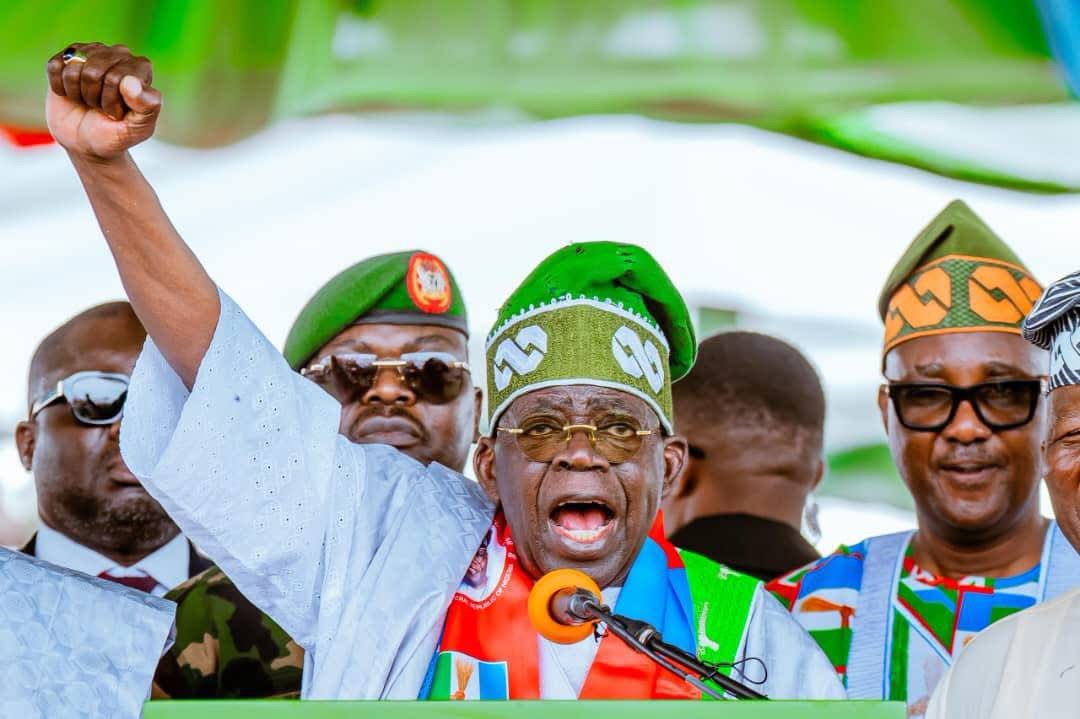
President Bola Tinubu has pledged that his administration will do everything possible to secure the release of about 70 schoolchildren abducted from Mussa and Lassa communities in Askira-Uba Local Government Area of Borno State.
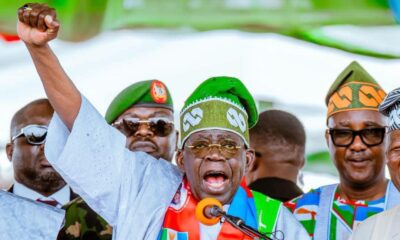
Tinubu gave the assurance on Wednesday in Maiduguri while addressing supporters at the North-East zonal rally of the All Progressives Congress (APC), held at the El-Kanemi Sports Centre.
The President, who acknowledged the security challenges confronting the region, assured residents that the Federal Government would intensify efforts to rescue the missing children.
“We shall do everything possible to rescue the schoolchildren abducted in Mussa and Lassa communities,” he said.
The abductions involved more than 30 children, including toddlers, from Mussa, as well as over 40 students from Government Technical School, Lassa.
The victims have remained missing since the incidents occurred in the first quarter of 2026, raising concerns over the safety of schoolchildren and the persistent security challenges in the North-East.
Tinubu also commended Nigerian troops, particularly personnel serving on the frontline, for their sacrifices in the fight against insurgency and terrorism.
He assured security operatives of the Federal Government’s continued support, stressing that his administration remained committed to defeating insurgency in the region.
“The present administration under my leadership acknowledges the sacrifices of troops, especially those at the frontline. Therefore, government will do its best to support our security operatives to defeat terrorism in this region,” the President said.
Meanwhile, Tinubu drew laughter from the crowd when he jokingly described Borno South Senator, Ali Ndume, as a “noisemaker” and “troublemaker” while acknowledging his presence at the rally.
The President made the remark while speaking about the College of Education in Gwoza, drawing attention to Ndume, who was among the dignitaries at the event.
“I cannot go without talking about the College of Education in Gwoza, and my man is here. He is a noisemaker o, and a troublemaker too, but we tolerate and know each other very well, and we are working together,” Tinubu said.
Ndume, who appeared amused by the President’s remarks, was seen smiling and waving to the crowd.
Tinubu subsequently acknowledged their long-standing relationship, suggesting that despite their political differences and Ndume’s outspoken nature, both men remained committed to working together for the development of Borno State and Nigeria.
The rally formed part of the APC’s political mobilisation activities in the North-East.
-
 Entertainment1 day ago
BREAKING: Veteran Nollywood Actor Pete Edochie Dies at 79 After Battle With Prostate Cancer
-
News3 days ago
INEC selects 520 polling units for mock election in Enugu
-
Politics3 days ago
BREAKING: 2027: Tinubu woos Lagos-based Igbos, seeks support for re-election
-
News20 hours ago
Gunshots as Obi, Kwankwaso Arrive Benin for NDC Town Hall Meeting
-
News1 day ago
‘We’ve Lost a Titan, Legend, an Icon’, Gov Mbah Mourns Pete Edochie
-
Politics2 days ago
‘Tinubu Must Go’ Chants As Atiku Takes Campaign To Kogi
-
News2 days ago
APC Mourns Members Killed in Zamfara Road Accident, Condoles with Governor, Families
-
News2 days ago
Mbah Makes Christmas Homecoming Easier, Offers Enugu Indigenes Free Transport