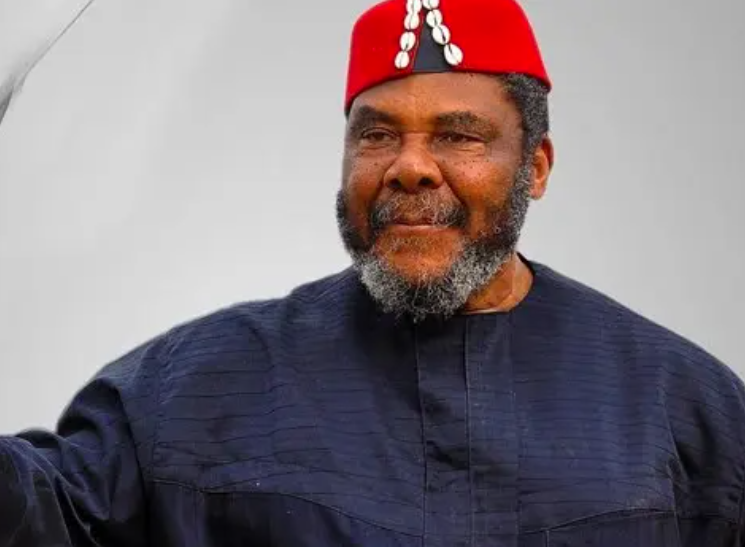
FRED IWENJORA reports that very brave Okonkwo of “Things Fall Apart”, Ebubedike, the Ononenyi of Nteje, Anambra State, and Ibobo Oyi na Omambala shed tears uncontrollably during this tour especially when students and pupils of Knutsford University used his name for different forms of recitations and poetry.
One may ask why Pete Edochie traveled to Ghana?
This visit was for the launching of the Pete Edochie Legacy project, themed “Celebrating the Africa legend; The lion that needs not to roar”.
It is “a cultural initiative created to honor and celebrate one of Africa’s most revered figures” according to the Ghanaian project organisers.
The Legacy project includes a biographical book, a documentary series and international tour with Ghana serving as the launch pad.
The publishers, KPL publishers had noted that the contributions of the 79-year-old screen star to Africa cinema are very noteworthy.
At the end of it all, the star actor had, aside unveiling his autobiography in a gala event, paid courtesy calls to industry and policy makers in Ghana including the visit to Ghana’s Goldbod, the body regulating everything gold in Ghana. Organisers saw the visit as an important segment of the tour because a visit to Ghana may have been incomplete without seeing first hand the reason the country was called Gold Coast.
He had also met and greeted select fans and featured in a public lecture and colloquium in his honor before returning to Nigeria.
From when he landed at Kotoka International Airport Tuesday 29th September, 2026 till his departure from Ghana on Wednesday 7, October 2026, there was no dull moment.
Reception was top notch and indeed out of this world.
Ghanaians as well as Nigerians left businesses and trouped out to see “the president of African screen” according to Elizabeth Ama Tetteh, one of his numerous Ghanaian fans who noted that she had been resident in Enugu, Nigeria. It was indeed heartwarming to see Ghanaian as well as Igbo cultural groups on hand to welcome him to the old Gold Coast. Dispatch riders led his motorcade out of the airport.
On arrival, he first paid a courtesy visit to Eze Dr. Chukwudi Jude Ihenetu, Onyendu Ndi igbo, Ghana and sued for peace between Nigeria and Ghana. The respected Eze Ihenetu had organised a congregation of Igbo and Ghanaian leaders for a traditional cocktail reception.
According to the major propeller of the project Kelvin King Dawie of King Dawie Publishing Ltd (KPL) “When people ask why Pete Edochie, I tell them that no honor for Pete Edochie is too big. He has very much distinguished himself on the continent of Africa and beyond as a custodian of the cultural heritage of Africa and has been consistent in it for decades since mounting the stage at the tender age of 15. He is well known and received a lot of honors and awards globally including Nigeria’s national honor of merit; MON.
“We also looked at the way he has distinguished himself on stage and in communication which has warranted him receiving Honorary Doctorate in Literature and creative arts.
On this continent, Pete Edochie is one of a kind and he needs to be projected and celebrated as that icon of Africa who has held high the heritage of Africa for over six decades of his acting life.
King Dawie, an accountant, business strategist and social impact leader also hinted that “the project is in four phases, the autobiography, a 16-episode documentary to properly chronicle his life’s journey and then also the African youth mentorship initiative to help him pass on information to the next generation and an international tour. It took a lot of several efforts from several people too numerous to mention to set this ball rolling and hopefully achieving. We also remain very grateful to our star guest for accepting our proposal. ” However, there are major take-aways from these nine days Pete Edochie “Presidential visit” to Ghana.
Cultural diplomacy at its highest African peak
Years back, Africa viewers had voted Pete Edochie as their main choice in (AMVCA).
However, this Ghana visit is International cultural diplomacy at its highest African peak.
It seems first in history that a film star would make so much impression in another country that a book would be written and unveiled on him in that country.
It also reveals that Nigeria and Ghana have co-existed as West Africa’s beloved Anglophone countries despite hiccups occasioned by various ‘Ghana must go’ or ‘Nigeria must go’ agitations.
And to see both Nigerians and Ghanaians under one roof because of Pete Edochie, animosities may have been doused even if for a moment.
The unveiling of the autobiographical book; Titan of Africa, the story of Pete Edochie, published by KPL Publishers was a big attraction on its own and first of its kind for a Nigerian actor. The event which held at Kempiski Accra drew together distinguished Ghanaians with highlights including his meeting with Ghanaian legendary actress, broadcaster and musician Grace Omaboe, known to many as Maame Dokono. He also met with 102 years old Warrant Officer 1 and WW2 veteran, Pa Joseph Ashitey Hammond. Their tight hug meant that this meeting for the WW2 veteran was highly anticipated like the story of the nunc dimitis contained in the synoptics.
There are pointers to the huge respect that he commands in the so called Gold Coast and that Africa is so culturally connected in many ways.
Another take away from the tour was that the man Pete Edochie is very well blessed and his star never seems to dim as years roll by.
Despite that he is bound to the wheelchair and could barely walk or sits on the chair in his current films, fans continue to adore him from far and near. (Saturday Vanguard)