Politics
Osun: The mourning after By Festus Adedayo

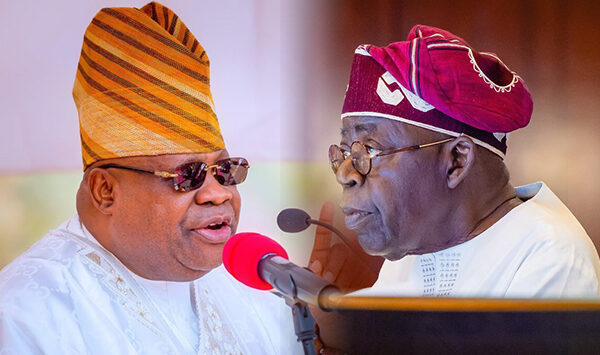
Speaking after an infrastructure inspection, Governor Ademola Adeleke openly backed President Bola Tinubu’s 2027 re-election bid. He warmly referredto him as “our own son, father and leader.” He went further to declare: “I am the governor of the ancestral birthplace of Mr President. How can I have my own in the saddle and think twice before embracing him?” Yet, even as those words echoed, in the election that held yesterday in Osun State, Governor Adeleke’s fate and that of Osun State were being systematically framed, for better or worse.
As we speak, spanning from Friday through the entire weekend, at least 25 states of the federation were left without a commissioner of police. They were all deployed to Osun State to do the president’s bidding. Reports confirmed that 32 Commissioners, 36 Deputy Commissioners, and 51 Assistant Commissioners descended upon a state with a mere 1,906,390 eligible voters. This was supplemented by an intimidating machinery of political heavyweights —the Senate President, ministers, governors, and presidential aides —acting as the semiotics of a Villa muscle-flexing designed to dismantle the state-level opposition.

That was the raw execution of federal might: thirty-five thousand police personnel and ten thousand Civil Defence officers holding vigil, alongside heavily armed soldiers who walked the state with infidel jackboots feet. Why inflict such immense dread upon a people if you are genuinely beloved? As Yoruba elders sagely observe, one only gazes blankly at the ceiling when the wisdom of Ifa divination appears entirely foreign —Àìgbọ’fá l’à ń wò’kè, Ifá kan ò sì ní párá.
As yesterday’s election unfolded, acuriously tragic political chemistry emerged between Tinubu and Adeleke. The tango between the duo strongly evokes the poignant caution against filicide in Chinua Achebe’s Things Fall Apart: “That boy calls you father; do not bear a hand in his death.” This grave warning was delivered by Ogbuefi Ezeudu, the oldest man in Umuofia, whose age cascaded like lies swimming on a slovenly head. A deeply revered elder and skilled warrior, Ezeudu’s voice was welded into Umuofia’s wisdom and tradition. His counsel concerned Ikemefuna, Okonkwo’s doomed foster child, who had lived in his household for three years. Between this period, Okonkwo and Ikemefuna developed a deep, quasi-parental bond with a warm brotherhood emerging between Ikemefuna and Nwoye, Okonkwo’s son.
Much like Okonkwo, who struggled with a desperate fear of being deemed weak or cowardly, Tinubu seemed gripped by an anxiety to prove his political virility in his ancestral home state of Osun — where his umbilical cord lies buried. He was apparently unwilling to confront failure in the battle to be a bearer of his cousin,Gboyega Oyetola’s political battle coffin. Ezeudu’s warning carried profound moral and spiritual weight: participating in the murder of someone who calls you “father” violates fundamental humanity, regardless of political expediency or clan custom. Yet, Okonkwo disregarded the elder’s counsel. He joined the execution party, and when a blow struck Ikemefuna and the terrified boy ran toward him crying, “My father, they have killed me!”, Okonkwo dealt the fatal final stroke.Replace Okonkwo with Tinubu and Ikemefuna with Adeleke. You will then discover that, what Tinubu did yesterday to an Adeleke who called him the father of Osun State was filicide.

A far greater tragedy awaited Okonkwo at Ezeudu’s funeral. As guns and cannons boomed, sending billowing fire into the sky and machetes clattered in a frenzy, Okonkwo’s gun unexpectedly exploded. A piece of shrapnel flew out, penetrating the heart of Ezeudu’s sixteen-year-old son and killing him instantly. Total chaos erupted. Okonkwo stood pensive, looking down as if counting his toes, fully aware of the grave consequences of killing the young boy. Tragedy wears a single, unforgiving colour. Killing a clansman, even accidentally, was an unpardonable offence against Ala, the earth goddess. Okonkwo knew the implication of murder in Umuofia: He had to go into a seven-year exile in Mbanta, his mother’s clan.
With what we saw in Osun, elections in Nigeria have increasingly transformed into the heavy beat of the Gbedu drum. It is characterized by a mournful, ululating cadence. When it is sounded as it was in Osun, a downcast populace asks in desperation: what song can be sung to this strange drumming? The Gbedu is no ordinary instrument; it is a sacred, massive drum symbolizing royal authority, sovereign power, and deep ancestral communion. Historically, it remains taboo for non-initiates to strike the Gbedu, as its resonant vibrations communicate directly with deities during coronations. Thus, when non-initiates commandeer this sacred beat, appalled Yoruba ask: “Orin wo laa ko si gbedu yi?”— What song do we sing to such a strange, ominous rhythm?
The Osun Gbedu comes with an air of foreboding of evil. William Shakespeare’s Brutus smelled the evil early enough. In his famous metaphor, wherein he said, “It is the bright day that brings forth the adder, and that craves wary walking,” Brutus saw hidden danger and tyranny. Just like the clairvoyant could see ahead of yesterday’s Osun election. Whatever is its outcome, the election will be a harvest of the wild oats we sowed in the last couple of months. This comprises the president’s frightening “all is fair in politics” Freudian slip; the 29 people killed in 73 political violence incidents in Osun; the brutally injured victims of the political war; the acerbic rhetoric and the do-or-die politics that have all become the hallmark of Nigeria’s electoral life.
The Brutus metaphor was made while he restlessly paced his orchard. Assassinating Julius Caesar was by then in the offing. Tension was as thick in the sky as the biblical wall of Jericho. Like Brutus, Nigeria is restlessly pacing the orchard of sanity. Already, the symphony filtering out of Osun is bad news for democracy. Blood and gangsterism have been on the menu since the election process started. Just as Julius Caesar was bad news to the conspirators who eventually stabbed him to death. The optics of an adder, the venomous snake, coming out in the day are however good news to those who cannot compete in a free and fair electoral atmosphere. They seem to have already had the day with the attempt to subvert the wishes of the people. As the sunny, prosperous times — the bright day — make venomous snakes — the adder — come out in the open, the Osun election is that venomous snake that is already out in the open and the die is cast. Even if the incumbent wins, Osun has foretold the January and February 2027 elections. As it seems, even those who didn’t purchase — apologies to this recourse to an old Yoruba lingo — will have to pay.
Osun and Nigeria find themselves jointly marking an anniversary of political anarchy, falling victim to George Santayana’s famous warning that “those who fail to learn from history are condemned to repeat it.” Exactly 43 years ago, the very anarchy that characterized this election defined old Oyo State (of which Osun was part) in August 1983. Just as the electoral horror of the Western Region signposted the collapse of the First Republic, the 1983 electoral violence in Osun ultimately buried the Second Republic.
I was in Osogbo, the state capital, as part of a Town Hall meeting organized by Arise TV and the Nigerian Tribune for the governorship candidates. Seated inside the hall were the key political gladiators: Ademola Adeleke, Bola Oyebamiji, Najeem Salam, and others. Their supporters wore multi-coloured outfits reminiscent of Dolly Parton’s 1971 classic “Coat of Many Colours.” Where spectators saw colourful gaiety, I observed two distinct things: an elephant and the tragedy of political propaganda textile material called Aso Ebi. I saw a massive elephant about to hit the canvas, surrounded by gluttons wielding glittering knives to carve out its humongous pieces of meat. This immediately brought to mind the Yoruba aphorism: “Orísiríṣi ọbẹ làá rí ní’jọ ikú erin”— On the day the elephant falls, knives of all shapes jostle for a share. Beyond the outer beauty of the Aso Ebi, a tragic drama was unfolding.
Regardless of who is declared winner, the scars inflicted on Osun State and Nigeria’s electoral politics risk becoming what the Yoruba describe as ada’jina — a chronic, festering wound that refuses to heal. Osun has long been a volatile swing state whose political temperature swings unpredictably, depending on whether authority is accepted or rejected. Pre-election violence involving both the federal ruling party (APC) and state-level political actors of the Accord Partyfollowed the familiar, ruinous template of Nigerian elections. Both sides displayed complete mastery of intimidation, vote-buying, and electoral violence, turning Osun into a battleground.
Turning Osun into a war theatre was vicariously the president’s doing. Itexposed a totalizing view of electoral politics that makes opposition dangerous in Nigeria. It explains why Francis Fadahunsi, a senator close to the president, could brazenly call for the elimination of opposition elements and instruct enforcement agents to deal with non-APC voters on Saturday. While Fadahunsi’s flippancy highlights his own villainy, it raises a wider question: how many others like him have grown emboldened inside a system where political brigandage is normalized?
Even as the presidency issued meek, statesmanlike press releases to distance itself from the heavy-handedness in Osun, the underground perception remains clear: the executive gave implicit approval to the ruthless villainy that unfolded.
In 1983, that same geography, which is now Osun State, became victim of electoral rampage. This writer, living in Ilesa at the time, witnessed the anarchy firsthand. Angry voters who suspected electoral fraud, battled policemen to a standstill in Ilesa. They set homes of political opponents ablaze in a violence that shook Ijesaland and Nigeria to their foundation. At least, 49 people were recorded killed in a week of the announcement of results by Ovie Whiskey’s FEDECO. President Shehu Shagari’s NPN was accused of mass ballot-rigging. While there were pockets of arson and killings, Nigeria’s worst hit states were the old Oyo and Ondo States, with unofficial casualty figures put at 25 dead in Oyo state and 24 in Ondo.
The Ondo carnage was described as the most gruesome, with human beings barbecued, their bodies fiddled with to and fro for total incineration, like grilled fish on hot iron gauze. This included Olaiya Fagbamigbe, Member of the Federal House of Representatives and Awoleye Agunbiade, former Majority Leader in the Ondo State House of assembly. NPN official, R.A. Agbayewa and his wife were also beaten to deathand ultimately grilled like fish. The angry mob in Ile-Ife equally burnt down a police station, as well as storming the city’s prison to free some recorded hundreds of prisoners. They equallyburned down the federal election commission office in Akure, as well asdestroying ballots and ballot boxes. Governor-elect Akin Omoboriowo had to pay homage to the hare to escape their wrath. Four months after, that republic collapsed as the army took over power.
That historic electoral tragedy in Osun and the earlier ones in the First and Second Republics mirror both Okonkwo’s tragic downfall and Christopher Marlowe’s Elizabethan masterpiece, Doctor Faustus. Marlowe tells the story of Dr. Faustus, a celebrated scholar who grows dissatisfied with traditional knowledge — law, religion, logic, and medicine, and turns instead to black magic taught by Valdes and Cornelius. Faustus summons Mephastophilis, who explicitly warns him of the horrors of hell. Undeterred, Faustus surrenders his soul to Lucifer in exchange for twenty-four years of magical power. Yet, having traded his eternal soul, the scholar squanders his time on petty tricks until midnight strikes, and he is dragged down into eternal damnation.
As the Osun election unfolded, the process was not only stained with blood, but stood as a perfect replica of Marlowe’s tragedy. It evokes the poignant lines of Negritude poet David Diop in The Vultures: “their talons stained in blood / From where the wild current floods / A heavy weight upon the crest / No song of peace / No gentle nest.”
This brings me back to the Aso Ebi seen across Osun and its signification of political tragedy. In Nigeria, textiles and politics are deeply intertwined instruments of propaganda. They appear as ankara fabric distributed in yardages, T-shirts, caps, and banners. Southwestern Nigeria has a long history of weaponizing textiles in politics. The legendary Ibadan politician, Adegoke Adelabu, pioneered this strategy ahead of the 1954 and 1956 elections. He commissioned propaganda cloths bearing his name and face. However, following his party’s defeat, the unsold fabrics left his Lebanese-Syrian business partner, Albert Younan, burdened with massive bank debts. It was on their return journey from Lagos after seeking a financial solution on March 25, 1958, that Adelabu’s car crashed near Ode-Remo, prematurely extinguishing the life of the 43-year-old political powerhouse. Ever since, Aso Ebi has remained an indispensable tool of Nigerian electioneering.
More instructively, power sometimes fails those besotted to it. If the gun of power suffers misfire, those who sang destruction as song in Osun State on Saturday could fall by their own dagger of power. It will answer to Yoruba’s saying that wisdom sometimes kills the wise. In which case, those federal billions spent to grab Osun could end up in ruins and Ikemefiuna would escape the attempted filicide of Okonkwo.
Beyond Okonkwo, the Gbedu drum, Brutus, and the semiotics of Aso Ebi, the Osun election serves as a metric for 2027. Even if the attempt of men of power to flex their muscles fails, it will be a measurement for January and February next year. It will then bring to mind the words of Muhammadu Odolaye Aremu, the legendary Dadakuada bard from Ilorin. In his music extolling the height and majestic power of Ilorin’s Sobi Hills, Aremu reminded us that all human power is fleeting and every empire eventually falls.
Weaving fatalism into oral poetry and epigrams, the bard observed that even Sobi Hills, despite its grand permanence, eventually grew so neglected that green weeds sprouted upon it. That song was acaution to all of us on the inevitable decline of dynasties, kingdoms, and political leaders. The Osun election results may yet prove this to the powerful men in Aso Rock. And an indication that even when they think they have everything, they may actually have nothing. One can only hope someone is listening.










Politics
Nigeria’s Weak Opposition and the Cost of One-Party Dominance: Can the Opposition Rebuild Before 2027?
THE SUNDAY DISCOURSE
By Tony Edike
As political defections, internal party crises and leadership struggles reshape Nigeria’s political landscape, the inability of opposition parties to organise a credible alternative raises troubling questions about democratic accountability, the future of multiparty politics and the welfare of millions of citizens.
Nigeria’s democracy faces a fundamental contradiction. While the country operates a multiparty political system in which citizens are constitutionally entitled to choose their leaders, the political forces expected to hold the ruling class accountable are struggling to organise themselves into a coherent and credible opposition.
The consequences extend beyond party headquarters, political rallies and the ambitions of presidential aspirants. They reach the markets where traders struggle with rising costs, the homes where families worry about feeding their children, the communities threatened by insecurity and the streets where unemployed young people search for opportunities that remain elusive.
When government policies produce hardship, citizens naturally look towards the opposition for scrutiny, alternative proposals and political accountability. Yet what happens when the opposition itself is weakened by factional disputes, defections, personal ambitions and an inability to agree on a common direction?
That question has become increasingly urgent as Nigeria approaches the 2027 general elections.
The ruling All Progressives Congress (APC), under President Bola Ahmed Tinubu, is preparing for another electoral contest, while several opposition parties are grappling with internal divisions and negotiations over possible cooperation. Recent reporting by Channels Television on October 17, 2026, highlighted the contrast between the APC’s expanding political alliances and the continuing consultations among opposition parties seeking a framework for cooperation ahead of the elections.
The challenge is no longer simply whether Nigeria has opposition parties. It is whether those parties can develop the organisation, credibility and public confidence required to hold the government accountable and offer voters a convincing alternative.
The roots of Nigeria’s opposition crisis
Nigeria’s opposition problem did not begin with the Tinubu administration. It is rooted in a political culture in which parties frequently function more as vehicles for acquiring political power than as institutions built around clearly defined ideologies, policy commitments and long-term national development programmes.
Since the return to democratic rule in 1999, political parties have often been shaped by powerful individuals, influential financiers, regional calculations and negotiations among political elites.
In such an environment, disagreements over leadership or the distribution of political positions can quickly threaten the survival of an entire party. When a powerful politician loses control of a party structure, the response is often to defect, establish a faction or negotiate a new political arrangement rather than submit to transparent internal competition.
This weakness is particularly damaging to opposition parties. A ruling party may retain considerable institutional advantages, access to an established political network and the influence associated with incumbency. An opposition party, by contrast, must persuade voters that it can govern differently while simultaneously building the organisation required to compete.
When its leaders spend more time fighting one another than interrogating government policies, the ruling party benefits from a political environment in which its opponents struggle to sustain a coherent challenge.
The crisis within the Peoples Democratic Party (PDP), which governed Nigeria from 1999 to 2015, illustrates this difficulty. The party’s internal disputes and the movement of prominent members to other platforms have weakened its position as a major opposition institution. Similar leadership and organisational challenges have affected other opposition platforms.
The Guardian, in its October 15, 2026 report on the PDP crisis ahead of 2027, highlighted the implications of factionalisation, defections and leadership disputes for the choices available to voters.
The lesson is clear: a party cannot effectively hold the government accountable nationally if it cannot establish discipline, resolve internal disagreements and maintain confidence among its own members.
Why politicians abandon the opposition
One of the most visible features of Nigerian politics is the movement of politicians from opposition parties to the ruling party, particularly as elections approach.
Such defections are often announced with claims of political realignment, development, unity or a desire to support the government of the day. Politicians may also argue that joining the ruling party will improve their ability to attract projects and opportunities for their constituencies.
However, repeated defections raise an important question about the strength of Nigeria’s political institutions.
If party loyalty is constantly subordinated to the search for political advantage, parties become unstable and voters struggle to identify what distinguishes one platform from another.
The problem is not that politicians must remain permanently in one party. Freedom of political association is a legitimate democratic principle, and individuals may leave parties over genuine disagreements. The concern arises when defections become a substitute for internal democracy, ideological consistency and accountability to the electorate.
A democracy needs politicians who can disagree with the government, challenge its decisions and propose alternatives without feeling compelled to join the ruling party to remain politically relevant.
When too many influential figures abandon opposition platforms, those platforms lose organisational capacity, experienced personnel, financial support and public visibility. Their remaining members may become increasingly discouraged, creating a cycle in which every departure makes the next one easier.
Ultimately, the electorate bears the cost when political competition weakens.
The danger of a dominant ruling party
A strong ruling party is not inherently undemocratic. Governments need sufficient political support to implement policies, pass legislation and fulfil their electoral mandates.
The danger emerges when dominance becomes so extensive that effective scrutiny and competition begin to deteriorate.
A functioning democracy requires more than periodic elections. It requires a legislature capable of examining government decisions, opposition parties capable of presenting alternatives, courts able to adjudicate disputes independently, journalists able to investigate public affairs and citizens able to organise peacefully.
Without these checks, poor policies may persist for too long, public expenditure may receive inadequate scrutiny and those entrusted with public resources may face weaker political pressure to explain their decisions.
Opposition parties therefore perform a public service even when they do not control government. They can expose inconsistencies in official claims, demand explanations for public spending, scrutinise appointments and challenge policies whose consequences disproportionately affect vulnerable citizens.
But opposition must also be responsible. Criticising every government decision without examining the evidence, spreading unverified allegations or promising unrealistic solutions does not strengthen democracy. It merely replaces meaningful scrutiny with political noise.
Nigeria needs an opposition that is both critical and credible: one that can identify failures, acknowledge legitimate achievements and explain how proposed alternatives would work.
Economic hardship and the accountability question
For millions of Nigerians, political debates are ultimately judged by their consequences for daily life.
The cost of food, transportation, electricity, housing, education and healthcare shapes how citizens experience government. Insecurity, unemployment and the difficulties confronting small businesses further influence public confidence in political leadership.
The Tinubu administration’s economic reform programme, including the removal of the petrol subsidy and changes to foreign-exchange arrangements, has generated extensive public debate over economic adjustment, inflationary pressures and the distribution of costs and benefits.
Supporters of the reforms argue that they address longstanding structural distortions and could improve public finances over time. Critics question the speed and social consequences of implementation and argue that relief measures have not adequately protected vulnerable households.
These competing arguments should be examined through evidence, measurable outcomes and the lived experiences of Nigerians.
The responsibility of the opposition is to move beyond slogans and establish a serious public examination of the reforms. How have they affected household purchasing power? What has happened to employment, wages, agricultural production and small businesses? Which social-protection measures have reached intended beneficiaries? What should be changed, and how would proposed changes be financed?
Such questions matter because hardship alone does not automatically produce an effective political alternative. Voters need to understand not only what opposition parties believe the government has done wrong but also what they would do differently, how quickly their proposals could deliver results and what trade-offs might arise.
Without that level of policy detail, political criticism risks becoming an expression of public frustration without a practical route to improvement.
Why the opposition keeps missing opportunities
The opposition’s difficulties can be traced to several interconnected weaknesses.
First, personal ambition often overwhelms collective purpose.
Political leaders may agree that the country needs change but disagree over who should lead that change. Negotiations then become contests over candidacies, influence and political positions rather than discussions about a common national programme.
Second, ideological differences remain poorly defined.
Nigerians should be able to distinguish parties by their approaches to taxation, education, healthcare, industrialisation, security, social welfare and the management of public resources. Where parties offer similar slogans but few clearly differentiated policies, political competition becomes a contest of personalities.
Third, internal democracy remains a challenge.
Disputed primaries, opaque candidate-selection processes and leadership struggles weaken trust within parties. Candidates who believe they have been unfairly excluded may defect, litigate or undermine the eventual nominee.
Fourth, opposition activity is often too concentrated around elections.
Effective opposition requires continuous engagement with communities, legislative scrutiny, policy research, public education and monitoring of government performance. Parties that become visible only during election campaigns surrender much of their opportunity to build enduring relationships with citizens.
Fifth, opposition parties struggle to convert public dissatisfaction into a coherent programme.
Economic hardship and dissatisfaction with government do not necessarily translate into support for any particular alternative. Citizens may distrust the opposition, remember the shortcomings of previous administrations or question whether new political coalitions represent genuine reform.
A credible opposition must therefore earn public confidence rather than assume that dissatisfaction with the ruling party will automatically benefit its rivals.
The 2027 test: Can political rivals agree on a common framework?
Recent consultations among opposition parties suggest that some leaders recognise the danger posed by fragmentation.
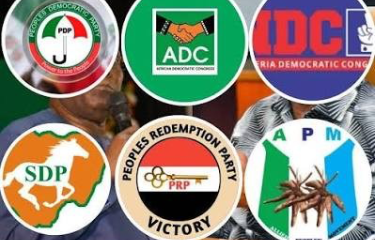
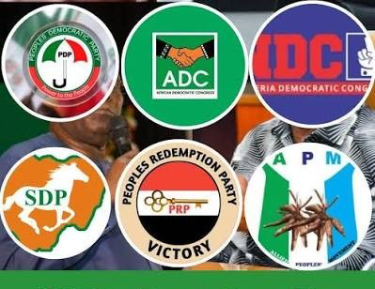
According to Vanguard on October 14, 2026, six parties—the African Democratic Congress (ADC), Allied Peoples Movement (APM), Nigeria Democratic Congress (NDC), Social Democratic Party (SDP), PDP and Peoples Redemption Party (PRP)—were involved in consultations with presidential aspirants on possible cooperation ahead of the elections.
However, the existence of discussions does not guarantee agreement, and agreement among political leaders does not automatically translate into support from their respective voters.
The opposition must resolve several difficult questions.
Can its parties agree on transparent rules for cooperation? Will they support common positions on major national issues? Can they manage disagreements over presidential and legislative nominations without destroying the coalition? How will they protect the autonomy of participating parties while coordinating their efforts?
Most importantly, will their cooperation be built around a national programme or simply around the shared desire to defeat the ruling party?
A coalition formed primarily to distribute political offices may struggle to survive after an election. A coalition built around measurable public commitments has a stronger basis for accountability, regardless of the election’s outcome.
Opposition leaders should also recognise that a single presidential candidate is not the only possible form of cooperation. Depending on the applicable electoral laws and the decisions of the parties, coordination may include common policy commitments, agreements on legislative priorities, joint monitoring of elections and cooperation on protecting votes.
Where a common candidate is pursued, the selection process must be transparent, lawful and sufficiently credible to secure the acceptance of participating parties and their supporters.
A consensus imposed by powerful individuals without broad acceptance could reproduce the same internal problems the coalition is trying to overcome.
What must the opposition do differently?
The approaching election provides an opportunity for Nigeria’s opposition parties to address the structural weaknesses that have repeatedly undermined their political relevance.
1. Put the national interest ahead of individual ambition
Opposition leaders must recognise that no individual politician owns the votes of party members or the support of the Nigerian people.
Where a common electoral arrangement is considered necessary, leaders should establish clear rules for selecting candidates and resolving disputes before negotiations reach their most contentious stage.
A credible process should include agreed criteria, independent oversight where appropriate, transparent communication and a commitment by participants to respect the outcome.
The objective should be to build a durable political arrangement rather than a temporary alliance that collapses when an individual loses a nomination.
2. Develop a practical national recovery programme
Opposition parties need a detailed, costed and publicly accessible programme addressing the issues that most directly affect citizens.
Such a programme should explain their proposed approaches to:
- Cost of living: Measures to improve food affordability, household purchasing power and access to essential services.
- Employment and industrialisation: Policies to support manufacturing, agriculture, small businesses and productive investment.
- Electricity: A credible plan to improve generation, transmission, distribution and the affordability of power.
- Education and healthcare: Funding priorities, measurable service-delivery targets and plans to improve access and quality.
- Security: Strategies for intelligence-led policing, community safety, conflict prevention and accountability for security agencies.
- Public finance: Transparent budgeting, responsible borrowing, procurement reforms and the publication of measurable expenditure outcomes.
Every major promise should be accompanied by an explanation of its cost, financing, implementation timetable and expected results.
Nigerians deserve policies that can be examined, challenged and measured—not merely declarations of good intentions.
3. Rebuild from the wards and communities
Political strength cannot be sustained through Abuja meetings alone.
Opposition parties need functioning ward, local government and state structures capable of listening to residents, documenting local problems and communicating policy proposals.
In communities across Enugu State and the wider South-East, for example, political engagement should address electricity, road infrastructure, agricultural productivity, healthcare, education, security and the constraints confronting small businesses.
The same principle applies throughout the federation: political parties should demonstrate that they understand local concerns while presenting a coherent national vision.
Community engagement must be continuous, not activated only when politicians require campaign crowds.
4. Make internal democracy non-negotiable
A party that cannot manage its own internal competition will struggle to convince the public that it can govern a complex country fairly.
Opposition parties should establish transparent membership records, credible primaries, clear disciplinary procedures and mechanisms for resolving disputes before they escalate into prolonged litigation.
Party constitutions should be respected, and leadership positions should not become permanent possessions of political patrons.
Candidates who emerge through credible processes are better placed to build legitimacy among party members, although a fair nomination process alone cannot guarantee electoral success.
5. Present a credible new generation of leadership
Nigeria’s political future should not be restricted to a recurring contest among familiar political figures.
Parties should create meaningful opportunities for younger Nigerians, women, professionals, entrepreneurs, community organisers and people with demonstrable records of public service.
This should not mean selecting candidates simply because they are young or popular on social media. Integrity, competence, experience, policy understanding and accountability must remain central considerations.
The country needs political institutions capable of discovering and developing talent rather than depending indefinitely on a small circle of powerful individuals.
6. Protect the credibility of the electoral process
Political competition is meaningful only when voters can exercise their rights and have their votes accurately counted and reported.
Opposition parties should invest in voter education, accredited polling-unit agents, lawful election observation, reliable incident reporting and the preservation of evidence needed to challenge genuine irregularities.
They should engage the Independent National Electoral Commission (INEC) on electoral preparedness and insist on transparent, consistent application of the law.
Any allegations of electoral malpractice should be supported by verifiable evidence and pursued through lawful channels.
Equally, opposition leaders must discourage political violence, intimidation, misinformation and attempts to undermine confidence in legitimate electoral procedures without evidence.
Protecting the vote is a democratic responsibility shared by political parties, electoral institutions, security agencies, the media, civil society and citizens.
7. Establish a permanent opposition accountability mechanism
Opposition parties should not wait for election campaigns before examining government performance.
They can publish periodic assessments of federal and state budgets, track major infrastructure projects, investigate implementation gaps through lawful means and explain how public policies affect citizens.
Where they control state governments or local institutions, they should apply the same standards to their own administrations.
This is crucial. An opposition that condemns a practice nationally but tolerates it where its own members exercise power undermines its credibility.
Consistency between criticism and conduct is one of the foundations of public trust.
The role of Nigerians: Citizens must demand more than political change
Although opposition parties carry substantial responsibility, Nigeria’s democratic weaknesses cannot be blamed on politicians alone.
Citizens also have a role in strengthening accountability by demanding evidence, examining policy proposals, attending public meetings, monitoring elected representatives and rejecting political violence.
Voters should ask every candidate difficult questions: What are your priorities? How will you finance them? What will you accomplish in your first year? How will citizens verify your progress? What consequences will follow if you fail to deliver?
Political parties should not be permitted to escape scrutiny simply because they oppose the government of the day.
The media also has a responsibility to examine the records, claims and proposals of all major political actors. Political reporting should go beyond rallies, defections and campaign personalities to investigate policy consequences, campaign financing, public expenditure and the practical implications of competing programmes.
Civil society organisations, professional associations, traditional institutions and community groups can contribute by promoting informed public debate and demanding transparency from political leaders.
The ultimate objective should be to make every government answerable to the people, regardless of the party in power.
Can Nigeria prevent the erosion of multiparty democracy?
The concentration of political influence in a dominant party can become a serious democratic concern when opposition institutions lose the ability to scrutinise government effectively or compete on fair terms.
However, the existence of a dominant party does not automatically mean that Nigeria has become a one-party state. The more important questions concern the freedom of political association, the fairness of electoral competition, the independence of democratic institutions and the ability of citizens to choose among credible alternatives.
Opposition parties must take responsibility for their own failures, including internal conflicts and poor organisation. At the same time, the government and relevant institutions have a responsibility to uphold the rules that permit genuine political competition.
A democratic system should not depend on the goodwill of a ruling party to remain accountable. It should contain institutional safeguards that apply regardless of which political organisation controls the executive or legislature.
The judiciary, electoral authorities, legislature, media and civil society must all be able to perform their lawful functions without improper interference.
The remedy, therefore, lies in strengthening institutions as well as improving the quality of political leadership.
Conclusion: The opposition must offer more than a promise to replace the APC
As Nigeria approaches the 2027 general elections, the opposition faces a test that extends beyond the fate of individual politicians and political parties.
Its task is to demonstrate that it can organise itself democratically, resolve disputes peacefully, develop practical policies and sustain accountability beyond election day.
The APC administration, like any government, should be judged through evidence of its policies, performance, costs and consequences for Nigerians. Opposition parties should be judged by the quality of the alternatives they offer, the integrity of their internal processes and their willingness to submit their own records to scrutiny.
A change of government, by itself, cannot guarantee better governance. Without stronger institutions, transparent public finance, accountable leadership and sustained citizen participation, the same weaknesses can survive under a different political platform.
But neither can a democracy function properly when opposition parties are too divided, disorganised or distrusted to provide meaningful scrutiny.
The central question for 2027 is therefore not simply whether the opposition can wrest power from the ruling party. It is whether Nigeria’s political system can produce genuine competition in which parties must earn public confidence through credible policies, democratic conduct and measurable commitments.
For the opposition, the opportunity is to transform political fragmentation into principled cooperation and public frustration into a serious programme of reform. For the ruling party, the responsibility is to demonstrate that its policies and performance can withstand scrutiny. For the electorate, the task is to demand evidence and accountability from every contender.
Ultimately, the strength of Nigeria’s democracy will not be measured solely by which party wins the next election, but by whether the political system gives citizens a meaningful choice, protects their votes and compels those in power to govern in the public interest.
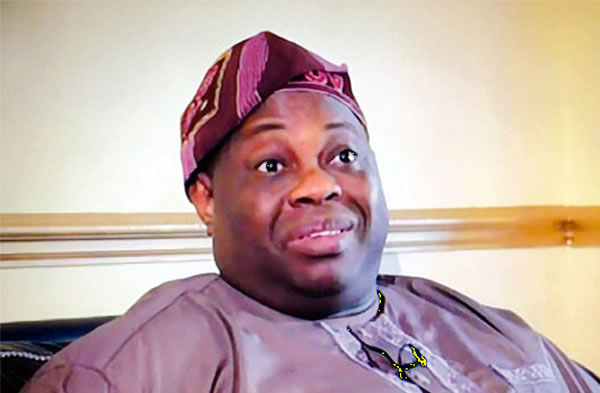
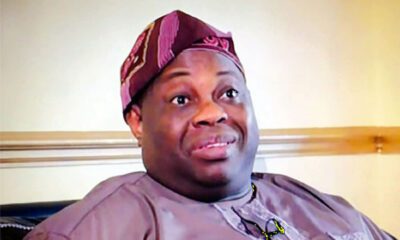
A chieftain of the African Democratic Congress, Dele Momodu, has said Peter Obi could defeat President Bola Tinubu in the South-East and parts of the South-South in the 2027 presidential election.
Momodu said Obi, the Nigeria Democratic Congress’s presidential candidate in the 2027 election, remained popular in the two regions and could pose a major challenge to Tinubu’s re-election bid.
He stated this during an interview on Arise Television on Wednesday, while discussing the opposition’s chances in the 2027 general election.
“I can tell you something. Soludo is the same. I can bet my life on it that Peter Obi will humiliate and disgrace Soludo in Anambra state. I have no question about that,” Momodu said.
He described Obi as a “rock star” in the South-East and South-South, arguing that his popularity could affect Tinubu’s electoral prospects in the regions.
“Peter Obi is a rock star. Where he comes from, especially in the South-East and the South-South,” he said.
Momodu, however, declared his support for former Vice-President Atiku Abubakar, who is also seeking to challenge Tinubu in 2027 under the ADC.
He said he would welcome calls for opposition leaders to unite, noting that their ability to work together could influence the outcome of the election.
“I’m supporting Atiku, but I will be very happy when people say, ‘Oh, if you people don’t come together, you are going to lose election,’” he said.
According to Momodu, Tinubu would face a difficult task if Obi retained his influence in the South-East and South-South, as the President would need substantial support across the southern part of the country while also competing in the North.
“The scenario is different this time. Peter Obi will humiliate Tinubu and all his supporters in the South-East and some parts of the South-South. And that’s dangerous for Tinubu,” he said.
He added that Tinubu would need to secure the three southern regions to strengthen his chances of victory, while also seeking support in the North.
“For Tinubu to win, he needs to lock down all the three regions in the South, and he now has to go and struggle in the North, where, number one, he was supported last time by President Muhammadu Buhari,” Momodu said.
Tinubu won the 2023 presidential election, while Obi finished third behind Atiku, who contested on the platform of the Peoples Democratic Party.
Obi secured significant support in the South-East and parts of the South-South during the 2023 election, while Tinubu’s victory was supported by votes from several parts of the country.
The 2027 presidential election is expected to feature renewed competition among major political parties, with opposition figures facing calls to build a common platform to challenge the ruling All Progressives Congress.
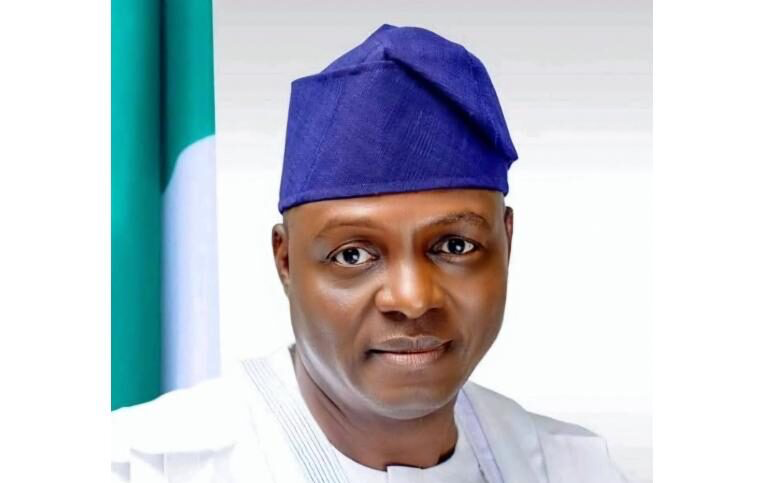
The National Chairman of the All Progressives Congress (APC), Professor Nentawe Goshwe Yilwatda, has charged members of the party’s Presidential Campaign Council to unite national and grassroots structures, communicate the achievements of President Bola Ahmed Tinubu’s administration and mobilise Nigerians for his re-election in 2027.
Speaking at the inauguration of the APC Presidential Campaign Council, Professor Yilwatda described the assignment as a collective responsibility requiring effective coordination, discipline, strategic communication and sustained engagement with Nigerians.
In a statement signed by his Special Adviser on Media and Information Strategy, Abimbola Tooki, he said the party’s campaign must be anchored on the administration’s record, an honest acknowledgement of prevailing challenges and a credible vision for the country’s future.
According to him, the administration’s economic reforms and investments in roads, power, gas, railways, ports, agriculture and digital connectivity must be clearly communicated to Nigerians, with emphasis on their impact on productivity, employment, commerce and national development.
“Our responsibility is to explain what has been achieved, what is progressing and what remains to be done. We must demonstrate how these reforms and investments will translate into practical improvements in the lives of Nigerians,” he said.
The APC National Chairman emphasised that the success of the campaign would depend on the effective collaboration of national leaders, governors, legislators, state chapters, local government structures and ward members to ensure that the party’s message reaches every community.
He also underscored the importance of women, youths and persons with disabilities, calling for their meaningful participation and leadership in the campaign process.
“Our women are indispensable to party organisation and community mobilisation. Our youths must be engaged as partners in shaping Nigeria’s future, while persons with disabilities must enjoy full, accessible and inclusive participation in our democratic process,” he stated.
Professor Yilwatda urged party members to approach the assignment with confidence, while warning against complacency.
“Confidence is not complacency. It is the determination to prepare thoroughly, work together and earn the trust of the people,” he said.
He noted that the APC would seek Nigerians’ support for President Tinubu’s re-election in 2027 by presenting evidence of progress, explaining the administration’s policies and outlining the work that remains to be done.
He stressed that the campaign must directly address citizens’ concerns about the cost of living, security, employment, education, healthcare, agricultural productivity and economic opportunities.
The National Chairman also called for issue-based and peaceful political engagement, recognising the legitimate role of the opposition in a democratic society.
“The APC will present its case with confidence, defend its record with facts and trust Nigerians to make their choice through a credible democratic process,” he said.
Professor Yilwatda reaffirmed the commitment of the APC National Working Committee to working closely with the Presidential Campaign Council and all party structures to achieve their shared objectives.
He charged members to remain united and focused, declaring that the party had a vision to communicate, a future to build and the confidence of Nigerians to earn.
“One mission, one responsibility: to work together, communicate effectively and earn the mandate of Nigerians for President Bola Ahmed Tinubu in 2027.”
-
 Faith2 days ago
BREAKING: Anglican Church Places Archbishop Ibezim on Six-Month Leave, Bars Him From Church Duties
-
News3 days ago
Senate fumes over death of NYSC Corps member at Enugu Camp, orders probe
-
News3 days ago
How Senator Mandiya died after bathroom fall in Abuja Home – Ningi
-
News2 days ago
Gunmen Abduct Catholic Priest in Benue, Police Launch Rescue Operation
-
Politics3 days ago
2027: I can bet my life Obi will humiliate Soludo in Anambra – Momodu
-
News2 days ago
Tinubu Orders Rescue of Kidnap Victims, Demands Peaceful 2027 Elections
-
News3 days ago
NDC secretariat attacked in Edo
-
News14 hours ago
BREAKING: Mbah Extends Enugu Movement Restriction to 10pm, Scraps Keke Ticketing