Business
Marketers oppose Dangote’s move to reduce cooking gas price
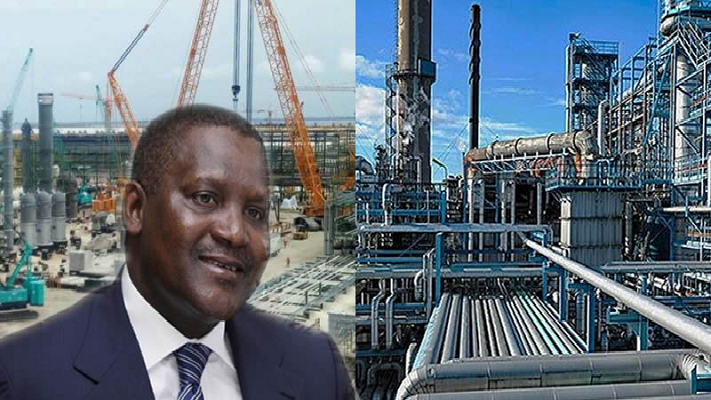
President of the Dangote Group, Alhaji Aliko Dangote, has announced plans to reduce the price of Liquefied Petroleum Gas, also known as cooking gas.
He also promised to start direct sales of the product to consumers should the existing distributors fail to allow the price crash in cooking gas.
However, operators in the sector have disagreed with the plan, saying the businessman was planning to monopolise the LPG sector. They kicked against the move on Monday, as the dealers expressed fear of a possible monopoly.
Speaking during a recent tour of his refinery by some local and foreign guests, Dangote stressed that the current price of cooking gas is expensive and not affordable for the common people who depend on firewood for cooking.
He disclosed that the refinery now produces 22,000 tonnes of LPG daily and it is ramping up production for distribution into the Nigerian market, especially as Nigerians move towards the use of gas for cooking.
Speaking to members of the Lagos Business School CGEO Africa, at the refinery in Lekki, Dangote said, “The one that we didn’t write, which you must have seen, is LPG. Currently, we do LPG of about 2,000 tonnes per day. You know Nigeria is gradually moving to the usage of LPG. But I believe it is expensive, but right now we’re trying to bring down the price and make it cheaper.”

Dangote warned that “if the distributors are not trying to bring it down, we’ll go directly and sell to the consumers, so that people will now transit from firewood or kerosene to LPG for cooking.”
Dangote had also announced plans to start the direct distribution of petrol, diesel, and aviation fuel to marketers nationwide in August, with 4,000 CNG-powered buses procured for the exercise.
Currently, the price of cooking gas hovers around N1,000 and N1,300 per kilogramme. Dangote said this would be brought down to ensure affordability.
Operators kick
It appears operators in the LPG market are not pleased with Dangote’s plan to disrupt the sector.
Speaking in an interview with our correspondent, the former Chairman of the LPG and Natural Gas Downstream Group of the Lagos Chamber of Commerce and Industry, Godwin Okoduwa, described the plan as monopolistic.
Okoduwa expressed concern that the billionaire businessman should recognise the fact that some investors grew the market from 70,000 metric tonnes in 2007 to over 1 million metric tonnes in 2022, saying collaboration is the way to go.
“I think it’s monopolistic. I think a market should be protected to encourage growth. The LPG industry in Nigeria grew from 70,000 metric tonnes in 2007 to over 1.3 million tonnes in 2022. That was done by collaboration — collaboration with the Federal Government, the NLNG, and offtakers. Everything was done in collaboration. It grew from 70,000 to 250 to 800, and now over a million,” Okoduwa said.
He stressed that growth cannot be achieved through a monopoly but through collaboration. “Today, we are just under 5kg or 6kg per capita consumption in terms of LPG. Other countries are doing much more. South Africa is doing double digits, Morocco and Tunisia are doing double digits. We can do much more.
“So, we should, as an industry and as a country, focus on how to grow the LPG industry and not allow someone (to frustrate the players). Yes, he has invested; yes, it’s a capital economy, but he should not be allowed to frustrate the players.
“There are people who have spent money, spent resources, even business and development, and someone just comes in to reap from the work that has been done. I’m sure he wouldn’t have built if there had not been an existing market. The work has been done, he should respect the market and let us grow. It shouldn’t be a zero-sum strategy. It should be collaborative,” he said.
In his recommendation, the gas expert said that though Dangote has the upper hand, he should embrace collaboration.
“My advice to him is that the pie can be bigger. The Nigerian market is about 1.3 million tonnes. The Nigerian LPG market can be 5 million tonnes. He should work towards collaboration rather than competition, because at the end of the day, everybody benefits,” he added.
Told that Dangote’s major concern is to bring the price of cooking gas to a rate where everybody can afford it and stop cooking with firewood, Okoduwa retorted, “I have news for him. He should go to the Northeast, where you have the least consumption of LPG. He should go to the Northeast and start developing the LPG infrastructure there. I think we will tell him thank you for that.”
Similarly, the Executive Secretary/Chief Executive Officer, Nigerian Association of Liquefied Petroleum Gas Marketers, Bassey Essien, doubted the possibility of Dangote selling gas directly to consumers or to crash the price.
“I am saying that it’s unrealistic. What is the position with PMS? Has the refinery been able to sell petrol directly to you and me into our cars at a very cheap rate?” Essien asked.
(PUNCH)

Business
S/East companies shutting down over rising energy costs — MAN
The Manufacturers Association of Nigeria (MAN) has raised alarm over the worsening state of manufacturing activities in the South-East, warning that rising energy costs and poor access to finance are forcing many companies in the region to shut down.
Chairman of MAN for Anambra, Enugu and Ebonyi states, Lady Ada Chukwudozie, disclosed this during the MAN South-East Stakeholders’ Industry Conversation held in Awka, Anambra State.
The forum was convened to address concerns surrounding electricity regulation, billing transparency and declining industrial productivity across the region.
Chukwudozie said the few factories still operating were doing so at less than 30 per cent of installed capacity due to soaring electricity tariffs, high energy costs and limited access to credit facilities.
According to her, the harsh operating environment informed the decision to convene the stakeholders’ roundtable, stressing that the manufacturing sector remains critical to economic growth, industrialisation and job creation.
She warned that unless urgent measures are taken to address the challenges confronting manufacturers, industrial activities in the South-East could further deteriorate, with serious implications for employment and regional economic stability.

“The manufacturing sector cannot thrive in an environment of uncertainty,” she said.
She called for reforms in the power sector to be driven by transparency, accountability and measurable performance standards, including agreed electricity supply hours, actual delivery levels and compensation mechanisms where supply consistently falls below expectations.
Chukwudozie also urged regulatory authorities to strengthen oversight of electricity providers and improve power supply to industrial clusters across the South-East.
Stakeholders at the forum expressed concern that manufacturers were increasingly struggling to cope with escalating production costs, worsened by unreliable electricity supply and the rising cost of alternative energy sources.
They noted that without affordable and stable energy, many more companies could either scale down operations or shut down completely.
In his keynote address, former Chairman and Chief Executive Officer of the Nigerian Electricity Regulatory Commission, NERC, Dr. Sam Amadi, urged governments in the South-East to adopt deliberate policies aimed at prioritising electricity supply to industrial clusters.
Amadi also advocated pricing frameworks that would encourage manufacturers to expand production and invest in growth.
The stakeholders’ meeting brought together manufacturers, regulators and other industry players to explore practical solutions to revive industrial output and tackle persistent power challenges affecting businesses in the region.
Business
Amukpe-Escravos pipeline and the real cost of ignoring current value, By Sufuyan Ojeifo
Nigeria’s oil infrastructure has a habit of telling uncomfortable truths. Not just about barrels and flow rates, but about how a country chooses to value what it cannot afford to lose, and what it risks when it gets that calculation wrong.
Take the Amukpe-Escravos Pipeline, for example. A syndicate of lenders, led by Sterling Bank, is pushing back against efforts to revive a collapsed transaction involving a 40% stake in the asset. Their argument is not complicated. It is rooted in numbers and contractual discipline.
To be clear, a deal that fell apart in 2024 is being reconsidered using a valuation from that same year. However, since then, the asset has proved its worth. Independent assessments now place that stake closer to $600 million. The earlier benchmark sits far below that. The gap is not cosmetic. It is material. And if left unaddressed, it becomes a cost.
The original $243 million offer did not collapse by accident. It was terminated in October 2024 after Conpurex Limited failed to meet payment obligations, breached key terms, and sought to shift risk back to the seller. By the time the Technical Committee closed the process, confidence had already drained out of it. That much is settled.
Ordinarily, that should have been the end. Instead, there are moves to return to a September 2025 approval linked to that same process. The lenders describe this as an administrative carryover. Their response is simple. Start again. Set aside the old approval. Bring in an independent adviser. Return the asset to the market and let current value speak.
What is striking is not just the position itself, but how unusual it sounds in the Nigerian context. In a system where strategic assets have too often travelled through corridors of convenience, an insistence on valuation and process can sound almost rebellious. It should not be so.

Because this is not entirely about one pipeline. It is about whether a terminated deal remains terminated. Whether contracts still mean what they say. Whether performance counts for anything once the paperwork has been filed away. And, crucially, who bears the cost when value is ignored.
The numbers, as always, are blunt. A 2025 independent valuation, referenced in the March 2026 edition of Africa Oil+Gas Report, places the 40% stake at a mid-case of $372 million, a high case of $544 million, and an upside of $641 million. These are not speculative figures. They reflect an asset that has quietly done its job in a difficult environment.
With a capacity of 160,000 barrels per day and uptime consistently above 95%, the Amukpe-Escravos Pipeline has become one of the more reliable evacuation routes in a system where reliability is often in short supply. While other corridors struggle with theft and disruption, this one works.
That fact matters a great deal. Because when an asset proves itself under pressure, its value does not stand still. It moves. To price it as though nothing has changed is not just a technical choice. It is a financial one. And every financial choice has consequences.
It says performance can be ignored. It says time does not count. It says administrative continuity can outrun economic reality. To be fair, the earlier process gave enough warning signs. Lenders questioned the assumptions. Coordination was weak. When Continental Oil and Gas stepped back, Conpurex entered without a clean transition and soon began to reopen settled terms, shifting obligations and introducing new conditions that unsettled the commercial balance. The eventual termination was not dramatic. It was inevitable.
What unsettles stakeholders now is the possibility that a process that ran its course may still shape the outcome. If a concluded transaction can reappear without a clear restart, the line between closure and continuity begins to blur. Once that line blurs, contractual uncertainty follows. And when certainty weakens, serious capital takes notice.
This is where the issue widens beyond the pipeline itself. Back in March, Africa Oil+Gas Report described the Amukpe-Escravos matter as no longer just a transaction story, but a test of how Nigeria governs, values, and safeguards strategic oil infrastructure. That reading feels even more relevant now.
Because what is at stake is not simply who acquires a stake in a pipeline. It is how the country signals to those willing to invest in its most critical assets. It is about whether value is recognised only in theory, or protected in practice. It is about whether losses are acknowledged, or quietly absorbed.
The lenders’ position is often described as resistance. It is better understood as discipline. Reset the process. Revisit the approval. Bring in independent oversight. Return the asset to the market through a transparent and competitive process that reflects present realities. Ensure capable counterparties. Align all stakeholders.
These are not extravagant demands. They are the basics. Nigeria has seen too many assets drift from promise to regret. Too many structures that once worked reduced to cautionary tales. When something works, when something proves resilient in a difficult system, the least that can be done is to treat it with the seriousness it has earned.
Moments like this do not announce themselves as turning points. They arrive quietly, dressed as routine decisions.
But they reveal everything. For an economy seeking disciplined capital and trying to rebuild confidence, the signal matters. Let the process be reset. Let valuation reflect reality. Let the outcome show that when Nigeria recognises value, it also knows how to protect it, and what it stands to lose when it does not.
Until then, the lenders’ position stands as a reminder that in a system where too much has been taken for granted, some lines are too important to be crossed and must be held.
● Sufuyan Ojeifo publishes THE CONCLAVE online newspaper.
Business
Nova Bank Appoints Jude Anele as Managing Director/CEO
…Meets CBN Capital Requirements, to Open Eight New Branches in 2026.
NOVA Bank Limited has announced the appointment of Jude Anele as its Managing Director and Chief Executive Officer, following the approval of the Central Bank of Nigeria.
The appointment comes at a pivotal moment in the Bank’s evolution, following its transition from merchant banking to commercial banking and the successful completion of its recapitalisation programme ahead of the March 31, 2026, regulatory deadline.
Anele brings more than 33 years of banking experience across West and Central Africa, with deep expertise in retail /commercial banking, corporate banking, risk management, institutional transformation and executive leadership. Over the course of his career, he has led complex banking operations, strengthened governance frameworks, delivered sustainable revenue growth and built high-performance teams.
The appointment reflects the Board’s strategic commitment to consolidating NOVA Bank’s commercial banking platform while accelerating growth across its Corporate, Commercial and Retail segments, as well as priority markets.
Speaking on his appointment, Anele said he was honoured to assume leadership of the Bank at a defining stage of its growth.
“Nova Bank has built a strong institutional foundation defined by regulatory compliance, capital strength, disciplined governance and a clear commercial mandate. Our focus now is execution — deepening customer relationships, expanding responsibly across priority markets, strengthening risk discipline and delivering sustainable value to our shareholders,” he said.

The Bank’s Chairman, Phillips Oduoza, also expressed confidence in the new leadership.
“The Board is pleased to welcome Mr. Jude Anele as Managing Director and Chief Executive Officer. His depth of experience, strategic clarity and proven leadership record align strongly with NOVA Bank’s growth ambitions,” Oduoza said. He added that with recapitalization completed ahead of the regulatory timeline, the Bank is entering a new phase defined by scale, stability and structured expansion.
NOVA Bank also confirmed that it has met the recapitalization requirements set by the Central Bank of Nigeria ahead of the regulatory deadline, reinforcing its capital adequacy and long-term financial stability. The capital raise, supported by new and existing shareholders, further strengthens the Bank’s balance sheet and positions it for disciplined growth.
In 2025, Global Credit Rating reaffirmed NOVA Commercial Bank’s national scale long- and short-term issuer ratings of BBB(NG) and A3(NG) respectively, while Agusto & Co. reaffirmed the Bank’s “Bbb” rating with a stable outlook, reflecting its strong capital base, sound liquidity position and resilient asset quality relative to its risk profile.
NOVA Bank currently maintains operations in Lagos, Abuja, Owerri and Port Harcourt, with plans to open eight additional branches across key commercial hubs in 2026 as part of its expansion strategy.
The commissioning of the Bank’s regional office in Owerri marked a significant milestone in its South-East and South-South growth strategy. The event attracted government officials’business leaders and Nigerians in diaspora and underscored NOVA Bank’s commitment to supporting enterprise development and economic growth.
NOVA Bank Limited is a commercial bank licensed and regulated by the Central Bank of Nigeria. Commencing operations in 2018 as a merchant bank, the institution transitioned to a commercial bank in 2024 and provides retail, SME, corporate and commercial banking services through its Phygital model—an integrated approach combining physical branch presence with digital banking infrastructure.
-
News2 days agoFinal-year female varsity student found dead in Kogi
-
News2 days agoGunmen kidnap ex-minister Adelabu’s sister, children in Ibadan
-
News2 days agoFive abducted Kwara worshippers killed, one escapes, others still held
-
News13 hours agoSecurity guard kidnaps employer’s two children, demands ransom
-
News14 hours agoPolice arrest suspect behind AI-generated Tinubu voice note
-
Uncategorized3 days ago2027: My spirit tells me Peter Obi will do well as President — Ebube Muonso
-
News2 days agoMbah Rewards Rangers Players, Management with Plots of Land, N150m for Winning NPFL
-
News3 days agoPastor beats 14-year old girl to death over alleged theft in Cross River