Politics
APC will lose 2027 presidential election if it fields Tinubu — Ex-presidential aspirant, Udeogaranya


High wire intrigues, cold calculations and schism within the ruling All Progressives Congress (APC) continue to unfold with Chief Charles Udeogaranya, a chieftain of the party and its 2019 presidential aspirant joining the fray. In this interview, Chief Udeogaranya, a business mogul and seasoned business administrator, warned that fielding President Bola Tinubu in the 2027 presidential election will spell doom for the party, insisting that the president has failed Nigerians and therefore, has no business seeking a re-election.
Spate of defections to the ruling party, APC, which also happens to be your party, moves by prominent opposition leaders to form a coalition to oust President Tinubu from office in 2027 and the fear that Nigeria is on the verge of becoming a one-party state currently dominate political discourse. Do you foresee a political shift in the next general election?

These things are storms in a tea cup and there is nothing new or more about it.
At the right time, Nigerians will take the right action and render all these moves as a bridge to nowhere.
Can you rate the chances of the emerging coalition and your party as regards the 2027 presidential election. Are you worried that the coalition could after all turn out a potent force against President Tinubu’s re-election?

May I point out clearly that I am not in favour of a continuous reign of President Tinubu as Nigeria’s President. To me and most Nigerians, he has failed woefully to address the concerns of most Nigerians. In my unmistakable view, he has no business seeking a re-election, and the greatest mistake my party, the APC will make at the party’s presidential primary and convention, would be to renominate an incompetent president as its flag bearer, but God forbid!
Failure of my party, APC, to nominate me or any other worthy aspirants as its presidential flag bearer for the 2027 presidential election, will translate to automatic victory for the opposition parties, if the Independent National Electoral Commission (INEC) will uphold the wishes of Nigerian electorates.
Critics allege your party is neck deep in planting crisis in opposition parties with the view to destabilising them, weakening them and coercing their bigwigs to defect so as to pave the way for an easy victory for the APC in 2027. How do you react to this?
I think the critics should be questioning those in government and not the party, APC. They need to ask President Tinubu and Buhari what they have done with the 12 years Nigerians have given to them so far. Are the 12 years of manna from heaven or 12 years of canker worms and locusts? You cannot be a devourer in reality and at the same time claiming a miracle worker. One more tenure is meant for miracle workers and not for devourers of our common heritage. So, let’s leave the party out of this.
As a chieftain of the ruling party, tell us your party’s Unique Selling Proposition (USP), that could attract votes to it in 2027?
Very simple, present to Nigerians a candidate like Charles Udeogaranya, who is young, creative, well informed, connected, and has the ability to transform the Nigerian economy in the quickest possible time and strongly willing to make the people of Nigeria, the primary focus of his government.
Recently you released a press statement berating your party for adopting President Tinubu as sole candidate for 2023; in the press release, you sounded more like an opposition politician than a loyal party member. Are you disenchanted with your party, the APC and why, if you are?
You see, a few people can gather and say whatever they like, it is given. That’s not the party, after all, the minority will have their say but the majority will have their way. The general assembly of the party known as the party convention will decide, a presidential primary, will decide who will fly the party’s presidential flag. Anything aside that is the minority having their say. (Daily Sun)



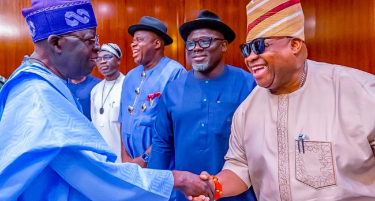


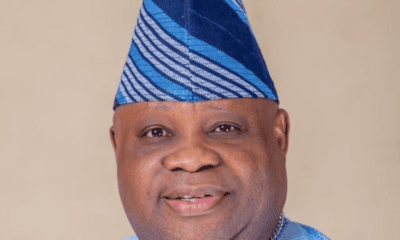


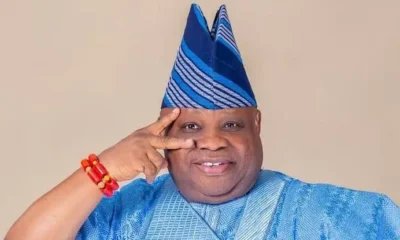

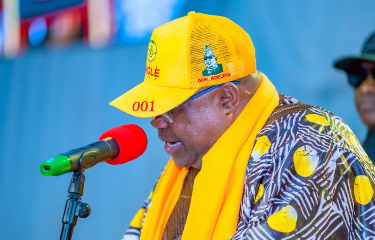

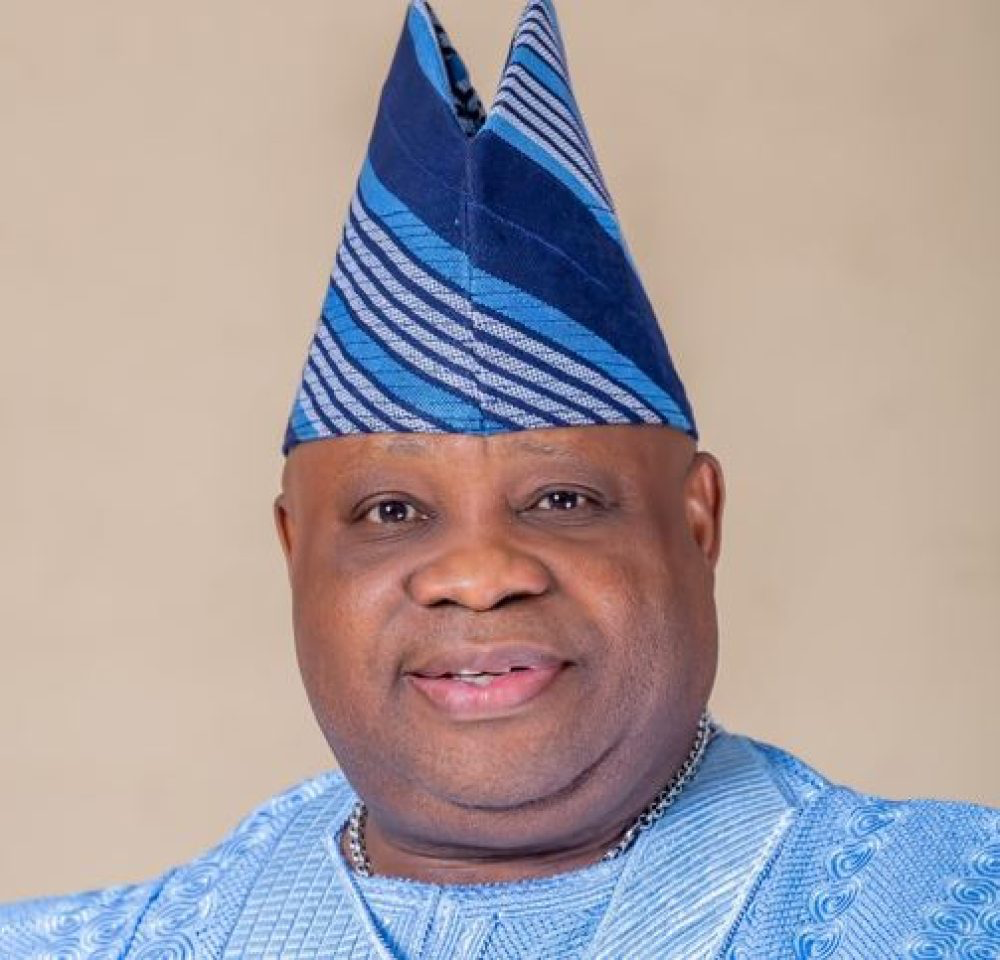
Osun State Governor, Ademola Adeleke, was on Sunday declared elected, having won 19 out of the 30 local government areas in the governorship election held across the state on Saturday.
The State Returning Officer, the Vice-Chancellor of the Federal University, Oye Ekiti, Prof Joshua Ogunwole, declared the result of the poll at about 7:24 am on Sunday.
Adeleke polled a total of 511067 votes to emerge victorious in the contest.
Ogunwole subsequently returned the governor to office for another term.
The incumbent Osun governor, who contested the poll on the platform of the Accord, defeated his closest challenger, Bola Oyebamiji of the All Progressives Congress, who won in 11 LG areas of the state.
While Adeleke won in Ede North, Ede South, Ejigbo, Iwo, Egbedore, Ife North, Ife East, Ife Central, Oriade, Ifelodun, Orolu, Ayedaade, Ayedire, Odo Otin, Boluwaduro, Ilesa West, Ifedayo, Osogbo and Ayedire local government areas.
Oyebamiji, however, won in Irewole, Isokan, Olorunda, Atakumosa East, Atakumosa West, Ilesa East, Boripe, Irepodun and Obokun local government areas.
Declaring the results, Ogunwole said, “Accredited voters, 1010684, total votes received by political parties, A, 511067, AA, 2308, AAC, 1458, ADC, 17180, ADP, 2946, APC, 444815, APGA, 1475, APM, 234, APP, 114, BP, 111, NNPP, 118, PRP, 83, SDP, 155, YPP, 534, ZLP, 2482, total valid votes, 985079, rejected votes, 207, total vote cast, 1,005,800.”
After agents of the political parties have signed the results of the election, the Returning Officer declared Adeleke of the Accord as the winner of the poll.
“That Ademola Nurudeen-Jackson Adeleke having satisfied the requirements of the law is hereby declare the winner of the August 15 Governorship election and returned elected,” Ogunwole said.
The candidate of the African Democratic Congress in the poll, Najeem Salaam, came third in the poll.
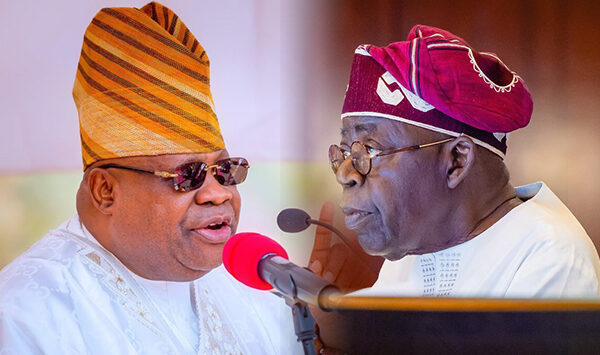
Speaking after an infrastructure inspection, Governor Ademola Adeleke openly backed President Bola Tinubu’s 2027 re-election bid. He warmly referredto him as “our own son, father and leader.” He went further to declare: “I am the governor of the ancestral birthplace of Mr President. How can I have my own in the saddle and think twice before embracing him?” Yet, even as those words echoed, in the election that held yesterday in Osun State, Governor Adeleke’s fate and that of Osun State were being systematically framed, for better or worse.
As we speak, spanning from Friday through the entire weekend, at least 25 states of the federation were left without a commissioner of police. They were all deployed to Osun State to do the president’s bidding. Reports confirmed that 32 Commissioners, 36 Deputy Commissioners, and 51 Assistant Commissioners descended upon a state with a mere 1,906,390 eligible voters. This was supplemented by an intimidating machinery of political heavyweights —the Senate President, ministers, governors, and presidential aides —acting as the semiotics of a Villa muscle-flexing designed to dismantle the state-level opposition.
That was the raw execution of federal might: thirty-five thousand police personnel and ten thousand Civil Defence officers holding vigil, alongside heavily armed soldiers who walked the state with infidel jackboots feet. Why inflict such immense dread upon a people if you are genuinely beloved? As Yoruba elders sagely observe, one only gazes blankly at the ceiling when the wisdom of Ifa divination appears entirely foreign —Àìgbọ’fá l’à ń wò’kè, Ifá kan ò sì ní párá.
As yesterday’s election unfolded, acuriously tragic political chemistry emerged between Tinubu and Adeleke. The tango between the duo strongly evokes the poignant caution against filicide in Chinua Achebe’s Things Fall Apart: “That boy calls you father; do not bear a hand in his death.” This grave warning was delivered by Ogbuefi Ezeudu, the oldest man in Umuofia, whose age cascaded like lies swimming on a slovenly head. A deeply revered elder and skilled warrior, Ezeudu’s voice was welded into Umuofia’s wisdom and tradition. His counsel concerned Ikemefuna, Okonkwo’s doomed foster child, who had lived in his household for three years. Between this period, Okonkwo and Ikemefuna developed a deep, quasi-parental bond with a warm brotherhood emerging between Ikemefuna and Nwoye, Okonkwo’s son.
Much like Okonkwo, who struggled with a desperate fear of being deemed weak or cowardly, Tinubu seemed gripped by an anxiety to prove his political virility in his ancestral home state of Osun — where his umbilical cord lies buried. He was apparently unwilling to confront failure in the battle to be a bearer of his cousin,Gboyega Oyetola’s political battle coffin. Ezeudu’s warning carried profound moral and spiritual weight: participating in the murder of someone who calls you “father” violates fundamental humanity, regardless of political expediency or clan custom. Yet, Okonkwo disregarded the elder’s counsel. He joined the execution party, and when a blow struck Ikemefuna and the terrified boy ran toward him crying, “My father, they have killed me!”, Okonkwo dealt the fatal final stroke.Replace Okonkwo with Tinubu and Ikemefuna with Adeleke. You will then discover that, what Tinubu did yesterday to an Adeleke who called him the father of Osun State was filicide.
A far greater tragedy awaited Okonkwo at Ezeudu’s funeral. As guns and cannons boomed, sending billowing fire into the sky and machetes clattered in a frenzy, Okonkwo’s gun unexpectedly exploded. A piece of shrapnel flew out, penetrating the heart of Ezeudu’s sixteen-year-old son and killing him instantly. Total chaos erupted. Okonkwo stood pensive, looking down as if counting his toes, fully aware of the grave consequences of killing the young boy. Tragedy wears a single, unforgiving colour. Killing a clansman, even accidentally, was an unpardonable offence against Ala, the earth goddess. Okonkwo knew the implication of murder in Umuofia: He had to go into a seven-year exile in Mbanta, his mother’s clan.
With what we saw in Osun, elections in Nigeria have increasingly transformed into the heavy beat of the Gbedu drum. It is characterized by a mournful, ululating cadence. When it is sounded as it was in Osun, a downcast populace asks in desperation: what song can be sung to this strange drumming? The Gbedu is no ordinary instrument; it is a sacred, massive drum symbolizing royal authority, sovereign power, and deep ancestral communion. Historically, it remains taboo for non-initiates to strike the Gbedu, as its resonant vibrations communicate directly with deities during coronations. Thus, when non-initiates commandeer this sacred beat, appalled Yoruba ask: “Orin wo laa ko si gbedu yi?”— What song do we sing to such a strange, ominous rhythm?
The Osun Gbedu comes with an air of foreboding of evil. William Shakespeare’s Brutus smelled the evil early enough. In his famous metaphor, wherein he said, “It is the bright day that brings forth the adder, and that craves wary walking,” Brutus saw hidden danger and tyranny. Just like the clairvoyant could see ahead of yesterday’s Osun election. Whatever is its outcome, the election will be a harvest of the wild oats we sowed in the last couple of months. This comprises the president’s frightening “all is fair in politics” Freudian slip; the 29 people killed in 73 political violence incidents in Osun; the brutally injured victims of the political war; the acerbic rhetoric and the do-or-die politics that have all become the hallmark of Nigeria’s electoral life.
The Brutus metaphor was made while he restlessly paced his orchard. Assassinating Julius Caesar was by then in the offing. Tension was as thick in the sky as the biblical wall of Jericho. Like Brutus, Nigeria is restlessly pacing the orchard of sanity. Already, the symphony filtering out of Osun is bad news for democracy. Blood and gangsterism have been on the menu since the election process started. Just as Julius Caesar was bad news to the conspirators who eventually stabbed him to death. The optics of an adder, the venomous snake, coming out in the day are however good news to those who cannot compete in a free and fair electoral atmosphere. They seem to have already had the day with the attempt to subvert the wishes of the people. As the sunny, prosperous times — the bright day — make venomous snakes — the adder — come out in the open, the Osun election is that venomous snake that is already out in the open and the die is cast. Even if the incumbent wins, Osun has foretold the January and February 2027 elections. As it seems, even those who didn’t purchase — apologies to this recourse to an old Yoruba lingo — will have to pay.
Osun and Nigeria find themselves jointly marking an anniversary of political anarchy, falling victim to George Santayana’s famous warning that “those who fail to learn from history are condemned to repeat it.” Exactly 43 years ago, the very anarchy that characterized this election defined old Oyo State (of which Osun was part) in August 1983. Just as the electoral horror of the Western Region signposted the collapse of the First Republic, the 1983 electoral violence in Osun ultimately buried the Second Republic.
I was in Osogbo, the state capital, as part of a Town Hall meeting organized by Arise TV and the Nigerian Tribune for the governorship candidates. Seated inside the hall were the key political gladiators: Ademola Adeleke, Bola Oyebamiji, Najeem Salam, and others. Their supporters wore multi-coloured outfits reminiscent of Dolly Parton’s 1971 classic “Coat of Many Colours.” Where spectators saw colourful gaiety, I observed two distinct things: an elephant and the tragedy of political propaganda textile material called Aso Ebi. I saw a massive elephant about to hit the canvas, surrounded by gluttons wielding glittering knives to carve out its humongous pieces of meat. This immediately brought to mind the Yoruba aphorism: “Orísiríṣi ọbẹ làá rí ní’jọ ikú erin”— On the day the elephant falls, knives of all shapes jostle for a share. Beyond the outer beauty of the Aso Ebi, a tragic drama was unfolding.
Regardless of who is declared winner, the scars inflicted on Osun State and Nigeria’s electoral politics risk becoming what the Yoruba describe as ada’jina — a chronic, festering wound that refuses to heal. Osun has long been a volatile swing state whose political temperature swings unpredictably, depending on whether authority is accepted or rejected. Pre-election violence involving both the federal ruling party (APC) and state-level political actors of the Accord Partyfollowed the familiar, ruinous template of Nigerian elections. Both sides displayed complete mastery of intimidation, vote-buying, and electoral violence, turning Osun into a battleground.
Turning Osun into a war theatre was vicariously the president’s doing. Itexposed a totalizing view of electoral politics that makes opposition dangerous in Nigeria. It explains why Francis Fadahunsi, a senator close to the president, could brazenly call for the elimination of opposition elements and instruct enforcement agents to deal with non-APC voters on Saturday. While Fadahunsi’s flippancy highlights his own villainy, it raises a wider question: how many others like him have grown emboldened inside a system where political brigandage is normalized?
Even as the presidency issued meek, statesmanlike press releases to distance itself from the heavy-handedness in Osun, the underground perception remains clear: the executive gave implicit approval to the ruthless villainy that unfolded.
In 1983, that same geography, which is now Osun State, became victim of electoral rampage. This writer, living in Ilesa at the time, witnessed the anarchy firsthand. Angry voters who suspected electoral fraud, battled policemen to a standstill in Ilesa. They set homes of political opponents ablaze in a violence that shook Ijesaland and Nigeria to their foundation. At least, 49 people were recorded killed in a week of the announcement of results by Ovie Whiskey’s FEDECO. President Shehu Shagari’s NPN was accused of mass ballot-rigging. While there were pockets of arson and killings, Nigeria’s worst hit states were the old Oyo and Ondo States, with unofficial casualty figures put at 25 dead in Oyo state and 24 in Ondo.
The Ondo carnage was described as the most gruesome, with human beings barbecued, their bodies fiddled with to and fro for total incineration, like grilled fish on hot iron gauze. This included Olaiya Fagbamigbe, Member of the Federal House of Representatives and Awoleye Agunbiade, former Majority Leader in the Ondo State House of assembly. NPN official, R.A. Agbayewa and his wife were also beaten to deathand ultimately grilled like fish. The angry mob in Ile-Ife equally burnt down a police station, as well as storming the city’s prison to free some recorded hundreds of prisoners. They equallyburned down the federal election commission office in Akure, as well asdestroying ballots and ballot boxes. Governor-elect Akin Omoboriowo had to pay homage to the hare to escape their wrath. Four months after, that republic collapsed as the army took over power.
That historic electoral tragedy in Osun and the earlier ones in the First and Second Republics mirror both Okonkwo’s tragic downfall and Christopher Marlowe’s Elizabethan masterpiece, Doctor Faustus. Marlowe tells the story of Dr. Faustus, a celebrated scholar who grows dissatisfied with traditional knowledge — law, religion, logic, and medicine, and turns instead to black magic taught by Valdes and Cornelius. Faustus summons Mephastophilis, who explicitly warns him of the horrors of hell. Undeterred, Faustus surrenders his soul to Lucifer in exchange for twenty-four years of magical power. Yet, having traded his eternal soul, the scholar squanders his time on petty tricks until midnight strikes, and he is dragged down into eternal damnation.
As the Osun election unfolded, the process was not only stained with blood, but stood as a perfect replica of Marlowe’s tragedy. It evokes the poignant lines of Negritude poet David Diop in The Vultures: “their talons stained in blood / From where the wild current floods / A heavy weight upon the crest / No song of peace / No gentle nest.”
This brings me back to the Aso Ebi seen across Osun and its signification of political tragedy. In Nigeria, textiles and politics are deeply intertwined instruments of propaganda. They appear as ankara fabric distributed in yardages, T-shirts, caps, and banners. Southwestern Nigeria has a long history of weaponizing textiles in politics. The legendary Ibadan politician, Adegoke Adelabu, pioneered this strategy ahead of the 1954 and 1956 elections. He commissioned propaganda cloths bearing his name and face. However, following his party’s defeat, the unsold fabrics left his Lebanese-Syrian business partner, Albert Younan, burdened with massive bank debts. It was on their return journey from Lagos after seeking a financial solution on March 25, 1958, that Adelabu’s car crashed near Ode-Remo, prematurely extinguishing the life of the 43-year-old political powerhouse. Ever since, Aso Ebi has remained an indispensable tool of Nigerian electioneering.
More instructively, power sometimes fails those besotted to it. If the gun of power suffers misfire, those who sang destruction as song in Osun State on Saturday could fall by their own dagger of power. It will answer to Yoruba’s saying that wisdom sometimes kills the wise. In which case, those federal billions spent to grab Osun could end up in ruins and Ikemefiuna would escape the attempted filicide of Okonkwo.
Beyond Okonkwo, the Gbedu drum, Brutus, and the semiotics of Aso Ebi, the Osun election serves as a metric for 2027. Even if the attempt of men of power to flex their muscles fails, it will be a measurement for January and February next year. It will then bring to mind the words of Muhammadu Odolaye Aremu, the legendary Dadakuada bard from Ilorin. In his music extolling the height and majestic power of Ilorin’s Sobi Hills, Aremu reminded us that all human power is fleeting and every empire eventually falls.
Weaving fatalism into oral poetry and epigrams, the bard observed that even Sobi Hills, despite its grand permanence, eventually grew so neglected that green weeds sprouted upon it. That song was acaution to all of us on the inevitable decline of dynasties, kingdoms, and political leaders. The Osun election results may yet prove this to the powerful men in Aso Rock. And an indication that even when they think they have everything, they may actually have nothing. One can only hope someone is listening.
The All Progressives Congress and Accord Party have been accused of engaging in a vote-buying jamboree across Osun State as agents of both parties offer voters between N10,000 and N20,000 ahead of today’s governorship election.
Unlike previous elections, the vote-buying started six days before the poll, according to Saturday Punch.
Some voters said the parties also collected the account numbers of thousands of voters a week before the election, with plans to credit them after voting.
Governor Ademola Adeleke of the Accord Party is being challenged by Bola Oyebamiji of the APC, Najeem Salaam of the African Democratic Congress and nine other contestants.
A total of 1,906,390 voters who have collected their Permanent Voter Cards are expected to participate in the election.
Findings by our correspondents revealed that both Accord and the APC started distributing cash between Monday and Tuesday.
In some instances, the voter inducement, which included the distribution of food items and cash gifts, was laced with spirituality, as beneficiaries were forced to swear an oath to vote for the candidate of the party providing the items.
Our correspondents also came across viral videos in which supporters of Adeleke and Oyebamiji openly distributed cash, salt, rice and other items while asking beneficiaries not to betray them at the poll.
Ilesa
Voters in Ilesa told Saturday PUNCH that the APC was disbursing N20,000 per voter across polling units in Ilesa East, Ilesa West and Atakunmosa East LGAs.
According to some of the beneficiaries, the money was being distributed at the house of an appointed APC chieftain in each polling unit.
The voters disclosed that the vote-buying began on Tuesday and lasted until Friday.
One of the beneficiaries, who spoke on condition of anonymity, said, “I collected my N20,000 at the Bonnke area of Ilesa on Wednesday. The cash was in N1,000 and N500 denominations. We had over 200 voters and it was done unit by unit. I collected mine around 11am at the bungalow belonging to one of the APC chieftains in our unit.”
A human rights activist in Ilesa, who also spoke on condition of anonymity for safety reasons, confirmed the vote-buying.
“At the Coca-Cola area, people were given N20,000 each at one particular storey building. But you have to show your voter card before being paid.
“At Abiola Avenue, APC members gave N20,000 to each voter. I was there. The storey building where the money was shared belongs to an APC leader in the area,” he said.
At Iroye and Imo areas of Ilesa, it was gathered that the APC was distributing rice and an undisclosed amount of money to voters.
“I saw them. They are APC supporters. They provided money and rice, but I don’t know the exact amount they were distributing. They were cursing the beneficiaries, saying it would not be well with them if they failed to vote for AMBO after collecting the money,” a student leader in Iroye said.
Saturday PUNCH also gathered that while the APC was giving out N20,000, Accord was disbursing N10,000 to voters.
It was learnt that at Olowu Village in Atakunmosa East LGA, Accord distributed N10,000 and asked beneficiaries to swear an oath of allegiance three weeks ago.
One of the community leaders told Saturday PUNCH that Accord leaders were distributing the money without fear of arrest.
Some other residents in Ilesa also confirmed that the ruling party had begun distributing N10,000 at Ifofin, Iloro and Okesa, among other parts of the city, since Tuesday.
Speaking in the development, an APC chieftain in Ilesa West LGA confirmed the inducement but claimed it was meant for transportation.
“We are not buying votes. We only provided them with cash to transport themselves to their various polling units,” he said.
Osogbo
In Osogbo LGA, our correspondents gathered that the APC distributed N15,000 each to some voters across polling units in all 15 wards.
An APC chieftain involved in the distribution told one of our correspondents that the party appointed three leaders in each ward to coordinate the exercise.
The APC chieftain, who spoke on condition of anonymity on Thursday, said, “We targeted 150 voters in every unit. We gave N15,000 each to 75 voters on Wednesday, and another 75 voters received N15,000 each on Thursday.
“That was not really for vote-buying; it was for feeding before election day. We know what to do on election day.”
Iwo
It was gathered that N700,000 was budgeted for vote-buying in each of the 170 polling units across the 15 wards in Iwo LGA by the APC.
According to an APC chieftain familiar with the process, the cash distribution began on Tuesday and was still ongoing as of the time of filing this report on Friday.
“A sum of N700,000 was provided per polling unit, and we have been distributing it at N15,000 per voter since Tuesday. We are systematic about it because the Accord Party is also distributing money,” he said.
Saturday PUNCH gathered that in Aiyedire LGA, Accord started distributing N10,000 to eligible voters across polling units on Monday.
“Both APC and Accord are distributing money, but APC has the upper hand because it is paying N15,000 against Accord’s N10,000. As for me, I collected from both parties in my polling unit at Ward 2 in Ileogbo,” a voter said on condition of anonymity on Thursday.
Similarly, over 200 women in Ileogbo, the headquarters of Aiyedire LGA, were offered N10,000 each by a group that asked them to vote for the APC.
In Ila, the headquarters of Ila LGA, it was gathered that both Accord and the APC had been inducing voters with cash ranging from N15,000 to N20,000.
While the APC was reportedly offering N15,000 per eligible voter, Accord offered N20,000.
The inducement, according to residents, began on Monday.
A resident said that he and his wife collected N20,000 each from Accord leaders.
“We were asked to swear an oath that we would vote for Adeleke. But we didn’t take any oath. So many others were given N10,000,” he said.
Another resident, who identified himself as Isaac Ibirogba, said Accord initially offered N10,000 per eligible voter before increasing it to N20,000 on Tuesday, while the APC was offering N15,000.
In Ile-Ife, a member of the Hausa community who also spoke on condition of anonymity disclosed that the APC was offering N15,000, while Accord offered N10,000 per voter.
He said both parties also requested Permanent Voter Cards before making payments.
“The APC people came to Sabo on Wednesday and, after interacting with some of us, they brought a bag containing cash. They requested our PVCs, but we told them we couldn’t give them. At the end of the day, they gave each of us N15,000. We were about 60,” he said.
Also, a medical doctor residing in the Iremo area of Ife said the APC began its cash distribution on Tuesday.
“I am aware that both parties started their cash distribution on Tuesday. Some of my people in Sabo, Ilare, Oluorogbo and Enuwa collected the money. APC offered N15,000, while Accord paid N10,000,” he said.
Ikire
In Ikire, the hometown of the APC candidate, Saturday PUNCH learnt that both the APC and the Accord Party were inducing voters with cash gifts ranging from N10,000 to N20,000.
A resident of the town, Oreoluwa Tolulope, said supporters of Oyebamiji and those of the senator representing Osun West Senatorial District, Lere Oyewumi, flooded all the wards in the town with cash.
“APC is offering N15,000, while Accord is providing N10,000. They started about a week ago,” he said.
It was gathered that in Boluwaduro LGA, the Accord Party was offering N10,000 per eligible voter and asking beneficiaries to swear by the Ogun deity that they would vote for Adeleke.
However, the APC had yet to commence cash distribution as of the time of filing this report, although two chieftains in the council said the party had budgeted N10,000 per voter.
In Ede, Adeleke’s hometown, Accord started distributing N10,000 to eligible voters as far back as two weeks ago, according to many residents.
It was learnt that the party initially asked voters to form groups of 100 and offered each group N1m before resorting to paying N10,000 to individuals at polling units.
Similarly, the APC began offering N15,000 per eligible voter on Tuesday in a move aimed at attracting more voters.
One of the APC leaders in Ede, who spoke on condition of anonymity on Friday, said, “The Adeleke people have been distributing N10,000 for the past two weeks. We waited to see how far they could go, and we decided to give them a run for their money. We started distributing N15,000 on Tuesday, and that will continue until election day.”
Last week, an APC chieftain, Alhaja Falilat Yusuf, popularly known as Ero-Arike, was seen in a viral video distributing bags of rice to women and urging them to vote for Oyebamiji.
She also placed curses on anyone, especially women, who collected the rice but failed to vote for the APC candidate.
Similarly, some voters were seen taking an oath while collecting cash to vote for Adeleke.
Police warn against vote-buying
Meanwhile, the police warned politicians and voters against vote-buying, saying anyone caught would be arrested and prosecuted.
The Force Public Relations Officer, Okokon Iniedu, stated this on Friday while speaking with journalists at the Osun State Police Command Headquarters in Osogbo after addressing officers deployed for the election.
He described vote-buying as an electoral offence that would not be tolerated.
Iniedu also pledged adequate security for INEC ad hoc staff and National Youth Service Corps members throughout the electoral process.
Eight killed in one week, soldiers deployed
Saturday PUNCH gathered that no fewer than eight persons were killed between Monday night and the early hours of Friday in Ilesa and Esa-Oke.
At about 8pm on Monday, three persons identified simply as Idowu, Yinka and Eja were killed around the Imo area of Ilesa.
Similarly, two persons were killed around the Boluwaduro area of Ilesa on Wednesday.
An Accord supporter in Ilesa, Sunday Obube, and another person were also reportedly killed by suspected political thugs on Thursday.
In the same vein, Dele Ayegbo, a nephew of the APC Governorship Campaign Director-General, Wole Oke, was reportedly killed in Esa-Oke, Obokun Local Government Area, on Wednesday.
Also, gunmen reportedly shot dead one Osaretine Obasohan at Oni Eran Area, Ilesa on Friday.
Residents said Obasohan was walking on the road when the assailants, said to be travelling in a vehicle, shot him at close range.
During a telephone interview, the spokesperson for the Osun State Police Command, Abiodun Ojelabi, confirmed the killing, which he linked to cult clashes.
“He (victim) was also suspected to be a cultist. The incident happened early this morning (Friday) around 7am at Omi Eran area,” he added.
Checks by the reporter indicated that soldiers with Armoured Personnel Carrier were deployed in the Osun/Kwara boundary in Ora, Ifedayo LGA over rising tension in the state.
Soldiers were also deployed in large numbers to Esa-Oke, Ilesa, Ikoyi, a community along Osun/Oyo, and Owens, an Osun/Ondo boundary community, among others.
Commenting on the deployment of security to especially flash points across the state.
Adeleke, Oyebamiji camps trade tackles over planned attacks
Also, the campaign council of the APC on Friday accused Governor Adeleke of keeping suspected hoodlums in the Government House in Osogbo.
Addressing journalists in Osogbo, a member of the media committee of the APC campaign council, Kehinde Ayantunji, called on the Inspector General of Police, Olatunji Disu, and the Director General of Department of Service, Adeola Ajayi, to immediately act on the complaint before the suspects were relocated to another place.
“As I am talking to you now, we have intelligence that a large number of political thugs have been mobilised into the Government House. In the last two hours, they have been moving in and out, and our intelligence has confirmed that most of these people are not from these states.
“The two individuals who led those thugs are Olowe and Iberu; these are the codenames given to them at the Government House this afternoon.
“We have no hesitation in concluding that some of these suspected political thugs are imported from Lagos with the registration numbers of these five groups. We are not just raising this alarm, we have double-checked our intelligence and we have pictorial evidence of what we are saying here this afternoon.
“The target is simple, having realised the imminent defeat in the state’s capital territory, that is Osogbo, Irepodun and Egbedore, the agenda is to mobilise them with funds and ammunition to destabilise Ward 5, Osogbo Local Government; Ward 4, Ward 8, Okini, in Egbedore Local Government, Ido Osun, and Ofatedo Local Government,” Ayantunji said.
However, the Accord Party bemoaned alleged statewide attacks on members and supporters and the attendant consequences on their lives and property across the state.
The state chairman of the party, Pastor Victor Akande, raised the alarm that political thugs had continued to unleash mayhem on members and supporters of his party, alleging that in addition to the killings, several others were wounded and were receiving treatment across different local government areas of the state.
Akande, in a statement on Friday, alleged that several houses across the state had also been attacked, vandalised and looted, while some had been pencilled for attack ahead of the election.
He said, “At Osogbo, five names of top appointees of Accord candidate, Ademola Adeleke, have been pencilled down for attacks and arrest. As of yesterday (Thursday), a manhunt was launched for one of the top appointees. Heavily armed thugs launched sporadic gun attacks across Obokun LGA, Odo Otin LGA, Boripe LGA, Irewole LGA and several others.
“At Iree town, gun attacks took place all through the night with many Accord members injured while the palace of Aree of Iree was attacked with multiple gun attacks from all corners. Five injuries were reported in the palace. At Obokun, attacks and killings have continued unabated with several houses burnt at Esa Oke. The violence started two days ago with the security agencies unable to contain it.
“At Odo Otin, the attacks took place at Okuku and other towns with over 20 Accord members receiving treatment for various gunshots. At Ikire, the house of 25 Accord members were raided and their family members molested while the houses were openly vandalised. The attack did not spare the house of the Director General of the campaign, Senator Lere Oyewumi.
“At Ifewara, a thug, who was arrested and later released, was reported to have coordinated sporadic attacks on the Accord members and their residences. Several injuries were reported.”
Election may not be credible — YIAGA Africa
Analysing the events leading to the election, the Executive Director of YIAGA Africa, Samson Itodo, expressed concern that the outcome of the poll might not be credible, citing widespread vote-buying and violence.
He lamented what he described as the “alarming rate” of voter inducement and political violence, condemning the development as the weaponisation of poverty and the monetisation of politics.
Itodo warned that attempts to undermine electoral institutions and create an atmosphere of intimidation could affect the credibility of the election.
“YIAGA Africa is very worried about the alarming rate of voter inducement and violence in the build-up to this election. This weaponisation of poverty and attempt to monetise politics is highly disturbing, and we urge voters to vote their conscience.
“When politics is determined by the highest bidder and the highest tender, what suffers is governance, transparency, integrity and accountability,” he said.
Itodo also raised concerns over the level of violence recorded in the state, noting that 34 deaths had been linked to the build-up to the election.
“Osun is currently tense and highly competitive, signposted by violence. When you have attempts to undermine institutions from performing their constitutional functions, what you get is a questionable outcome,” he added. Saturday PUNcH
-
 News2 days ago
Mammoth crowd as Peter Obi makes triumphant entry into Benin, dares Gov Okpebholo [VIDEO]
-
News2 days ago
ICPC exposes Payroll Scandal: Official paying 14 family members, another worker collects 13 salaries
-
News1 day ago
Police confirm release of abducted Jezco Chairman, Ezeokafor, Rev Sister
-
News9 hours ago
BREAKING: Adeleke wins 19 LGs, APC’s Oyebamiji secures 11 LGs
-
News1 day ago
Kidnapping: My life in captivity — Justice Bunza
-
News1 day ago
Rigging Attempt: Police aiding APC to intimidate voters in Osun — Adeleke
-
Politics1 day ago
Osun Election: APC, Accord wage N20,000-per-vote war
-
News3 days ago
Vanguard Alumni to Unveil Book Chronicling Newspaper’s 40-Year Journey, Legacy