International
Kevin Farrell, Irish-American cardinal appointed acting Head of Vatican


When the Vatican announced on Easter Monday that Pope Francis had passed on at the age of 88, the Catholic Church entered a period known as sede vacante, which is Latin for “the seat being vacant”, the period between the death or resignation of a pope until the election of the next pontiff.
At this critical juncture, the temporary mantle of administrative leadership over the Vatican falls on the Cardinal Camerlengo, who holds the fort until the College of Cardinals elects a new pontiff in a conclave.

In 2019, Pope Francis nominated Irish-American Cardinal Kevin Joseph Farrell as camerlengo.
The 77-year-old camerlengo serves as the interim administrator of the Vatican City State and the Holy See, managing temporal affairs to ensure continuity and order during the interregnum.
Cardinal Farrell’s duties as camerlengo include:

Certifying the pope’s death: Farrell officially confirmed Pope Francis’ death at 7:35 AM on Easter Monday, April 21, in the presence of Vatican officials, including the head of the Vatican’s health department. He oversaw the drafting of the death certificate, a formal step to initiate the sede vacante.
Sealing the papal residences: In a symbolic gesture to mark the end of Francis’ pontificate, the camerlengo presided over the sealing of the Papal Apartment in the Apostolic Palace and Francis’ residence at Casa Santa Marta, where the pontiff chose to live instead of the traditional papal quarters. This act, historically intended to prevent looting, underscores the formal closure of the pontificate.
Mourning and funeral rites: The camerlengo, alongside a team of three assisting cardinals, is responsible for coordinating the nine-day mourning period (novendiales) and the funeral, scheduled for Saturday, April 26.. The pope’s body will be placed in a single wooden coffin and moved to St. Peter’s Basilica for public viewing starting on Wednesday, April 23.
Preparing for the conclave: The camerlengo will oversee logistical preparations for the papal conclave, expected to begin 15 to 20 days after Pope Francis’ death, possibly May 6–11. This includes arranging accommodations for the 135 cardinal electors under 80, who will gather in the Sistine Chapel to vote.
Managing Vatican finances and administration: During the interregnum, the camerlengo administers the Vatican’s temporal affairs, ensuring financial and operational stability. He also destroys the late pope’s Fisherman’s Ring, a signet used for official documents, in the presence of the College of Cardinals, symbolising the end of Francis’ authority.
Who is Cardinal Kevin Farrell, the acting head of the Vatican?

Cardinal Kevin Farrell and other Vatican officials announce the death of Pope Francis in a video statement from the Vatican on 21 April.
When the world learned of Pope Francis’ death on Monday morning, an Irish-American cardinal, little known in the wider world, was the one to break the news.
After announcing that the pope had “returned to the home of the Father”, Irish-American Cardinal Kevin Farrell took on one of his biggest roles yet: the “camerlengo”, or the person who runs the Vatican after the death or resignation of a pope.
Pope Francis nominated the cardinal for the role in 2019. The cardinal will remain in the position during the “Apostolica Sedes Vacans”, the period between the death or resignation of a pope until the election of the next pontiff.
He also will play an important role in the centuries-old ceremonies to mourn Pope Francis.
Born in 1947 in Dublin, Farrell attended the University of Salamanca in Spain and the Pontifical Gregorian University in Rome, according to the Vatican.
He held roles in churches around the world, serving as a chaplain at the University of Monterrey in Mexico as well as at a parish in Bethesda, Maryland.
All told, the 77-year-old spent more than 30 years working for churches in the US.
Farrell was appointed Bishop of Dallas in 2007 until Pope Francis asked him in 2016 to serve as the leader of the Vatican’s new department responsible for the pastoral care of families, raising him to the rank of cardinal.
Years after naming him as camerlengo, in 2023, Francis chose Farrell as president of the Supreme Court of Vatican City State. He was also named president of the Commission for Confidential Matters.
As camerlengo, Cardinal Farrell will be tasked with making arrangements for the conclave, the process through which the next pontiff is selected.
Technically, a camerlengo can become pope, as has happened twice in history: Gioacchino Pecci (Pope Leo XIII) in 1878 and Eugenio Pacelli (Pope Pius XII) in 1939.
The cardinal also will preside over the certification of Francis’s death, laying his body into the coffin. After that, the cardinal is expected to lead a procession moving the pope’s body from the chapel of the Domus Santa Marta to St Peter’s Basilica.
The ceremony could take place as soon as Wednesday morning, according to the Vatican.













International
France braces for another weekend of protests as authorities launch massive security operation
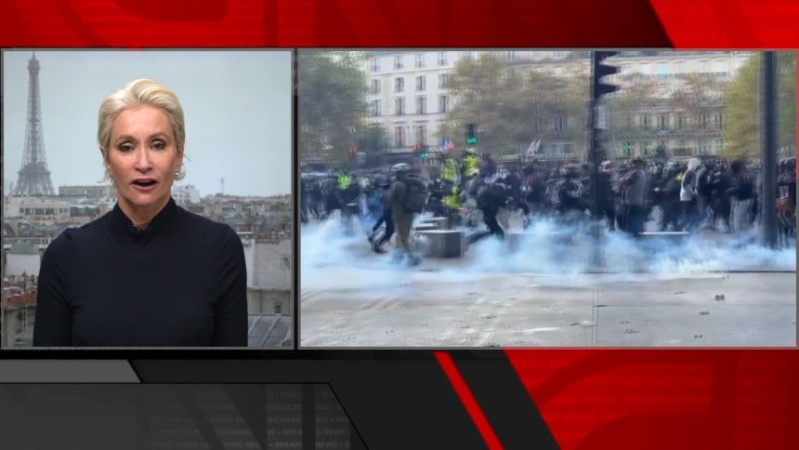
France is bracing for yet another wave of protests this weekend with authorities racing to prevent a repeat of the kind of violence and riots that hit the nation last week.
French authorities will be launching a massive security operation with some 70,000 police officers deployed across the country over the weekend, according to the interior ministry.
Specialist SWAT units, helicopters, armored vehicles, police dogs and water cannons will all be part of the operation. On top of that, the number of French army soldiers that normally patrol Paris as part of the country’s counter-terrorism measures will be increased to free the police from stationary guard duties.
Interior Minister Laurent Nuñez issued a stark warning on Friday to anyone looking for trouble, saying the government would be “uncompromising with those who engage in destruction.”
Last week’s violence followed weeks of protests over education, dismal job prospects and the cost of living. Initially peaceful and attended mostly by students, the demonstrations quickly turned into the worst wave of deadly, nationwide violence in years.
This week, curfews were imposed in some cities to help maintain calm.
Bracing for Saturday
A large demonstration has been called for Saturday afternoon in Paris and French media are expecting hundreds of thousands of people to attend.
The protest is organized by France’s main student union, UNEF, with one of the country’s biggest trade unions, CGT, announcing it would join. Other groups are expected to attend, including farmers, climate activists and the Yellow Vests, the movement that first emerged in 2018 during the protests over fuel costs.
While the protest in Paris has been authorized by the authorities, French President Emmanuel Macron on Thursday banned all non-trade union protests on Saturday as he seeks to control the civil unrest.
But the preparations go well beyond bans and police warnings, especially since last week’s riots sparked criticism of the authorities for not taking the threat seriously enough.
A police officer ties in place a perimeter tape near Chatelet – Les Halles to enforce a curfew, in central Paris on October 20.
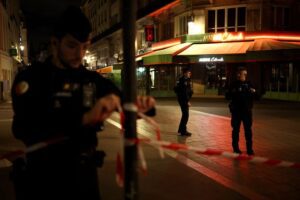
A police officer ties in place a perimeter tape near Chatelet – Les Halles to enforce a curfew, in central Paris on October 20.
Simon Wohlfahrt/AFP/Getty Images
The City of Paris announced earlier this week it was clearing public spaces of equipment and materials that could be used to cause damage, including barriers, bins, construction material and other items.
Many of the main tourist sites in the French capital, including world-famous museums like the Louvre, the Musée d’Orsay and the Musée de l’Orangerie will be closed on Saturday.
Art Basel finished the Paris version of its fair on Friday, two days earlier than scheduled. The Paris National Opera cancelled its performances on Saturday, citing the protests as the reason, and at least two dozen metro stations will also be closed for much of the day, according to Paris municipal authorities.
An NFL game between Pittsburgh Steelers and New Orleans Saints is set to take place at the Stade de France just outside of the capital on Sunday. While the match is scheduled to go ahead, a Steelers fan event in Paris was cancelled by the NFL.
During last weekend’s riots, at least two people died and multiple others suffered serious injuries, including two people who lost their hands. French Justice Minister Gérald Darmanin said some 2,700 people were held for questioning and 232 have been incarcerated in connection to the riots. (CNN)

There are grave fears for the passengers of a private plane that suddenly vanished mid-flight, sparking a major search off the coast of the US.
US authorities say the Gulfstream G100 lost contact with air traffic control about 2am local time on Saturday (4pm Saturday AET) while flying from L.F. Wade International Airport in Bermuda to Boston Logan International Airport.
The US Coast Guard said the Federal Aviation Administration alerted it after contact was lost with the aircraft – which plummeted from 23,500 feet to 11,000 feet in just three minutes, according to FlightAware data.
“We are praying for a safe outcome,” a spokesperson for Latitude Air Ambulance, which operates the missing plane, told City News.
A search is now under way off Nantucket in the air and on water as crews work to locate the missing jet, the Coast Guard said. Data from FlightRadar24 showed a number of aircraft searching south of the island.
Six people are missing after a private jet vanished, sparking a major search off the coast of Nantucket in the US.
The plane was en route from Bermuda to Boston when it vanished.
“Air & surface crews have launched in search of the aircraft. Updates will be provided here as info becomes available,” the Coast Guard Northeast District said on X.
The plane was carrying out a medical evacuation in Bermuda – a British overseas territory in the north Atlantic Ocean, according to Clarence Togeretz, Director of Flight Operations at Latitude Air Ambulance.
“We always get rather concerned when our crew doesn’t report to us in a timely manner,” he told NBC News.
“But I will say that again, optimistically and positively, that doesn’t mean that the worst has happened.”
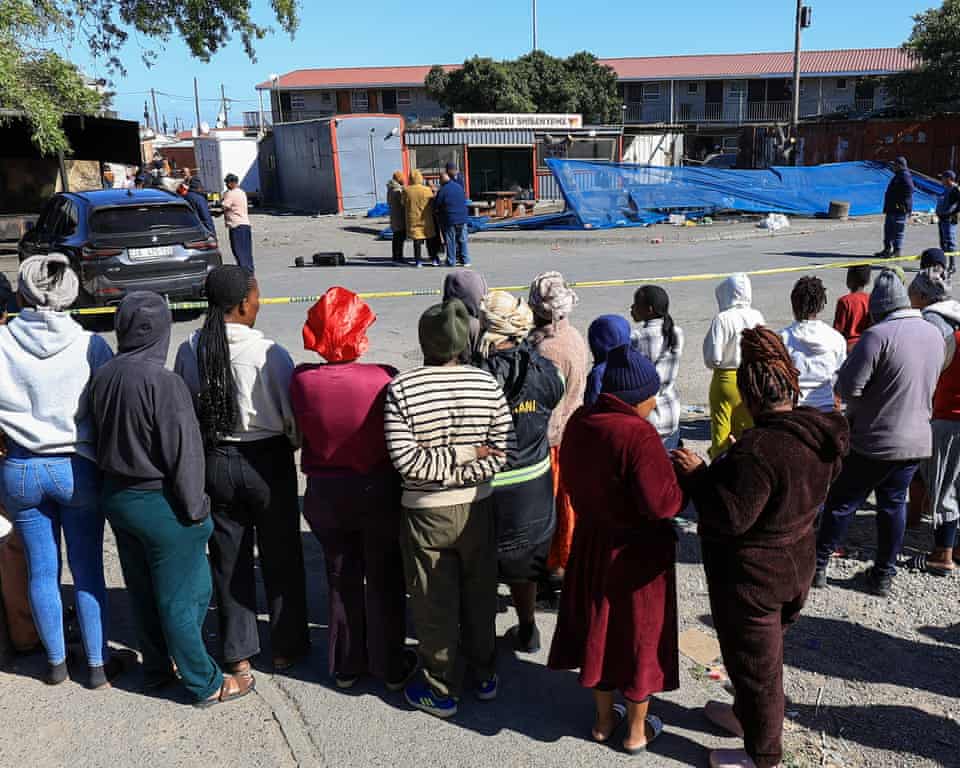
Seventeen people were killed when eight gunmen stormed a bar close to Johannesburg on Saturday evening, with 15 more injured.
In a separate shooting in the early hours of Sunday morning, 10 people were killed outside an entertainment venue in a township near Cape Town and a further 11 were injured.
South Africa has one of the highest murder rates in the world and has struggled to contain gang-related gun violence in recent years. Police have not indicated a motive for either of the latest attacks.
In Johannesburg, gunmen opened fire on customers outside the bar before continuing the attack inside and torching two vehicles before fleeing.
Police said thirteen men and four women were killed.
Deputy provincial police commissioner Maj Gen Fred Kekana said the attack may have been a retaliation for an incident last month, in which one person was killed and another wounded, according to AFP news agency.
Speaking at the scene, he said police had clear pictures and in some cases names for the suspects.
In Cape Town, five victims died at the scene and a further five people died in hospital.
No arrests had been made in either case on Sunday morning.
The two mass shootings came days after 11 people were killed in the city of Duban when gunmen stormed a house in the KwaMakhutha township.

Illegal weapons are prevalent in South Africa and gun violence has been a persistent problem for decades, with about 60 murders recorded every day in the country of 62 million.
But a recent spate of mass shootings has raised fears that the problem is deepening, with violence often linked to turf wars between gangs engaged in drug trafficking and illegal mining.
In February, President Cyril Ramaphosa called organised crime “the most immediate threat to our democracy, our society and our economic development”.
Earlier this year the military was deployed alongside police in areas with the highest murder rates in an effort to reduce armed violence.
On Saturday a tenth woman’s body was found in Ekurhuleni, to the east of Johannesburg, with local police saying they were unable to rule out a serial killer operating in the area with similarities between the deaths. (BBC)
-
 Features22 hours ago
Mmesoma Umeorini: When Love Turns Deadly, and a Young Woman Pays With Her Life
-
Features20 hours ago
Why Igbos Celebrate New Yam Festival Worldwide: The History, Cultural Significance and Lessons For The Younger Generation
-
News10 hours ago
Kogi Police Probe Alleged Murder-Suicide Involving Two Officers
-
News2 days ago
Mbah: Why We Built 268 Smart Green Schools Across Enugu State
-
News2 days ago
UBA Commences Contempt Proceedings Against WEMPCO Directors over Alleged Disobidence of Court Order
-
News2 days ago
Enugu CP Orders Probe into Death of Izuchukwu During Police Raid
-
News2 days ago
Macron Postpones Planned Visit to Nigeria Until 2027
-
Politics3 days ago
2027: Atiku, Obi, Duke, Others in Talks on Single Opposition Candidate – Coalition