




Connect with us

News

‘Why I planned coup against Tinubu’ – Colonel Ma’aji

Published

on

Spread the love

Nigerian Army Colonel Mohammed Ma’aji, has explained the motivation behind an alleged plan to overthrow Nigeria’s democratically elected government in a coup d’état, saying the plot was driven by patriotism, concern over worsening conditions in the country and what he described as a desire to rescue Nigeria from a dangerous trajectory.

Ma’aji allegedly spearheaded the plan, which was uncovered in September 2025 before it could be executed, triggering the arrest and interrogation of serving and retired military officers as well as civilians suspected of playing various roles in the alleged conspiracy.

In 2025, after more than three decades of Nigeria’s clean break from military coups, the alleged attempt resulted in a series of arrests and interrogations involving military personnel and civilians accused of participating in the alleged plan to topple President Bola Ahmed Tinubu’s administration.

In its first official reaction to the matter, the Defence Headquarters (DHQ) did not categorically deny that the military officers were involved in an alleged coup plot. Instead, it said the “ongoing investigation involving” the arrested officers was “a routine internal process aimed at ensuring discipline and professionalism is maintained within the ranks.”

The alleged plot, uncovered in late September 2025, unsettled the Tinubu administration and was followed, among other developments, by the cancellation of the October 1 Independence Day Parade and changes in the military hierarchy, including the removal of then Chief of Defence Staff, Christopher Musa.

Maduka College Advert

Although media reports linked the cancellation of the parade to the alleged coup plot, the DHQ explained that the event was called off to enable the President “attend a strategic bilateral meeting outside the country.”

The DHQ later acknowledged that there had indeed been an alleged plot to oust the Tinubu government and said indicted officers would face military judicial panels.

Drawing on interviews with intelligence sources, Premium Times has extensively reported on the alleged conspiracy, beginning with the initial arrest of 16 serving military officers in September.

By February, about 40 people, including senior military officers across the armed forces, a police officer and civilians allegedly involved in reconnaissance, funding and propaganda activities, had been arrested in connection with the alleged conspiracy.

For the first time, however, this newspaper is reporting authoritatively in a series of exclusive publications based on a trove of confidential documents running into about 7,424 pages.

The documents include bank statements, exchanges on encrypted messaging platforms, hotel receipts and records of items purchased, as well as statements from participants and non-participants whose financial dealings allegedly linked them to the suspected coup planners.

Ma’aji, a 50-year-old Nigerian colonel who failed his promotion examination to the rank of brigadier general twice, explained to military investigators how he conceived the alleged plot and the motivation behind it.

Ma’aji was arrested on September 29, 2025, the same day the Nigerian government cancelled the Independence Day parade.

According to statements signed by him and a military investigator at the headquarters of the Nigerian Army Corps of Military Police (NACMP) in Asokoro, Abuja, he was interrogated between October 18, 2025 and February 19, 2026.

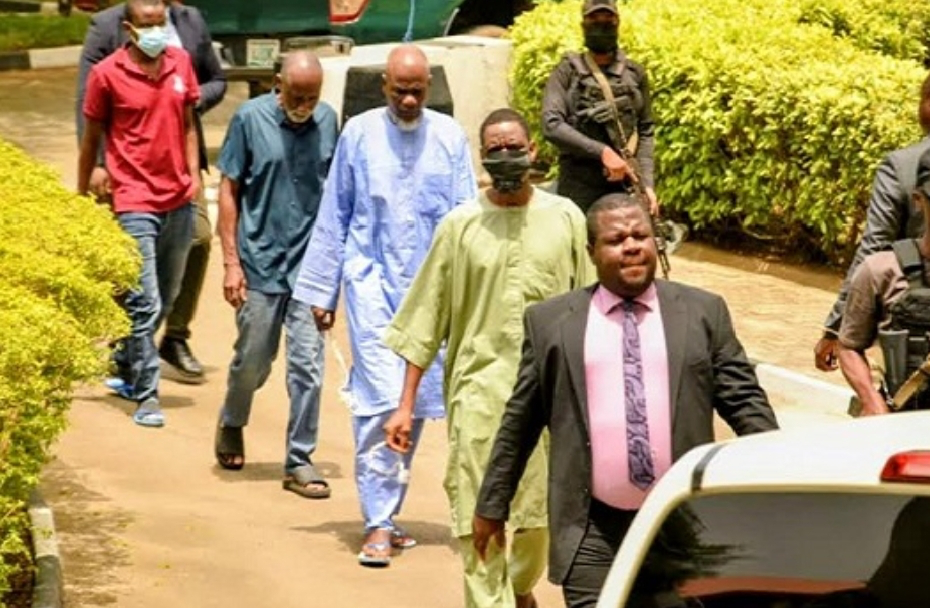
In April, the Federal Government filed 13 charges against six individuals accused of being involved in the alleged coup plot.

They are retired Major-General Mohammed Ibrahim Gana, retired Navy Captain Erasmus Ochegobia Victor, Police Inspector Ahmed Ibrahim, electrician Zekeri Umoru, Bukar Kashim Goni and Zaria-based Islamic cleric Abdulkadir Sani.

While the former military officers and civilians are being tried in a civil court, serving military officers, including Ma’aji, are facing trial before a court-martial.

According to documents reviewed for this report, more than 30 officers and civilians were interrogated by military investigators. Their statements form part of the prosecution’s case, although their admissibility remains contested after several defendants told the court that the statements were not made voluntarily.

The dispute prompted the court to order a trial-within-trial to determine whether the statements were obtained voluntarily before ruling on whether they could be admitted as evidence in the substantive proceedings.

Discover more
History
Newspaper
Africans & Diaspora
Corporate & Financial Crime
Government
In his statement, Ma’aji, an officer from Niger State, said the alleged plot dated back to 2023, towards the end of former President Muhammadu Buhari’s administration.

He attributed the beginning of the idea to concerns over corruption, alleged nepotism, insecurity, kidnapping and banditry, particularly across northern Nigeria.

“Things particularly got out of control towards the end of Buhari’s administration when corruption and nepotism became the order of the day. Insecurity started spreading from the North (east) to the North-west and North-central parts of the country. Kidnapping and banditry engulfed the whole of northern Nigeria,” Ma’aji stated.

He said the deteriorating situation became “critical and precarious,” with troops and civilians losing their lives, adding that it was at that point that “the idea of military intervention started.”

According to him, the military hierarchy was expected to act but failed to do so.

“It was expected that the higher hierarchy of the military could have acted to save the situation. Unfortunately, there was no action from the top,” he said.

Ma’aji said the movement initially involved identifying officers who shared concerns about what he considered the deteriorating condition of the country and bringing them into the scheme.

“Most of the officers involved share the same sense of patriotism, love of country and genuine desire for positive change,” he said.

Ma’aji said the alleged plan could not initially be executed because of difficulties in raising funds, logistics and manpower.

He told investigators that much of the money spent came from his personal resources, including proceeds from the sale of personal property, alongside contributions from some members of the group.

He said he sold three houses in Kaduna State and a students’ hostel at Ahmadu Bello University, Zaria, in an effort to support the movement.

The colonel said one officer contributed N1 million through a bank account, while another made contributions in foreign currency.

The plan was later revived after Ma’aji failed his second promotion attempt in 2024.

He said some officers became concerned that he could be prematurely retired and urged him to revive the movement.

According to Ma’aji, Lieutenant Colonel Shamsuddeen Bappah was among those who strongly pushed for the revival.

He said Bappah travelled from his unit in Ibadan to Abuja to convince him that they had no option but to revive the movement.

Ma’aji said he raised concerns about logistics and manpower because he had already exhausted significant personal resources, but Bappah insisted that the plan should continue.

The officer subsequently promised to sell personal property to support the movement but later informed Ma’aji that he had been unable to find a buyer.

Ma’aji said he subsequently asked whether other officers remained committed to the plan and was assured that they were.

He said the first meeting took place towards the end of 2024 or early 2025, while subsequent meetings were held at different locations in Abuja, with largely the same officers attending and some new members joining.

Ma’aji said his failed promotion attempts were not the primary motivation behind the alleged plot.

According to him, members of the movement believed that Nigeria’s situation had deteriorated further under President Tinubu compared with the Buhari administration.

He cited the removal of fuel subsidy, the floating of the naira, what he described as dubious and multiple taxation, electricity tariff increases, corruption and widespread insecurity as major concerns.

He also said attempts by young Nigerians to have political leaders listen to their grievances had failed, citing the #EndSARS, #EndBadGovernance and Take Back Your Country protests.

According to Ma’aji, excessive force used by security agencies against demonstrators contributed to growing frustration.

He described the average Nigerian youth as frustrated, unemployed and without a clear means of livelihood or hope for the future.

He also lamented the situation of military veterans and retired personnel, saying some had been forced to protest before receiving their pensions, gratuities and other benefits.

In a lengthy statement, Ma’aji repeatedly insisted that the alleged plan was motivated by patriotism rather than personal ambition.

He said he struggled to raise his five children on his salary and questioned how ordinary military personnel could afford quality education and other basic needs amid the country’s economic difficulties.

He also expressed concern about the welfare of wounded soldiers, pointing to the situation at the 44 Nigerian Army Reference Hospital in Kaduna.

According to him, soldiers and officers who sustained injuries in combat had been abandoned to their fate.

He said these concerns reinforced his belief that Nigeria was heading towards a dangerous point.

“The summary of all this is that this action was driven by the desire to have a prosperous nation and country that we all can be proud of,” he stated.

Ma’aji said he believed Nigeria was becoming a “banana republic” and argued that the country had functioned better under military rule.

He said officers and soldiers shared many of the concerns and that the movement was built around recruiting those who genuinely believed that Nigeria needed a change of direction.

The documents also contain Ma’aji’s account of how the group allegedly sought support from military personnel and civilians.

He identified several individuals who, according to his statement, were aware of or allegedly connected to different aspects of the plan.

However, he also specifically denied involvement by a number of officers and said some senior officers who were initially aware of the discussions subsequently withdrew.

Ma’aji said the movement never reached the stage of a fully constituted team because more meetings, resources and personnel were still required.

He also said no definitive “D-Day” had been agreed.

Some of the operational details contained in his statement concern proposed mobilisation, communications, weapons and the intended treatment of senior government and military officials.

Those allegations remain matters before the courts and are not proof that any such plan was actually executed.

Ma’aji further denied discussing the alleged plot with several senior officers whose names had circulated in connection with the investigation.

He said some officers were merely aware of general concerns within the military and were not necessarily participants in the alleged conspiracy.

Former Bayelsa State Governor Timipre Sylva, who was alleged to be a major financier of the coup plot, has vehemently denied any involvement in the conspiracy.

Sylva, a former Minister of State for Petroleum Resources under Buhari, issued the denial through his spokesperson in October 2025 following a security raid on his Abuja residence.

The statement described him as a “thoroughbred democrat” who could not have been involved in such a plot, insisting that he “has no involvement whatsoever—either in planning or in logistics—with any such plot.”

It added that Sylva and his wife were in the United Kingdom at the time for a routine medical check-up and were expected to travel to Malaysia for a professional conference.

The former governor is not known to have returned to Nigeria since then.

Meanwhile, five people associated with him are facing charges over allegations that they concealed his whereabouts, while nine properties linked to him have been placed under interim forfeiture orders.

In his statement, Ma’aji also offered recommendations which he said could prevent a recurrence of such incidents.

He called for improved remuneration for members of the Nigerian Armed Forces, arguing that their salaries were inadequate given current economic realities and inflation.

On welfare, he called for stronger packages for serving personnel and their families, better treatment of casualties, expansion of the COAS Loan Programme, a review of the Armed Forces National Health Insurance Scheme, sustainable housing programmes and the revival of previous car-loan initiatives.

He also called for a dedicated department within the Armed Forces focused on personnel welfare.

On what he described as “godfatherism”, Ma’aji criticised a system in which officers allegedly struggle to advance without influential backing, noting that some personnel spend years on operations while others rarely serve in conflict zones.

He also called for improved pensions for retired personnel, saying veterans deserved better treatment after sacrificing their working lives for the country.

On fuel subsidy removal, Ma’aji argued that the policy should have been phased rather than implemented suddenly, describing its impact as “anti-human”.

He called on the Federal Government to invest savings from subsidy removal in practical projects capable of reducing hardship and urged the revival of mass transit initiatives.

He also called for stronger action against corruption, citing high-profile corruption cases as examples of what he believed had undermined confidence in the system.

Ma’aji criticised the state of education, budget padding and what he described as the inability of many military personnel to afford housing and school fees for their children despite years of service.

He further called for an institutionalised communication channel through which military personnel could directly raise concerns with the Chief of Army Staff without fear of victimisation.

Towards the end of his statement, Ma’aji said his experience in detention and interrogation had changed his perspective.

He said that if released and the underlying problems persisted, he would consider “a different approach,” but added that his interactions with the panel had shown him that there were alternative ways of expressing grievances.

He appealed to the authorities for forgiveness and leniency, saying the alleged plot had not resulted in injury or the release of any bullet.

He said the incident had served as an eye-opener and changed his mindset.

“If God willing, the authority is kind enough to pardon us, we will never contemplate this course of action again in the future,” he said.

Ma’aji maintained that the alleged plan was not intended to destabilise Nigeria but was born out of what he described as patriotism, love of country and a desire for a prosperous nation.

He also appealed for an opportunity for those involved to interact directly with the authorities, plead for forgiveness and commit themselves not to repeat the alleged course of action.

Ma’aji and the other accused persons facing trial before the General Court Martial have denied wrongdoing.

Six other defendants, including retired military officers facing charges arising from the alleged plot before the Federal High Court in Abuja, have similarly maintained their innocence.

They have challenged the admissibility of written statements and video recordings of their interrogations, arguing that the materials were improperly obtained.

The prosecution, however, maintains that due process was followed and has urged the court to dismiss the objections.

The claims contained in Ma’aji’s written and verbal statements, as well as statements made by other people interrogated over the alleged coup, do not in themselves establish guilt.

The courts will ultimately determine the guilt or innocence of the defendants at the conclusion of the ongoing proceedings after considering the totality of evidence presented by both the prosecution and defence. (Premium Times)

News

Sanwo-Olu, Lai Mohammed, Gbenga Daniel, others to attend 7th Freedom Online lecture Thursday

Published

on

Spread the love

Governor Babajide Sanwo-Olu of Lagos State, on Thursday, will deliver the 7th yearly lecture of Freedom Online newspaper.

Theme of the event, which holds in Ikeja, Lagos, is “2027 Elections, Economy, Security and Nigeria’s Future”.

Former Information Minister, Alhaji Lai Mohammed, is the Chairman of the event while former Governor of Ogun State, who is currently representing Ogun East District in the Senate, Senator Gbenga Daniel, is the Special Guest of Honour.

According to a statement by the Managing Director/Editor-in-Chief of the newspaper, Gabriel Akinadewo, other eminent Nigerians will grace the epoch-making event.

President of the Nigerian Guild of Editors (NGE) and Editor of Vanguard, Eze Anaba, is the Chief Host.

Maduka College Advert
Continue Reading

News

EFCC sacks over 40 staff for corruption, prosecutes 5 others

Published

on

EFCC Chairman, Ola Olukoyede
Spread the love

The Chairman, Economic and Financial Crimes Commission (EFCC), Mr Ola Olukoyede, says more than 40 staff members have been dismissed for corruption and financial malpractice in the last three years.

Olukoyede disclosed this on Monday in Abuja at a media interactive session to mark his three-year stewardship at the commission’s headquarters.

The chairman also said that about five of the commission’s staff are currently being prosecuted for corrupt practices.

“In the past two and a half to three years of my service, I have asked them to dismiss over 40 staff on account of corruption and financial malpractice. More than five of them are being prosecuted at the moment,” he said.

The EFCC chairman said some of the affected staff members are already being prosecuted, while case files involving others are being prepared for prosecution.

Maduka College Advert

“You can follow those cases in court; they are public knowledge.

“If that is what people do in other agencies and I arrest them, I investigate them, I prosecute them, why must I just dismiss you if you do it within our own system and I’m not prosecuting you?” he asked.

Olukoyede said the disciplinary measures were part of efforts to ensure EFCC personnel were held to the same standards of accountability the agency demanded from other Nigerians.

“You must be sure that your hands are clean. You can’t be fighting corruption when your hands are soiled with corrupt practices,” he said.

The EFCC chairman also announced the renaming of the commission’s former Internal Affairs Department to the Department of Ethics and Integrity as part of its drive for “internal cleansing.”

He said the commission had also introduced a gift policy to strengthen transparency and prevent conflicts of interest.

According to him, under the policy, staff will be required to declare gifts above a specified value, including those received from friends and relatives at home and abroad.

“The commission will also define the categories of gifts personnel can accept and require officers to account for their sources of income and standard of living,” he added.

The chairman called for stronger institutional reforms and policy changes to fight corruption, saying law enforcement alone could not win the war.

“The most effective system that fights financial crime is not law enforcement. It is the policy regime, institutional reforms that close leakages,” he said.

He urged the media and civil society to return to their watchdog roles.

(NAN)

Continue Reading

News

EFCC summons ex-gov Sylva over alleged $14.86m fraud

Published

on

Ex-Governor Timipre Sylva
Spread the love

The Economic and Financial Crimes Commission has urged former Bayelsa State Governor, Timipre Sylva, who has been declared wanted over an alleged $14.86m fraud, to make himself available for questioning.

The commission’s spokesman, Dele Oyewale, stated this on Monday while reacting to Sylva’s allegation that the anti-graft agency had conducted itself more as an organ of the All Progressives Congress than as an institution of the state.

“He has been declared wanted; he should make himself available to the commission,” Oyewale said when asked to respond to the allegation.

Sylva, who announced his resignation from the APC on Monday, said he had forwarded a copy of his resignation letter to the EFCC, accusing the commission of acting as an organ of the ruling party.

The former Minister of State for Petroleum Resources also accused the APC of abandoning its founding ideals and said the Tinubu administration had disappointed Nigerians.

Maduka College Advert

The resignation letter, addressed to the APC chairman of Ward 4 in Brass Local Government Area of Bayelsa State, was delivered electronically. It was also copied to the national chairman of the APC, the executive chairman of the EFCC and the chairman of the APC in Bayelsa State.

Sylva said his decision to quit the party followed consultations with his family, associates, colleagues and sympathisers.

He said he had no option but to leave what he described as a “floundering ship whose fate appears to have been sealed by its irredeemable load of iniquities.”

The former governor said he could no longer remain in a party whose leaders, in his view, had embraced the belief that “all is fair in politics.”

In the resignation letter dated August 31, 2026, and obtained by our correspondents, Sylva said the ideals upon which the APC was founded had been “thoroughly and unrecognisably thwarted.”

He wrote, “As a founding member of the APC, and one who joined other well-meaning Nigerians in building the Party with sweat and money, it is deeply saddening to witness how the ideals we espoused have been so thoroughly and unrecognisably thwarted.

“Moreover, I cannot, in all good conscience, continue to belong to a Party whose leaders believe that ‘all is fair in politics;’ and have consistently demonstrated that belief in practice.

“All cannot be fair in any endeavour of life. The demands of basic decency and morality forbid it. Unfortunately, this mentality appears to underpin virtually every action, and even inaction, of this administration.”

Sylva also criticised the APC-led Federal Government, saying it had failed to meet the expectations of Nigerians.

“The present Government, formed under the banner of the APC we once loved, has disappointed the vast majority of Nigerians. And I can see neither a credible attempt nor any possibility of a revamp,” he stated.

He said he was leaving the party in the belief that Nigerians would use the next election to change the political direction of the country.

“I am therefore left with no other choice than to jettison a floundering ship whose fate appears to have been sealed by its irredeemable load of iniquities. I have no doubt that, in the coming election, Nigerians will vote for Nigeria and free the Country from this stranglehold on our beautiful country,” he said.

Explaining why he copied the EFCC in the resignation letter, Sylva accused the commission of becoming increasingly political and expressed fear that his resignation could trigger further investigation against him and his associates.

He wrote, “I am deliberately putting the EFCC in copy of this letter because, of late, it has conducted itself more as an organ of the APC than as an institution of State.

“I am fully aware that this action of mine may invite a redoubled witch-hunt against me and my associates, but that is a risk I am willing to take.”

The former governor expressed confidence that Nigerians would use the next general election to “vote for Nigeria” and free the country from what he described as the current “stranglehold” on the country.

Sylva expressed confidence that Nigerians would use the next election to change the political direction of the country.

The EFCC declared Sylva wanted in November 2025 in connection with an alleged case of conspiracy and dishonest conversion involving $14,859,257.

His resignation from the APC also comes months after he was linked to an alleged plot against the administration of President Bola Tinubu.

Sylva is listed as a defendant and described as “still at large” in a 13-count federal charge involving allegations of treason, terrorism-related offences, conspiracy and money laundering arising from the alleged plot.

Multiple reports indicate that Sylva left the country after the investigation into the alleged plot became public. Sources familiar with the investigation also said he suspended plans to return to Nigeria after learning of a raid on his Abuja residence and the arrest of some of his associates.

Investigators have reportedly identified Sylva as an alleged principal financier of the plot, accusing him of contributing about N785m through Purple Waves Limited, an Abuja-based company.

More than N5bn was reportedly pooled for the alleged operation, with investigators tracing about N785m through Purple Waves and a bureau de change operator before the funds were allegedly distributed.

Investigators also reportedly linked funds paid into Purple Waves to proceeds from contracts awarded by the Niger Delta Development Commission and loans obtained by the company.

Sylva has denied involvement in the alleged plot. The allegations remain subject to judicial proceedings and he has not been convicted.

In July 2026, the Department of State Services arraigned five of his associates for allegedly concealing his whereabouts after he was declared wanted in connection with the alleged plot. They pleaded not guilty and were granted bail.

In May 2026, the Federal High Court in Abuja granted an interim forfeiture order covering nine properties linked to Sylva following an application by the EFCC.

Sylva served as Bayelsa State governor from 2007 to 2012, with his tenure interrupted by court rulings. He later served as Minister of State for Petroleum Resources under former President Muhammadu Buhari. (The PUNCH)

Continue Reading

Trending

Maduka College Advert