News
Despair in Benue, Plateau as killings hit over 284 in three months

• Defend yourselves, attackers are after land, says T.Y. Danjuma
• Kukah warns of national collapse, seeks urgent action on insecurity, hunger
• Group blames Alia for worsening insecurity in Benue, claims gov ‘inaccessible’
• Vigilante groups compounding national security risks, ex-DSS boss alleges
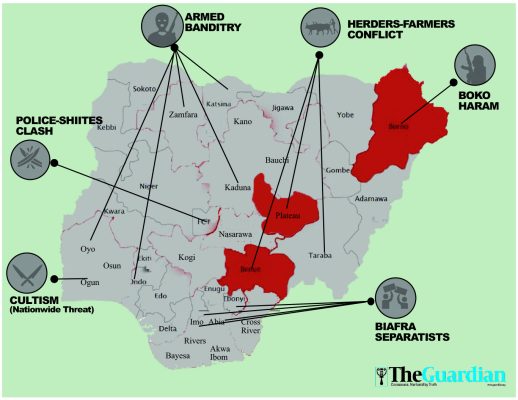
Deadly clashes between nomads and farmers in Benue and Plateau states have risen to at least 284 in about three months, with escalated killings claiming about 70 over the weekend.
Though the clashes are not new, recent mindless killings are the worst since the 2015 New Year onslaught that claimed over 300 lives in the region. The renewed yet escalating crisis has elicited despair and desperation among the living, just as the state governments have confirmed the invasion of several communities by bandits in possession of sophisticated weapons.

Deeply concerned by what is fast becoming a pogrom, Gen. Theophilus Danjuma and Bishop Matthew Kukah have also condemned the killing, with the former urging Benue and Plateau residents to brace up in self-defence.
Killing spree
The statistics are indeed gory: This year alone, the country has witnessed wanton killings all over, just as from Benue to the hills of Plateau, bloodletting fester with alarming frequency.
Indicators have emerged that some of the killer gunmen parade as either vigilantes claiming to protect their people or gun-toting marauding herdsmen. Whatever the case, the senseless killings that ensue daily have caused pain and suffering for residents and indigenes of these states. At the same time, citizens continue to wallow in despair on account of the indifference or seeming helplessness of security agencies and the Federal Government.

The dead continue to be reflected as figures. From February 1 to 2, the Gwer West attack in Benue State claimed lives. Fulani militias had attacked Tse Shugun Vengav and Tse Gyuche, killing two and kidnapping one woman.
On February 3, in Otukpo, Benue State, three people were killed in a fresh militia attack. On February 5, 2025, five local hunters were killed by Fulani militias in Okpomaju, Benue State.
February 18, 2025, Kwande Massacre (Benue State), 19 people were murdered, while 16 were dumped in a river in Kwande, Benue State. March 24, 2025, in Ruwe, Plateau State, there was a major attack by Fulani militias that left over 100 people dead in multiple communities. March 27, 2025, another attack in Hurti and Ruwi in Plateau State left 36 Hurti people burned alive, with 11 Ruwi indigenes dead.
March 28, 2025, 16 Hausa hunters were lynched by a mob over kidnapping allegations. On April 2, in Manguna and Daffo, Plateau State, four persons were killed during coordinated attacks by gunmen.
April 3, Fulani gunmen attacked a Benue Links bus, killing two and abducting 13. On April 13, 2025, at least 40 people were killed by suspected Fulani Herders in Zike Bassa LGA of Plateau State.
Almost every day comes with a new story of sorrow, tears and blood, especially in these two states. For instance, the death toll in the latest herdsmen massacre at Ukum, near Zaki Biam, and other parts of the Sankera constituency in Benue State has climbed to 70.
Before this latest massacre by herdsmen in Benue, there was the well-known January 1, 2018, or New Year Day massacre in Guma and Logo local councils. The dead were given a mass burial by the state government. Although the New Year Day massacre received more media visibility, what was acclaimed as the worst herdsmen massacre happened in Agatu. That sad debacle, which claimed the highest number of lives in Benue State, occurred in 2015. The death toll was put at between 300 and 500.
In his public broadcast, the Benue State governor, Rev. Fr Hyacinth Alia, at the weekend put the death toll at 56, even as he stated that the search was still going on for other bodies.
Between Saturday and Sunday, more dead bodies were discovered in the surrounding bushes and farms where some of the fleeing wounded had died, just as some of the critically injured were still at the hospitals.
National collapse, hunger imminent
The Catholic Bishop of Sokoto Diocese, Most Revd Hassan Kukah, has raised the alarm over the worsening state of the nation, warning that Nigeria is reaching a breaking point.
Delivering his Easter message titled, “Mr President, Please Bring Us Down from This Cross”, Kukah appealed to President Bola Ahmed Tinubu to urgently rescue Nigerians from the current wave of hardship, hunger, and insecurity.
He lamented that the country is engulfed in brutality and savagery, unprecedented in its history, with citizens increasingly exposed to kidnappings and killings across various regions. According to him, the situation has pushed Nigeria beyond human civilisation.
“A dark pall of death hangs languidly from north to south. It is impossible to find a home, a family, or a community that has not been caught in the cusp of this savagery,” Kukah said.
“Mr President, we all admit that you neither erected this cross nor effected our collective crucifixion. Nonetheless, Nigerians have been dangling and bleeding on this cross of pain and mindless suffering for too long.”
Kukah said a deep sense of cynicism and hopelessness has settled across the country, with citizens doubting the nation’s capacity to secure peace. Yet, he called for a renewal of hope, insisting that despite the grim realities, Christians are taught to hold fast to hope.
“These times of great suffering should be times of hope; hope beyond human imagination. The road to our collective discouragement has been laid by marauders, murderers, savages, and ravenous predators who threaten to overrun our nation,” he said. “Mr President, rid our dear country of these forces of darkness and bring us down from this cross of cynicism.”
The cleric also urged the President to make food security a fundamental human right and alleviate the hunger plaguing millions of Nigerians. Expressing further concern over the deepening insecurity, Kukah warned that the crisis is now like cancer, eating into every facet of national life. He said the bandits have become entrenched in communities and are eroding the social fabric of society.
“Kidnapping has become a dog whistle for undermining the very structure and foundation of our country. We now hang on the cross at the mercy of these forces of darkness,” he said.
He noted that while most Nigerians wish to live in peace, the government’s failure to curb insecurity could destroy any form of national goodwill.
Kukah urged Tinubu to act with urgency, especially in the spirit of Easter, a season that signifies triumph over death.
‘FG cannot defend you…’
Senator representing Benue North-East district, Emmanuel Udende, told The Guardian that “so far, 70 dead bodies have been counted.” Immediate past chairman of Ukum LGA, Iorzaa Victor Msuega, who was also involved in the rescue missions, confirmed the death toll at 70, noting that “as of yesterday, when the governor visited, only 56 dead were recovered.”
Describing the attacks as unacceptable, Senator Udende expressed disappointment at “the recent coordinated attacks by marauding armed herdsmen in Gbagir, Mbatyu, Une, and Mbater, all in Logo, Ukum and Katsina-Ala Local Government Areas that resulted in loss of innocent lives, including those of children.”
He regretted that despite prior information about the influx of attackers, no measure was taken by security operatives to thwart the killings.
“This is no longer a random occurrence. It appears to be an organised and premeditated onslaught. We cannot continue to sit back and watch our people being slaughtered for no reason,” he declared.
Former Minister of Defence, Gen. Theophilus Danjuma, said the way out is for Nigerians to rise and protect themselves, noting that the marauding killers are in search of land.
Danjuma, who spoke in his hometown, Takum, Taraba State, at the weekend, stated: “I told you before to rise and defend yourselves, and I’m saying it again—this time with even more urgency.
“Those attacking you are heavily armed. Nobody knows how they got such weapons, but you, too, should find a way to arm yourselves. Wherever they got theirs from, get yours too.
“It is now very clear that the government alone cannot protect us. We must stand up and defend ourselves, our families, and our lands before these criminals overrun the entire country,” he added.
Former Senate President, David Mark, has called on the Federal Government to adopt a more proactive and decisive strategy in tackling insecurity across the country, particularly the menace of kidnappings, violent crimes, and the activities of armed herdsmen.
In his Easter message released through his media aide, Paul Mumeh, in Abuja, Mark expressed deep concern over the continued wave of violence in parts of the country, especially in Plateau and Benue states, which he said has resulted in the loss of numerous lives and destruction of property. He urged the Federal Government to officially designate violent armed herders and other criminal groups as terrorists, saying their actions meet the criteria for such classification .
“We must not shy away from the truth. If they are not terrorists, why are they killing people? Why are they destroying communities? Why are they chasing people away from their ancestral homes?” he asked.
Mark described the unrelenting attacks on communities by suspected herdsmen as unacceptable and called for a total prohibition of their activities. He said no individual or group has the right to take another person’s life under any guise.
Condemning the persistent killings in Benue and Plateau states, the former Senate President advocated a nationwide ban on open grazing. He said the government must move towards adopting modern practices such as enclosed ranching, which he described as the global standard.
“The time has come to end open grazing across the country. We must embrace ranching, which is more sustainable and safer for both herders and host communities,” he said.
Mark, whose Otukpo country home in Benue South has reportedly come under repeated attacks by suspected herdsmen, also called for a more inclusive approach to security management and a coordinated response to insecurity in all its forms.
He further recommended the creation of a well-equipped Border Security Force to check the infiltration of criminal elements into Nigeria. According to him, the porosity of the country’s borders has enabled foreign elements to enter freely and unleash terror on Nigerian citizens.
“We must not allow criminal elements to stream into our country unchecked. We need to change our strategy and possibly consider fencing our borders, as done in countries like India, Israel, the United States, and Mexico,” he said.
Blame Governor Alia
The Sankera Peace and Development Forum (SAPEDEF) has accused the Benue State Governor, Rev. Fr. Hyacinth Alia, of failing to address the worsening insecurity in the state, particularly in the Sankera axis.
The group attributed the rising violence and killings in the area to the governor’s alleged inaction and inaccessibility. SAPEDEF, a Sankera-based non-profit peace advocacy group, said the governor’s failure to engage with critical stakeholders has hindered the path to sustainable peace.
The group noted that the lack of coordination between the political leadership and grassroots actors was fuelling insecurity in the state, which is widely referred to as Nigeria’s “food basket”.
In a statement jointly signed yesterday by its National President, Dr Paul Gbande, and National Secretary, Doshima Vembe, the group said Governor Alia has yet to support a peace initiative led by the Catholic Bishop of Katsina-Ala Diocese, Most Rev. (Dr) Isaac Dugu, despite its early signs of success.
“We are saddened by the killings in Sankera, occasioned by rising tensions and bloody clashes between rival criminal gangs,” the statement said.
“Our investigations revealed that a peace process initiated by Bishop Dugu led to some criminal gangs agreeing to lay down their arms under certain conditions, but the state government has not acted on the initiative.”
SAPEDEF alleged that Alia has refused to convene a stakeholders’ meeting to deliberate on the outcomes of Bishop Dugu’s engagements with armed groups. According to the group, the initiative had the backing of security agencies and only required the political will to be formalised and funded.
Contrary to widespread beliefs, SAPEDEF claimed that Fulani herders did not carry out the recent killings, but that they were the result of a supremacy battle between two local gangs: Full Fire Boys, allegedly supported by Fulani elements, and Chengs Boys.
The group said the conflict often escalates when cattle rustling occurs, triggering reprisals from Fulani herders.
The group stressed that the violence has already taken a toll on the socio-economic life of the people, warning that continued inaction could plunge the state further into chaos.
It also accused the state government of failing to fund local councils, thereby weakening their ability to implement grassroots initiatives that could help curb insecurity.
“It is disheartening that Governor Alia is allegedly inaccessible to critical stakeholders in the security ecosystem. Security proposals and classified reports brought to his attention are often not treated with the urgency they deserve,” the group claimed.
SAPEDEF concluded by urging the governor to take decisive action to end the violence, stating that as the state’s Chief Security Officer, he is constitutionally obliged to ensure peace and protect lives and property.
“The people of Benue deserve better. The delay in adopting workable peace frameworks has cost lives. Governor Alia must act now before the situation becomes irredeemable,” the group said.
Caution on vigilante groups
Prescribing a solution to the menace, former Director, Department of State Services (DSS), Dennis Amachree, frowned at the rising risk of vigilante groups across Nigeria, stressing that the growing reliance on vigilante groups as a stopgap measure for the nation’s deepening security crisis is worrisome.
He acknowledged the emergence of vigilantes as a response to the stark absence of formal law enforcement in many rural communities. Still, he warned of their dangers when left unchecked.
His words: “Vigilante groups have become visible in parts of the country where state security apparatus is either stretched thin or non-existent.
“Their rise reflects the urgent need to address real security challenges, particularly in rural areas plagued by armed herders and bandits.”
While observing that some state governments in several regions have turned to the informal security outfits as a way to combat violent crime, terrorism, and general lawlessness, the former DSS director noted that in many areas, these groups serve as the first line of defence for communities, especially in the face of marauding armed herders and increasing banditry.
“But even as they fill a critical gap,” he warned, “their growing presence has come with serious consequences. There have been disturbing reports of extrajudicial killings, torture, and other human rights abuses carried out by these groups.
“Many members lack formal policing training, which significantly increases the likelihood of rights violations and the escalation of violence.”
The former intelligence chief emphasised that while vigilante groups may offer community-based security solutions, the lack of oversight and accountability raises serious red flags, adding, “Without proper structures in place, these groups risk becoming lawless themselves, further complicating the already fragile security landscape.”
To mitigate these dangers, Amachree urged state governments to approach the deployment of vigilante groups with caution and responsibility, even as he advocated for a standardised training curriculum for all members, focusing on human rights, community policing principles, and non-violent conflict resolution.
“Training alone isn’t enough. There must be clear reporting lines for misconduct and established procedures for escalating suspicious activities to official law enforcement. Vigilantes should only apprehend suspects and must never act as judge and executioner,” he stated.
Beyond the structural reforms, Amachree pointed to broader social issues as root causes of the country’s insecurity and urged the government to invest in economic empowerment programs and improved social services to address poverty and unemployment. These factors often push individuals toward crime.
On the need for greater national unity, he noted: “Ethnic and religious divisions continue to fuel insecurity in Nigeria. Fostering a strong sense of patriotism and shared national identity could go a long way in reducing violence and promoting long-term peace.”
Also, former Director Defence Media Operations, Major General Danmadami (Rtd.) hinted that the rising clashes are triggered by fast approaching general elections in 2027, adding that insecurity has become a weapon for campaign rhetoric.
He urged state governors to hand allocation of the Local council chairmen to them to enable them to check grassroots crimes, stressing: “My view is that the increase is a result of the fact that the 2027 election is coming fast, and insecurity is being weaponised as a campaign rhetoric. We all saw what was used against Jonathan.
“The solution is to let the governors allow the LGA to have their money so they can function properly and be held accountable. There is a nexus between the non-functionality of the LGA, poverty and insecurity.
“All the ungoverned spaces where all these incidents are taking place are domiciled in the LGA. The LGA has a serious administrative vacuum, which criminals have now taken over.”
On his path, the Galadima of Daffo, in Bokkos LGA of Plateau State, Da Jonathan Akuns, noted that “in every nodal settlement of Plateau State, village or hamlet or district or LGA, different ethnic groups coexist. They constitute residents of a multicultural society and pursue their livelihoods based on their various fields of endeavour or occupational trade.”
He said the killings should be purely presented as a gangster criminality, remarking that “these are the dominant views and perspective understood by the national cum international observers.
“A reframing of the issues as invasion paves the way for the hegemonic authorities to overrun our territory with their might under the guise of flushing out invaders; we saw it in 2004 & Jang vs Yar’Adua in the affairs of our territory as well as at the western regional government during the first republic. We are better placed to hold our own when the issues are resolved on our terms, for being communal, that is, autochthones versus migrant settlers.”
The Guardian







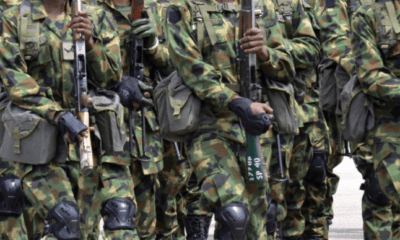



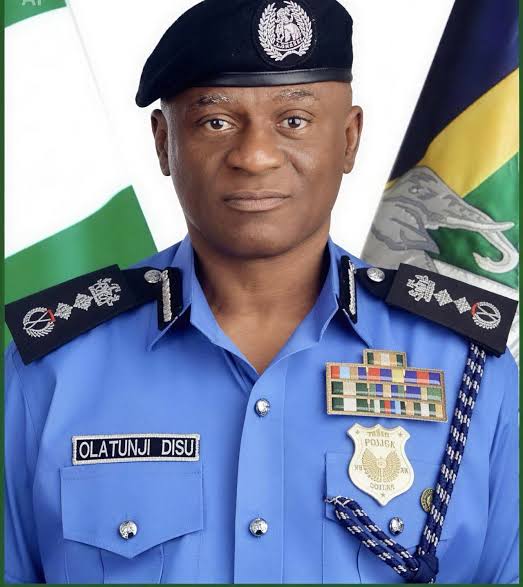
The Nigeria Police Force has placed its formations nationwide on red alert following intelligence reports of planned terrorist attacks on worship centres, schools, NYSC orientation camps and other public places.
The alert followed fresh intelligence indicating increased mobilisation of terrorist elements for possible coordinated attacks on vulnerable targets across the country.
Police authorities also reportedly received intelligence on the movement of armed elements from Katsina through Kaduna towards Plateau State.
The operational order was contained in a police wireless message dated September 13, 2026, with reference number CB: 0900/FDPS/DOPS/FHQ/ABJ/VOL38/68, issued by the Department of Operations at Force Headquarters, Abuja.
Marked “Security General” and tagged “Treat as Very Important,” the message was circulated to Assistant Inspectors-General of Police overseeing Zones 1–17, Mobile Police formations, counter-terrorism and other specialised units, as well as Commissioners of Police in the 36 states and the Federal Capital Territory.
The police directed formations to intensify vigilance and take proactive measures to prevent criminal and terrorist elements from carrying out attacks.
The warning specifically highlighted places of worship, educational institutions, NYSC orientation camps and other vulnerable public locations as potential targets.

Former Vice President Atiku Abubakar has faulted the administration of President Bola Tinubu over the current pump price of petrol, noting that Nigerians are now paying as much as ₦1,470 per litre even though crude oil, at $102.52 per barrel, sells for far less than the $147 per barrel it fetched in 2008 when petrol sold for ₦65 per litre under the late President Umar Musa Yar’Adua.
In a statement issued by his Senior Special Assistant on Public Communication, Phrank Shaibu, Atiku accused the Tinubu administration of presiding over what he described as an organised system of grand larceny against the Nigerian people, built around opaque Federation Account FAAC deductions, questionable management of oil revenues, parallel funding arrangements and allegations of off-book transactions.
“With crude oil around $102.52 per barrel, Nigerians are paying as much as ₦1,470 per litre. In 2008, when crude oil reached about $147 per barrel, petrol sold at ₦65 per litre under the Yar’Adua administration. The difference is that government then understood that economic policy must ultimately protect the welfare of citizens,” he said.
The Presidential Candidate of the African Democratic Congress ADC said it is unconscionable for a government that has extracted unprecedented sacrifice from citizens in the name of subsidy removal to keep raising the cost of survival while refusing to provide a clear, verifiable account of the revenues, savings and deductions accumulated under its watch.
He recalled that Nigerians were told subsidy removal would free resources for education, healthcare, infrastructure and other essential services, yet nearly three and a half years later, fundamental questions remain unanswered about where the money has gone.
“Petrol at ₦1,470 per litre is not merely a figure at the filling station. It enters the price of transportation, food, school runs, farming, manufacturing and virtually everything Nigerians buy. Every increase at the pump travels directly into the household budget.
“After all the pain imposed on Nigerians, they have a right to ask: where are the subsidy savings and where is the money?”, he queried.
Atiku said official FAAC records themselves justify greater scrutiny, pointing out that in June 2025, gross Federation Account revenue was reported at ₦4.232 trillion while only ₦1.818 trillion was eventually distributed, with substantial sums categorised as cost of collection, transfers, interventions, refunds and savings.
He demanded a comprehensive reconciliation of Federation Account revenues from 2023 to date, showing gross collections, every deduction made before distribution, the statutory authority for each deduction, the receiving accounts and the ultimate beneficiaries.
“Nigerians deserve accounts they can interrogate, not accounting labels designed to discourage questions,” he said.
The former Vice President also called for full disclosure around the Renewed Hope Infrastructure Development Fund, OML 143, oil-production revenues, the Nigerian National Petroleum Company NNPC’s international Liquefied Natural Gas LNG trading operations, offshore corporate structures and allegations involving unofficial crude lifting, maritime surveillance contracts and other possible off-book revenue flows.
“These allegations are too serious to be answered with press statements and political insults. Every barrel can be measured, every cargo identified and every legitimate payment traced. If everything is in order, publish the records and allow independent forensic auditors to reconcile them. If the allegations are false, the records will clear the government,” he said.
Atiku equally rejected attempts to use the current international crisis as a blanket excuse for rising domestic fuel prices, drawing attention to the widening gap between what Nigerians earn and what they now pay at the pump compared to other climes.
“At about $4.31 per gallon, U.S. petrol is roughly $1.14 per litre. Yet while the U.S. federal minimum wage is $7.25 per hour, Nigeria’s minimum wage is only ₦70,000 per month.
“Tinubu has brought Nigerians close to American fuel prices while leaving them with Nigerian poverty wages. That is the true cost of his subsidy-removal policy”, he said.
He insisted that the administration can no longer demand endless sacrifice from citizens while treating public accountability as optional.
“After all the oil, all the revenue, all the deductions and all the hardship, petrol is now ₦1,470 per litre. The question Tinubu must answer is simple: where are the savings, where are the revenues, and who is taking Nigeria’s money?”
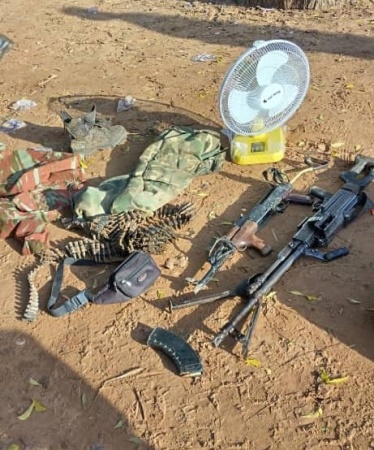
The Kebbi Police Command, in collaboration with the military, has neutralised some suspected terrorists and recovered rifles, ammunition, motorcycles, and other items during a clearance operation in Gumki Forest, Kangiwa.
The Police Public Relations Officer (PPRO), SP Bashir Usman, disclosed this in a statement issued on Monday in Birnin Kebbi.
He said the operation was conducted at about 6:05 a.m. on Monday, adding that Gumki Forest, Arewa Local Government Area, was a known route used by bandits and Lakurawa elements operating in the area.
He said the joint security team successfully engaged the terrorists during the operation and neutralised some of them.
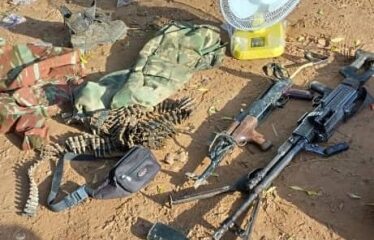
According to him, the operation also led to the recovery of one PKT rifle with 174 rounds of live ammunition and one AK-47 rifle with 14 rounds of live ammunition.
Other items recovered, he said, included a pair of military camouflage uniforms, a pair of boots, two mobile phones, charms, and four motorcycles.
“The area remains relatively calm, while joint operations are ongoing to further clear the area and rid the state of criminal elements,” he said.
Usman quoted the Commissioner of Police, CP Umar Hadejia, as commending the operatives for their gallantry and dedication to duty.
Hadejia reiterated the command’s commitment to sustaining coordinated and intelligence-led operations with other security agencies to counter banditry, terrorism, and other forms of criminality in the state.
He also urged members of the public to continue providing timely and credible information to security agencies to support ongoing efforts to safeguard lives and property.
The commissioner assured residents of the command’s determination to work with other security agencies to maintain peace and security across the state. (NAN)
-
 News1 day ago
Youths set APC offices ablaze, block highways
-
News2 days ago
2027: Obi’s credentials under probe as LP chieftain sues WAEC, UNN, NYSC
-
News2 days ago
Senior EFCC Officer faces allegations of abuse of office and unexplained wealth
-
News3 days ago
More hardship for Nigerians as petrol, diesel prices rise again
-
News2 days ago
Four rescued, one feared dead as uncompleted building collapses in Enugu
-
News1 day ago
Police, military neutralise terrorists, recover rifles, ammunition, motorcycles in Kebbi
-
Politics3 days ago
2027: Tinubu, Atiku, Obi, 15 others make INEC final presidential candidates’ list
-
Uncategorized8 hours ago
Army warns of possible attacks on churches, schools