News
BREAKING: SERAP drags Akpabio to court over refusal to reverse Senator Natasha’s suspension


The Socio-Economic Rights and Accountability Project (SERAP) has filed a lawsuit against Senate President Godswill Akpabio over what it describes as the “patently unlawful” suspension of Senator Natasha Akpoti-Uduaghan.
According to SERAP, the senator’s suspension was solely based on her peaceful exercise of the right to freedom of expression.

The lawsuit, filed on behalf of all Senate members, challenges the six-month suspension imposed on Senator Akpoti-Uduaghan after she reportedly “spoke without permission” and “refused her new seat in the Senate chamber.”
The suspension also comes with a withholding of her salary and allowances, along with a restriction preventing her from identifying herself as a senator during the period.
In suit number FHC/ABJ/CS/498/2025, filed last Friday at the Federal High Court in Abuja, SERAP is seeking a judicial order compelling Akpabio to overturn the suspension, reinstate Akpoti-Uduaghan, and restore all her legislative rights, entitlements, and privileges.

SERAP has also requested an order of perpetual injunction to prevent the Senate from imposing further suspensions or disciplinary actions against the senator for exercising her fundamental human rights.
Furthermore, the lawsuit calls for a declaration that the Senate’s application of sections 6(1)(2) of the Senate Rules and the Senate Standing Orders 2023 (as amended) violates Akpoti-Uduaghan’s rights and deprives her constituents of political participation.
SERAP argued that granting this request would serve public interest and uphold the rights of all members of the National Assembly.
The group contends that no senator should be punished for expressing their views, emphasizing that the Senate should be a model for upholding the rule of law and protecting human rights rather than suppressing them.
The suit further states that Akpoti-Uduaghan’s suspension disproportionately affects the ability of other senators to freely express their opinions.
SERAP argued ⁴that the cited reasons for her suspension appear to be a pretext for restricting her fundamental rights.
The case, filed by SERAP’s legal team, including Kolawole Oluwadare and Adelanke Aremo, emphasizes that no Senate member should face penalties for exercising freedom of expression.
It argued that political speech requires a higher level of tolerance, especially when directed at government officials.
SERAP further highlights that Akpoti-Uduaghan’s suspension indirectly violates Nigerians’ right to receive information, affecting the right of her constituents in Kogi Central Senatorial District to participate in governance.
The lawsuit references several constitutional and international human rights provisions, including:
Section 39 of the Nigerian Constitution (1999, as amended), which guarantees the right to freedom of expression.
Article 9 of the African Charter on Human and Peoples’ Rights, which affirms the right to receive and disseminate information.
The International Covenant on Civil and Political Rights, emphasizing strict limitations on restricting freedom of speech.
Article 13 of the African Charter, which guarantees citizens’ rights to political participation.
SERAP stated that the Senate Standing Orders 2023 (as amended) cannot override constitutional and human rights protections, insisting that Akpoti-Uduaghan’s right to express herself is firmly established under Nigerian and international law.
The court has yet to set a date for the hearing of the case.
The Advocate Nigeria reports that SERAP had last week called on the Senate President to immediately reverse the suspension of Senator Akpoti-Uduaghan.
SERAP described her suspension as “patently unlawful” and a violation of her right to freedom of expression.









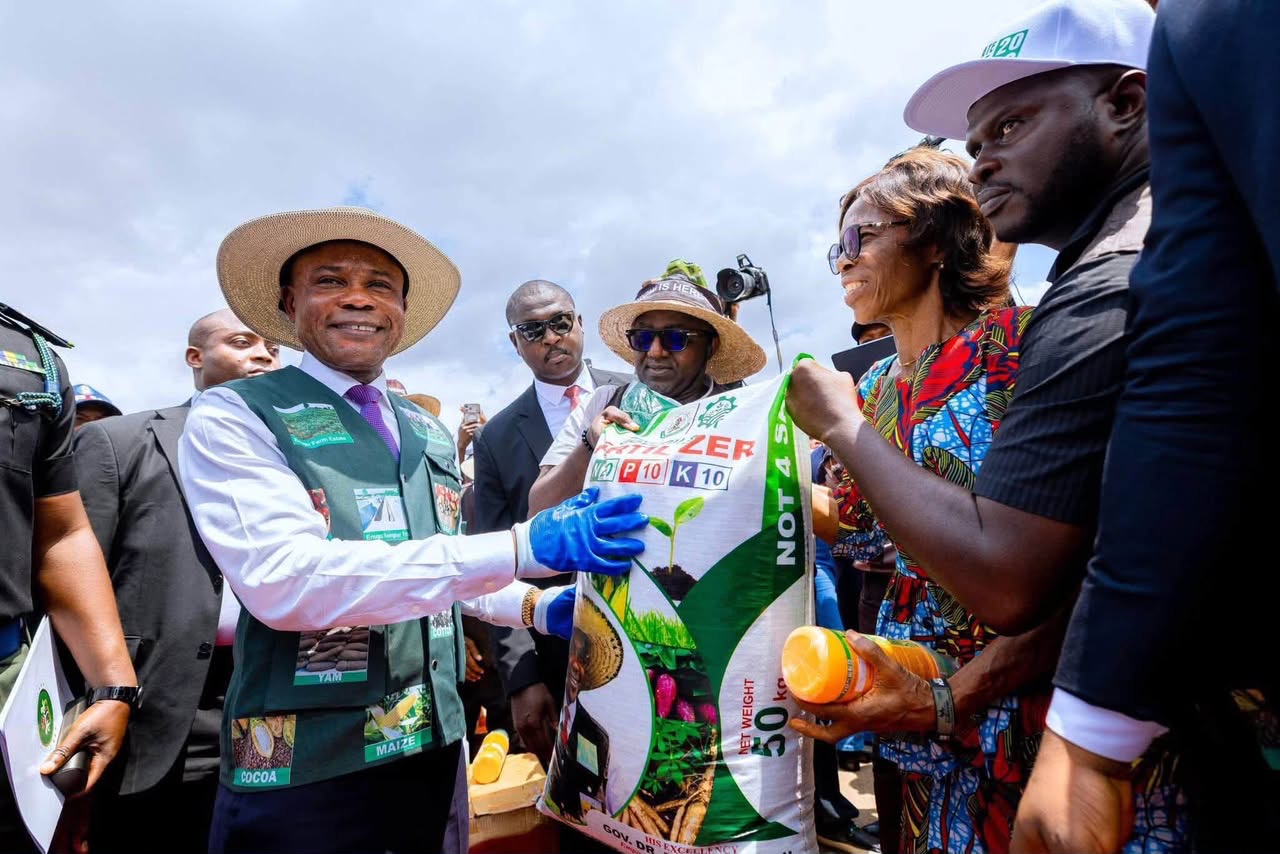
The Enugu State Government has approved the payment of about ₦32 billion in outstanding legacy gratuities owed to retirees, with the first tranche of ₦10 billion scheduled for release from next week.
The Secretary to the State Government (SSG), Prof. Chidiebere Onyia, disclosed this on Friday while briefing journalists at the Government House, Enugu, after the State Executive Council meeting.
Onyia, who briefed newsmen alongside the Commissioner for Information and Communication, Dr. Malachy Agbo; Commissioner for Lands and Urban Development, Barr. Chimaobi Okorie; and Commissioner for for Commissioner for Human Development and Poverty Eradication, Prof. Benedett Ekwutosi Okoli, said the payment was part of the commitment of the Governor Peter Mbah Administration to clear the inherited gratuity liabilities before the end of Mbah’s first tenure.
He explained that the outstanding gratuities were liabilities inherited by the present administration, adding that the state government had made provisions for the settlement of the gratuities in the 2026 budget, which had been approved by the State House of Assembly.
“This amount of money was put in the 2026 budget and approved by the Enugu State House of Assembly. So, it is in appropriation law,” he said.
The SSG stressed that the decision was not a hastily conceived measure but part of a planned process to address the state’s outstanding obligations to retired workers.
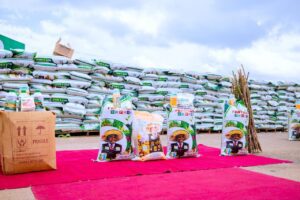
According to him, the government suspended the existing gratuity verification process in December 2025 and established a verification committee to review records dating back to 2000.
He said the exercise was designed to establish the actual liabilities by examining retirees’ records and supporting documents, adding that the amount approved by the Executive Council was based on the outcome of the verification.
Onyia disclosed that the first ₦10 billion tranche would be released to commence payments, after which subsequent tranches would follow until the entire verified liability of approximately ₦32 billion was cleared.
The SSG added that the administration was also addressing gratuity obligations at the local government level, where the outstanding exposure was estimated at more than ₦10 billion.
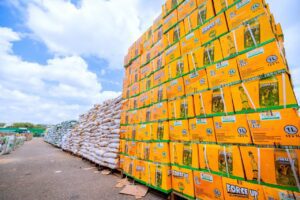
He said Governor Mbah had approved a meeting of the Economic Council to review the local government liabilities to enable local government retirees to start receiving their gratuities soon, alongside their counterparts at the state level.
He clarified that the current exercise focused on legacy gratuities, noting that the government had already commenced the payment of outstanding pension obligations following the verification of eligible beneficiaries.
“The gratuity owed to every retiree across the board from 2000 will be paid,” he said.
The SSG also disclosed that the verification committee, which he chaired, had reviewed the records of 66,783 persons across the workforce and pension-gratuity categories.
He explained that the verification exercise was necessary to guard against fraudulent claims and ensure that payments were made to legitimate beneficiaries.
He, however, clarified that retirees, who had concerns with the outcome of the verifications were free to submit their complaints to the verification committee for further review.
Onyia said that clearing the inherited gratuity liabilities was an important step towards ensuring that the state did not continue to accumulate unpaid retirement benefits for future administrations.
He reiterated that the Mbah administration was committed to settling the verified legacy obligations while sustaining payments to eligible pensioners and putting in place a more sustainable pension system for the state.
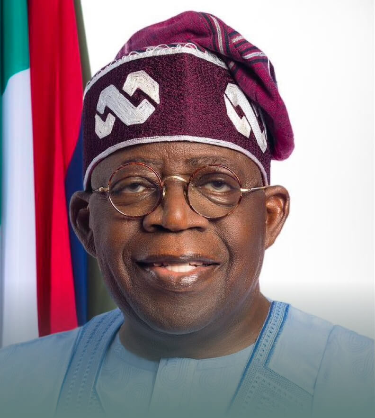
President Bola Tinubu has directed heads of security agencies to rescue all abducted persons and ensure that no terrorist or bandit camp remains anywhere in Nigeria, the Minister of Defence, Gen. Christopher Musa (retd.), said on Thursday.
Musa, who spoke to State House correspondents after a security meeting presided over by the President at the Presidential Villa, Abuja, said Tinubu also asked the service chiefs and other security heads to guarantee a safe environment for Nigerians to vote in the elections scheduled for January.
The minister said the meeting was convened to brief the President on the security situation ahead of the polls, with all heads of security agencies in attendance.
“The directive from the President is: all of us must go all out to fish out and rescue all those that have been abducted, kidnapped, wherever they are.
“There shouldn’t be any camp of any terrorists or bandits anywhere in Nigeria,” he stated.
Musa said Tinubu made it clear that he wanted a free, fair and credible election, and assured political parties that the security forces would not take sides.
Musa stated, “Mr President made it very clear he wants a free, fair and credible election. We must do everything possible to ensure that the country is safe and secure for the citizens to go out and vote.
“We are going to ensure that we give everybody the opportunity to go and serve, so they have nothing to worry about, nothing to be afraid of, and nobody is going to intimidate them for whatever reasons.”
He added that it was “important for all other political parties to understand that the security forces are going to be neutral.”
The minister rejected suggestions that underage persons were being recruited into the armed forces, saying the concern related to the use of children by terrorists.
According to Musa, “There is nobody that is underage that is being brought here. I think the discussion that was made was that the accusation was on the terrorists using underage.
“We know that we don’t have control over what they do, and that’s why we need to understand that we must not allow them to remain wherever they are.”
On efforts to boost the capacity of the security forces, Musa cited increased recruitment, training and procurement.
He said Tinubu would soon inaugurate about 10 newly acquired aircraft and helicopters.
“Mr President is coming to commission a set of new aircraft and helicopters that have been bought.
“I think almost about 10 of them in number, and to show Nigerians that despite the economic issue, the issue of security is on the front burner of Mr President’s view,” he announced.
He pointed to the recent salary increase for members of the armed forces and said improvements for the police, other agencies and pensioners were being addressed.
“Nobody is going to be left behind,” he said.
On August 4, Tinubu approved salary increases of between 30 and 80 per cent for about 250,000 armed forces personnel, effective September 1.
Privates to staff sergeants got the highest rise, at 80 per cent, while officers above the rank of colonel got 30 per cent. The yearly salary bill rose from N660bn to N924bn.
In October 2025, the Defence Ministry said 24 aircraft, including 10 AW109 Trekker attack helicopters and M-346 fighter jets, were being built for Nigeria by Leonardo in Italy, for delivery in four batches.
The minister urged Nigerians to support the security agencies, including by reporting wrongdoing by security personnel.
He argued, “Security is everybody’s responsibility. It’s not only for members of security forces. Everyone has a role to play.
“Whatever you see that is going wrong, even with our members that are not doing what is right, please don’t hesitate to report. Action will be taken.”
The meeting was attended by the National Security Adviser, Nuhu Ribadu; the Minister of Police Affairs, Ibrahim Gaidam; the Minister of State for Defence, Bello Matawalle; and the Special Adviser to the President on Homeland Security, Maj Gen Adeyinka Famadewa (retd.).
Others present were the Chief of Army Staff, Lt Gen Waidi Shaibu; the Chief of Naval Staff, Vice Adm Idi Abbas; the Chief of Air Staff, Air Marshal Sunday Aneke; the Chief of Defence Intelligence, Lt Gen Emmanuel Undiandeye; the Inspector-General of Police, Olatunji Disu; the Director-General of the National Intelligence Agency, Mohammed Mohammed; and the Director-General of the Department of State Services, Adeola Ajayi.
Thursday’s meeting comes 90 days before Nigerians head into the January 2027 general elections, with the presidential poll scheduled for January 16.
Impeccable sources familiar with the discussions held at the meeting told our correspondent that the President ordered the deployment of forest guards in all reclaimed territories from terrorists and bandits, to prevent them from reoccupying areas from where the military had dislodged them.
The sources also said the council discussed the designation of power facilities as critical national assets, following repeated vandalism, and that the President asked for a review of possible restrictions to stem the risk of Ebola entering Nigeria.
One of the sources said the military, by the nature of its operations, clears areas and moves on, often leaving retaken swaths of land open for reoccupation by terrorists.
“The President has directed that we deploy forest guards to hold the grounds that the military has taken. The military does not hold ground. They simply clear the place and move.
“When the military clears the place, these insurgents, they run. And once we take it, we can’t stay there, so they come back.
“The plan now is to deploy forest guards to hold some of these territories,” one high-ranking official stated.
However, the official did not say how many guards would be deployed, in which states, or when.
The Presidential Forest Guards Initiative, coordinated by the Office of the National Security Adviser, was launched in May 2025.
It was conceived in February 2024 after a meeting with state governors, who were asked to recruit between 2,000 and 5,000 guards each.
On December 10, 2025, Tinubu directed the NSA, Nuhu Ribadu, to begin the “immediate training, arming, and deployment of additional forest guards nationwide.”
The President said, “We need all the forces we can utilise.”
On December 27, 2025, more than 7,000 guards graduated after three months of training and were deployed in seven states including Borno, Sokoto, Yobe, Adamawa, Niger, Kwara and Kebbi.
Ribadu described them as a “force multiplier” and said they would “identify hot spots” in forests.
He stated that the Department of State Services and the National Park Service will handle operational coordination.
After the May 15, 2026 abduction of pupils and teachers in Oriire Local Government Area of Oyo State, the Federal Government said Tinubu had approved the recruitment of 1,000 more guards for the state.
In August, the programme grew to 10 states, with over 2,000 more trained in Kaduna, Edo and Kogi, reportedly bringing the total to about 9,000.
On February 19, 2016, the Chief of Defence Staff, Gen Olufemi Oluyede, inaugurated Operation Savannah Shield in Kwara, vowing that forests and ungoverned spaces “will no longer serve as safe havens” for terrorists.
Another official familiar with Thursday’s deliberations said the council discussed attacks on electricity infrastructure.
“Because of the problems of vandalism of power facilities, we are already working to designate it as a critical national asset. It was brought up at the meeting to be designated.
“It has to be designated before we can now take appropriate action on it,” the official said.
On June 24, 2024, Tinubu signed the Critical National Information Infrastructure Order, which listed power generation and distribution among 13 sectors and tasked the NSA with protecting them.
In October 2024, vandalism of the Shiroro–Kaduna line plunged about 17 northern states into darkness.
Tinubu at the time said the government would no longer tolerate sabotage of public utilities and ordered security cover for repair crews.
A third source said the council also reviewed the Ebola outbreak in Central Africa, which he said was rising.
According to the official, “We looked into this Ebola crisis. We have to look at it because it’s rising. Beyond what we’re doing now, the President said we have to look at it and see whatever restrictions we might need to make to safeguard Nigerians. We cannot afford to fold our arms.”
When pressed for specific measures to be taken by the Federal Government, the official declined to speak. (Punch)
Faith
BREAKING: Anglican Church Places Archbishop Ibezim on Six-Month Leave, Bars Him From Church Duties
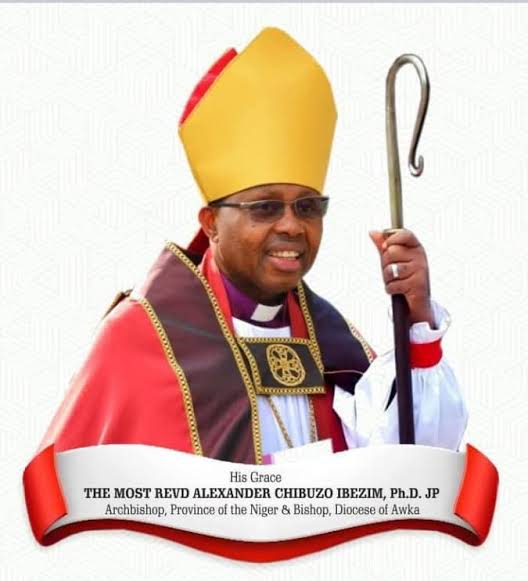
Primate appoints Bishop Ezeofor to oversee Awka Diocese, Province of the Niger amid investigation
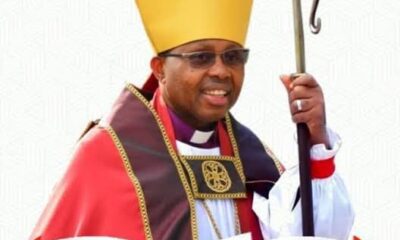
The Church of Nigeria (Anglican Communion) has directed the Archbishop of the Province of the Niger and Bishop of the Diocese of Awka, Most Rev. Alexander C. Ibezim, to proceed on six months’ leave with immediate effect amid investigations into allegations and recent developments within the diocese.
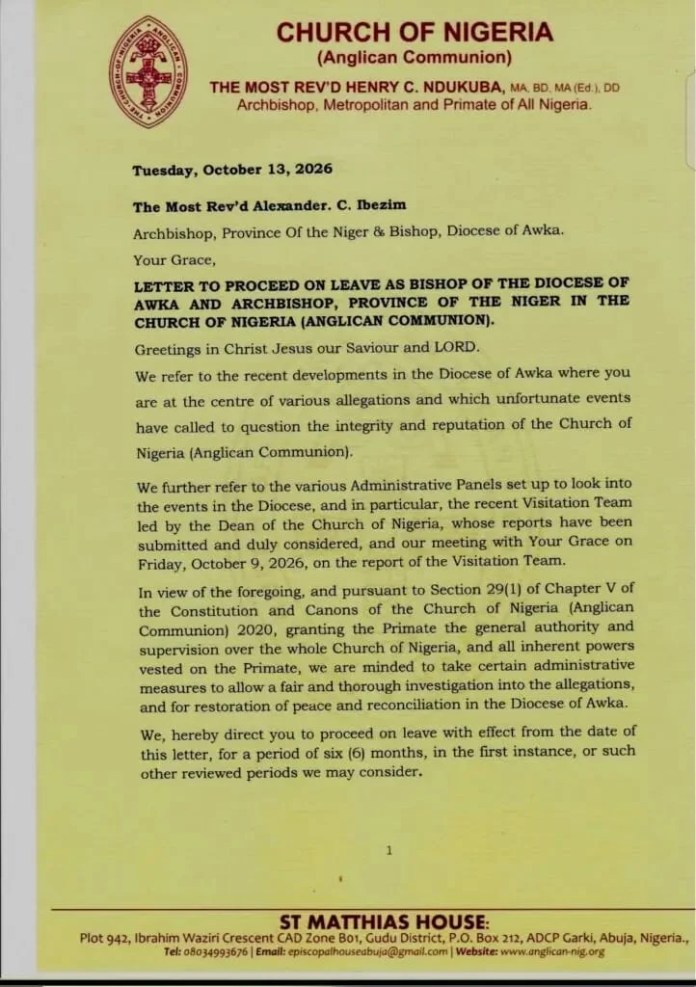
The Primate of the Church of Nigeria, Most Rev. Henry C. Ndukuba, announced the decision in a letter dated Tuesday, October 13, 2026, while appointing the Bishop of the Diocese of Aguata, Rt. Rev. Samuel Ezeofor, as Supervising Bishop of the Diocese of Awka and Coordinating Bishop of the Province of the Niger during Ibezim’s absence.
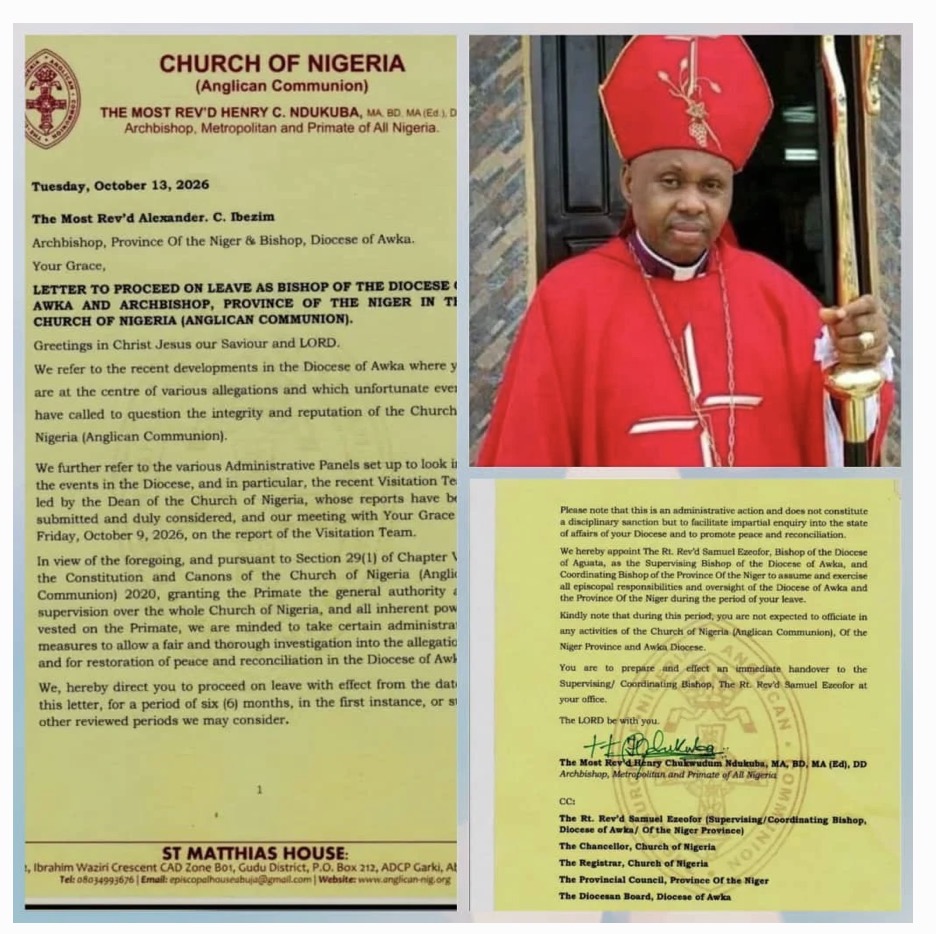
Screenshot
In the letter addressed to Ibezim, Ndukuba said the decision followed developments in the Diocese of Awka that had raised concerns about the integrity and reputation of the Church of Nigeria.
He referenced administrative investigations into the matter, particularly the report of a visitation team led by the Dean of the Church of Nigeria, which had been submitted and considered by the church leadership.
The Primate also cited a meeting with Ibezim on Friday, October 9, during which the visitation team’s report was discussed.
According to the letter, the directive was issued pursuant to Section 29(1) of Chapter V of the Constitution and Canons of the Church of Nigeria (Anglican Communion), 2020, which provides for the Primate’s general authority and supervisory powers over the church.
Ndukuba explained that the administrative measure was intended to facilitate a fair and thorough investigation, while creating an opportunity to restore peace and promote reconciliation within the Diocese of Awka.
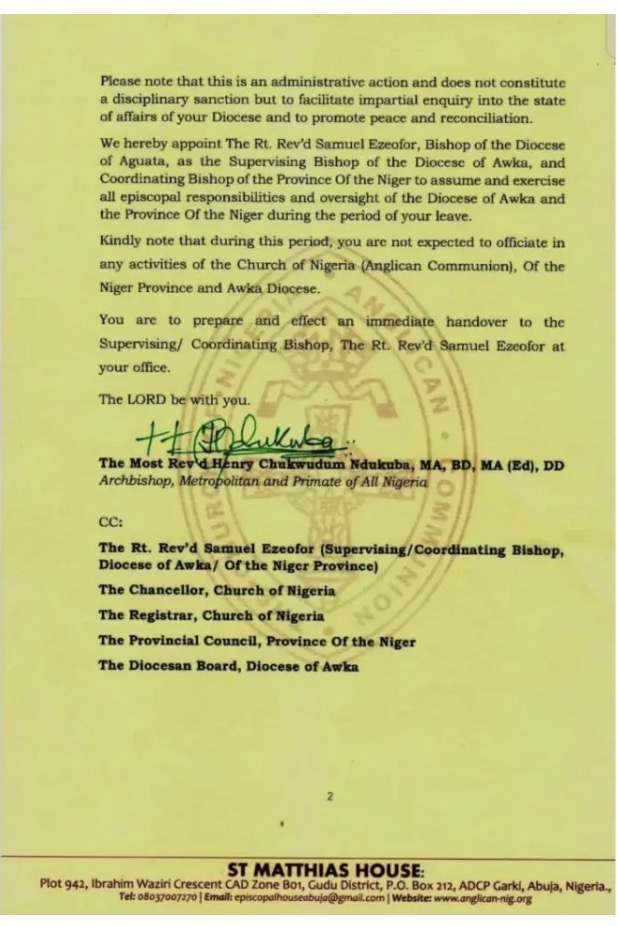
He stressed that the leave should not be interpreted as a disciplinary sanction but as an administrative arrangement designed to allow an impartial inquiry into the issues affecting the diocese.
The letter stated that the leave would last for an initial period of six months, subject to any revision the church leadership might consider necessary.
During this period, Ezeofor will assume episcopal responsibilities and oversee the affairs of both the Diocese of Awka and the Province of the Niger.
Ibezim was also directed not to officiate at any activities of the Church of Nigeria (Anglican Communion), the Province of the Niger or the Diocese of Awka throughout the period of his leave.
The Primate further instructed the archbishop to make immediate arrangements to hand over his responsibilities to Ezeofor at his office before departing.
Copies of the letter were sent to Ezeofor, the Chancellor and Registrar of the Church of Nigeria, the Provincial Council of the Province of the Niger and the Diocesan Board of the Diocese of Awka.
Background to the controversy
Although the letter did not disclose the specific allegations against Ibezim or provide details of the visitation team’s findings, reports have linked the controversy to allegations that the archbishop sold church lands valued at more than ₦2 billion without authorisation.
The allegation reportedly triggered a legal and ecclesiastical dispute, alongside speculation that the Economic and Financial Crimes Commission (EFCC) was seeking to arrest the archbishop.
The development followed a petition dated July 28 and submitted to the EFCC’s Enugu Zonal Directorate by Chief G. Tagbo (SAN) of Ike Ike Associates on behalf of Echezona Onuigbo, a member of St. Faith Cathedral, Awka.
However, an arrest was reportedly restrained by the Anambra State High Court sitting in Awka following an order granted by Justice F. I. Aniukwu in response to a motion ex parte dated September 4, 2025. The application was filed by Ibezim through his counsel, B. E. I. Nwofor (SAN).
The controversy also reportedly resulted in the removal of the Chancellor of the Diocese of Awka, Hon. Justice O. J. Okeke (retd.), by the archbishop.
The circumstances surrounding the allegations and the outcome of the church’s ongoing investigation remain unclear, as the Primate’s letter did not disclose the details of the findings or specify the allegations under investigation.
The six-month leave and the appointment of Ezeofor mark a significant administrative development in the leadership of the Diocese of Awka and the Province of the Niger as the church seeks to address the issues and restore stability.
The letter:
Screenshot
-
 Faith16 hours ago
BREAKING: Anglican Church Places Archbishop Ibezim on Six-Month Leave, Bars Him From Church Duties
-
News1 day ago
Senate fumes over death of NYSC Corps member at Enugu Camp, orders probe
-
News1 day ago
How Senator Mandiya died after bathroom fall in Abuja Home – Ningi
-
News2 days ago
2027: Why I wont attend every campaign rally – Tinubu
-
Features3 days ago
Aguleri/Umuoba Anam Crisis: The Bloody Battle Between Close Neighbours
-
News2 days ago
EFCC probes Atiku over alleged corruption committed as Vice President
-
Politics2 days ago
2027: I can bet my life Obi will humiliate Soludo in Anambra – Momodu
-
News3 days ago
‘Anyone who attempts suicide and fails will go to jail,’ says Akpabio