News
Gov Mbah presents record N971bn 2025 Budget to Enugu House of Assembly


…Crashes Recurrent further to 14% at N133.1bn
…Capital Expenditure rises to N837.9bn
…Again, Education gets over 33% of budget
… Ramps up IGR from N37.4bn to N144.7bn in 2024
…Assembly promises early passage
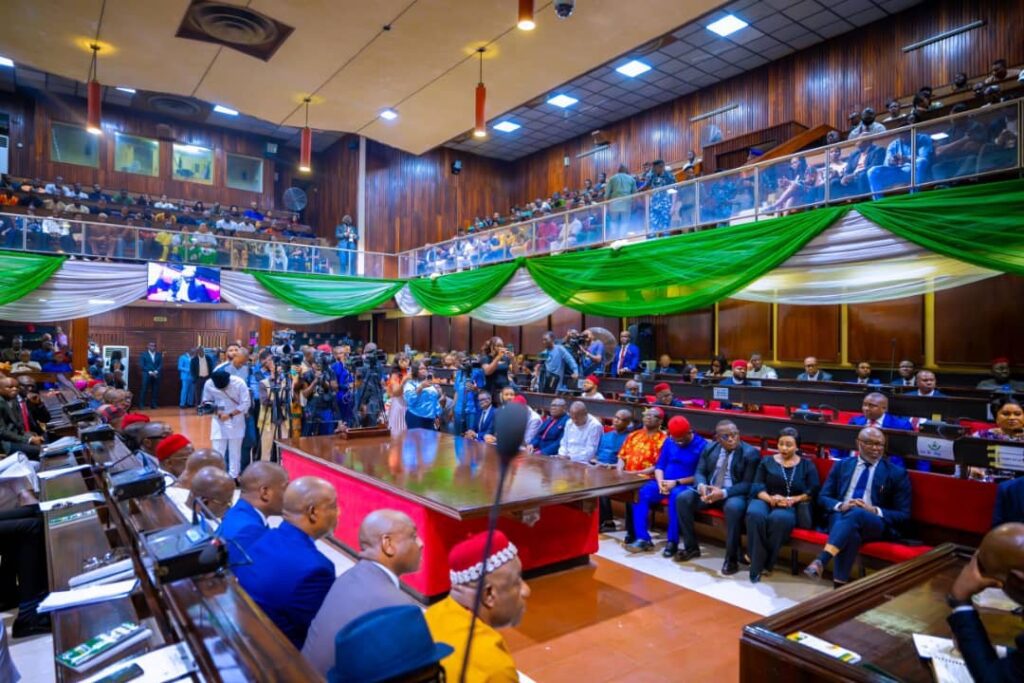
Governor of Enugu State, Dr. Peter Mbah, has proposed a record N971bn budget bill for the 2025 fiscal year to the Enugu State House of Assembly.
Presenting the estimates entitled “Budget of Exponential Growth and Inclusive Prosperity” at the floor of the House on Tuesday, Mbah said the proposed estimates comprised N837.9bn Capital Expenditure, representing 86 per cent of the budget estimates, and a Recurrent Expenditure component of N133.1bn, representing only14 per cent of the budget.

This topples the record-holding 2024 budget of N521.5bn, consisting of N414.3bn Capital Expenditure, representing 79 per cent of the total budget and N107.2bn Recurrent Expenditure, representing about 21 per cent.
However, like the 2024 budget, the 2025 budget proposal emphasizes huge investment in education as well as basic but critical infrastructure and amenities like roads and bridges, water supply, transport services, energy, modernization and digitization of public services and associated processes, with the Education sector getting a lion-share of N320.6bn, representing over 33 per cent of the total budget for two consecutive years.

Mbah said that this was in line with his administration target of poverty eradication and an inclusive development model, which ensures that no one or segment of the society is left behind.
The governor equally announced a growth in the state’s Internally Generated Revenue, IGR, from N37.4bn at the end of 2023 to N144.7bn in September 2024, representing a radical 286.2 per cent increase in line with the administration’s deliberate effort to wean the state off reliance on FAAC allocations.
Addressing the House, Mbah said, “In crafting this budget, we have sort to continue to lay the right foundation in Enugu to enhance the economy and attract even more private investment.
“In spite of the dreary economic environment across the country, for us here in Enugu, we have elected to remain bullish in our aspirations, and to double down on our commitment to elevate our state to top three status in terms of GDP nationally, and eradicate poverty from our midst.
“Indeed, we see this as a vindication of our previously espoused view that sustainable national growth can really only be driven from the sub-national units to the federal levels, and not the other way round as we have attempted to do to date.
“It is on account of this that we are proposing to the House of Assembly today, a budget with a total envelope of N971,084,000,000.00 as against the budget for 2024 fiscal year which totaled N521,561,386,000.00.
“This represents an 86.4 per cent increase from the 2024 revised budget.
“The budget is broken down as follows: N133,140,000,000.00 as Recurrent Expenditure and N837,944,000,000.00 as Capital Expenditure,” he said.
On sources of revenue, he said, “In the area of our revenues, we estimated that total Recurrent revenues during 2025 will amount to N692,179,000,000 as against the approved revised provision for 2024 of N383,789,000,000.00.
“The Recurrent revenues for 2025 are broken down as follows: opening balance – N32,000,000,000; Internally Generated Revenue, IGR – N509,947,000,000; statutory revenue – N48,749,000,000; exchange rate differential – N26,559,000,000; and Value Added Tax, VAT – N74,924,000,000.
“With the total Recurrent Expenditure at N133,140,000,000.00, this translates to a Net Recurrent Revenue of N559,039,000,000.00, which is thus transferred to the Capital Development Fund.
“The total Capital Expenditure for the year 2025 is projected at N837,944,000,000.00 as against N414,334,120,000.00 for the 2024 Revised Budget. The Current Capital Expenditure estimate will be funded from the sum of N559,039,000,000.00 to be transferred from the Consolidated Revenue Fund, and the Capital receipts of N278,905,000,000.00 to be realized as follows: External and Internal Aids and Grants – N15,000,000,000; other receipts – N80,202,000,000; Domestic Loans/Borrowings receipts – N55,000,000,000; and International Loans/Borrowings – N128,503,000,000.”
Meanwhile, in terms of broad sectors, the Economic Sector got a lion share of N462bn, representing 55.1 per cent of the Capital Expenditure, followed by the Social Sector with N345.7bn, representing 41.2 per cent.
In terms of specific sectors, Education got 33.2 per cent, the largest chunk, in sync with Mbah’s effort to eradicate poverty and graduate the state to a knowledge-based economy.
“As we must all know by now, Education is both our ‘sword’ and ‘shield’ in this battle to achieve economic growth in our state and banish poverty and want among our population. Consequently, we are maintaining the ambitious direction we charted in 2024 by voting a total of N320,609,059,000,00 for that sector. This represents 78% of the social sector of the budget and 33.2% of our Capital Expenditure this year,” he stated.
The governor explained that the 2025 budget would also focus greatly on health, road infrastructure, transport, agriculture, and water sectors, among others.
“There can be no economic growth without quality healthcare. This is why we are spending N45,830,896,000.00 on the sector this year.
“In the area of Works and Infrastructure, we will continue our relentless advance towards our target to build or refurbish all key roads across the state by 2031. In line with this, we will spend a total of N213,120,267,000.00 in 2025.
“Food inflation is a major component of core inflation in Nigeria. Consequently, food production is critical to moderation of the currently high levels of inflation in the Country. As a result, we will be spending up to N82,300,761,000.00 in the agricultural and agro-industrialisation sector this year.
In the area of Transport, we will be spending a total of N41,132,463,000.00 to expand Enugu Air with the acquisition of 4 additional aircraft. In addition, we will be consummating the concessioning of the Akanu Ibiam international airport as well as the construction of an international cargo terminal. We will also be floating a new taxi scheme in collaboration with the private sector to modernize urban and inter-urban transportation for Ndi Enugu.
2024 Budget Performance
Giving a breakdown of the state’s IGR and overall performance of the 2024 budget, the governor noted a remarkable increase in the state’s IGR since the inception of this administration, explaining that while the state’s IGR stood at N26.8bn in 2022, the administration it by 39 per cent to N37.4bn at the end of 2023.
However, as at September 2024, the state’s IGR had drastically increased to ₦144.7bn, representing a 286.2 per cent increase, expressing confidence that ti would surpass 200billion by the end of the year.
“In terms of budgetary performance, the total revenue realised in the state as at October 2024 came to N459,851,309,396.47, which comes to a budget performance of 88%. Of this amount, N178,354,494,502.47 related to Statutory Receipts, while N136,700,000,000.00 related to Capital Receipts and N144,796,814,894.00 to Internally Generated Revenue.
“As at October, these inflows had been applied to Expenditure with N382,427,929,564.00 as Capital Expenditure and N76,546,090,116.18 as Recurrent Expenditure. These translated to a budget performance of 88%. Additional revenues and Expenditure are still expected before the end of the year, with IGR envisaged to surpass the N200 billion mark.
“While we may make bold to say that our progress in this past year is commendable given the odds that were arraigned against the state economy, we are not yet ready to rest on our oars,” Mbah said.
Meanwhile, the Speaker of the State Assembly, Hon. Uchenna Ugwu, has promised early passage of the budget by the House to sustain the governor’s development strides.
“He exhibited his leadership mantra, tomorrow is here.
“Because you have demonstrated enormous capacity; because you have exhibited enormous potential of the very fabric of our state’s economy, I want to assure you that the House of Assembly shall expeditiously consider this and give you the legal framework to continue flying high,” Hon. Ugwu stated.









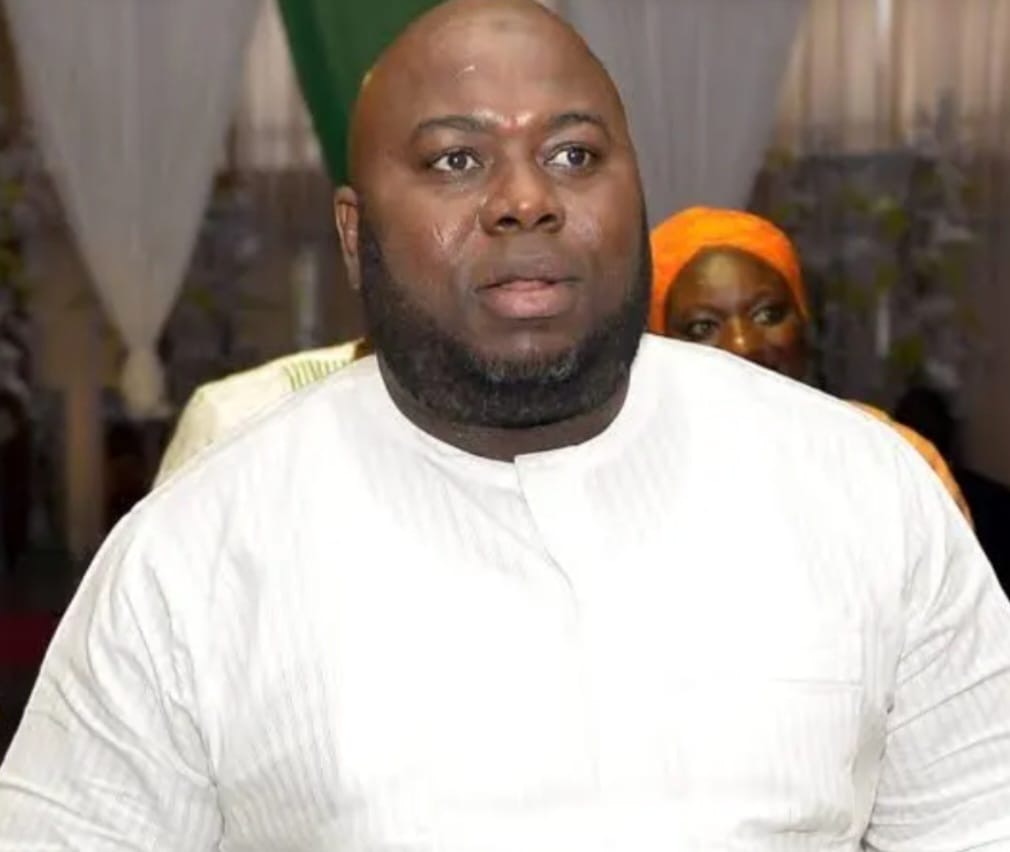
By Sufuyan Ojeifo
There is something deeply troubling about the latest public outburst by Asari Dokubo.
It has little to do with the legitimate demand that public contracts face scrutiny. Men like Tompolo are not beyond criticism, nor should they be. The real concern lies in the peculiar logic with which Dokubo has chosen to defend one figure while attacking others.
In a video now circulating widely, Dokubo alleges that the Olu of Warri and Dr Osahon Okunbo collect ₦2.7 trillion annually for pipeline surveillance. He then introduces ethnicity into the argument, suggesting that the two escape scrutiny because they are “Benin” and “Itsekiri”, while Tompolo is being singled out.
The question that follows is simple: where is the evidence?
Dokubo has produced no contract, no payment record and no documentary proof of any kind to substantiate this extraordinary claim. The Olu of Warri’s representative has publicly challenged him to produce the evidence.
A figure of ₦2.7 trillion is not a sum one casually introduces into national discourse and expects responsible citizens to accept on the strength of a speaker’s word alone.
If Dokubo has the documents, let him publish them. If he has the contract, let him display it. If he has evidence of payment, let him present it.
That is how serious allegations are made.
In the absence of such proof, what remains is an allegation dressed up as fact.
There is a more troubling dimension to the argument.
Dokubo appears to suggest that because pipeline surveillance occurs in the Niger Delta, contracts associated with it are somehow the proprietary entitlement of Niger Delta actors. That proposition should concern every Nigerian.
The Niger Delta belongs to Nigeria. Its oil belongs to Nigeria. The pipelines are national infrastructure. Contracts for protecting them are matters of public procurement, public accountability and national security.
They are not tribal dividends.
If a company from Rivers State is competent, let it compete. If a company from Delta State is competent, let it compete. If a firm from Edo, Abia, Lagos, Kano or Kaduna possesses the expertise, resources and capacity and wins a properly awarded contract, that should be welcomed as evidence that Nigeria remains a country rather than a collection of ethnic fiefdoms.
The idea that a contract is somehow “Niger Delta money” until someone from elsewhere secures it, at which point it becomes private enrichment, is a dangerous distortion of federalism.
It is precisely the kind of thinking that has kept Nigeria trapped in the politics of ethnic entitlement.
Perhaps the most unfortunate aspect of the intervention is the attempt to drag the Olu of Warri into a commercial argument in which the monarch has not been shown to be the contractor alleged.
The Olu of Warri, Ogiame Atuwatse III, is married to Olori Atuwatse III, daughter of the late Captain Hosa Okunbo. Osahon Okunbo is Captain Hosa’s son. The family connection is a matter of public record.
But marriage does not turn a traditional ruler into a commercial contractor.
Being someone’s son does not make a businessman guilty of whatever detractors choose to allege against him.
That distinction is elementary.
Osahon Okunbo currently serves as Executive Director of Pipeline Infrastructure Nigeria Limited. Publicly available information indicates that PINL has been involved in pipeline infrastructure and surveillance activities, including the deployment of camps, vessels, drones and other assets along pipeline corridors.
That work should be scrutinised, as should every naira of public money and the performance of every contractor. But scrutiny is not the same as slander. An allegation is not evidence.
There is another question Dokubo should answer: If the real concern is the cost and effectiveness of pipeline surveillance, why does the argument repeatedly return to the ethnic identity of those involved?
Why does “Benin” matter?
Why does “Itsekiri” matter?
Why does “Ijaw” matter?
The only questions that should matter to the Nigerian taxpayer are straightforward: who received the contract, under what terms, for what amount, to perform what work, and what did the country receive in return?
That is the conversation worth having.
If a contract is inflated, expose it.
If a contractor has failed, expose the failure.
If public funds have been misused, let the appropriate agencies investigate and prosecute.
If procurement rules have been breached, pursue the evidence. But if all that exists is a video, an allegation and a theory about ethnicity, then one has not established corruption. One has established noise.
There is also something deeply distasteful about dragging a dead man into this quarrel.
Captain Hosa Okunbo died in August 2021. He cannot answer for himself, produce a document or challenge an allegation. That places an additional responsibility on those who invoke his name.
Captain Hosa was a businessman whose interests spanned maritime, transportation, logistics, agriculture, hospitality and security. At his death, tributes from across Nigeria recognised both his commercial achievements and his philanthropy.
His son has chosen to continue in business. His daughter is married to the Olu of Warri.
Neither fact constitutes evidence of wrongdoing. Neither fact grants anyone the right to convert family relationships into an ethnic conspiracy.
There is, finally, a curious irony in Dokubo’s intervention.
A man presenting himself as an advocate of the Niger Delta should be particularly careful about reducing the region’s legitimate grievances to a crude contest over who gets what contract.
The Niger Delta’s historical grievances are real. Environmental degradation is real. The failures of successive governments are real. The region’s demand for justice, development and a greater stake in the management of its resources is legitimate.
But those grievances are diminished, not strengthened, when they are converted into a doctrine that says public opportunity belongs first to one ethnic constituency and everyone else is an interloper.
That is not justice.
It is simply another form of entitlement.
Dokubo is entitled to question government contracts. He is entitled to criticise Tompolo’s critics. He is entitled to demand greater participation by Niger Delta businesses. He is even entitled to argue that pipeline surveillance should be organised differently.
What he is not entitled to do is manufacture certainty where there is no evidence and then dress the allegation in ethnic colours.
That is not agitation.
That is recklessness.
Nigeria has suffered enough from those who mistake volume for evidence, anger for courage and ethnic mobilisation for patriotism.
If Asari Dokubo possesses evidence that the Olu of Warri or Osahon Okunbo received ₦2.7 trillion annually for pipeline surveillance, he should produce it.
*Watch the Asari Dokubo video posted on Facebook via the link below:*
_*https://www.facebook.com/share/v/1FJbNd2Gf2/?mibextid=wwXIfr_*
Let the documents speak.
Let the contracts speak.
Let the auditors speak.
Let the law speak.
But if he cannot produce the evidence, the responsible course is to withdraw the allegation.
In a country already strained by suspicion, insecurity and ethnic distrust, there are some accusations a responsible man should not make without proof.
This is one of them.
■ Sufuyan Ojeifo, is a journalist and publisher.
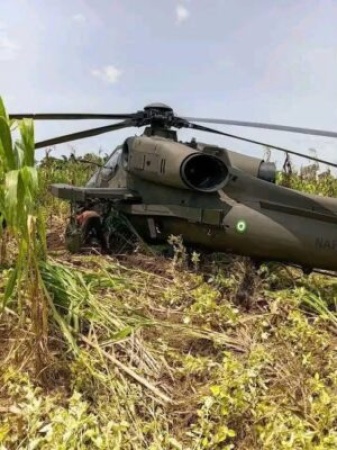
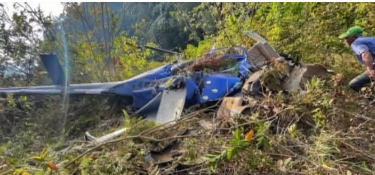
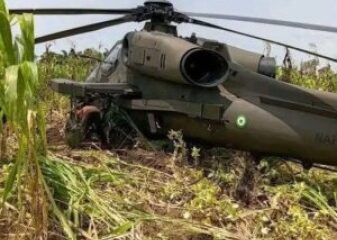
Just two days after the Nigerian Air Force lost 25 personnel in the tragic Ondo aircraft crash, another NAF helicopter on Wednesday made an emergency landing on a farmland in Makurdi, Benue State.
The incident occurred at Utur Tse-Igboji, Bar Council Ward, along the Welfare Quarters–Mopol 13 Ring Road.
According to eyewitness Stephen Ikpam, the helicopter reportedly developed a technical fault, forcing the crew to make an emergency landing.
Residents rushed to the scene to assist the officers on board.
All those on board reportedly survived and came out safely.
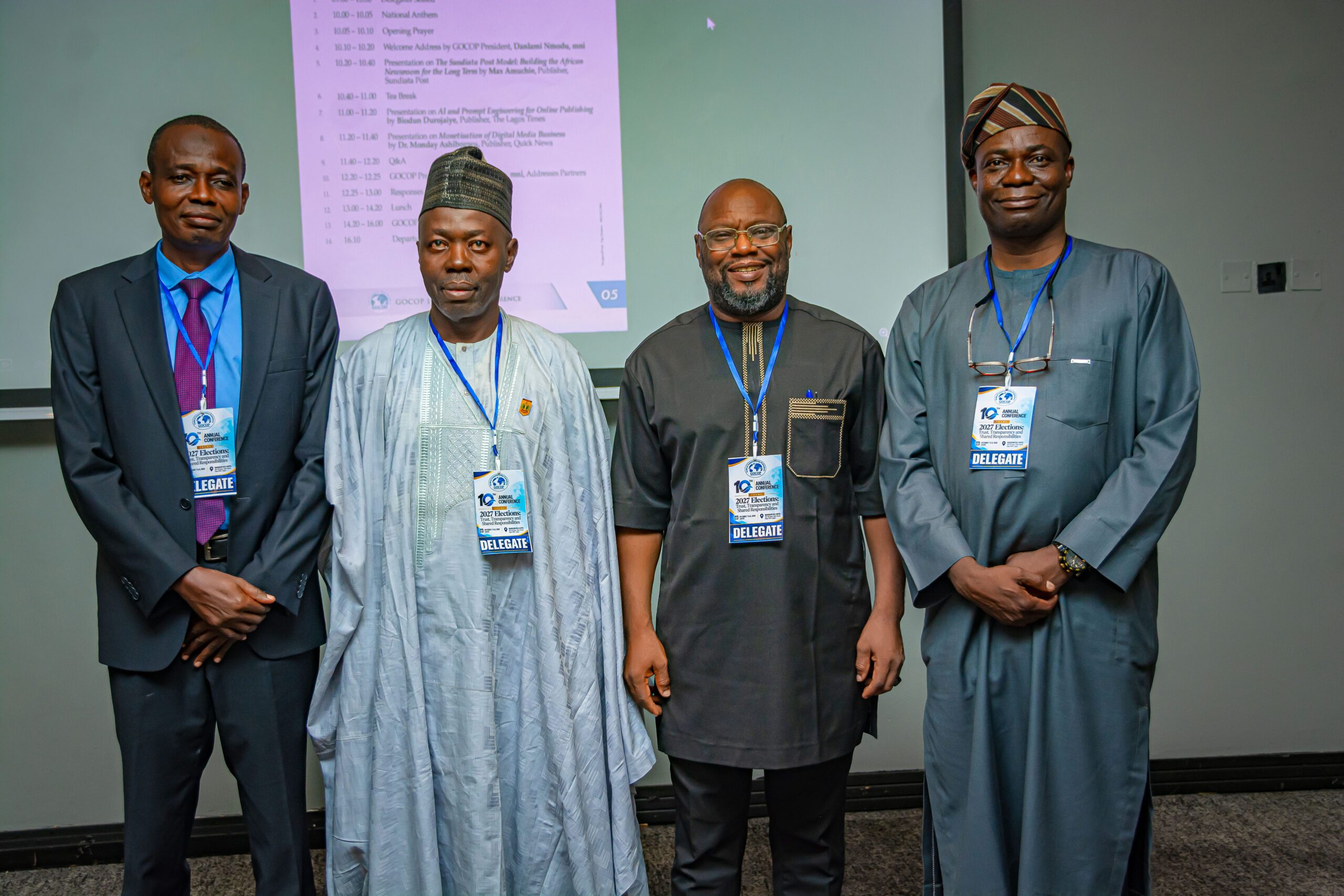
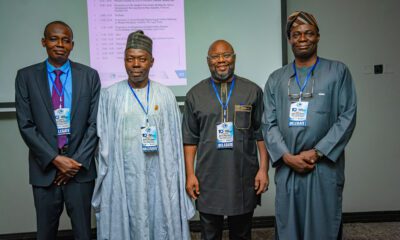
The Guild of Corporate Online Publishers (GOCOP) has organised a training session for its members on effectively deploying Artificial Intelligence (AI) tools as part of measures to help them publish faster, better, and more professionally to increase profitability.
The training comes on the sidelines of the Guild’s 10th Annual Conference, holding October 8-9, 2026, at the Radisson Blu Hotel, GRA, Ikeja, Lagos, with the theme: “2027 Elections: Trust, Transparency and Shared Responsibilities”.
The training session, which was anchored by an AI expert and publisher of The Lagos Times, Sulaimon Durojaiye with the title: “The AI-Powered Newsroom: AI & Prompt Engineering for Online Publishing”, explored how participants can publish faster, better and more profitably in the age of AI.
Durojaiye defined AI as technology that enables computers to perform tasks that normally require human intelligence.
While observing that publishing has changed over time from its yesteryear structure of the newsroom-newspaper-reader, he noted that AI understand language, recognises patterns, analyses information, generates content, solves problems, makes predictions, assists decision-making, insisting that one does not need to be a programmer to use AI.
He listed three AI terms every publisher should know, comprising Generative AI, which creates text, images, audio, video and code.
He also listed Large Language Models, which are systems trained on enormous amounts of information that understand and generate human language, such as ChatGPT, Gemini, Claude and Copilot.
He also noted that AI is not Google Search Engine, as it finds information for the user, returns links and sources, while you investigate and decide.
According to him, generative AI works with information, creates, transforms and analyses, but could be wrong many a time, a development that makes it incumbent on the user to verify every piece of information sourced from AI so as not to run into trouble.
He also took participants through the rudiments of what he described as ‘Enter Prompt Engineering’, which is the art and science of giving AI clear instructions to produce useful results.
He differentiated a Bad Prompt, which might involve a prompt like write a story about the budget, and a Better Prompt, which might just be like asking the AI to act as a senior Nigerian newspaper correspondent, who might be required to analyse the supplied budget speech, write a 600-word news story, lead with the most significant development in the budget speech, using the inverted pyramid format in news writing.
He further listed the Five-Part Prompt Formula comprising: Role, Task, Context, Requirements and Output, warning that better instructions would produce better results and vice versa.
On the AI Newsroom, he told participants that AI can be deployed for both news gathering and research, as it can analyse long speeches and reports, summarise government documents, extract key facts, compare documents, generate interview questions and also identify story angles.
Other newsroom and research capabilities of the AI include its ability to analyse datasets, research background information, convert complex materials into plain English and help to investigate, but it is warned that it does not replace investigation itself.
Other uses of the AI listed include its ability to assist across the publishing workflow comprising news gathering, research interviews, transcription, writing, editing and SEO social newsletter analytics, noting that it is not just one tool, but rather an entire workflow.
According to him, with the use of AI, one news event can become multiple content products. including news stories, features and explainers, profiles and interviews, opinion drafts, headlines and captions, newsletters, press-release transformation, adding that while AI accelerates production, the journalist remains responsible for facts, context and news judgement.
Durojaiye also disclosed that AI could be used for SEO, which underscores the fact that one does not just need to publish, but to get found, noting that it could be used for search-friendly headlines, SEO titles and meta descriptions, keywords and search intent, FAQs, content structures, internal-link suggestions and content clusters
“The story isn’t finished when you publish it. It is finished when the right audience can find it”, he said.
-
 Editorial1 day ago
Nigeria’s Roads: Where a Driver’s Licence May Not Mean a Driver Can Drive
-
News2 days ago
Nigerian Air Force releases names of passengers on board crashed Aircraft in Ondo
-
News3 days ago
Bandits allegedly kidnap 18 Oyo students, kill driver
-
News2 days ago
“Stop chasing shadows” – Obi’s camp fires back at Soludo over anti-Obi campaign
-
News19 hours ago
Over 1,000 Islamic clerics ask Tinubu to drop 2027 re-election bid
-
News2 days ago
Ralph Obioha, Ex-NADECO founding member, dies at 80
-
Features19 hours ago
TWENTY YEARS IN MEMORY: MARIA UKAMAKA IFEOMA OJUKWU
-
News2 days ago
90-year-old father of ADC Edo South candidate abducted