News
Economic hardship: We are dying of hunger – Kogi beggars cry out


Beggars on the streets of Lokoja, the Kogi State capital, have cried out over the declining rate of assistance from members of the public.
The beggars described their condition of living as “terrible” and unbearable.

Speaking at the popular old market in Lokoja, a beggar, who identified himself as Mallam Abubakar Alli, expressed concern that he and his colleagues in the alms business no longer made enough money to feed.
Alli said: ”Few years back, I could boast of making N1,500 to N2,000 a day from begging, but for the past one year or so, I hardly make up to half of that amount.”
Another beggar, Mohammed Adamu, who noted that he lost his sight many years ago, said he has been finding it very difficult to cope with life due to diminishing earnings from begging.

“We cannot engage in meaningful physical work that can bring money to our pocket.
“As persons with disabilities, we depend solely on other members of the society.
“What they keep on telling us is that they are also feeling the negative impact of the bad economy. We are dying of hunger. Where do we go from here?” He asked.
The beggars called on the State and the Federal Government to find meaningful solutions to the current social and economic challenges facing the country.
DAILY POST reports that the cost of living in Kogi State, especially Lokoja, is very high.
For instance, garri, a staple food hitherto regarded as the common man’s food, has gone beyond purchasing capacity, with a measure of it skyrocketing from N500 to N2,200.
A market survey conducted by the newspaper in Lokoja revealed that prices of rice, beans, noodles, semovita, meat, tomato, pepper, onion, maize, corn, fruits, groundnut oil, red oil, among others have hit the roof top.
This is coupled with the high cost of transportation and other social services due to the removal of fuel subsidy by the President Bola Ahmed Tinubu-led Federal Government in 2023.



News
Court Orders Interior Minister Tunji-Ojo to Respond to Suit Seeking Release of His NYSC Records
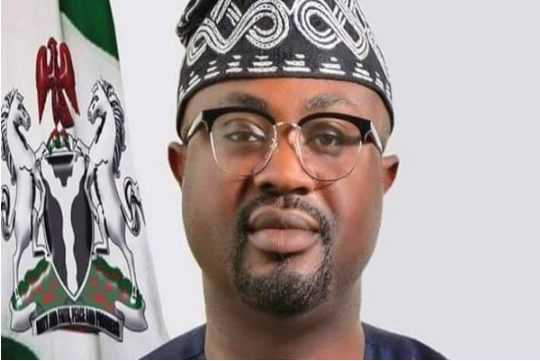
The Federal High Court in Abuja on Monday ordered the Minister of Interior, Olubunmi Tunji-Ojo, to respond to a suit seeking to compel the release of records of his National Youth Service Corps (NYSC) scheme.
Justice Salim Ibrahim gave the order when the matter came up for hearing.
The Incorporated Trustees of Pathway to Equity and Charity Foundation had filed the suit, marked FHC/ABJ/CS/1812/2026.
The group prayed the court to compel the NYSC to disclose documents supporting the minister’s claim that he completed the mandatory one-year national service.
The foundation also sought an order of mandamus directing the Federal Capital Territory Administration (FCTA), the 2nd respondent, to produce records showing that the minister did his primary assignment at the FCTA.
When the case was called, counsel to the applicant, Chief Solomon Akuma, SAN, told the court he was ready to proceed with the hearing.
However, Abiola Olaniji, who appeared for the minister, said he had filed an application for Tunji-Ojo to be joined as the 3rd respondent.
Olaniji said the applicant (foundation) had responded with a counter affidavit raising serious issues, to which he needed time to reply.
The lawyer stated that the minister was ready to take part in the proceedings as an interested party.
But Akuma opposed the application, arguing that the minister was not a proper party.
He said the suit only sought an order of mandamus compelling the respondents (NYSC and FCTA) to produce documents that are not in the minister’s custody.
Justice Ibrahim directed the minister to file and serve his reply to the applicant’s counter affidavit, which opposed his application to be joined as a party in the suit before the next hearing date.
The judge then adjourned the matter until Oct. 18 for hearing.
The applicant had sought from the NYSC the mobilisation or call-up letter issued to Tunji-Ojo in 2006 or any other year; the posting letter to the FCTA in 2006 or any other year; and his application for mobilisation.
It also sought the evidence of approval of his remobilisation by the NYSC’s Director-General; evidence of payment of allowances to him; the record of his Community Development Service and his discharge certificate.
The foundation equally sought from the FCTA, the mobilisation or call-up letter, the posting letter, his attendance record during the service year, evidence of any allowance paid to him, among others.
It said the application was brought under Section 14 of the Federal High Court Act, Order 34 Rules 1, 2 and 5 of the Federal High Court (Civil Procedure) Rules 2019.
It also cited Sections 20, 21 and 25 of the Freedom of Information (FOI) Act, 2011.
(NAN)

The presidential candidate of the Nigeria Democratic Congress, Peter Obi, has advised Nigerians residing in the United Kingdom to stop sending money to people who seek financial help at home.
Obi also advised them to urge their relatives to vote for productive leaders.
He made the remarks at a town hall meeting with diaspora supporters in Manchester, United Kingdom, on Sunday.
He stressed that Nigeria’s prevailing economic hardship resulted from bad leadership, arguing that continuous financial assistance only cushions the effects of poor governance without addressing the root causes.
“You have people at home in Nigeria today who are begging you for money. Tell them no!” he said.
The former Anambra State governor insisted that his record in public office distinguished him from other governors, claiming none of them matched his achievements in saving public funds.
“I’m not saying I’m a saint, but I saved money. I’ve not seen one governor who has saved 10 per cent of what I saved. No governor has done it.
“Let’s start with this one that is less corrupt. That’s how other countries change.”
He maintained that his conversations with the people reinforced the need for collective responsibility, stressing that building a new Nigeria would require citizens to take an active role in addressing challenges facing the country.
Obi also urged Nigerians to take the 2027 election seriously, describing the contest as a critical moment for the nation.
Contrary to false and misleading reports on social media that a Federal High Court (FHC) sitting in Abuja had nullified the N150 million fee prescribed by the Enugu State Structures for Signage and Advertisement Agency (ENSSAA) for political campaign billboards, findings have revealed that the court actually ruled in favour of the agency, upholding its powers to prescribe the fee.
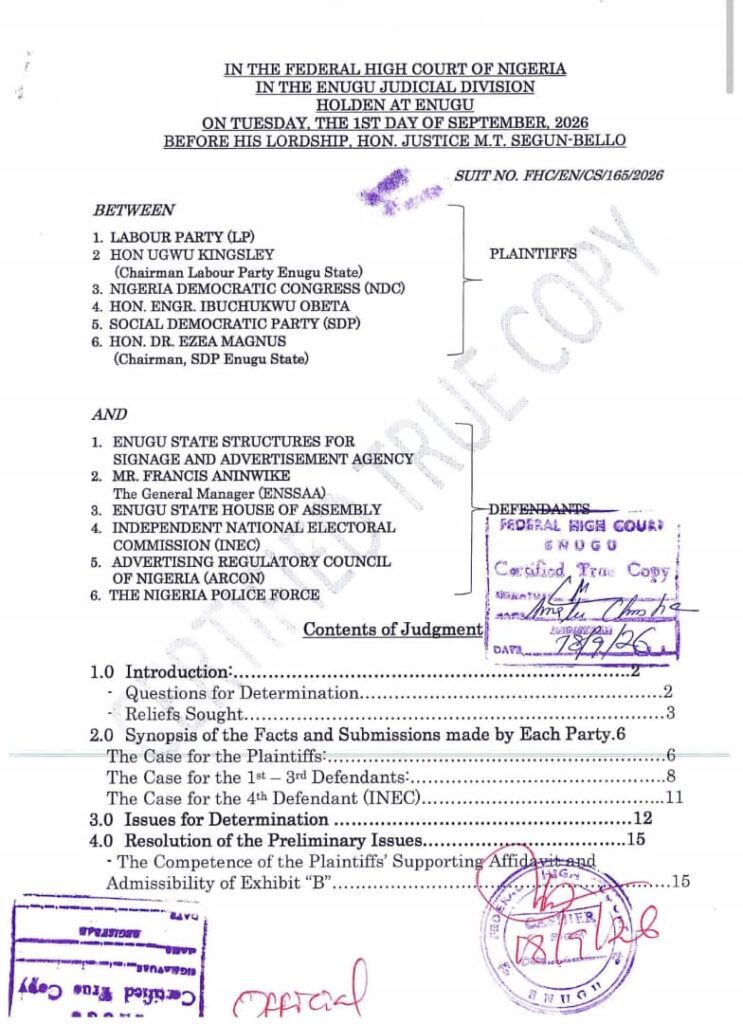
According to a certified true copy (CTC) of a judgment of FHC sitting in Enugu, the court had on September 1, 2026, dismissed a suit by opposition parties and figures challenging ENSSAA’s authority to impose a mandatory N150 million fee on each political party seeking to erect campaign billboards or display posters ahead of the 2027 general election.
The judgment rendered by Justice Mabel Segun-Bello held that it was within the legislative competence of the Enugu State House of Assembly to make laws on outdoor advertising and for ENSSAA to exercise powers donated to it by state law.
The suit marked FHC/EN/CS/165/2026 had the Labour Party; Chairman of the Labour Party (LP) in Enugu, Hon. Kingsley Ugwu; Nigeria Democratic Congress (NDC); NDC factional state Chairman, Engr. Ibuchukwu Obetta; the Social Democratic Party (SDP) and its state Chairman, Hon. Magnus Ezea, as plaintiffs, while ENSSAA; its General Manager, Mr. Francis Aninwike; the Enugu State House of Assembly; Independent National Electoral Commission (INEC); Advertising Regulatory Council of Nigeria (ARCON); and Nigeria Police Force were the respondents or defendants.
The plaintiffs had in June 2026 approached the court seeking a declaration that, by virtue of Sections 99 (1) and (2) of the Electoral Act, 2026, and Section 153 of the 1999 Constitution, which donated exclusive powers to INEC to regulate electoral campaigns of political parties in Nigeria, it was ultra vires the powers of ENSSAA and its General Manager to make executive decisions and publications imposing a mandatory payment of N150 million by political parties and their candidates in the state as an advertisement permit fee for the placement of billboards for the council election and the 2027 election.
They equally sought a declaration by the court that it was unlawful and ultra vires the legislative powers of the Enugu State House of Assembly to make laws regulating the advertisement of political campaigns in the state.
Consequently, the plaintiffs sought an order of the court setting aside the mandatory N150 million fee, as well as an injunction restraining the agency and its GM, the Enugu State Government, its agents and representatives from enforcing ENSSAA’s executive directive.
They finally sought an order of the court mandating the Nigeria Police Force to protect political parties in Enugu State against possible harassment for the placement of billboards and posters for the council election and the 2027 elections.
However, delivering her judgment in September, after a careful consideration of the totality of the affidavit evidence, the exhibits, and submissions by both parties, the presiding judge, Justice Mabel Segun-Bello, held, among other things, that the National Assembly does not hold exclusive legislative powers over outdoor advertising.
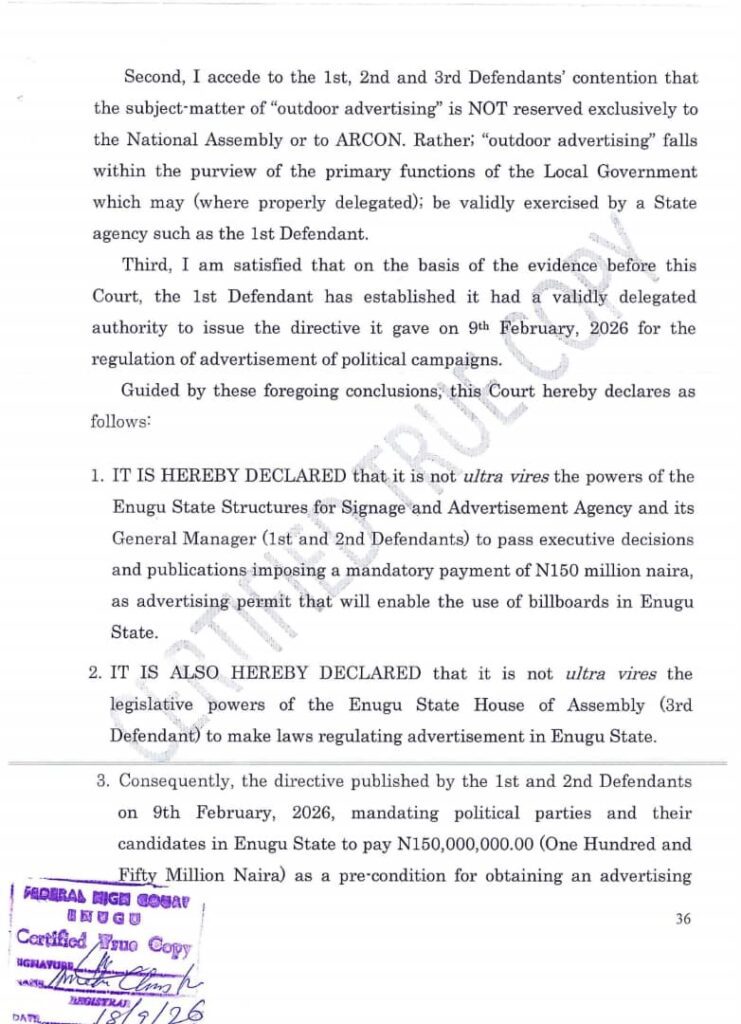
“I accede to the 1st, 2nd and 3rd Defendants’ contention that the subject matter of ‘outdoor advertising’ is NOT reserved exclusively to the National Assembly or to ARCON.
“Rather, ‘outdoor advertising’ falls within the purview of the primary functions of the Local Government, which may (where properly delegated) be validly exercised by a State agency such as the 1st Defendant (ENSSAA).
“Third, I am satisfied that on the basis of the evidence before this Court, the 1st Defendant has established it had a validly delegated authority to issue the directive it gave on 9th February, 2026, for the regulation of advertisement of political campaigns,” she stated.
Guided by these foregoing conclusions, Justice Segun-Bello held that “it is not ultra vires the powers of the Enugu State Structures for Signage and Advertisement Agency and its General Manager (1st and 2nd Defendants) to pass executive decisions and publications imposing a mandatory payment of N150 million naira, as advertising permit that will enable the use of billboards in Enugu State.”
Continuing, she said, “It is also hereby declared that it is not ultra vires the legislative powers of the Enugu State House of Assembly (3rd Defendant) to make laws regulating advertisement in Enugu State.
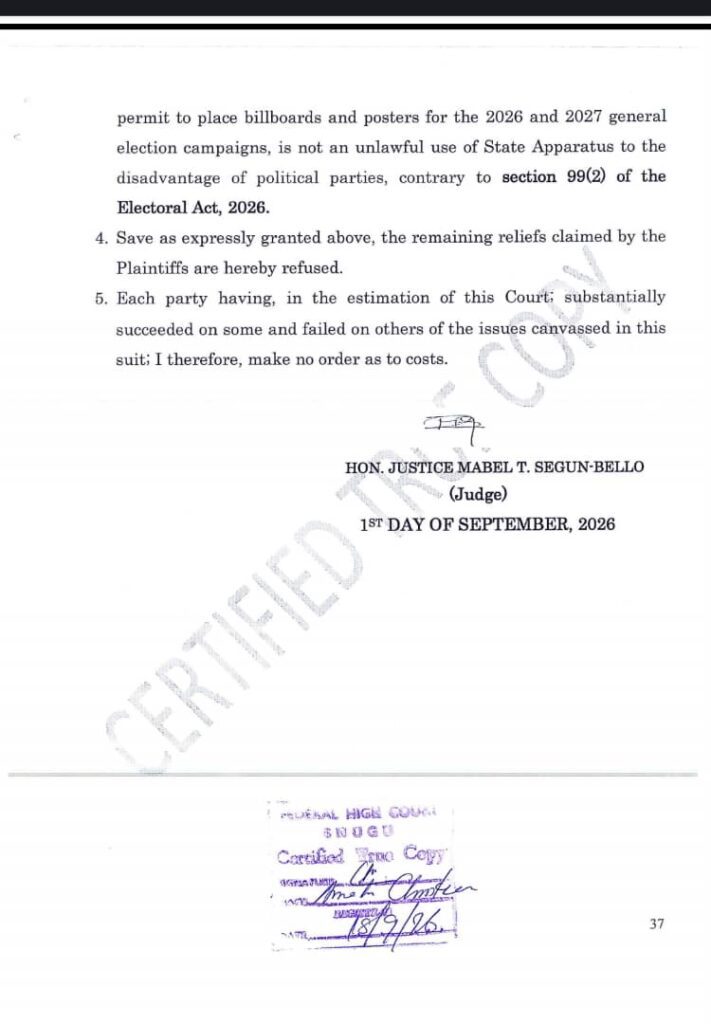
“Consequently, the directive published by the 1st and 2nd Defendants on 9th February, 2026, mandating political parties and their candidates in Enugu State to pay N150,000,000.00 (One Hundred and Fifty Million Naira) as a pre-condition for obtaining an advertising permit to place billboards and posters for the 2026 and 2027 general election campaigns, is not an unlawful use of State Apparatus to the disadvantage of political parties, contrary to Section 99(2) of the Electoral Act, 2026.
“Save as expressly granted above, the remaining reliefs claimed by the Plaintiffs are hereby refused.”
Meanwhile, the Enugu State Government says that unlike the practice in most states, the N150 million fee is for each political party, not for candidates, as misrepresented on social media and by some commentators.
The Secretary to the State Government, Prof. Chidiebere Onyia, made the clarification recently while fielding questions from Government House correspondents in Enugu, adding that there was no court judgment on the fee by any FHC in Abuja, as falsely circulated.
In a related development, finding show that the Abia State Structures for Signage and Advertising Agency (ABSSAA) prescribed feea for candidates ranging from N20 million for State House of Assembly candidates to N200 million for presidential candidates.
Imo State fees range from N3.55 million for each House of Representatives candidate to N55 million for each governorship candidate, while the permit fees range from N300,000 for local council candidates to N150 million for presidential candidates.
The campaign permit fee ranges from N100,000 for each councillorship candidate to N50 million for each presidential candidate, while Kwara State fixed its fees at N2 million for each House of Assembly candidate and N100 million for presidential candidates.
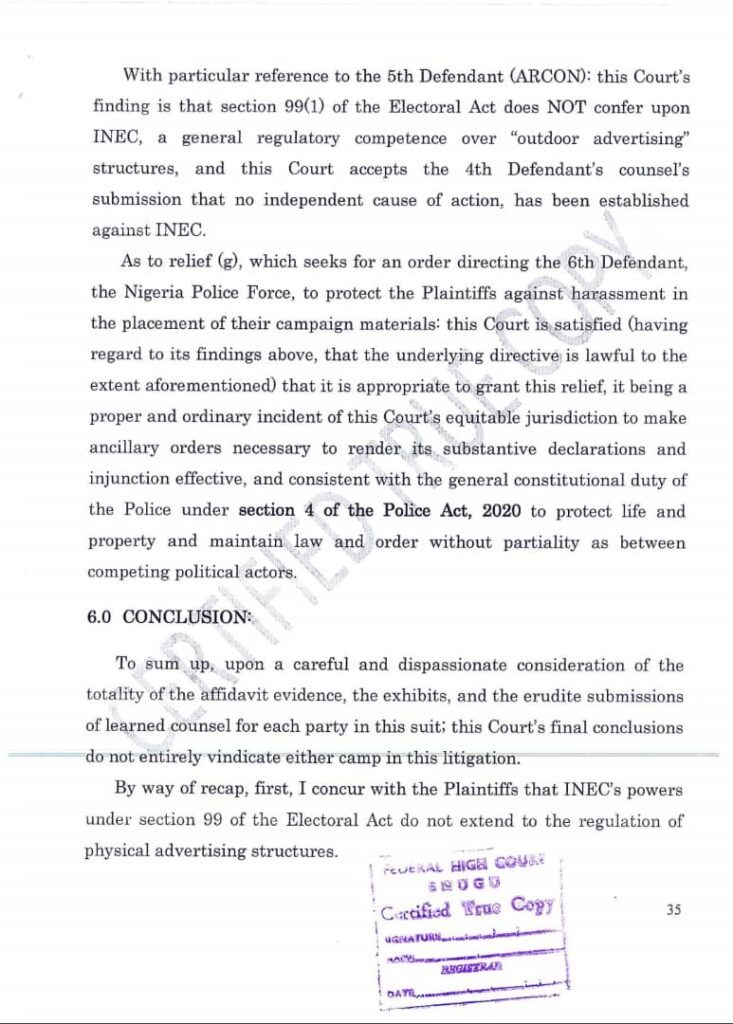
The Certified True Copy of the Court Judgement :
-
 News1 day ago
JUST IN: Former Delta Governor, Uduaghan, dies
-
Faith2 days ago
Awka Anglican Diocese Rejects Ibezim’s Suspension, Threatens to Leave Church of Nigeria
-
News3 days ago
BREAKING: Mbah Extends Enugu Movement Restriction to 10pm, Scraps Keke Ticketing
-
Politics2 days ago
Nigeria’s Weak Opposition and the Cost of One-Party Dominance: Can the Opposition Rebuild Before 2027?
-
News3 days ago
2027: Keke Riders Endorse Mbah, Tinubu
-
News1 day ago
Federal High Court Upholds ENSSAA’s N150m Political Campaign Billboard Fee, CTC Reveals
-
News2 days ago
Corruption turning Nigerian Courts to ‘market stalls’ — Retired Justice Augie
-
Politics1 day ago
AA Assembly Candidate, Ugbaje Friday, Unveils Development Agenda for Ibaji