Connect with us
Maduka University Advert

Education

IMT must reclaim its past glory, Gov. Mbah vows as Panel of Inquiry submits report

Published

on

Spread the love

Governor of Enugu State, Dr. Peter Mbah, has reiterated the determination of his administration to return the Institute of Management and Technology (IMT), Enugu to its past glory.

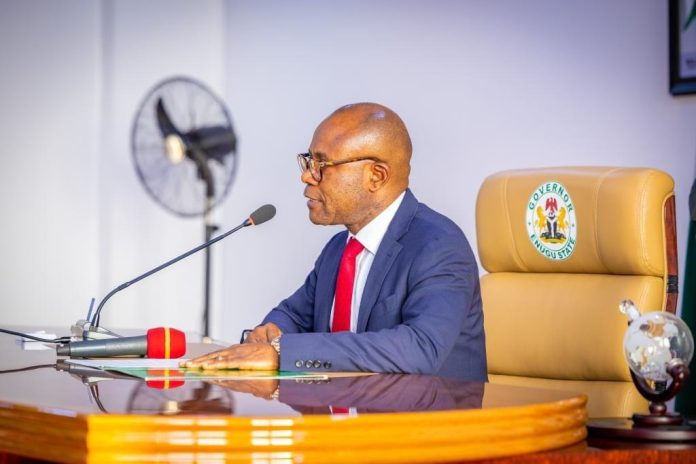
Mbah stated this at the Government House, Enugu, while receiving the report of the Committee of Inquiry into the Accounts, Management Practices and Staff Conduct in the institute, which the government set up in August.

The Governor was represented by the Secretary to the State Government, Prof. Chidiebere Onyia, who said the report of the Committee would serve as one of the pillars for the planned reforms in the institution and across all levels of education in the state.

“It is important to state that the essence of this Committee was initially misconstrued, but His Excellency was very clear on what he wants to see in the education sector and it ranges from what happens at the elementary all the way to the tertiary levels.

“This is the first of many processes like this, to make sure that the IMT, which is also a historical institute of excellence, is restored to its glory. But we do not want to speak to the issues subjectively. That was why this Committee was set up to provide guidance for the government to start the process of reform using the empirical data.

“What we want is for IMT to return to its old glory both from the governance point of view and also from the selection point of view and the quality of faculty that is there.

Maduka College Advert

“Faculty quality is very important so that the graduating students are able to meet the level of performance to be competitive locally and globally.

“The IMT was set up with the level of the Massachusetts Institute of Technology (MIT) in the US. So, the fact that we have retrogressed over the years should be a thing of concern to every citizen of Enugu State and every parent that hopes that his or her child passes through IMT as a higher institution of education.

“So, I am very happy that you did not just submit a report, but you also submitted a report with evidence to back up every assertion made here. I have not read this report, but I am confident that for you to have brought this report and also brought a pile of evidence to back up every thing that you have said, allows us to verify some of the things here before we start to implement them.

“The governor is determined that as we begin to work on IMT, to change the governance process and address some of the key recommendations here, this report becomes a guidance to other higher institutions in Enugu State”.

Meanwhile, speaking at the event, Chairman of the Committee, Prof. Edd Nwobodo, thanked the Dr. Peter Mbah administration for the steps taken and for finding them worthy to carry out the job.

Also throwing more light on their work after the presentation, Prof. Nwobodo told newsmen that the Committee’s work was essentially centred on pillars of reforms needed at the IMT.

“It is a reform-bias type of work essentially to get things done the right way. It was basically to ask the necessary questions, look at the systems, practices, and consequences for the manifestation of those systems”, he said.

Recall that the Enugu State Government set up the Committee in August to evaluate the legal and policy framework underpinning the constitution of the Business Committee and thoroughly analyse the various categories of fees charged to students, investigating the methods of payment, designated accounts for transactions, and the overall management of fee-related processes.

The Committee was also mandated to assess the degree of adherence to pertinent laws, regulations, and institutional policies in the selection and appointment of staff members, particularly those occupying key positions such as Heads of Department, Deputy Rector, among others; identify and scrutinise all streams of revenue generation for the institution, delving into the mechanisms for revenue collection, proper accounting practices for remittances, and the overall management of these financial resources.

They were also to investigate any instances of undue financial demands imposed on students either by lecturers or the administrative body, regardless of the pretext used; explore any other relevant areas that may emerge in the course of addressing the aforementioned issues: and to conduct a comprehensive examination leading to well-founded conclusions and recommendations concerning the matters outlined.


Education

JAMB announces sale of 2026 UTME, Direct Entry Forms

Published

on

Spread the love

The Joint Admissions and Matriculation Board (JAMB) has announced the sales of registration forms for the 2026 Unified Tertiary Matriculation Examination (UTME) and Direct Entry (DE) admissions for the 2026/2027 academic session.

JAMB stated this in a post on its X handle on Tuesday night.

“UTME is open to suitably qualified candidates for admission into Nigerian tertiary institutions for the 2026/2027 academic session,” the photo statement signed by its Registrar, Ishaq Oloyede, read.

“Registration commences January 2026 and closes March 2026 (exact dates to be announced by JAMB),” the post read, disclosing that the UTME examination is scheduled to hold in April 2026.

“The period of registration for UTME candidates, including those from foreign countries, is from Monday, 26th January, 2026 to Saturday, 28th February, 2026,” the statement read in part.`

Maduka College Advert

According to JAMB, candidates must have obtained their National Identification Number (NIN) before registration.

The agency said, “Only candidates who will not be less than 16 years old by 30th September, 2026 are generally eligible to apply/be considered.”

But it clarified that, “Candidates less than 16 years old by 30th September, 2026 will have to undergo an intensive evaluation to determine their eligibility for a waiver. Such must have scored not less than 80% in each of UTME/ALEVEL, PUTME, SSCE, and in the exceptional candidate assessment.”

“The UTME results of the underage candidates will be released only at the conclusion of the complete evaluation process,” JAMB said.

For Direct Entry candidates, the “Sale of 2026 Direct Entry (DE) application documents and E-PIN vending would commence from Monday, 2nd March, 2026, and end by Saturday, 25th April, 2026, and would only be at the Board’s State and Zonal Offices.”

“The 2026 UTME will commence on Thursday, 16th April, 2026 and end on Saturday, 25th April, 2026,” JAMB wrote. “Mock-UTME (optional) shall hold on Saturday, March 28th, 2026.”

Continue Reading

Education

Enugu Leads Nigeria’s Shift to Smart Green Schools

Published

on

One of the New Enugu Smart Green Schools
Spread the love

•  Mbah: Africa’s Future Sovereignty begins in the Classroom

…New model equips children for evolving workplace

… Acknowledges teething challenges, but resolved to deliver

… Justifies 33% budgetary allocation to education

Enugu State, on Monday, ushered in a new epoch in its history and the life of the state’s children, as it officially began the transition from existing primary and junior secondary schools to Smart Green Schools, Governor Peter Mbah’s signature initiative in the South East state.

In a broadcast to usher in the new era Monday morning, Governor Mbah said the shift from old school structures and learning by memorisation to world-class infrastructure and experiential learning had become imperative to equip Enugu children with knowledge and skills to compete in the global economy, stressing that “we are no longer a state waiting to be saved – we are a state shaping the future on our own terms.”

“Africa today is the youngest continent in the world. More than 60% of our people are under the age of 25. By 2050, our population will reach 2.5 billion, and one in every three young people on earth will be an African. This is a stark reminder that our future will be built by young hands.

Enugu Smart Green School

“This is not just a statistic; it is a summons. It means that the destiny of African nations rests on what we nurture in the minds and hearts of our children.

“If we raise them well and leave them opportunity, when they inherit tomorrow; when they own it; they will shape it and defend it. If we fail them, no amount of slogans will save us,” he stated.

Maduka College Advert

Mbah said his administration’s slogan, “Tomorrow is here,” was not just a catchphrase for Enugu, but “a covenant with that future,” adding that Africa’s sovereignty rests on the quality of its human capital.

“It is the recognition that the sovereignty of our state, of Nigeria, and indeed of Africa, will be determined by the strength of our young people – their ability to think critically, to innovate, and to act with integrity.

“Our sovereignty begins in the classroom. It begins with how we choose to welcome the child into the world. And this takes time, care – and investment,” he said.

Citing his personal experience where he had to journey from “the slums of Port Harcourt, where every day was a struggle and nothing was guaranteed,” Mbah said education and resilience were his “passport to a life of possibility.”

He, however, maintained that Enugu children did not have to go through such ordeals on account of economic circumstances, insisting that education must be treated as a public right.

“At home and at school, when a community receives and educates each child as a whole human being, it is akin to public service at the deepest level.

“The habits a child rehearses – attention, curiosity, patience, empathy, self-belief – become the civic habits of our culture. A school day shaped by rhythm, responsibility, and care quietly trains the nervous system for self-regulation and the social muscle for cooperation.

“Those capacities later show up as lower violence, stronger communities, and a public square that can tolerate disagreement without tearing itself apart.

“The school, then, is not just a service; it is a commons where the human village renews itself,” he added.

Noting that the Smart Green Schools represent the most personal and transformative project of his leadership, he explained, “They are not only schools – they are my promise of a new society; my covenant with the Enugu child. In them, Tomorrow Is Here finds its truest form.

“Each of the 260 schools is designed as a complete ecosystem for learning. ‘Smart’ means integrating technology, critical thinking, and problem-solving into every subject. Each has about 25 digitally-connected modern classrooms, ICT centres, robotics and AI labs, e-libraries, and spaces for experiential learning.

“They are ‘green’ because they have renewable energy sources and smart farms where children plant, grow, and harvest, learning agriculture not as theory but as practice.

“And they are inclusive. Every child is provided with free uniforms, books, meals, and tablets. Each school has its own medical clinic, reliable water systems, and community halls that anchor the school in village life. Housing for teachers is on-site so that the best educators live within the communities they serve, ensuring continuity of care and commitment.

“Smart Green Schools are not just an investment in classrooms, but in the soul of our people. The habits a child rehearses, of curiosity and collaboration, become the civic habits of the culture. A generation raised in schools of innovation will build an economy of innovation. A generation raised in classrooms of fairness will create a politic of justice.

“So, those buildings are beyond mere bricks; we see in them children eagerly looking forward to the future.”

He said that while a child could pass through six years of schooling and still be limited to memorising theories on a chalkboard under the old system of learning, “in the new model, the classroom is a creativity hub; learning becomes experiential; theory meets practice, and knowledge is translated into tangible skills; children are able to put into practice what they have learnt.”

The governor, however, acknowledged some challenges in building the 260 new schools simultaneously, but restated his administration’s resolve to see the initiative through.

“This journey has not been easy. We know that every Smart Green School is not yet complete. There have been setbacks, delays, and challenges to overcome.

“While some schools will open today, some will open next week, and yet some more in a fortnight.

“We do not claim perfection. What we do claim is resolve.

“We set out with a bold vision, and boldness sometimes requires a little more time. But by all means, every school shall be open this term. No school’s academic calendar will be interrupted. We have planned for every contingency.

“Make no mistake: we will deliver. Because attending a Smart Green School – even if it means waiting a few more weeks – is worth it. It is the transformation of a lifetime for our children, and we ask for your patience as we finish the work. We’re doubling down on our commitment,” he assured.

He urged the communities to protect the schools as if they were their own children.

“These schools are a once-in-a-lifetime opportunity to bring world-class education home to Enugu. Cherish them. Defend them. Guard them as a community. Take shared responsibility for our future, which is walking in on two small feet every time a child enters these gates.

“Support the teachers – the custodians and guardians of our future farmers, entrepreneurs, nurses, artists, engineers, lawyers, and leaders.

“They are the cornerstone of this transformation. Equipment and buildings matter, but machines do not teach; people do,” he stated.

He added that his administration has invested in continuous professional development, in mentorship programmes, and in the tools teachers need to deliver child-centred and competency-based learning.

Mbah insisted that his administration’s investment of 33 percent of the state’s budget in education was worth it, as “the wealth of human potential is the truest capital of our society.”

Continue Reading

Education

FG reintroduces History as compulsory subject in primary, secondary schools

Published

on

Maruf Tunji Alausa, Nigeria's Minister of Education
Spread the love

The Federal Government has reintroduced Nigerian History as a compulsory subject in the basic education curriculum to strengthen national identity, unity, patriotism, and responsible citizenship.

The Federal Ministry of Education announced the introduction in a statement on its official X account on Wednesday.

“For the first time in decades, Nigerian pupils will study History continuously from Primary 1 to JSS3, while SSS1–3 students will take the new Civic and Heritage Studies, integrating History with Civic Education,” the statement read.

“Primary 1–6: Pupils will learn about Nigeria’s origins, heroes, rulers, culture, politics, economy, religions, colonial rule, and post-independence governance.

“JSS1–3: Students will study civilisations, empires, trade, European contacts, amalgamation, independence, democracy, and civic values.”

According to the Ministry of Education, this reform is a priceless gift to the nation, reconnecting children with their roots while inspiring pride, unity, and commitment to national development.

Maduka College Advert

The ministry has released the revised curriculum and will retrain teachers, provide resources, and strengthen monitoring.

Continue Reading

Trending

Maduka College Advert