News
10th N’Assembly: How Tinubu’s anointed candidates floored APC rebels


All the candidates, who received the backing of President Bola Tinubu and the APC, defeated aspirants, who contested the positions contrary to the zoning arrangement of the party.
Senator Godswill Akpabio emerged as the President of the Senate, while Senator Jibrin Barau won the position of the Deputy President of the upper legislative chambers. At the House of Representatives, Tajudeen Abbas won the election for the position of Speaker, while Benjamin Kalu emerged as the Deputy Speaker.

The ruling party zoned the Senate presidency to the South-South and endorsed Akpabio (Akwa Ibom) for the position, while the deputy Senate presidency was zoned to the North-West. Barau,from Kano State, was tipped for the position.
The positions of the Speaker and the Deputy Speaker were zoned to the North-West and South-East respectively, while Abbas (from Kano State) and Kalu (from Abia State) were endorsed for the seats.
The APC senators, who were mindful of the 2015 experience, when Senator Bukola Saraki and Yakubu Dogara, shunned the party’s zoning arrangement to emerge as the Senate president and the Speaker respectively, started arriving at the National Assembly as early as 7 am.

At the Senate, the voting process started at 8 am with the nomination of candidates for the position of Senate president.
Akpabio was nominated by Senator Ali Mohammed Ndume ( APC Borno South), after the call for nomination was made by the Clerk to the National Assembly, Sani Tambawal.
His nomination was seconded by Senator Solomon Adeola ( APC Ogun West ).
Drama, however, ensued when the clerk asked if there was any other nomination, and Senator Elisha Abbo (APC Adamawa North) signified his readiness to nominate another candidate.
But as Abbo attempted to nominate Senator Abdulaziz Yari, Senator Mohammed Mongono (APC Borno North), kicked against it by describing Yari as a non-ranking Senator.
Mongono in kicking against Yari’s nomination by Abbo, said it contravened Order 3 of the Senate Standing Rules. His position was however rejected by senators who were in support of Yari, with shouts of “no!, no! “
But the Clerk of the National Assembly overruled Mongono by declaring that nomination of Yari was in order.
After the voting, which was done through a secret ballot, Akpabio scored 63 votes to defeat Yari, who got 46 votes.
The former Zamfara State governor embraced the new Senate president and congratulated him.
Immediately after the result was declared, the clerk called for nominations for the position of Deputy President of the Senate,
Senator David Umahi (APC Ebonyi South) nominated Barau while Saliu Mustapha (APC Kwara Central) seconded. Barau was returned unopposed.
Akpabio, in his inaugural speech, extended his hand of fellowship to all Senators of the 10th Senate, irrespective of political party membership, saying, “Having won elections and inaugurated, we should see ourselves as Senators of the Federal Republic of Nigeria and not that of political parties”.
He described the 10th Senate as an uncommon one that would collaborate with the executive arm of government in the area of improved revenue generation for the country.
He said, “I assure you that I am mindful of the enormous responsibilities that this position calls for. You will have my cooperation in all matters and our joint efforts will be one of teamwork. I extend my sincere hands of fellowship to all of us, including those who, at a time, may have had different opinions regarding the leadership of the Senate.”
In his reaction, the Deputy Director-General of Yari’s team, Senator Abdul Ningi, said the election was free and fair.
He said, “The election was free and fair without much-anticipated drama. That is what makes the institution of the Senate different. The animosity, the fear of what happened in the last two days completely vanished. You go into the hall and you see how people are embracing themselves and that is parliament and that is democracy.”
This followed the election in the Senate which saw Akpabio beat a former Governor of Zamfara State, Senator Abdulaziz Yari, by 63 votes to 46.
At the House of Representatives, Abbas, who was the preferred candidate of the All Progressives Congress, polled 353 votes, beating his rival and former Deputy Speaker, Ahmed Wase and Aminu Jaji.
Abbas emerges Speaker
In the House of Representatives, Abbas secured his victory on Tuesday, riding on the votes of opposition members whose numbers were more than the ruling party in the chamber.
The outgoing Deputy Speaker, Ahmed Wase, and Sani Jaji, who contested against Abbas, garnered three votes each, all from the APC members.
An analysis of the votes secured by Abbas and his two opponents showed that all the members of the seven opposition parties that form the minority caucus in the 10th House voted for the APC-endorsed candidate.
The seven minority parties are the Peoples Democratic Party, Labour Party, New Nigeria Peoples Party, All Progressives Grand Alliance, Social Democratic Party, African Democratic Congress, and the Youth Progressive Party.
The PDP has 117 members; LP, 35; NNPP, 19; APGA, five; SDP, two; ADC, two; and the YPP, one, totalling 181 opposition members. Those in the APC are 178.
There are 360 seats in the House, with 359 members voting in the election for the speaker, and Abbas securing 353 of the votes.
The vacant seat was to be occupied by a PDP member-elect, Ismaila Maihanci, who died on April 22, 2023, about two months after winning the election for the seat of Jalingo/Yorro/Zing Federal Constituency in Taraba State at the House, and less than two months to the inauguration of the 10th Assembly.
The outgoing Majority Leader of the House, Alhassan Ado-Doguwa (APC/Kano), nominated Abbas for Speaker, while Nnolim Nnaji (PDP/Enugu) seconded the motion.
Tijjani Ismail nominated the outgoing Deputy Speaker of the House, Ahmed Wase, for the Speaker, a nomination that was seconded by Abdulmumin Mohammed from Nasarawa State.
Another member of the House, Sani Jaji, was nominated by Muhammad Ibrahim. It was seconded by Yusuf Doro.
The Clerk to the National Assembly, who supervised the election and swearing-in ceremony, read out sections of the Standing Orders of the House of Representatives (as amended) stating that members would openly declare the candidates they would vote for.
Abbas emerged the winner of the poll and was declared the winner by the Clerk as the duly elected Speaker of the 10th House.
Abbas candidate garnered 353 votes out of the available 359 votes to defeat Wase and Jaji, who scored three votes each.
The Director-General of Jaji’s Campaign, Olaide Akinremi, a former aspirant of the position of Speaker from Oyo State, voted for Abbas. He declined to speak when approached by our correspondent after the election.
Similarly, apart from Jaji and Wase who contested, all other members of the G-7, a group of aspirants for the position of Speaker, aggrieved with the adoption of Abbas by the APC, voted for the party’s candidate.
They include the Chairman of the House Committee on Appropriations, Aliyu Betara; the Chairman of the House Committee on Navy, Yusuf Gagdi; the Chairman of the House Committee on Water Resources, Sada Soli; Chinedu Ogah and Miriam Onuoha.
In his inaugural speech, Abbas described his emergence as Speaker as a “momentous victory for the 10th House of Representatives.”
While thanking all those who believed in his candidacy, the lawmaker said he was “indeed humbled and honoured to be elected as your Speaker, as the Speaker of the Nigerian people.”
The Speaker especially thanked Tinubu and the APC “for finding me competent to be nominated to serve in this position for the Nigerian people,” while extending the greeting to “every other person who has directly or indirectly contributed to this journey.”
LP, NNPP worried
Speaking on the elections at the National Assembly, the Peoples Democratic Party, through its spokesman, Debo Ologunagba pleaded for time to put together a formal statement, saying,”We are aware of the election and the outcome. We will react appropriately when we are ready.”
On its part, the Labour Party expressed disappointment with the Presidency and the ruling party for getting a majority of Senators and House of Representatives members to do their bidding.
Speaking exclusively with The PUNCH, acting National Publicity Secretary of the party, Obiorah Ifoh said, “The conventional thing to do is to allow members of both chambers to elect their leaders but this was not what Nigerians witnessed on Tuesday.
“The APC and Presidency did everything possible to have their way and they succeeded. Nigerians should not expect this Assembly to champion any form of legislative independence because the Senate President and the Speaker of the House were the picks of the Presidency.’’
The Spokesman for the New Nigeria Peoples Party in the 2023 Presidential Campaign Council, Ladipo Johnson told one of our correspondents that the leadership of the 10th National Assembly was the creation of the ruling party and the Presidency.
“Nigerians should not expect much in terms of disagreement between the executive and the judiciary. This should be worrisome considering that a healthy disagreement is necessary between the two arms of government in a constitutional democracy.’’
Also, the National Publicity Secretary of the Social Democratic Party, Rufus Aiyenigba, attributed the victory of Akpabio and Abbas to what he called their extensive and intensive consultations across the different party platforms that produced lawmakers in the federal parliament. (PUNCH)



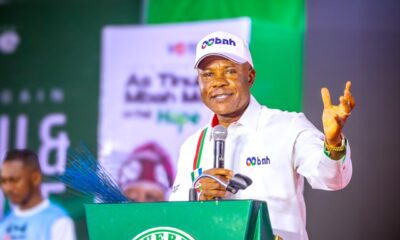





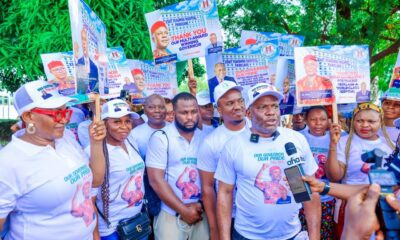


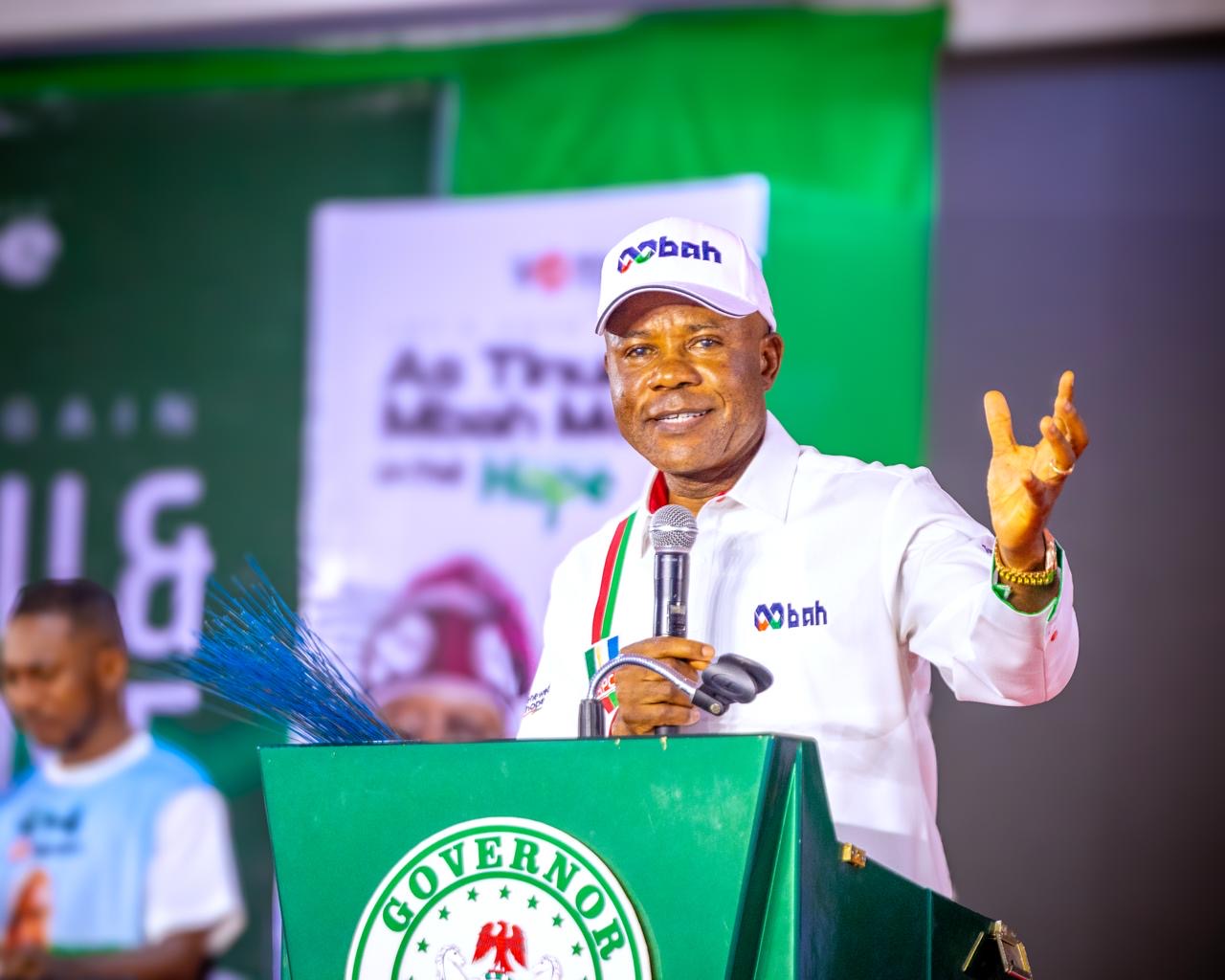
Minister of Innovation, Science and Technology, Dr Kingsley Udeh (SAN), on Saturday officially inaugurated a political support group, As Tinubu and Mbah Move (ATM), to mobilise support for the re-election of President Bola Ahmed Tinubu, Enugu State Governor Peter Mbah and other All Progressives Congress (APC) candidates in the 2027 general elections.
The group, which is anchored on technology and innovation, is expected to deploy digital tools to mobilise voters, monitor grassroots engagement and track its membership and electoral mobilisation activities across the 4,145 polling units in Enugu State.
Speaking at the inauguration, Governor Mbah commended Udeh for the initiative, describing its technological approach and grassroots mobilisation strategy as important complements to the existing political structures of the APC in the state.
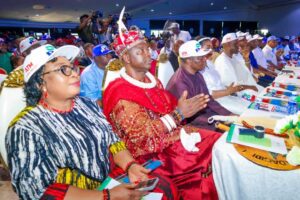
Mbah, who expressed excitement over the large turnout at the event, urged members of the group to extend the enthusiasm generated by the inauguration to communities, villages, kindreds, families and polling units across the state.
He said the support group’s effectiveness would be measured not by the crowd at its inauguration but by its ability to translate the energy into grassroots mobilisation and electoral support.
“ATM, this heat, this energy must go beyond this inauguration hall. You must take this energy to our streets, villages, polling units, kindreds and families,” he said.
The governor urged members to convince voters through visible development projects and the achievements of his administration, including Smart Green Schools, the International Conference Centre, Presidential Hotel, International Hospital and other infrastructure projects.
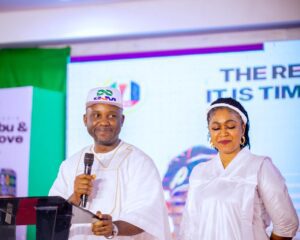
On President Tinubu’s re-election bid, Mbah described the President as a unifier, arguing that his administration’s economic reforms and infrastructure investments had laid the foundation for national growth and shared prosperity.
He said the President’s decision to remove fuel subsidy and unify the foreign exchange regime demonstrated the political courage required to address longstanding structural challenges in the Nigerian economy.
According to him, although the reforms initially imposed difficulties on citizens, they were necessary to restore macroeconomic stability, rebuild confidence in the economy and attract private capital and foreign investment.
Mbah argued that sustained economic reforms were necessary to translate the emerging growth trajectory into employment opportunities and improved living conditions for Nigerians.
He also highlighted the Federal Government’s infrastructure interventions in the South-East, particularly the improved Enugu-Onitsha highway, the ongoing Enugu-Port Harcourt Expressway project and the concessioning of the Akanu Ibiam International Airport.
The governor said the airport concession would strengthen the South-East’s economic competitiveness, particularly with the planned commencement of cargo operations and direct flights between Enugu and Guangzhou, China, before the end of the first quarter of 2027.
He maintained that the region stood to benefit significantly from the expansion of its aviation and cargo-handling capacity, given the volume of goods currently transported by road from Lagos to the South-East.
On the political implications of the 2027 elections, Mbah urged the people of the South-East to adopt a strategic approach to national politics, stressing the importance of building political alliances beyond the region.
He recalled the political alignments of the First and Second Republics, particularly the alliances involving Dr Nnamdi Azikiwe and Dr Michael Okpara, as examples of how political cooperation across regional boundaries could advance the interests of the Igbo.
The governor argued that supporting Tinubu’s re-election would provide the South-East with an opportunity to strengthen its political relevance and deepen its participation in national governance.
He cautioned APC members against complacency, despite the party’s dominance of the state’s political structures, urging them to campaign vigorously as though they were the underdogs.
Mbah disclosed that the group would complement the party’s existing structures across the state’s 4,145 polling units, adding that its digital monitoring platform would provide a verifiable picture of grassroots mobilisation.
He also urged eligible voters who had yet to collect their Permanent Voter Cards (PVCs) to do so and mobilise for the January 16, 2027, presidential and National Assembly elections, as well as the February 6, 2027, governorship and State Assembly polls.
The governor, however, stressed that the administration’s development agenda remained a work in progress, noting that the presence of poverty, inadequate electricity supply, water challenges and unpaved roads in some communities meant that more work was required.
Earlier, the convener of ATM, Dr Udeh, said the support group was different from conventional political organisations because of its reliance on technology, innovation and a data-driven approach to electoral mobilisation.
He disclosed that the group had established an innovation situation room and digital dashboard to monitor membership registration, grassroots activities and voter mobilisation across polling units.
According to him, membership registration would be tied to the possession of a PVC and the submission of voters’ identification details through a dedicated online portal, while the platform would also track referrals and recruitment of new members.
Udeh said the initiative was designed to replace unverified membership claims with a credible database that would enable the group to measure its performance and provide verifiable reports.
He added that Governor Mbah would have direct access to the dashboard to monitor activities, verify membership figures and assess the group’s progress.
Describing the initiative as an expression of appreciation and loyalty to the governor, Udeh said the relationship between the group and Mbah went beyond the 2027 electioneering season.
He pledged that ATM would deliver measurable results in support of APC candidates at all elective levels, particularly President Tinubu.
Also speaking, the APC National Vice Chairman, South-East Zone, Dr Ijeomah Arodiogbu, commended Governor Mbah for his developmental strides in Enugu State and his efforts in coordinating the party’s presidential campaign activities in the South-East.
Arodiogbu also praised Udeh for establishing the support group and his contributions to the Federal Ministry of Innovation, Science and Technology.
He called on the people of the South-East to support Tinubu’s re-election, while urging the people of Enugu State to vote for Mbah and all APC candidates in the 2027 elections.
Using an apprenticeship analogy, the APC chieftain said no responsible father would send his son to learn a trade under a master who would not settle him after completing his apprenticeship.
He argued that the South-East should support Tinubu because, according to him, the President understood the importance of rewarding loyalty and political support.
Also speaking, the Enugu State Coordinator of ATM, Ugwuoke Onyebuchi, said the group comprised largely individuals who had previously been active in civil society rather than partisan politics.
He said their decision to mobilise support for Mbah and Tinubu was informed by the confidence reposed in Udeh and their conviction that they could contribute to the state’s political and developmental direction.
Ugwuoke said members would embark on grassroots mobilisation, voter education and engagement to persuade residents to support the APC candidates in the forthcoming elections.
He added that the group would deploy technology and data-driven strategies to identify, classify and engage voters across communities, insisting that its activities and results would be measurable.
The highlight of the event was the swearing-in of ATM members and executives at the state and local government levels by the Enugu State Commissioner for Youth and Sports, Barr. Lloyd Ekweremadu.
The event was attended by the APC National Vice Chairman, South-East Zone, Dr Ijeomah Arodiogbu; former members of the House of Representatives, Hon. U.S.A. Igwesi, who is also the Enugu State Coordinator of Renewed Hope Ambassadors of Nigeria, and Rt. Hon. Ogbuefi Ozomgbachi, Deputy Coordinator of the Presidential Campaign Council in the South-East.
Others included the Chairman of the Enugu State Traditional Rulers Council, HRM Igwe Ikechukwu Asadu; local government chairmen; members of the Enugu State Executive Council; the state Chairman of the APC, Dr Martin Chukwunwike; and the APC South-East Women Leader, Dr Oby Ajih.
News
Police Arrest Three, Including Governor’s Wife’s Orderly, Over Her Unauthorised Departure from Kano Government House
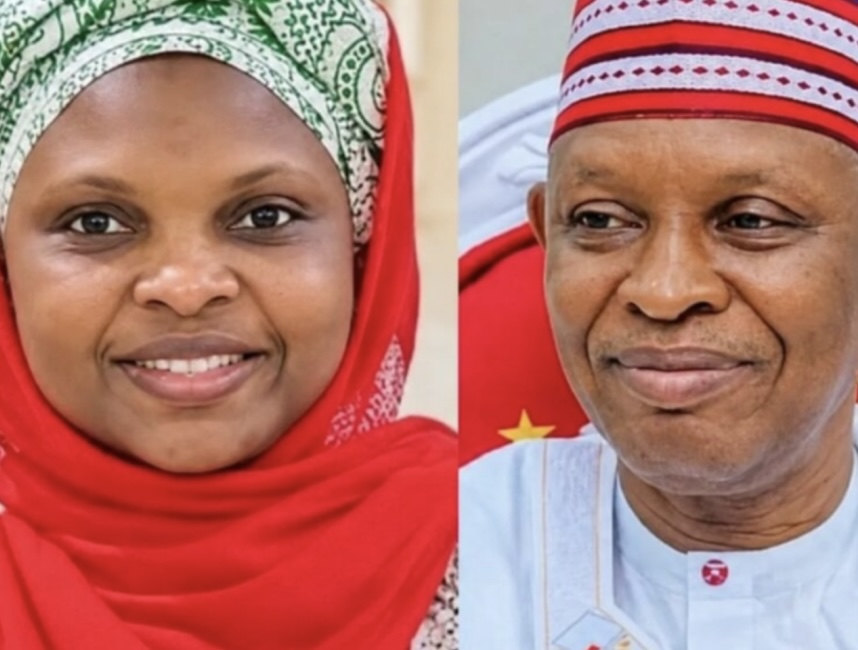
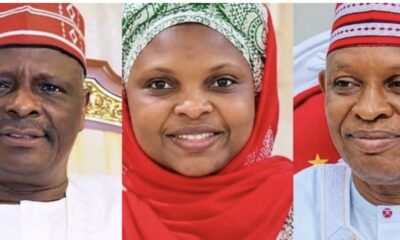
The Kano State Police Command has arrested three persons, including a police orderly attached to Zainab Kwankwaso, the second wife of Governor Abba Kabir Yusuf, over the circumstances surrounding her reported departure from the Kano Government House without the knowledge of the governor or her security aides.
Reports indicate that Zainab, identified as the daughter of former Kano State Governor and Senator Rabiu Musa Kwankwaso, reportedly left the Government House and travelled to Abuja without informing her husband or members of her security detail.
The state Commissioner of Police, Dr Ibrahim Adamu Bakori, was said to have ordered an investigation to establish how she was able to leave the Government House and travel outside the state without the knowledge of security personnel assigned to her.
Sources disclosed that Zainab had reportedly moved out of the Government House on October 28 amid alleged marital disagreements. She was said to have initially relocated to her father’s residence on Miller Road, Kano, before subsequently travelling to Abuja by air without her police orderly or other security operatives.
Her absence reportedly triggered concern after her orderly discovered that she was no longer at her residence and raised the alarm, prompting security officials to investigate the circumstances surrounding her movement.
The arrested persons are reportedly being investigated over their alleged roles in facilitating or failing to prevent her departure. There were also reports that some family members, including her brother, Ado Kwankwaso, were invited for questioning over allegations that they assisted her movement.
The development comes amid reports that Zainab has instituted divorce proceedings against Governor Yusuf at an Upper Area Court in Gudu, Abuja, in a suit reportedly marked CV/97/26.
The court is said to have summoned the governor to appear on November 17, 2026, following the petition in which Zainab is seeking dissolution of the marriage through the Islamic divorce procedure known as khul’i. She has reportedly indicated her willingness to refund the dowry.
The couple got married on July 29, 2006, and have six children together.
The unfolding developments also come against the background of the strained political relationship between Governor Yusuf and his former political benefactor and father-in-law, Senator Kwankwaso.
Yusuf was elected governor in 2023 on the platform of the New Nigeria Peoples Party (NNPP) before defecting to the All Progressives Congress (APC), a move that further widened the political differences between the two former allies.
As of the time of filing this report, the Kano State Government and the Kwankwaso family had yet to issue comprehensive official statements on the reported incident. Police authorities have reportedly confirmed the arrests and ongoing investigation.
The circumstances surrounding Zainab’s departure, the alleged involvement of the arrested persons and the reported marital dispute remain subjects of public interest as investigations continue.
News
Ebonyi Government Accused of Restricting Submission of Correspondence After Newspaper’s FOI Request

• National Issue Newspapers seeks clarification on state revenue accruals from June 2023 to October 2026
The Ebonyi State Government has been accused of restricting the submission of official correspondence at the Government House, Centenary City, following a Freedom of Information (FOI) request by National Issue Newspapers seeking details of the state’s total revenue accruals.
The alleged development comes after the newspaper formally requested comprehensive information on the total revenue received by the state government between June 30, 2023, and October 2026, pursuant to the Freedom of Information Act, 2011.
The request was reportedly followed by a pre-action notice issued to the state government over its handling of the information request.
Sources at the Government House alleged that clerical officers had become reluctant to receive memoranda and other official correspondence from members of the public who are not government officials.
According to the sources, even documents presented by government officials are subjected to preliminary scrutiny before they are accepted.
The alleged restriction has reportedly left some visitors and members of the public stranded at the Government House, raising concerns about public access to government offices and the channels through which citizens can communicate with the state administration.
Although it remains unclear whether the development resulted from an official directive by the state government or an administrative decision by officials at the Government House, the situation has generated questions about the accessibility of public institutions.
Meanwhile, legal consultants to National Issue Newspapers have reportedly cautioned the state government against any action that could obstruct the lawful submission of correspondence.
They maintained that the issuance of a pre-action notice should not be used as a justification for restricting members of the public from submitting official documents through established government channels.
The legal consultants also noted that there are several lawful procedures for serving court processes and other legal documents on government institutions, stressing that refusing to receive ordinary correspondence would neither prevent legal proceedings nor resolve the outstanding FOI request.
The controversy has renewed attention on transparency, accountability and the public’s right to access information concerning the management of public resources.
The Freedom of Information Act, 2011, was enacted to promote transparency in governance and ensure that public institutions are accountable for their activities and the utilisation of public funds.
Under the law, citizens and organisations are entitled to request information held by public institutions, subject to the exemptions provided by the Act.
The newspaper’s request specifically seeks details of the revenue that accrued to Ebonyi State within the period under review, an issue of public interest given the state’s statutory allocations and internally generated revenue.
As the controversy unfolds, attention is expected to focus on whether the Ebonyi State Government will clarify the alleged restrictions at the Government House and provide a response to the newspaper’s request.
The state government has yet to issue an official clarification on the alleged restriction as of the time of filing this report.
The central question remains whether the government will make the requested revenue information available in the spirit of transparency and accountability.
-
 News1 day ago
UNN Party Horror: ‘I Woke Up At 9pm To Find My Friends Lying Lifeless’ – Survivor
-
News3 days ago
DSS intercept weapons shipment from Niger Republic, recover 21 AK-47 rifles, four PKT Machine Guns in Sokoto
-
News3 days ago
Tragedy As Six UNN Graduates Found Dead In Nsukka Apartment After Graduation
-
News3 days ago
Police Uncover ‘Phone Farms’, Arrest Suspect Over Election Misinformation
-
News2 days ago
UNN Tragedy: Police Recover Alcoholic Drinks, Probe Deaths of Four Students in Nsukka
-
News2 days ago
Angry Nigerians Confront INEC Chairman’s Convoy In UK Protest
-
News2 days ago
UNN Deaths: Gov Mbah Mourns, Orders Investigation
-
Politics1 day ago
Obi Defies Lagos Attack, Vows To Campaign Across Every Part Of State As Reps, Police Launch Probe