Connect with us

Politics

Kogi youths accuse State INEC REC, Longpet of bias, demand his immediate removal

Published

on

The protesting Kogi youths
Spread the love
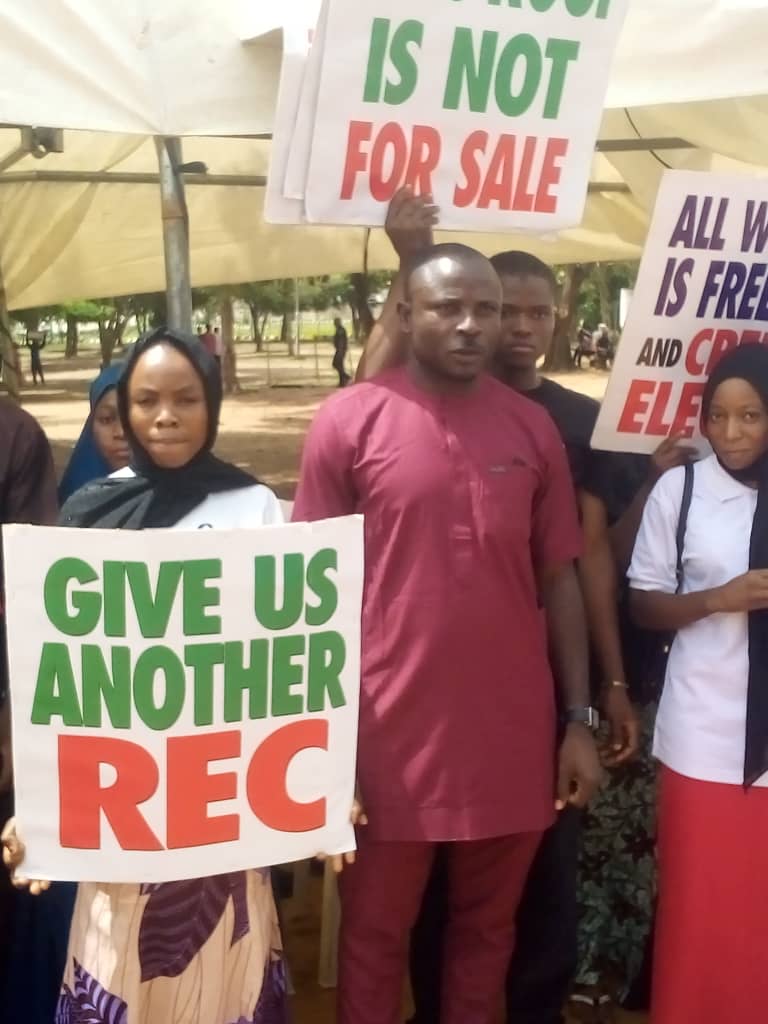
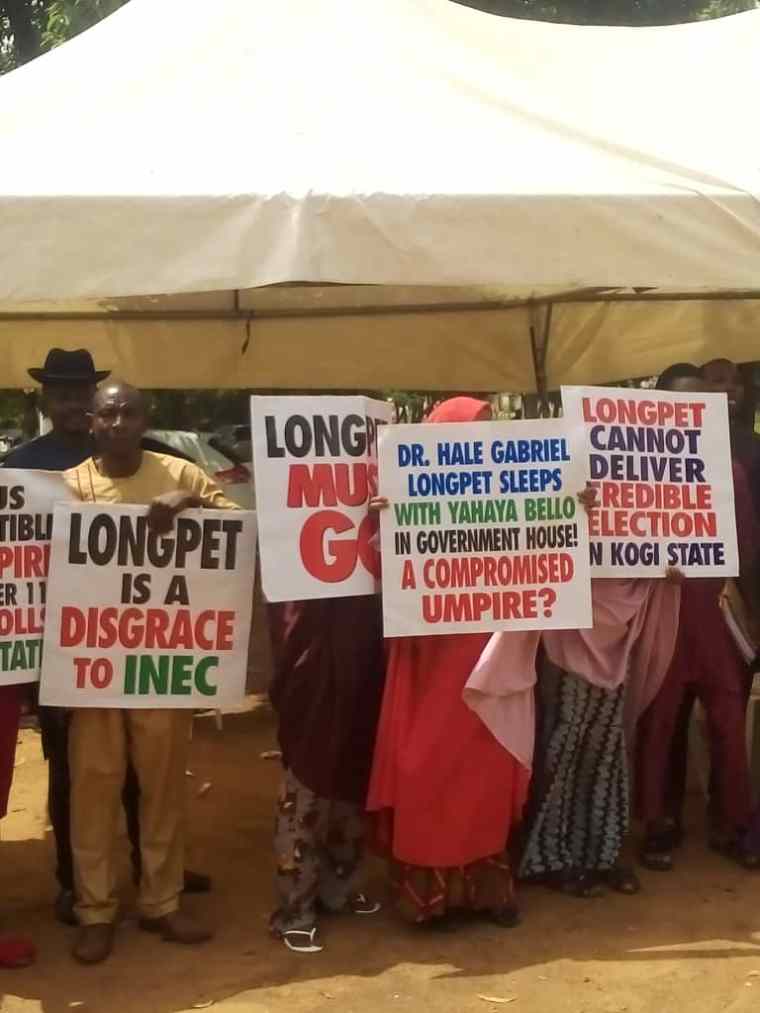
Hundreds of Kogi youths stormed the headquarters of Independent National Commission, INEC in Abuja on Tuesday demanding the immediate removal of the state Resident Electoral Commissioner, REC, Dr Hale Gabriel Longpet, accusing him of being biased.
The protesting youths said the continued stay of Longpet as Kogi REC would jeopardize the forthcoming governorship election because of his close romance with the state Governor, Yahaya Bello.
The angry youths operating under the umbrella of Igala Youth Leaders Assembly (IYLA), Ukomu Igala, and other similar organisations from Kogi East Senatorial District, said that they have totally lost confidence in the ability of Dr Longpet to deliver a credible election in the state.
The protesters were armed with various placards some of which read: ‘Longpet is a disgrace to INEC’, ‘Give us another REC’, ‘We want Longpet replaced forthwith’, ‘INEC, Kogi is not for sale,’ ‘Remove and Replace Longpet now,’ ‘We demand for free and fair election in Kogi’, ‘Longpet Must Go,’ among others.
They later moved to the Unity Fountain in Abuja where Dr. Felix Akor Ojoachele, the IYLA speaker, addressed a press conference giving details of the alleged “malfeasance displayed by Dr Hale Gabriel Longpet, INEC’s Resident Electoral Commissioner (REC) in Kogi State being administratively misguided by the State INEC Administrative Secretary Engr. Suleiman Tanko, a close ally of Kogi State Governor Yahaya Bello, whose wrongdoings have (allegedly) polluted the electoral process, diminished the confidence in INEC, and spread sorrow and unhappiness in Kogi State.”
Dr. Ojoachele said: “This press conference is a follow-up to an earlier letter to the Chairman of the Independent National Electoral Commission (INEC), Professor Yakubu Mahmoud, last month written on our behalf by Ukomu Igala Organisation.
“That letter unequivocally called for the immediate discipline of Dr Hale Longpet as Resident Electoral Commissioner (REC) in Kogi State. Weeks after the letter was delivered to Professor Yakubu Mahmoud, the INEC Chairman has not shown evidence of a desire to take us seriously.”It is for that reason that members of this organization and like-minds have organised this world press conference today (Tuesday), to reinforce our demand that Professor Yakubu Mahmoud and the INEC Management show that steps are being taken to redeem the battered image of INEC in Kogi State, and to give us confidence that the gubernatorial election is going to be free, fair, credible and transparent.

“This step is to immediately, without wavering, remove or discipline Dr Hale Gabriel Longpet and Engr.Suleiman Tanko as the REC and Administrative Secretary of INEC  in Kogi State for their roles in supporting Governor Yahaya Bello to claim that APC primaries held across all wards and Local Government Council Headquarters across Kogi State, which sparks outcry of the possible outcome of the November gubernatorial election, if the shoddy APC gubernatorial primaries can be applauded by INEC as acceptable.

“Dr Hale Longpet and Engr. Suleiman Tanko have been engaged in professional misconduct and biases, which have made mockery of elections and the democratic process in the North-Central State of Kogi State.

“Apparently, their cups are full and running over, so INEC cannot continue to turn a blind eye to their misconduct. The people of Kogi State, have totally rejected them, and INEC must immediately remove them and replace them with people who have capacity to ensure free, fair, credible and transparent polls in the coming gubernatorial election in November 2023.

“Without mincing words, we call on Professor Yakubu Mahmoud to remove Dr Hale Longpet and Engr.Suleiman Tanko, including those Electoral Officers who have served for so many years and have become landlords in the State, whose activities for the Governor give him the opportunity to boast that his already written results for the Kogi November 11, 2023 gubernatorial election will be announced in favour of his anointed candidate.

Maduka College Advert

“These electoral umpires should be removed from Kogi State due to their lack of impartiality, which is unbecoming.

“We, the people of Kogi State, have, therefore, lost confidence in Dr. Hale Longpet and Engr. Suleiman Tanko’s neutrality to conduct the next governorship election in the State, scheduled to hold in November 2023.”

Continuing, the IYLA Speaker pointed out some of the distortions, flaws and aberrations which the INEC officials in the state overlooked in the February 25, 2023 National Assembly elections which made a mess of the poll to include, “manipulation of BVAS, as many voters were denied their right to vote because BVAS showed that they had been accredited, though they were not”, adding that  it was clear that INEC officials had configured BVAS to prevent thousands of persons to cast their votes in the National Assembly elections.
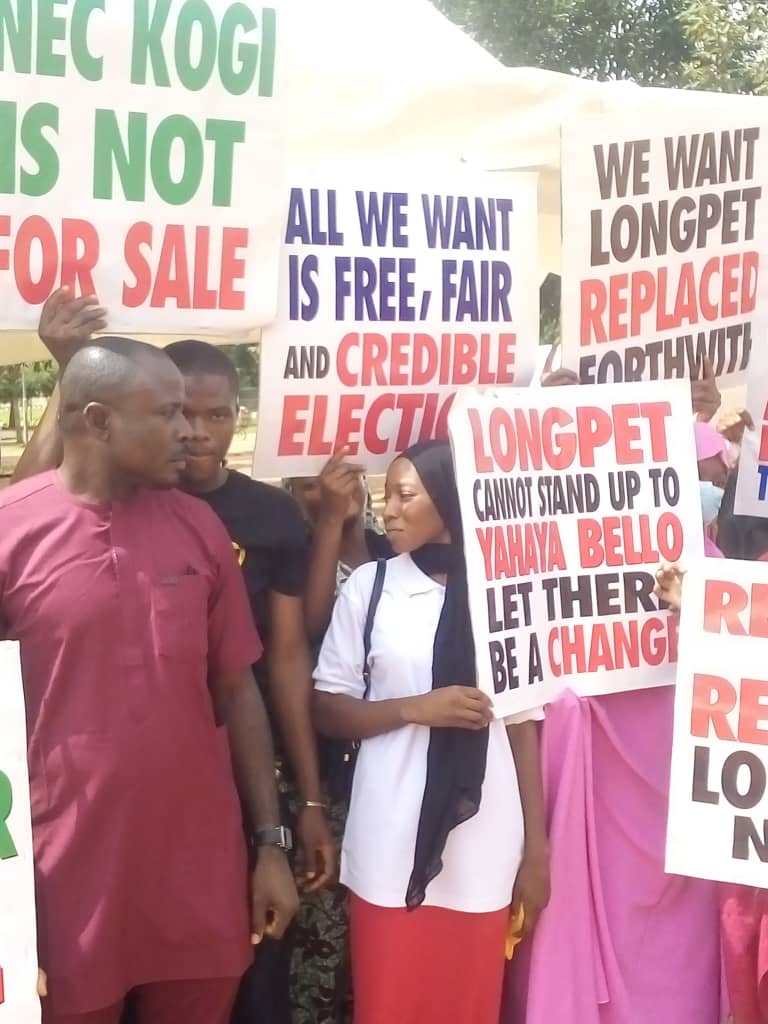
The IYLA protesters armed with various placards

He also pointed out the electoral violence in Kogi East Senatorial District, which according to him, ‘the REC turned the blind eye and failed to take the right steps in such circumstances.”

Others, he said, were:  “Snatching of ballot boxes at gunpoint in Kogi East Senatorial District. Video and photographic evidence were on display for the world to see, but Dr. Hale Long pet did not see them. He went ahead to declare winners;

“Inconclusive polls in hundreds of polling units in Kogi East Senatorial District due to disruptions by criminal elements who worked for a political party;

“Party agents were forced to sign fraudulent election results at gunpoint, in the presence of INEC officials, who still declared those results as valid;

“Alleged Electoral fraud, in the form of alteration of results in favour of Yahaya Bello’s candidates, from many polling units in Kogi East Senatorial District, carried out by INEC officials and security personnel during the collation of the results;

“Failure to call for the conduct of fresh elections (or make up polls) at polling units where violence or lack of electoral materials prevented thousands of voters from casting the votes during the elections; Declaring results under shady circumstances,” as well as the destruction of ballot papers and boxes by a local government chairman that belongs to the ruling all Progressives Congress (APC) in the state as shown in the viral video, but which the INEC failed to take necessary action. 

Dr. Ojoachele further said that they have received intelligent information that suggested that thugs were being trained somewhere in Okene Local Government Area “to promote insecurity in the state ahead of the gubernatorial election.”

“This was evident in the incidence of Saturday, 3rd of June 2023, where the governor’s convoy was alleged to have attacked the SDP candidate’s convoy coming to Lokoja on a thank you visit along Lokoja-Abuja road,” he added.

The IYLA spokesman, however, called on the people of state to be vigilant and resist any attempt by dubious politicians to cause anarchy in the state ahead of the November governorship election.


Politics

The Real Ethnic Bigotry Is Ugwuagbo’s Dangerous Ethnic Stereotyping, Not Governor Mbah’s Appointments

Published

on

Enugu Governor, Dr Peter Ndubuisi Mbah
Spread the love

By Dan Nwomeh

There is an obvious irony in a write-up accusing Governor Peter Mbah, an Igbo governing an overwhelmingly Igbo state, of the absurd practice of ethnic bigotry against his own people by favouring Yoruba people over fellow Igbo, while repeatedly reducing Nigerians to their ethnic identities and presenting the presence of a few Yoruba professionals in the Enugu State Government as evidence of “Yorubanisation” of the state. “Since coming into office, Governor Mbah has demonstrated a clear preference to work with Yorubas than with Enugu people” (sic), the author recklessly charged.

The real ethnic bigotry in this disingenuous attempt to contrive a controversy is not in Governor Mbah’s decision to appoint a handful of people from other parts of Nigeria; it is in one Ugwuagbo Chizoba’s dangerous ethnic stereotyping of those appointees and his attempt to turn their Yoruba identity into a reason for questioning their competence or qualification to serve Enugu State.

This is an important distinction, because a governor who searches for the best hands wherever he can find them is not practising ethnic bigotry. He is instead practising the very cosmopolitanism that a modern, ambitious state like Enugu needs. A writer who examines the performance of a public official, regardless of where that person comes from, is doing legitimate scrutiny. But when the principal evidence offered against an appointee is that he or she is Yoruba, and when a few Yoruba professionals serving Enugu State are presented collectively as evidence of a sinister ethnic pattern, the argument ceases to be about competence and becomes an exercise in ethnic stereotyping dressed up as political criticism.

That is precisely what the said Ugwuagbo Chizoba does in his write-up with the inflammatory and inciting title, “Ethnic Bigotry: Governor Mbah’s Yorubanization of Enugu and the Questions That Are Becoming Too Difficult to Ignore”. In the write-up, Ugwuagbo tells us that ethnic bigotry means being prejudiced against people because of their ethnic group. Then, almost immediately, he begins identifying the people he considers unfit for public office primarily by their ethnicity; a “Yoruba woman” here, an “incompetent Yoruba man” there, and even “Yoruba girls” allegedly occupying positions around Government House. Their ethnic identities are repeatedly placed at the centre of the narrative, as though being Yoruba is itself a relevant qualification for determining whether they deserve to hold public office in Enugu.

Maduka College Advert

This is the fundamental contradiction that destroys the entire write-up. You cannot credibly denounce ethnic bigotry while making ethnicity the central basis of your case against public officials and repeatedly highlighting their ethnic origins, yet offering no credible evidence to support the serious allegations of incompetence you make against them, as one would ordinarily expect from a so-called journalist.

If a Yoruba professional is appointed in Enugu, the appointment is presented by Ugwuagbo as evidence of “Yorubanisation.” But he never seriously considers the obvious alternative explanation, which is simply that the governor may have chosen someone he believed possessed the experience or competence required for the job. That is a remarkably convenient way to cobble together a piece of political propaganda. The ethnicity of the appointee becomes the evidence, the conclusion and the accusation all at once.

Beyond the blatant falsehoods, including the false attribution of certain government positions and institutional leadership roles to Yoruba people who do not actually hold them, the write-up is conspicuously devoid of evidence to substantiate the serious allegations it makes.

Take the case of Ladi Akeredolu-Ale, who is described dismissively as an “incompetent Yoruba man.” What is the evidence offered for this sweeping conclusion? Zilch. Yet Akeredolu-Ale came into the Enugu State Broadcasting Service leadership with decades of broadcasting experience, including senior management experience at Channels Television and previous leadership of the Ondo State Radio and Television Corporation.

One may certainly question his performance at ESBS. Public officials should be subjected to scrutiny. But the relevant questions are: What targets were set for him? What resources were available? What did he inherit? What has he accomplished or failed to accomplish? What measurable indicators demonstrate incompetence? His Yoruba ancestry answers none of those questions.

Had Ugwuagbo risen above his clannish insularity and parochial outlook and taken the time to examine the pedigree of these appointees, he might have been far more circumspect, and perhaps even humbled by their credentials rather than scoffing so derisively at their competence and addressing them with such intemperate disrespect.

Adenike Okebu brings formidable professional credentials to her role as Senior Special Adviser on Revenue, including a BSc in Accounting from OAU, Ile-Ife, MSc in Finance from Nottingham Trent University, Fellow of ICAN, Certified Fraud Examiner, Chartered Certified Forensic Accountant, Associate of the Chartered Institute of Taxation of Nigeria and Member of the Institute of Directors. With experience spanning EY Nigeria, Deloitte, BUA Group, Platform Capital and Pinnacle Oil and Gas, she combines Big Four audit experience with expertise in revenue assurance, financial governance and fraud detection. In Enugu, she has been central to efforts to plug revenue leakages, modernise revenue administration and drive the exponential growth of the state’s IGR, while also mentoring accounting students at the University of Nigeria Enugu Campus, helping to bridge academic training and professional practice.

Governor Mbah’s Special Adviser on Health, Dr. Yomi Jaye, is a medical doctor and healthcare-management professional with more than two decades of experience across Africa and the United States, with qualifications including MBBS, MBA and a Master of Public Health from the University of Liverpool, as well as international training at Harvard Medical School and MIT. In his role, he has brought his clinical, public-health and management expertise to Enugu’s healthcare reforms, helping to secure long-delayed accreditation and upgrades for the state’s medical and nursing training institutions, including the Medical and Dental Council of Nigeria’s approval of a 350-student admission quota for Medicine and Dentistry at ESUT (the highest admission quota approved for any medical school in Nigeria at the time), and the Nursing and Midwifery Council of Nigeria’s accreditation of ESUT’s Nursing Sciences programme. Beyond government, his private-sector and philanthropic work includes founding Cecy Health Consult and the Cecilia Oyebola Foundation, which recently supported healthcare interventions including the renovation and re-equipping of the neonatal ward at ESUTH Teaching Hospital, Parklane.

Dr. Akinbayo Olasoji, Commander of the Enugu State Forest Guard, combines advanced academic training with decades of high-level security experience, having retired from the Nigeria Police Force as a Deputy Commissioner of Police just before his appointment, after serving in senior operational positions, including the strategic DCP Operations at the Enugu State Police Command. He holds a PhD and has brought his policing and intelligence experience to the professionalisation of the Forest Guard, strengthening its operational structure, inter-agency collaboration and community-based security strategy. Under his command, the Forest Guard has participated in significant security operations, including the rescue of kidnapped victims from forest hideouts, demonstrating that the organisation is evolving into a serious component of the state’s security architecture.

Captain Tolu Ita, the CEO and Accountable Manager of Enugu Air, is a highly experienced aviation professional whose credentials combine technical expertise, executive leadership and international exposure. She was trained and licensed as a pilot in Nigeria and the United States and has nearly 20 years of professional experience in aviation and business, including a distinguished career at Aero Contractors, where she rose to become Dash-8 Fleet Manager. She has also held other senior executive positions, serving in aviation policy and regulatory advisory roles involving ICAO and AFCAC, and undertaken executive training at Oxford University’s Saïd Business School. As CEO of Enugu Air, she has already overseen a major achievement in securing the airline’s Air Operator Certificate (AOC) in just five months and three weeks, compared with the typical 15–24-month process, with the NCAA commending the airline for meeting the required safety and operational standards.

Taken together, these appointments represent less than three per cent of Governor Mbah’s top-level appointments over the past three years, a statistically insignificant fraction of the administration’s overall appointments, yet each demonstrates its willingness to deploy people with proven professional competence and relevant experience to demanding portfolios.

If then a governor appoints a person from another ethnic group because that person has the required qualification and experience, what exactly is wrong with that? It is called meritocracy, not ethnic bigotry. And Peter Mbah has a particularly compelling personal reason for believing in that philosophy. Mbah is not a man whose worldview was formed within the narrow boundaries of his ancestral community. His business career is a practical demonstration of the benefits of a cosmopolitan Nigeria.

He built Pinnacle Oil and Gas from scratch into a leading energy business in Lagos. The company’s Lekki terminal, inaugurated by President Muhammadu Buhari in October 2022, was described by the Nigerian Investment Promotion Commission as a $1 billion investment and as a strategic national asset. The project was developed as a massive petroleum storage and distribution infrastructure occupying a large expanse of land within the Lekki Free Zone.

Think about it for a moment. An Igbo businessman from Enugu went to Lagos and built a massive oil and gas infrastructure project in Yoruba land. It could not have happened without the accommodating disposition of the Yoruba owners and host communities, Lagos authorities, regulators, financial institutions, and the many Nigerians who worked with him.

The success of Pinnacle is therefore not merely a business story. It is also a powerful demonstration of what is possible when Nigerians are allowed to live, work, invest and build outside the narrow confines of their ethnic homelands. That is the Nigeria Peter Mbah knows. And that is the Nigeria an ambitious Enugu must build. Imagine if Lagos had adopted the parochial logic of Ugwuagbo’s write-up. Someone could have said: Why should an Igbo man be allowed to build a massive petroleum terminal here when there are Lagosians who can do it? Why should an Igbo businessman be entrusted with such a strategic investment? Fortunately, Lagos did not think that way. It judged the investment on its economic value, the company’s capacity, regulatory compliance, financing and the potential benefit to the state and the country. That is precisely how Enugu should work.

And many Igbo have been beneficiaries of the cosmopolitan attitude that Ugwuagbo now seems to regard as anathema when applied in Enugu. Let’s consider Ben Akabueze, an Igbo man who served as Lagos State Commissioner for Economic Planning and Budget from January 2007 to May 2015, first appointed by Governor Bola Tinubu and subsequently reappointed for two terms by Governor Babatunde Fashola. This was not a mere decorative position. Economic Planning and Budget is among the most strategically important portfolios in any state government. Were there no competent Yoruba economists and accountants in Lagos? There is also Joe Igbokwe, an Igbo from Anambra who became a prominent political figure in Lagos and rose through the ranks of the Lagos political establishment before being appointed by Governor Babajide Sanwo-Olu in 2019 as Special Adviser on Drainage and Water Resources.

Unbeknown to Ugwuagbo and his nativistic fellow travellers, people of South East origin have occupied, and continue to occupy, substantial professional and career positions in Lagos State’s public service, including within the directorate cadre and the education system. A friend from Enugu State who lives in Lagos once told me about his wife’s experience at an interview for recruitment into the Lagos State Local Government Service. He expressed his utter surprise that her ethnic origin was never raised or even discussed throughout the process. She is now serving in the directorate cadre of the Lagos State public service. In the state’s education system, a significant number of people of South-East origin also serve as secondary school principals. Lagos has also repeatedly elected state and federal lawmakers of Igbo extraction since the return to democracy in 1999.

The examples go beyond Lagos. In Ekiti State, Governor Biodun Oyebanji appointed four Senior Special Assistants and Special Assistants of Igbo origin to serve in his administration. In Kaduna, Governor Uba Sani appointed Igbo professionals to senior advisory positions. In Osun, Governor Ademola Adeleke appointed Prof. Chinwe Obuaku-Igwe, an Igbo and United Nations-certified climate-change expert, as the Director-General and Special Envoy to the Governor on Climate Change and Renewable Energy, placing her directly under the governor with responsibility for high-level partnerships, climate action and renewable-energy initiatives. This is precisely the sort of thing that should be happening in every Nigerian state.

Take aviation, which is obviously of new interest to Ugwuagbo. When the Ekiti State Government commissioned the Ekiti Airport in Ado-Ekiti, it entered into a partnership with United Nigeria Airlines, owned by an Igbo businessman, Prof. Obiora Okonkwo, to operate commercial flights linking Ado-Ekiti with Lagos and Abuja. A Yoruba state built an airport and its first commercial airline operator was an airline owned by an Igbo businessman. Did anybody in Ekiti scream “Igbonisation”?

The double standard in Ugwuagbo’s argument is as embarrassing as it is insulting to sensibilities. If an Igbo professional is appointed in Lagos, we celebrate it as evidence that Lagos is open and cosmopolitan. If an Igbo-owned company wins a major commercial opportunity in another state, we call it enterprise and success. When an Igbo professional is appointed to the highest echelons of an institution or elected to a sensitive public position in the United States, Canada or Europe, we celebrate it as proof that merit can transcend racial and national boundaries.

But if a Yoruba professional is appointed in Enugu, suddenly the same principle becomes “Yorubanisation”.

The contradiction becomes even more glaring when we consider the Igbo experience as sojourners. The Igbo are among Nigeria’s most geographically dispersed and commercially mobile populations. Our people live, work and invest in virtually every part of the country and around the world. Igbo-owned businesses operate outside the South-East on an enormous scale.

It is therefore difficult to understand why an ethnic group whose economic success has depended so heavily on moving beyond its ancestral homeland would suddenly become threatened by other Nigerians moving into Enugu. Why should the most travelled major ethnic group in Nigeria become xenophobic about who works in Enugu?

There is an even more disturbing dimension to this campaign of ethnic suspicion and antagonism. At a time when Nigerians, including many Igbo, are once again facing the ugly consequences of xenophobic hostility in South Africa, it should concern every responsible Nigerian that anyone would deliberately promote a similar sentiment against fellow Nigerians at home. We know how deeply unsettling such developments are to us, particularly because Igbo constitute a significant part of Nigeria’s commercial and professional community in South Africa. So we should be extremely careful about normalising the same mentality amongst ourselves. If we condemn South Africans for saying Nigerians do not belong in South Africa, we should be extremely careful about saying Yoruba people do not belong in Enugu.

For context, I want to say something directly to Ugwuagbo Emmanuel Chizoba, a local champion of ethnic and primordial bigotry and sectional hatred, and to those who encourage and amplify his xenophobic rhetoric. I welcome the opportunity to work alongside Yoruba colleagues in government. I have never regarded ethnicity as a barrier to competence, friendship or professional excellence. I am a proud product of the University of Lagos, where I was not only a merit-based Unilag Scholar, but also graduated top of my class, winning the Professor Gabriel Olusanya Prize for the Best Graduating Student in History. I studied in a faculty whose teaching staff was predominantly Yoruba. Yet throughout my years at Unilag, I never suffered discrimination from my Yoruba lecturers because I was Igbo. On the contrary, they taught me, challenged me, encouraged me and helped me become who I am today. I also earned a master’s degree from the same institution.

Without mincing words, if, as has been widely alleged in political circles, this campaign of ethnic profiling is connected to interests aligned with the 2027 governorship ambitions of Chief Uche Nnaji, a factional PDP gubernatorial aspirant currently facing multiple criminal charges, and Ugwuagbo is merely serving as one of their political minions and a hack writer, then every lover of inter-ethnic harmony should be deeply concerned. Whatever the political disagreements in Enugu State, no ambition is worth poisoning inter-ethnic relations or encouraging citizens to view fellow Nigerians through the dangerous prism of ethnicity. It is particularly troubling that anyone whose public and political journey benefited from the openness, accommodation and inclusiveness that have long characterised Yoruba society would now be associated with rhetoric capable of breeding suspicion against the very people who exemplified those values. Nnaji was appointed a minister by a president of Yoruba descent, yet it raised no dust. Politics must never descend into ethnic baiting and scapegoating.

History offers painful warnings. Rwanda did not descend into genocide overnight. It began with persistent ethnic labelling, stereotyping and the gradual dehumanisation of fellow citizens until political competition became an ethnic confrontation. Every responsible political actor must therefore reject language that profiles entire people or seeks to make ethnicity itself a ground for public suspicion. Nigeria has paid too high a price for division to permit such dangerous narratives to gain legitimacy in our democratic discourse. No one should ever seek to incite another civil war by exploiting ethnic sentiments merely to advance selfish political interests.

Yet, there is another inconvenient fact the writer seems not to have noticed. Enugu has never been defined by intolerance toward people of other ethnicities. From its emergence as a major administrative, commercial and industrial centre, the city has attracted workers, traders and professionals from different parts of Nigeria and beyond, giving it a distinctly cosmopolitan character. Its history is deeply intertwined with migration, commerce and national integration. As Governor Mbah would say, many of the non-indigenes living in the city for more than 100 years have the placentas of their forefathers buried here in Enugu.

We are talking about Enugu, the land of Mallam Umaru Altine, a Fulani cattle dealer from Sokoto who, having migrated to Enugu and embraced its cosmopolitan political life, became the city’s first elected Mayor in 1952. His emergence, strongly supported by Nnamdi Azikiwe and the NCNC, was a remarkable demonstration of the openness of Enugu’s political culture. A man from faraway Sokoto was accepted and elected to lead the municipal government of the capital of the predominantly Igbo Eastern Region. Altine went on to win re-election in 1956. Enugu has streets and landmarks carrying the names of prominent non-Igbo Nigerians. There are major streets named after Adegoke Adelabu and Obafemi Awolowo, among others. This is part of the history of a Nigerian city that has always been bigger than its ethnic or village boundaries.

Ugwuagbo is perfectly entitled to oppose Governor Peter Mbah or to continue wailing in frustration and despair as his administration exceeds expectations and becomes harder and harder to challenge ahead of the next governorship election. However, the governor’s responsibility is to continue delivering results for the people of Enugu State.

Continue Reading

News

2027: ‘Tinubu not tired’ – Yilwatda fires back at Obi’s resignation call

Published

on

S’Court didn’t deliver judgment in Obi’s case against Tinubu -LP
President Bola Tinubu and Mr Peter Obi
Spread the love

National Chairman of the All Progressives Congress (APC), Nentawe Yilwatda, has dismissed Labour Party presidential candidate Peter Obi’s suggestion that President Bola Tinubu is “tired” and should step aside ahead of the 2027 elections.

The national chairman, who appeared on Channels Television’s Politics Today on Tuesday, questioned the basis for describing the president as exhausted, insisting that Tinubu continues to work tirelessly while delivering key projects across the country.

“Let me put it this way, epecially to Obi, who claimed that Tinubu is tired—is he (Tinubu) going for boxing or 400 metres?” Yilwatda said. “Are you telling me that the President who stays and works from morning till night is tired? These are the issues we are talking about.”

Nentawe Goshwe Yilwatda, APC National Chairman

He argued that millions of Nigerians benefiting from the administration’s policies would not support calls for Tinubu to retire from office.

Maduka College Advert

“Are you telling me that over a million students and mothers who depend heavily on and celebrate NELFUND would be praying that the President be retired?” he asked.

Yilwatda also pointed to ongoing infrastructure projects, including the Lagos-Calabar Coastal Highway and the development of new seaports in Calabar, Akwa Ibom, Port Harcourt, Ondo and Lagos, as evidence of the administration’s commitment to national development.

“Are you telling me that over a million students and mothers who depend heavily on and celebrate NELFUND would have prayers that the President be retired?” he asked.

Yilwatda also cited several infrastructure projects as evidence that the administration remains focused on delivering its agenda, pointing to the ongoing Lagos-Calabar Coastal Highway as well as new seaport developments across the country.

“Are you telling me that people who have the coastal road from Lagos to Calabar, to Akwa Ibom and Port Harcourt, or the five seaports in Calabar, Akwa Ibom, Port Harcourt, Ondo and Lagos, are those who wish that the President be retired?” he said.

The APC chairman further referenced the ongoing modernization of Nigeria’s aviation sector, saying the extensive airport upgrade projects supervised by the Minister of Aviation reflect a government actively investing in critical infrastructure.

“I am sure you watched the renewal of airports being upgraded by the Minister of Aviation. This and many others, even in the North,” he added.

According to Yilwatda, the administration’s investments in education, transportation, maritime infrastructure and aviation demonstrate that President Tinubu remains fully engaged in governing the country, contrary to claims that he is too tired to continue in office.

Yilwatda’s comments follow remarks of former Anambra State Governor Peter Obi who, in a sit-down interview with Channels TV interview, stated that President Bola Tinubu is “tired” and lacks the capacity to lead Nigeria, calling for him to step aside and retire ahead of the 2027 general election.

Continue Reading

Politics

ADC: Appeal Court judgement has reaffirmed supremacy of rule of law, says Atiku

Published

on

Atiku Abubakar , ADC Presidential candidate
Spread the love

The presidential candidate of the Nigeria Democratic Congress (NDC), Atiku Abubakar, has welcomed the Court of Appeal judgment that overturned the Federal High Court ruling seeking to deregister the African Democratic Congress (ADC) and other political parties ahead of the 2027 general elections.

The Court of Appeal sitting in Abuja on Tuesday set aside the earlier judgment which had ordered the Independent National Electoral Commission (INEC) to deregister ADC, Accord Party and three other political parties.

Reacting to the judgement, Atiku’s media office described the judgement of the Federal High Court as erroneous, commending the Appeal Court for its stance.

“We warmly welcome the landmark judgment of the Court of Appeal, which set aside the erroneous judgement.”

“We congratulate the learned Justices of the Court of Appeal for their courage, fidelity to the Constitution and unwavering commitment to justice. Their judgment is a reassuring affirmation that the judiciary remains the last hope of the common man and the ultimate guardian of constitutional democracy. At a time when many Nigerians are anxious about the future of democratic governance, the Court has demonstrated that justice, when courageously dispensed, remains the strongest defence against arbitrariness.

Maduka College Advert

“With this Court of Appeal judgment validating the legal status of ADC plus the judgment of Hon. Justice Liman of the Federal High Court, Abuja Division, affirming the Election of Senator David Mark’s led exco of ADC, the leading opposition party has finally navigated its ways to the ballot for the 2027 General Elections as there’s no suit pending that challenges its leadership again.

“The appellate court rightly held that the judgment delivered on 15 June by Justice Lifu was a nullity, having been rendered in disobedience to a subsisting order of the Court of Appeal. It further found that the respondents lacked the locus standi to institute the action, describing their claims as speculative and legally unsustainable.

“The Court also clarified that Section 225A of the Constitution must be interpreted disjunctively, not conjunctively, and held that since the Osun and Ekiti election cycles were still active when the suit was filed, the action was premature.

“Equally significant was the Court’s finding that the trial court ignored the uncontroverted affidavit evidence of the Independent National Electoral Commission (INEC), which confirmed that the ADC and the other affected political parties had complied with all constitutional and statutory requirements. Having accepted INEC’s evidence, the lower court had no legal basis to manufacture additional conditions in order to arrive at what the Court of Appeal rightly described as a perverse decision.

“This judgment is far more than a legal victory for the ADC. It is a victory for every Nigerian who believes that democracy must be nurtured through free political competition rather than strangled through speculative litigation. The strength of a democracy lies not in the exclusion of political opponents but in allowing the people to freely determine their leaders through the ballot.

“We urge anti-democratic forces to resist the dangerous temptation of using the courts and other institutions of the state as instruments of political engineering. The judiciary must never be transformed into a battlefield for eliminating political competitors or shrinking the democratic space. Such conduct undermines public confidence in our institutions and diminishes the sacrifices made by countless Nigerians in the struggle to enthrone constitutional democracy.

“As the nation moves steadily towards the 2027 general election, political contests must be settled by the votes of Nigerians—not by contrived lawsuits designed to achieve through the courtroom what cannot be won at the ballot box.”

Continue Reading

Trending

Maduka College Advert