Connect with us

News

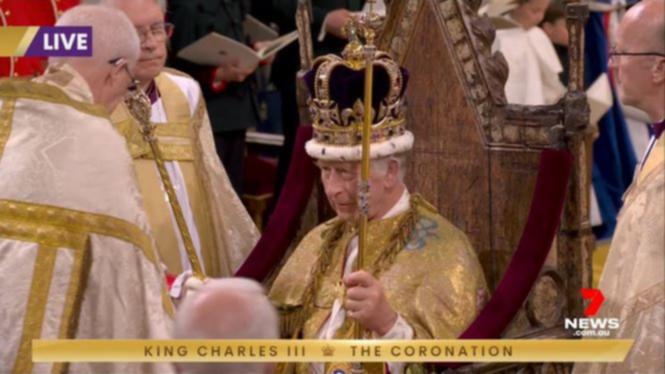
BREAKING: Charles III crowned king at first UK coronation in 70 years

Published

on

King Charles is crowned.
Spread the love

Charles III on Saturday finally met his date with destiny after a lifetime as heir to his late mother Queen Elizabeth II, as he was officially crowned king in the first coronation in Britain since 1953.

At 12:02 pm, the Archbishop of Canterbury Justin Welby placed the solid gold St Edward’s Crown on Charles’s head as a sacred and ancient symbol of the monarch’s authority.

Cries of “God Save the King” rang out from the 2,300-strong congregation at Westminster Abbey and trumpet fanfares sounded at the climax of the solemn religious confirmation of his accession.

Outside, ceremonial gun salutes blasted out across land and sea while bells pealed in celebration at churches across the country.

The build-up to the Christian ceremony of prayer and praise — steeped in 1,000 years of British history and tradition, with sumptuous robes and priceless regalia — has been mostly celebratory.

Maduka College Advert

But even before Charles, 74, and Queen Camilla, 75, left Buckingham Palace for a rainy procession to the abbey, police arrested dozens of protesters using new powers rushed onto the statute book to crack down on direct action groups.

The anti-monarchy movement Republic — which wants an elected head of state — said six of its organisers were detained, while climate activists Just Stop Oil said 19 of its number were held.

Nevertheless, dozens of Republic activists held aloft banners on the route of the procession route, declaring: “Not My King.”

Both Human Rights Watch and Amnesty International voiced concern at the arrests. “This is something you would expect to see in Moscow, not London,” HRW said.

London’s Metropolitan Police has some 11,500 officers on the streets in one of its biggest ever security operations. It has warned that it has an “extremely low threshold” for protests.

As well as being the first coronation in 70 years, it was the first of a king since 1937. It was only the second to be televised and the first in colour and streamed online.

– Changes –

Much of the two-hour Anglican service, in which Charles pledged “I come not to be served but to serve”, would have been recognisable to the 39 other monarchs crowned at Westminster Abbey since 1066.

But while many of the intricate rituals and ceremony to recognise Charles as his people’s “undoubted king” remained, the king sought to bring other aspects of the service up to date.

Women bishops participated for the first time, as did leaders of Britain’s non-Christian faiths while its Celtic languages — Welsh, Scottish Gaelic and Irish Gaelic — featured prominently.

A gospel choir sang for the first time at a coronation while a Greek choir intoned a psalm in tribute to Charles’s late father, Prince Philip, who was born on the island of Corfu.

As king, Charles is supreme governor of the Church of England and has described himself as a “committed Anglican Christian”.

But he heads a more religiously and ethnically diverse country than the one his mother inherited in the shadow of World War II.

As such, he sought to make the congregation more reflective of British society, inviting ordinary members of the public to sit alongside heads of state and global royalty.

In another change, the coronation themes mirrored his lifelong interest in biodiversity and sustainability.

Seasonal flowers and foliage were brought, from the wind-battered Isle of Skye in northwest Scotland to Cornwall at the tip of England’s southwest coast, to fill the abbey.

Ceremonial vestments from previous coronations were reused, and the anointing oil — created from olives on groves on the Mount of Olives and perfumed with essential oils — was vegan.

Charles was anointed out of sight of the congregation behind a three-sided screen in front of the High Altar to the strains of Handel’s soaring anthem “Zadok the Priest”, sung at every coronation since 1727.

– Opposition –

Rishi Sunak — Britain’s first prime minister of colour, who gave a reading from the Bible at the service — has described the coronation as “a proud expression of our history, culture and traditions”.

But not everyone is convinced: polling indicates waning support for the monarchy, particularly among younger people.

Charles’s eldest brother Prince Andrew — sidelined due to his friendship with the late convicted paedophile Jeffrey Epstein — was booed as he headed to the abbey.

Another royal exile Prince Harry, who has criticised the family since leaving for the United States in 2020, attended the coronation on his own.

Overseas, Charles’s position as the hereditary monarch and head of state of 14 Commonwealth countries looks increasingly fragile.

Jamaica and Belize both signalled this week that they are moving toward becoming republics, while Australia, Canada and others may eventually follow suit.

Britons struggling with the soaring cost of living have meanwhile questioned why taxpayers should stump up for the coronation, with the bill estimated to be over £100 million ($126 million).

– Support –

Yet the huge crowds of royal fans that have been building all week on The Mall outside Buckingham Palace indicate that the royals still have a central role in British culture and history.

Many of those camping out to watch have flown in from abroad, underlining the royal family’s untouched position as Britain’s leading global brand.

Christine Wilen travelled from Niagara Falls in Canada for the event.

“I’m very excited to be here, to be part of this history,” said Wilen, wearing a visor and sweatshirt in Canadian colours.

“It’s just too good an opportunity to miss,” said Nick Demont, 60, outside the abbey. “There’s a good chance I won’t see another one.”

AFP

News

BREAKING: Gunmen abduct Kogi school principal, NECO official, students during exam

Published

on

Spread the love

The Kogi State Police Command has confirmed that gunmen attacked Government Secondary School, Odo-Ekina, in Dekina Local Government Area on Tuesday evening, abducting four students, the school principal and a National Examinations Council (NECO) ad hoc staff member while candidates were writing their NECO examination.

According to a statement issued by the Police Public Relations Officer, ASP Saliu Oyiza Afusat, on Wednesday, the incident occurred at about 5:25 p.m. on Tuesday.

The police spokesperson disclosed that a combined team of security operatives immediately launched a search-and-rescue operation following the attack and is currently pursuing the kidnappers.

She said one of the abducted students has already been rescued, while efforts are ongoing to secure the release of the remaining victims and arrest those responsible for the attack.

The statement added that the Commissioner of Police, Kogi State Command, CP Naziru Bello Kankarofi, alongside the Brigade Commander and the Kogi State Security Adviser to the Governor, was on his way to the scene to carry out an on-the-spot assessment of the situation.

Maduka College Advert

The command assured residents that security agencies are committed to ensuring the safe rescue of the remaining victims and restoring calm in the area.

The police said a comprehensive statement containing further verified details would be issued as the investigation progresses.

The latest attack comes days after suspected kidnappers ambushed a funeral convoy along the Ochadamu-Ejule Road in Ofu Local Government Area on 9 July, abducting nine mourners, including two officials of the Federal Road Safety Corps (FRSC), who were accompanying the remains of Deputy Corps Commander Augustine Ikwue to his hometown in Benue State.

The abductors later abandoned Mr Ikwue’s corpse near Ejule while demanding N450 million ransom for the release of the kidnapped victims.

The police said security operatives, including soldiers, vigilantes and local hunters, launched rescue operations after the attack.

The latest school abduction also comes despite recent efforts by Kogi and Benue states to strengthen security along their shared border.

Last week, the two states launched Operation Handshake Patrol, a joint policing initiative aimed at improving intelligence sharing, dismantling criminal hideouts and allowing security operatives to pursue suspects across state boundaries.

Governor Hyacinth Alia of Benue said the operation was designed to tackle criminals who commit offences in one state and escape into the other, while security officials expressed optimism that the collaboration would improve patrols and reduce cross-border crimes.

Meanwhile, the latest incident has renewed concerns over attacks on schools in Kogi State.

On 10 June, suspected terrorists attacked Government Secondary School, Iluke Bunu, in Kabba/Bunu Local Government Area, killing three people, including the school’s vice principal and a six-year-old child, in what the state government described as a failed attempt to abduct students.

The Kogi government later announced that security forces had killed the alleged mastermind of the attack, Kachalla Ibrahim Batijo, during a coordinated operation.

Authorities have also announced a series of security measures in recent weeks, including restrictions on motorcycle operations in parts of Kabba/Bunu, a ban on night travel on some state roads, intensified military operations and intelligence-led raids targeting suspected criminal groups.

Despite those measures, attacks by kidnappers have continued in parts of the state, particularly along major highways and in rural communities. Security agencies say operations are ongoing to rescue the remaining victims of Tuesday’s school attack and arrest those responsible.

Continue Reading

News

NUC approves AI, Cyber Security, Three Other Undergraduate Programmes for ESUT

Published

on

Spread the love

The National Universities Commission (NUC) has approved the establishment of five new full-time undergraduate programmes at the Enugu State University of Science and Technology (ESUT), effective from the 2026/2027 academic session.

The approval followed a resource verification exercise conducted by a panel of experts that assess the adequacy of the university’s human and material resources for the proposed programmes.

In a letter signed by the Director of Academic Planning, Abubakar M. Girei, on behalf of the Executive Secretary of the NUC, the Commission approved the introduction of Bachelor of Science (B.Sc.) degree programmes in Artificial Intelligence, Cyber Security, Intelligence and Security Studies, Data Science, and Software Engineering.

The Commission, however, clarified that the approval is limited to the full-time mode of study and does not extend to part-time delivery at this stage.

It added that the university must notify the Commission and obtain the requisite approval before introducing part-time or postgraduate components of any of the newly approved undergraduate programmes.

Maduka College Advert

The NUC further urged ESUT to continue providing adequate human and material resources to ensure the effective implementation, development, and sustainability of the programmes.

The approval comes at a time Governor Peter Mbah’s administration has consistently committed more than 33 per cent of Enugu State’s annual budget to education, with a strong emphasis on science, technology, innovation, and digital skills development to prepare young people for the demands of the future workforce.

Governor Mbah had earlier disclosed that his administration was redesigning the state’s education system to equip learners—from the primary school level to the university—with the capacity to develop technology-driven innovations, create globally competitive solutions, and participate effectively in the digital economy through curricula anchored on the Smart Green Schools initiative.

As part of realising the vision, the governor recently sponsored a high-level academic delegation led by the Vice Chancellor of ESUT, Prof. Aloysius-Michaels Okolie, to Doha, Qatar, to understudy global best practices in artificial intelligence, applied learning, and innovation ecosystems, with a view to adapting and implementing the models at the university.

Continue Reading

News

Nigerian woman commits suicide two years after relocating to UK on skilled worker visa

Published

on

UK-based Nigerian, Beatrice Solomon, 27, was found dead in her home on Wednesday
Spread the love

A United Kingdom UK-based Nigerian, Beatrice Solomon, 27, was found dead in her home on Wednesday.

A coroner in the United Kingdom ruled that a 27-year-old Nigerian woman, Beatrice Solomon, died by suicide after an inquest into her death.

Beatrice, a mother of one, was found unresponsive at her home on Norris Road in Stanfield by her husband, Damian Butler, on March 4.

According to evidence presented at the inquest, Butler, 40, had left for his delivery job at about 4:30 p.m. before returning home roughly two hours later to use the toilet, where he made the tragic discovery.

Police Constable Hinchliffe told the hearing that paramedics arrived shortly afterwards, but Beatrice was pronounced dead at the scene at 6:21 p.m. Officers also ruled out any third-party involvement.

Maduka College Advert

The inquest heard that Beatrice moved from Nigeria to Stoke-on-Trent in November 2023 on a skilled worker visa, where she worked as a carer. She is survived by her young son and siblings.

Giving evidence, Butler said Beatrice had struggled with her mental health over the previous 12 months due to ongoing issues involving Stoke-on-Trent City Council.

He also revealed that he later discovered she had made two previous attempts to take her own life.

Pathologist Dr Jones told the inquest that Beatrice died from oxygen deprivation.

Delivering her conclusion, Coroner Li Hammond-Naylor ruled that Beatrice died by suicide.

She said: “It is clear to me that Beatrice had researched and planned how to take her own life. I can only extend my sincere condolences to Beatrice’s family and friends.”

Continue Reading

Trending

Maduka College Advert