Connect with us

International

Several shot dead at Hamburg Jehovah’s Witness center

Published

on

Spread the love

Police are yet to give a death toll, but multiple local media outlets reported that the shooting had left seven dead and eight seriously injured, with the gunman believed to be among the dead.

The first emergency calls were made around 8:15 p.m. GMT after shots rang out at the building in the city’s northern district of Gross Borstel, a police spokesman at the scene said.

Police tweeted that “several people were seriously injured, some even fatally” in the incident.

“At the moment there is no reliable information on the motive of the crime,” police said, urging people not to speculate.

An alarm for “extreme danger” in the area had been sounded using a catastrophe warning app, but Germany’s Federal Office for Civil Protection lifted it shortly after 3 a.m. local time.

Hamburg police tweeted early Friday: “The police measures in the surrounding area are gradually being discontinued. Investigations into the background of the crime are continuing.”

Maduka College Advert

The port city’s mayor, Peter Tschentscher, expressed shock at the shooting on Twitter.

Sending his sympathies to the victims’ families, he said emergency services were doing their utmost to clarify the situation.

Bible study group

In the nondescript, three-story building, police said an event had been taking place Thursday evening.

Jehovah’s Witnesses had gathered for a weekly Bible study meeting, according to the local daily, Hamburger Abendblatt.

There are about 175,000 people in Germany, including 3,800 in Hamburg, who are Jehovah’s Witnesses, a U.S. Christian movement set up in the late 19th century that preaches non-violence and is known for door-to-door evangelism.

The first officers at the scene found several lifeless bodies and seriously wounded people, police said.

Hamburger Abendblatt reported that 17 unhurt people, who had been at the event, were being attended to by the fire brigade.

Officers heard a shot in the “upper part of the building” before finding a body in the area where it rang out, police said.

“We have no indications of a perpetrator on the run,” said the police spokesman.
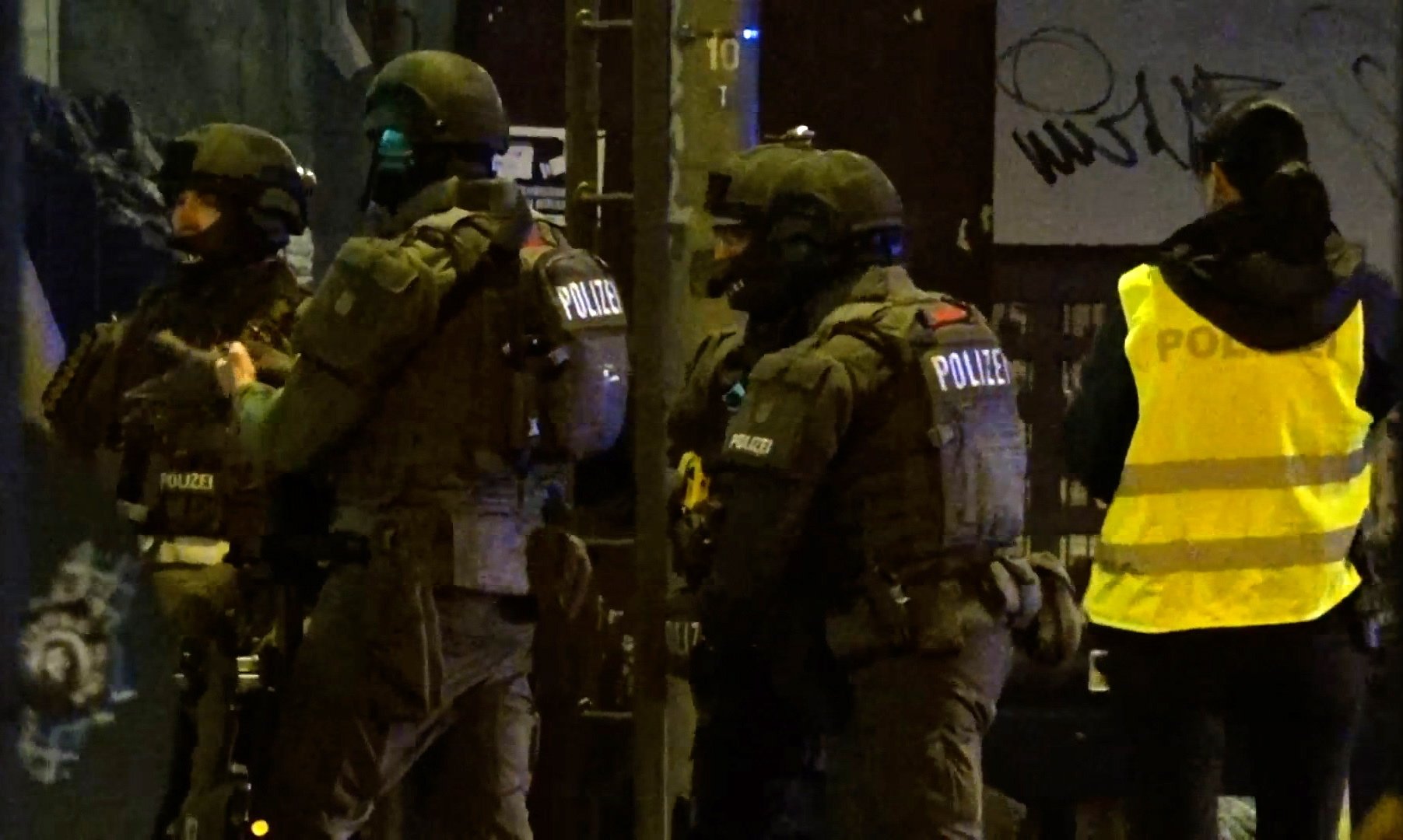
Armed police officers gather at the scene of a shooting in Hamburg, Germany, March 9, 2023. (EPA Photo)

Instead, officers have “indications that a perpetrator may have been in the building and maybe even among the dead.”

The spokesman added that the person uncovered in the upper part of the building was “possibly” the perpetrator.

“We have found a lifeless person in a community center in (Gross Borstel) which we assume could be a perpetrator,” Hamburg police tweeted early Friday morning.

“According to the current state of affairs, we assume that there is one perpetrator,” police said in a separate tweet.

Hit by attacks

Germany has been rocked by several terrorist attacks in recent years.

Among the deadliest was a truck rampage at a Berlin Christmas market in December 2016 that killed 12 people.

The Tunisian attacker, a failed asylum seeker, was a supporter of the Daesh terrorist group.

Europe’s most populous nation remains a target for Daesh-like terrorist groups because of its participation in the anti-Daesh coalition in Iraq and Syria.

Between 2013 and 2021, the number of terrorists considered dangerous in the country had multiplied by five to 615, according to interior ministry data.

But Germany has also been hit by several far-right assaults in recent years, sparking accusations that the government was not doing enough to stamp out neo-Nazi violence.

In February 2020, a far-right extremist shot dead 10 people and wounded five others in the central German city of Hanau.

And in 2019, two people were killed after a neo-Nazi tried to storm a synagogue in Halle on the Jewish holiday of Yom Kippur.

AFP

International

$300bn reconstruction aid, sanctions lift’ – US-Iran MoU details emerge

Published

on

Spread the love

The following is the text of the US-Iran Memorandum of Understanding, as read out by a senior US official to reporters on Wednesday:

“The United States of America and Islamic Republic of Iran have jointly agreed in good faith on (a date yet to be determined, the official said), on the following:

“Paragraph 1 – The United States of America and the Islamic Republic of Iran and their allies in the current war, by signing this MOU, declare an immediate and permanent termination of military operations on all fronts, including in Lebanon, and undertake from now on not to initiate any war or any military operation against each other and to refrain from the threat or use of force against each other, and ensuring the territorial integrity and sovereignty of Lebanon. The final deal will confirm the permanent termination of the war on all fronts, including in Lebanon, and other provisions of this paragraph.

“Paragraph 2 – The United States of America and the Islamic Republic of Iran undertake to respect each other’s sovereignty and territorial integrity and to refrain from interfering in each other’s internal affairs.

“Paragraph 3 – The United States of America and the Islamic Republic of Iran commit to negotiating and achieving the final deal in maximum 60 days extendable with mutual consent.

“Paragraph 4 – Immediately upon the signing of this MOU, the United States of America will begin the removal of its naval blockade and any disturbances or impediments against the Islamic Republic of Iran, and will fully end the naval blockade within 30 days. During this period, the traffic of vessels will be in proportion to the numbers of pre-war traffic being restored by the Islamic Republic of Iran. The United States of America further undertakes to remove its forces from the proximity of the Islamic Republic of Iran within 30 days after the final deal.

Maduka College Advert

“Paragraph 5 – Upon the signing of this MOU, the Islamic Republic of Iran will make arrangements using its best efforts for the safe passage of commercial vessels with no charge for 60 days only, from the Persian Gulf to the Sea of Oman, and vice versa. The traffic of commercial vessels will immediately start, and considering the need for removing the technical and military obstacles, and de-mining by the Islamic Republic of Iran, will be instated within 30 days. The Islamic Republic of Iran will conduct dialogue with the Sultanate of Oman to define the future administration and maritime services in the Strait of Hormuz, in discussion with other Persian Gulf littoral states, in line with the applicable international law and the sovereign rights of coastal states of the Strait of Hormuz.

“Paragraph 6 – The United States of America undertakes with regional partners to develop a definitive mutually agreed plan with at least USD 300 billion for the reconstruction and economic development of the Islamic Republic of Iran. The mechanism for the implementation of this plan will be finalized as part of a final deal within 60 days. All required licenses, waivers, and permissions needed for the relevant financial transactions will be granted by the United States of America.

“Paragraph 7 – The United States of America undertakes to terminate all types of sanctions against the Islamic Republic of Iran, including the United Nations Security Council resolutions, IAEA Board of Governors resolutions, and all unilateral US sanctions, primary and secondary, in an agreed-upon schedule as part of the final deal. The Islamic Republic of Iran and the United States of America acknowledge the critical importance of the sanctions termination issue above mentioned, and express their intentions to immediately address these issues in the negotiations in order to achieve mutual agreement on them.

“Paragraph 8 – The Islamic Republic of Iran reaffirms that it shall not procure or develop nuclear weapons. The United States of America and the Islamic Republic of Iran have agreed to resolve the disposition of stockpiled enriched material pursuant to a mechanism that will be mutually agreed upon in accordance with the schedule mentioned in Paragraph 7, with the minimum methodology to be down-blending on site under the supervision of the IAEA. The two parties also agreed to discuss the issue of enrichment and other mutually agreed matters related to the Islamic Republic of Iran’s nuclear needs, based on a satisfactory framework being agreed upon in the final deal. The final deal will confirm the provisions of this paragraph. The United States of America and the Islamic Republic of Iran acknowledge the critical importance of the nuclear issues above mentioned, and express their intention to immediately address these issues in the negotiation in order to achieve mutual agreement on them.

“Paragraph 9 – Pending the final deal, the United States of America and the Islamic Republic of Iran agree to maintain the status quo. The Islamic Republic of Iran will maintain the current status quo of its nuclear program, and the United States of America will not impose any new sanctions, and will not deploy additional forces in the region.

“Paragraph 10 – The United States of America undertakes that immediately upon the signing of this MOU, and until the termination of sanctions, US Department of Treasury will issue waivers for the export of Iranian crude oil, petroleum products and derivatives, and all associated services, including banking transactions, insurances, transportation, etc.

“Paragraph 11 – The United States of America undertakes to make fully available for use the frozen or restricted funds and assets of the Islamic Republic of Iran upon the implementation of this MOU. The United States of America and the Islamic Republic of Iran will mutually agree on the procedures related to the release of these funds during the negotiations. Such funds, whether retained in the original account or transferred, shall be made fully usable for payment to any ultimate beneficiary designated by the Central Bank of the Islamic Republic of Iran. The United States of America undertakes to issue all necessary licenses and authorizations accordingly.

“Paragraph 12 – The United States of America and Islamic Republic of Iran agree that an executive mechanism will be established to monitor the successful implementation of this MOU and the future compliance of the final deal.

“Paragraph 13 – After signing this MOU and subject to the beginning of the implementation of Paragraphs 1, 4, 5, 10 and 11 of this MOU, and the continuing implementation of these measures, the United States of America and the Islamic Republic of Iran will start negotiations regarding the final deal exclusively on the other paragraphs.

“Paragraph 14 – The final deal will be endorsed by a binding UNSC resolution.”

Continue Reading

International

Iran threatens retaliation, says US strikes violated ceasefire

Published

on

US President Donald Trump
Spread the love

Iran’s foreign ministry on Tuesday accused the United States of violating a fragile ceasefire during the past 48 hours in the southern coastal province of Hormozgan, without specifying the incident.

The accusation comes after US Central Command said its forces had on Monday attacked missile sites and boats in southern Iran that were trying to lay mines in the Gulf, while Iran’s Revolutionary Guards said it fired at US aircraft trying to enter its airspace.

“The US terrorist army, continuing its illegal and unjustified actions since the ceasefire… has, in the past 48 hours, committed a gross violation of the ceasefire in the Hormozgan region,” the Iranian foreign ministry said in a statement.

It added that Tehran “will not leave any evil unanswered and will not hesitate to defend the Iranian nation,” without elaborating.

Tuesday’s statement came as a top Iranian delegation was in Qatar for talks as part of a “diplomatic process” aimed at ending the war with the United States, which broke out on February 28

Continue Reading

International

Dozens of lranian fighters killed, as US resumes strike in Strait of Hormuz, targets IRGC Naval Boats in the Gulf

Published

on

Spread the love

U.S. fighter jets have reportedly struck IRGC naval boats in the Gulf after Iranian forces allegedly targeted a vessel near Bandar Abbas.

U.S. Central Command confirms “self-defense strikes” were carried out against Iranian boats and missile sites near the Strait of Hormuz amid rising tensions in the region.

It was stated that the numbers of dead has increased from 9 to 15, with dozens still missing while others remain injured.

According to emerging reports, the strikes targeted IRGC maritime assets and defensive positions during what rapidly escalated into a major military confrontation in the region. Rescue and emergency operations are said to be ongoing as authorities continue searching for missing personnel.

Iranian and regional media report heavy explosions and gunfire near Bandar Abbas, while negotiations between Washington and Tehran continue in Qatar.

Maduka College Advert

The situation is still developing, and some battlefield claims remain independently unverified.

Continue Reading

Trending

Maduka College Advert