Connect with us

News

APGA guber candidate’s convoy attacked by suspected Ebubeagu operatives

Published

on

Spread the love

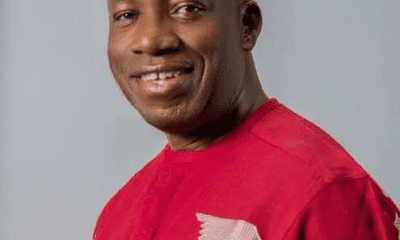
•Ebonyi State APGA 2023 governorship candidate, Prof. Odoh 

The Ebonyi State governorship candidate of the All Progressives Grand Alliance (APGA), Professor Bernard Ifeanyi Odoh, has accused Ebubeagu operatives of attacking and shooting at his convoy in Izzi Local Government Area of Ebonyi State, thereby damaging one of his cars.

Odoh, a former Secretary to Ebonyi State Government (SSG), made the allegation to journalists in Abakaliki on Thursday.

According to Odoh, his convoy was attacked by men of Ebubeagu in Izzi Local Government Area of the state when he visited the area for his campaign activities.

He said: “Today, we scheduled a visit to Izzi local government because Izzi Local Government is part of the state. It’s one of the 13 local government areas in the state. We have our supporters there; we have our campaign office there.

“As earlier as 6 O’clock this morning, I started getting distress calls. One of our coordinators called and said the chairman of the local government called and warned him that no visit should take place in his local government and that he is under pressure from the government.

Maduka College Advert

“The DPO also called, raised a similar alert, that he’s under enormous pressure, that we should not come.

“I am the candidate of APGA in Ebonyi, Professor Benard Odoh, is my name. I am in this race to govern the whole local governments in the state.

“Therefore, if I cannot go to Izzi, then, I am not qualified to run for the election, and that is why I had to go to Izzi, defied all their orders and threats to go to the place.”


Editorial

Three Years of Service: Governor Mbah reaffirms commitment to Enugu’s sustainable development

Published

on

Enugu Gov Dr Peter Mbah during the 3rd Anniversary Thanksgiving Service
Spread the love

At a Thanksgiving Mass marking the third anniversary of his administration, Peter Mbah delivered a speech and shared a testimony at the Government House Chapel, Enugu, on May 29, 2026.

The Full Speech:

A Mass is usually not a platform for speeches. So, I crave your indulgence – given what today represents.

This is an opportunity to express my gratitude for the support and prayers of Ndi Enugu in the last three years.

Nothing we achieved would have been possible without the support of the civil servants and my entire team.

Thank you for your dedication to duty and painstaking implementation of our policies.

Thank you, My Lord Bishop, for your wise counsel and prayers. And to the Chaplain – for your daily dose of enriching sermons.

Maduka College Advert

The church has been an important part of this journey. Our gathering here this morning re-affirms that.

My dear Ndi Enugu,

This morning feels both sombre and energising to me.

Perhaps anniversaries naturally create that feeling. Like a birthday. A celebration, yes, but also a moment that interrupts the rush of events and forces you to reflect.

Three years ago, after taking the oath of office at Okpara Square, I signed the Citizens’ Charter.

I remember the weight of that moment very clearly.

At the time, many people saw just another government promise. Public life had produced too many declarations that never truly reached ordinary people. Hope had become cautious.

But I believed that moment mattered.

The Charter was about trust. About rebuilding faith in public office and creating a service-centred mindset by government for the people of this state.

Most of what we now speak about so easily had not yet taken physical form. It existed as planning, conviction and hard belief. You could describe the future, but you could not touch it.

That gap between vision and evidence is uncomfortable. It asks people to hold faith before results arrive.

And honestly, that was our first challenge.

We had become too used to disappointment.

Too used to shrinking our expectations in order to protect ourselves from frustration.

That was the atmosphere surrounding Enugu three years ago.

Which is why I have always felt that the deeper significance of the Citizens’ Charter was psychological before it was political. It marked a decision to think seriously again about what this state could become and how future generations might eventually live here.

This morning, I think it is worth pausing to reflect on that moment properly.

Let us go on a journey across Enugu State today.

Picture it:

You leave early in the morning. You move through the capital and further outward into the rural communities.

You pass schools in every ward of the state.

Step inside one of them. Listen to children speaking confidently about robotics, AI, coding, agriculture, science and citizenship.

Watch how naturally they use computers and smart boards, as though this future already belongs to them.

Keep driving.

You come across healthcare centres communities can actually reach, where maternal mortality has fallen dramatically and healthcare is moving closer to ordinary life.

Move again.

You travel on smooth roads now connecting communities more efficiently across the state. Roads carrying farmers, traders, workers, students and businesses more from one place to another.

At some point, you stop at a junction and watch the city drive by:

Workers, students and traders traveling in air-conditioned CNG buses with Wi-Fi.

Watch how differently the city now breathes.

Then visit the terminals; The International Conference Centre; Hotel Presidential.

Look in on Hotel Presidential. Watch people visiting from different parts of the state and country. Watch how infrastructure shapes the feeling of a place before a single conversation even begins.

Go further.

Take a flight on Enugu Air: to Lagos, Abuja, Kano today, and tomorrow – the world.

Connectivity changes the psychology of a place. It changes how people see themselves and how the world sees them too.

Watch the shops opening throughout the week.

Watch young people working late at an ICT hub or filling restaurants late into the evening.

Then come back to the Lion Building.

Sit with my team.

Tell them what you saw.

Tell them what you can feel happening around the state.

Tell us whether this still looks like the Enugu you once knew.

And then come and see me.

Tell me how all this makes you feel

Now let me paint a different picture.

Imagine waking up tomorrow and finding yourself back in the Enugu of three years ago.

The roads are broken again. Gridlock clutters the junctions. Mondays fall silent under sit-at-home orders. Shops close. Businesses retreat indoors. Public transport becomes stressful and exhausting again. Schools drift further behind the modern world. Healthcare centres struggle to meet basic needs. Hotel Presidential slips back into decay. Rural communities remain cut off by weak infrastructure and poor connectivity.

The tech hubs are gone. The innovation ecosystem disappears before it fully matures. Investment dries up.

National attention moves elsewhere. International partnerships fade. The state begins losing confidence in itself again.

And the people who drove this transition – I and the team around me – are no longer there.

Slowly, quietly, expectations begin shrinking again.

And then ask yourself honestly: how would that feel?

What would you fight to keep?

What would you protect for your children and for the generations coming after us?

What people see today are outcomes.

What they do not always see is the struggle, persistence and invisible labour required to bring those outcomes into existence.

A functioning society does not emerge because somebody gives a speech and announces a vision. Between intention and reality sits an enormous amount of hard thinking, strategy and effort.

Take Hotel Presidential.

By the time we came into office, the matter had already been trapped in legal processes for years. Hearings had been pushed far into the future. It would have been easy to leave it there and move on to easier things.

But that building mattered symbolically to the state. It represented pride, confidence and economic possibility.

Allowing it to continue decaying indefinitely would have meant accepting paralysis as permanent.

So, we pushed. We engaged. We argued the case directly. We insisted the people of Enugu deserved results instead of endless postponement.

The same thing applies across the state.

People drive on constructed roads now, but before asphalt is laid there are engineering studies, negotiations, budgeting decisions and months of planning.

You see buses moving more smoothly across the city today, but somebody first had to think carefully about routes, congestion, pricing, terminals and sustainability.

Security required major investment, coordination, difficult decisions and resolve.

Even political harmony does not happen automatically. Across these past years, countless meetings have taken place quietly behind closed doors. Stakeholders have been engaged patiently. Communities have been listened to. Consensus had to be built repeatedly.

And still, we do not always get everything right.

None of this work is glamorous.

Most of it never appears in headlines.

But this is how serious transformation actually happens.

Through sustained effort, difficult decisions, and people remaining focused long after applause fades.

What we are doing here cannot be understood simply as a collection of projects.

We are rebuilding the operating system of this state.

A different future is being constructed layer by layer -economically, culturally and institutionally.

And we are living through one of those rare moments when the direction of a society can change fundamentally.

Can you feel it?

A state that had learned to manage limitation is thinking ambitiously again.

Young people are starting to imagine futures for themselves here at home. Investors are looking at Enugu. The wider region is paying attention.

And God willing, what is being built here will contribute to something larger nationally.

But work at this scale cannot remain superficial if it is going to endure.

That is why the foundations matter so much – education, healthcare, infrastructure, security, technology, investment, public trust.

These things only last when people begin treating them as their own.

When we are gone, what will remain?

Will future generations inherit systems strong enough to carry them further than we ourselves travelled?

Will they look back and recognise this period as the moment Enugu truly changed direction?

Or will people mistake the beginning for the end?

Because what we see around us today is not completion.

It is proof that far more is possible.

Three years ago, much of this journey depended on vision, trust and the willingness of people to take a chance on a different direction for the state.

Today, the situation is different.

People can now see the changes around them in daily life.

And that changes the responsibility all of us now carry.

Tomorrow Is Here can no longer remain government’s project alone.

It belongs to Ndi Enugu.

The future of this state cannot depend permanently on one administration or one political moment. It must become rooted in public culture – in the way communities protect what has been built, participate seriously and hold leadership accountable for continuing the work properly.

Lasting transformation survives only when citizens themselves begin carrying part of the responsibility for protecting it.

What we are building is still young.

A child taking its first steps into the world still needs guidance, patience and careful attention, even when those first steps fill the family with pride. In many ways, our wider transformation is still at that stage.

And anything young requires protection while it strengthens itself.

Eight months from now, in January, we will enter another election.

Do we realise enough that history has placed something precious in our hands?

History is full of people who reached this stage, relaxed too early and stopped thinking like underdogs. Momentum made them comfortable. Success softened their discipline. They mistook winning a battle for winning the war.

We cannot afford that mistake.

Forces that threaten serious progress never disappear. Political brinkmanship. Short-term thinking. Financial pressures. Geopolitical instability. People more interested in noise, ego and personal advancement than long-term results.

These are the challenges before us now.

So let us gather around what we have begun building here carefully.

Let us protect it.

Let us strengthen it.

Let us campaign for it.

Let us bring more people into the fold and help them understand why this moment matters.

Why!

Because Tomorrow is Here

God bless Enugu State

God bless the Federal Republic of Nigeria

Continue Reading

News

Coup plotters were foolhardy even civilians would’ve taken them down — Defence minister

Published

on

File Photo: Minister of Defence, Gen Christopher Musa
Spread the love

Defence Minister Christopher Musa has said the officers who plotted to overthrow President Bola Tinubu’s government had so little support that ordinary Nigerians would have taken them down without the military’s intervention.

He described the plotters as a band of confused individuals who recklessly dragged clueless junior officers into a doomed enterprise.

Musa spoke on Arise News on Friday, as the general court martial of officers accused of involvement in the October 2025 plot continues.

“Even the civilians in Nigeria would have taken them down. So I think it was just foolhardy for them to have done what they wanted to do,” hThe minister expressed disbelief at the calibre of those involved, saying he shook his head when he considered who they were.

“I just looked at the people that were involved and I shook my head, because they are just a bunch of confused individuals that exposed very junior officers who didn’t know their left from their right, and now put them into this mess. It’s quite unfortunate,” he said.

Musa reserved particular sympathy for the lower-ranked officers, whom he described as victims of a senior officer’s recklessness.

Maduka College Advert
“We always feel bad when we see our colleagues in this situation. But the good thing is that the system has a way of going about it,” he said.

On the ongoing prosecution, the minister said the process was transparent and that the accused were being given every opportunity to defend themselves.

“The investigation was very thorough. The prosecution is now ongoing, and the court martial will go as planned. We are giving them all the benefits to defend themselves.

“But the facts on the ground are very, very clear, and I can tell you that we are following all the processes. Nothing is hidden,” he said.

He was equally emphatic that the plot had no rational basis, given the state of the armed forces.

“They had no reason to do that. The country was going very well. The armed forces have been taken care of quite well. We’ve never had issues with our salaries.

“Efforts have been made to even increase our allowances. Our troops are doing quite well,” he said.

Musa also used the occasion to restate the case for democracy over military rule, saying the plotters had misjudged the national mood entirely.

“Democracy is far, far better than any military regime. And so this is an opportunity to show the junior ones that this coup doesn’t pay,” he said.

The plot, according to earlier disclosures by the minister, predated the Tinubu administration and centred on a disgruntled colonel who had failed the examination for promotion to the rank of brigadier-general.

The conspiracy first emerged in late September 2025 after intelligence was received by the Nigerian Army and the State Security Service, with the original plan said to have targeted the May 29, 2023 presidential inauguration.

The Defence Headquarters initially denied any coup attempt, insisting the arrested officers were only undergoing routine internal scrutiny, even as raids linked to the investigation, including a search of the Abuja residence of former Bayelsa governor Timipre Sylva, continued to widen its scope.

About three months after the initial denials, the military confirmed that the detained officers would face trial before a court martial.

Continue Reading

News

Presidential candidates to pay N50m for campaign permits in Anambra

Published

on

Governor Chukwuma Soludo
Spread the love

The Anambra State Government, through the Anambra State Signage and Advertisement Agency, has announced permit fees for political parties and candidates seeking to deploy campaign materials and conduct outdoor campaign activities ahead of the 2027 general elections.

Under the new guidelines, presidential candidates are expected to pay N50 million for outdoor campaign permits, while senatorial candidates will pay N20 million.

The agency disclosed this on Friday during a press briefing at its headquarters in Awka addressed by the Assistant General Manager of ANSAA, Chika Ngobili.

Ngobili said the briefing was necessary to inform political parties and candidates about the out-of-home promotions and visual campaign guidelines for the forthcoming elections.

According to him, House of Representatives candidates will pay N5 million, candidates for the Anambra State House of Assembly N1.5 million, local government chairmanship candidates N2.5 million, while councillorship candidates will pay N100,000 before they can commence outdoor campaigns in the state.

He said, “The permits cover the deployment of campaign materials and activities including posters, public address systems, branded vehicles, banners, fliers, buntings, T-shirts, caps, street storms, campaign booths, rallies, and other related promotional materials within approved locations across the relevant electoral areas in the state.

Maduka College Advert

“The guidelines were issued in line with the regulatory framework governing political campaign activities in Anambra State and ahead of the official lifting of the ban on campaigns by the Independent National Electoral Commission.

“The agency is formally informing political parties, candidates, advertising practitioners, media organisations, and the general public about the Out-of-Home Promotions and Visual Campaign Guidelines for the 2027 general elections in Anambra State.”

Ngobili explained that ANSAA is legally empowered to issue permits and licences for the construction and deployment of signage and advertisements, ensure environmental aesthetics, protect public infrastructure, and collect revenues on behalf of the state government.

He said the permit system was introduced to ensure orderliness, prevent visual pollution, protect public infrastructure, maintain professional standards, guarantee fairness and equal access to advertising spaces, and ensure proper coordination of campaign-related outdoor activities across the state.

According to him, all campaign materials intended for outdoor display by political parties, candidates, support groups, advertising agencies, and practitioners must first be vetted and approved by the Advertising Regulatory Council of Nigeria before deployment.

The agency also warned political actors against destroying or defacing opponents’ campaign materials.

“We hereby formally notify all political parties and candidates participating in the 2027 general elections in Anambra State of the mandatory requirement to obtain campaign permits from ANSAA before commencing campaign activities involving out-of-home visual promotions, rallies, branded materials, public address systems, and other outdoor promotional activities.

“We appeal to all political parties, candidates, their supporters, and members of the public to be considerate of other users of advertising and visual promotion spaces across the state and refrain from destroying, removing, or defacing campaign materials belonging to opponents.

“Such actions are unlawful and contrary to the principles of peaceful democratic engagement. No political party, candidate, individual, or support group is permitted to erect billboards or advertisement structures in any part of Anambra State except through duly registered and licensed advertising practitioners recognised by ARCON and authorised by ANSAA.

“We are also cautioning against the indiscriminate pasting of posters on public buildings, road signs, bridges, flyovers, drainage channels, public monuments, utility installations, schools, hospitals, and other prohibited locations across the state.

“ANSAA enforcement teams will monitor compliance throughout the campaign period, while violators of the guidelines will face sanctions in accordance with the laws of Anambra State,” he added.

Ngobili, however, urged political stakeholders to approach the electioneering process peacefully and responsibly, stressing that elections should not be treated as a “do-or-die affair.”

He also called on journalists and media practitioners to support the agency in ensuring a peaceful, professional, and orderly campaign environment across the state.

The Independent National Electoral Commission is expected to release the official timetable and guidelines for the 2027 general elections, which will usher in new administrations at the federal and state levels.

Continue Reading

Trending

Maduka College Advert