News
Power Minister Adelabu tenders resignation letter


The Minister of Power, Chief Adebayo Adelabu, has formally tendered his resignation and proposed the establishment of a Coordinating Minister for Energy to drive integrated reforms across Nigeria’s power, gas, and related sectors.
Adelabu announced his resignation in a letter dated April 22, 2026, and signed by Bolaji Tunji, his Special Adviser on Strategic Communications and Media Relations.

In the letter addressed to President Bola Tinubu, Adelabu stated that his resignation will take effect on April 30, 2026, to enable him to focus on his governorship ambition in Oyo State.
He, however, emphasised that sustaining and consolidating the gains recorded in the power sector requires stronger coordination at the highest level, including the appointment of a central authority to harmonise policy direction and execution.
Speaking further on the development, Tunji said the minister expressed deep appreciation to President Tinubu for the opportunity to serve, describing his tenure as a privilege to contribute to national development.

Adelabu noted that his decision aligns with the provisions of the Amended Electoral Act 2026, which precludes serving political office holders from contesting elections. He further disclosed that his gubernatorial aspiration dates back to 2016 during his tenure as Deputy Governor of the Central Bank of Nigeria.
In his three-page letter, the minister outlined key achievements recorded during his tenure, including the implementation of the Electricity Act 2023, which decentralised the electricity market and improved the investment climate.
He highlighted that peak power generation rose to over 6,000 megawatts, driven by the integration of the Zungeru Hydropower Plant and the rehabilitation of thermal power plants. Transmission capacity was also strengthened through grid upgrades under the Presidential Power Initiative.
Adelabu further cited notable improvements in the distribution segment, including enhanced regulatory oversight, improved revenue collection, and progress in reducing Aggregate Technical, Commercial and Collection (ATC&C) losses.
Efforts to close the metering gap, he added, gained momentum through the Presidential Metering Initiative and the World Bank-supported Distribution Sector Recovery Programme (DISREP).
On the financial front, Adelabu stated that tariff reforms and a ₦4 trillion debt restructuring programme increased market revenues from ₦1 trillion in 2023 to ₦2.3 trillion in 2025, restoring investor confidence and placing the sector on a path to sustainability.
Despite these gains, the minister acknowledged persistent challenges, including gas supply constraints, infrastructure vandalism, and the need for full commercialisation of the electricity value chain.
He therefore proposed key measures to sustain progress, including the implementation of cost-reflective tariffs with targeted subsidies, recapitalisation of distribution companies, accelerated nationwide metering, sustained transmission investments, and strengthened regulatory enforcement.
“Central to his recommendations is the creation of a Coordinating Minister for Energy to provide strategic oversight and ensure synergy across power, gas, water resources, and environmental sectors,” Tunji said.
“According to him, this approach is critical to improving gas supply for thermal generation, optimising hydroelectric resources, and accelerating renewable energy deployment.”
Tunji added that Adelabu remains committed to ensuring a smooth and seamless handover process, while expressing gratitude to the President for the confidence and support extended to him throughout his tenure.




…moves online services to www.enuguairlines.ng
Enugu Air has announced the launch of its new official website, enuguairlines.ng, as part of efforts to provide passengers and customers with a better, safer and more convenient digital experience.
The airline said the migration to the new website is designed to improve how passengers connect with Enugu Air and access its services online, including flight bookings, schedules and the latest updates.
Announcing the development, the airline said: “We’ve moved! We’re innovating! We’ve migrated to a better, safer and convenient website to connect you to the world.”
Passengers can now access Enugu Air’s online services through its new web address, enuguairlines.ng, which the airline described as its new digital home.
The airline urged passengers and prospective travellers to save the new web address and use it for flight bookings, checking schedules and obtaining the latest information about its operations.
“Same Enugu Air. New web address,” the airline stated, emphasising that the change represents an improvement in its digital platform while retaining the Enugu Air brand and services.
The airline further encouraged customers to visit, www.enuguairlines.ng for all flight-related information and online services.
It further stated that the old website, enuguairlines•com has been discarded and no longer in use.

A kidnapped female police officer has been found dead in Ebonyi State after a suspected member of a kidnapping syndicate was arrested and led police operatives to the scene where her remains were recovered.
The Nigeria Police Force disclosed this in its state-by-state operational update issued by Force Public Relations Officer
Force Headquarters, Ani Iniedu on Monday, detailing several arrests, rescues and recoveries recorded across the country between September 19 and 20, 2026.
According to the police, the suspect was arrested following a sustained intelligence-led and technology-based investigation into the kidnapping of the female officer.
The suspect reportedly led combined police teams to the crime scene, where the remains of the officer were recovered.
The police said the case is being investigated by the State Criminal Investigation Department (SCID) in Abakaliki.
In a separate operation in Adamawa State, police operatives rescued two kidnapped victims from a suspected kidnappers’ hideout in Shako Forest, Toungo Local Government Area.
The operation, carried out on September 20 following actionable intelligence, also led to the recovery of two magazines containing 10 rounds of 7.62×39mm live ammunition.
A National Identification Number (NIN) card, mobile phone, passport and chain were also recovered from the suspected hideout.
In the Federal Capital Territory, police arrested 334 suspects during coordinated raids on criminal hotspots, black spots and uncompleted buildings across several locations.
The operation, conducted on September 19, also resulted in the recovery of various quantities of substances suspected to be illicit drugs.
Meanwhile, police in Anambra State arrested a suspected child trafficker who was allegedly intercepted while travelling with a six-month-old baby boy.
The baby was recovered and handed over to the appropriate authorities for necessary action, according to the police.
In Kaduna State, four suspected members of a kidnapping syndicate were arrested following intelligence-led operations.
Police said the suspects confessed to their alleged involvement in kidnapping and provided information about fleeing accomplices. A locally made Dane gun was recovered.
Another suspected kidnapping syndicate member was arrested at Soba Market in the state. Police said the suspect also confessed and gave information implicating five fleeing accomplices.
In Ogun State, police arrested a suspect linked to a fatal shooting incident in Isara, Remo North Local Government Area.
One single-barrel gun, one live cartridge and one expended shell were recovered during the operation.
In Imo State, a suspect was arrested during a raid on a suspected criminal gathering at Nekede, Owerri West Local Government Area, with police recovering a locally made cut-to-size single-barrel gun.
Police in Ekiti State also arrested two suspects linked to multiple shop-breaking and stealing incidents in Ado-Ekiti and recovered suspected stolen iron rods.
In another operation in Ado-Ekiti, police recovered an abandoned white sack containing a pump-action gun loaded with two live cartridges and a locally made single-barrel gun from a farmland.
In Benue State, police tactical teams, supported by personnel of the Police Mobile Force and military, intervened in a renewed communal conflict at Akpa-Mbakor Community in Tarka Local Government Area.
The security teams dispersed the rampaging youths and restored normalcy in the area, according to the police.
In Oyo State, police arrested a truck driver allegedly involved in a fatal road traffic incident along the Ijebu-Ode/Idi Ayunre Road.
The truck was impounded for further inspection and investigation.
The police said all the cases remain under investigation by the respective State Criminal Investigation Departments.

Teachers trained in Nigeria and Ghana are no longer eligible to apply for Qualified Teacher Status (QTS) in England under the United Kingdom’s overseas-trained teacher application route.
The change took effect on September 9 and means teachers trained in the two West African countries can no longer use the route to obtain QTS, a status recognised by many schools in England.
The UK Department for Education said countries included in the scheme must meet specific requirements to ensure that applicants’ qualifications, professional standing and teaching experience can be properly verified. One of the requirements is that a country must have a national regulator capable of confirming a teacher’s professional status and providing authenticated references.
According to the department, Nigeria and Ghana did not meet the reference-verification requirement.
“Our data shows that more than 70% of applications from teachers in Ghana and Nigeria include work history references that use public email addresses, such as Gmail or Hotmail, rather than a school’s official email domain. This means assessors spend additional time and resources trying to verify information provided in applications,” the department said.
The UK department said about 90 percent of applications are assessed within 12 months.
India was also removed from the eligible list because it does not have a national regulator capable of confirming teachers’ professional standing.
South Africa is now the only African country remaining on the list of countries whose teachers can use the QTS application route.
The department said the verification process was necessary to ensure that information provided by applicants was genuine and that teachers awarded QTS possessed the required skills and experience to teach in England.
To apply for QTS, overseas-trained teachers must have a valid passport, an undergraduate degree equivalent to a UK bachelor’s degree and professional recognition as a teacher in the country where they trained.
Applicants must also have completed any mandatory induction requirements needed for full teacher registration in their country of qualification.
They are required to demonstrate that they are qualified to teach children aged between five and 16 and have at least nine months of teaching experience gained after qualifying as a teacher.
Applicants must also provide employment references that verify their work history and use an email address linked to the school’s official domain.
Depending on the country where a teacher trained, additional requirements may include qualifications to teach pupils aged between 11 and 16 and a specialism in subjects such as mathematics, science, biology, chemistry, physics, French, German, Italian, Japanese, Latin, Mandarin, Russian or Spanish.
However, because teachers in England are employed by individual schools rather than the Department for Education, schools may consider alternative routes into teaching.
The department said teachers who are no longer eligible to use the QTS application service can explore other routes into teaching in England.
-
 Politics15 hours ago
WHEN PRIVACY BECOMES CONTENT: The Dangerous Normalisation of Leaked Private Conversations
-
Editorial3 days ago
Why Nigerian Graduates and Youths Are Jobless — and Increasingly Vulnerable to Crime and Other Vices
-
News21 hours ago
BREAKING: Gov Mbah appoints 101 new aides
-
News2 days ago
Former Kogi Gov, Ibrahim Idris, dies in UK at 77
-
News2 days ago
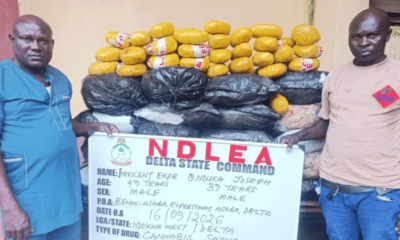
NDLEA intercepts N3.4bn drugs, arrests fake police officer
-
News2 days ago
Woman allegedly kills husband over plans to marry second wife
-
Politics3 days ago
NDC disowns purported OK Movement PCC, moves to sanction John Ugulu
-
News1 day ago
Flood Alert: 8,000 communities, 4,500 schools at risk – FG