International
Assassination fear: Iran’s leader Khamenei picks three successors, skips son


The Islamic Republic of Iran’s Supreme Leader Ayatollah Ali Khamenei has reportedly handpicked three potential successors in case he is killed during Israel’s ongoing military campaign — a revelation that signals unprecedented urgency inside Tehran’s highest ranks.
According to an investigative report by The New York Times on Saturday, the 86-year-old Supreme Leader, now operating from a fortified bunker, privately named three senior clerics to assume power should he die during the conflict.

The Times cites “senior Iranian officials” who say Khamenei made the selections after a string of high-level assassinations by Israeli forces.
Significantly, Khamenei’s influential son, Mojtaba, long rumoured to be groomed for succession, was not included in the list.
This marks a dramatic shift from years of speculation that a dynastic handover was being engineered behind the scenes, Jerusalem Post also reports on Saturday.

“Khamenei has nominated three clerics as potential successors while hiding in a bunker… Mojtaba is not among them,” reported The New York Times, citing confidential Iranian sources close to the leadership.
Meanwhile, The Jerusalem Post corroborated the report, noting that the Supreme Leader has also “selected replacements down his military chain of command” in anticipation of further Israeli strikes that could decimate his inner circle.
Succession Crisis in Real Time
Under normal conditions, Iran’s Supreme Leader is chosen by the Assembly of Experts — an 88-member clerical body.
But Khamenei’s reported actions suggest he is attempting to shape that outcome in advance, potentially bypassing traditional structures to preserve his ideological legacy and prevent internal fractures.
Analysts say the selection of three clerics, rather than one, reflects both a lack of consensus within Iran’s ruling elite and the urgency of contingency planning as the threat level escalates.
While names have not been officially released, the report indicates the candidates are figures trusted by Khamenei and aligned with the regime’s hardline core.
Implications Beyond Iran
The move has immediate geopolitical consequences. With the region on edge following Israeli strikes on senior Iranian and Hezbollah commanders, the specter of regime instability could further inflame the Middle East.
It also raises questions about the viability of Iran’s leadership structure should Khamenei be incapacitated.
“Khamenei’s action signals a regime that sees the risk of decapitation as real,” said a senior regional intelligence official quoted in The New York Times. “It is succession planning not in theory — but under fire.”
What Happens Next
The Assembly of Experts could still exercise formal authority, but if Khamenei’s influence continues beyond the grave — through his private picks — Iran’s post-Khamenei era may be shaped more by survivalism than clerical consensus.
For now, the message from Tehran is clear: the Islamic Republic is bracing for a leadership transition in the shadow of war, multiple media agencies report.













There are grave fears for the passengers of a private plane that suddenly vanished mid-flight, sparking a major search off the coast of the US.
US authorities say the Gulfstream G100 lost contact with air traffic control about 2am local time on Saturday (4pm Saturday AET) while flying from L.F. Wade International Airport in Bermuda to Boston Logan International Airport.
The US Coast Guard said the Federal Aviation Administration alerted it after contact was lost with the aircraft – which plummeted from 23,500 feet to 11,000 feet in just three minutes, according to FlightAware data.
“We are praying for a safe outcome,” a spokesperson for Latitude Air Ambulance, which operates the missing plane, told City News.
A search is now under way off Nantucket in the air and on water as crews work to locate the missing jet, the Coast Guard said. Data from FlightRadar24 showed a number of aircraft searching south of the island.
Six people are missing after a private jet vanished, sparking a major search off the coast of Nantucket in the US.
The plane was en route from Bermuda to Boston when it vanished.
“Air & surface crews have launched in search of the aircraft. Updates will be provided here as info becomes available,” the Coast Guard Northeast District said on X.
The plane was carrying out a medical evacuation in Bermuda – a British overseas territory in the north Atlantic Ocean, according to Clarence Togeretz, Director of Flight Operations at Latitude Air Ambulance.
“We always get rather concerned when our crew doesn’t report to us in a timely manner,” he told NBC News.
“But I will say that again, optimistically and positively, that doesn’t mean that the worst has happened.”
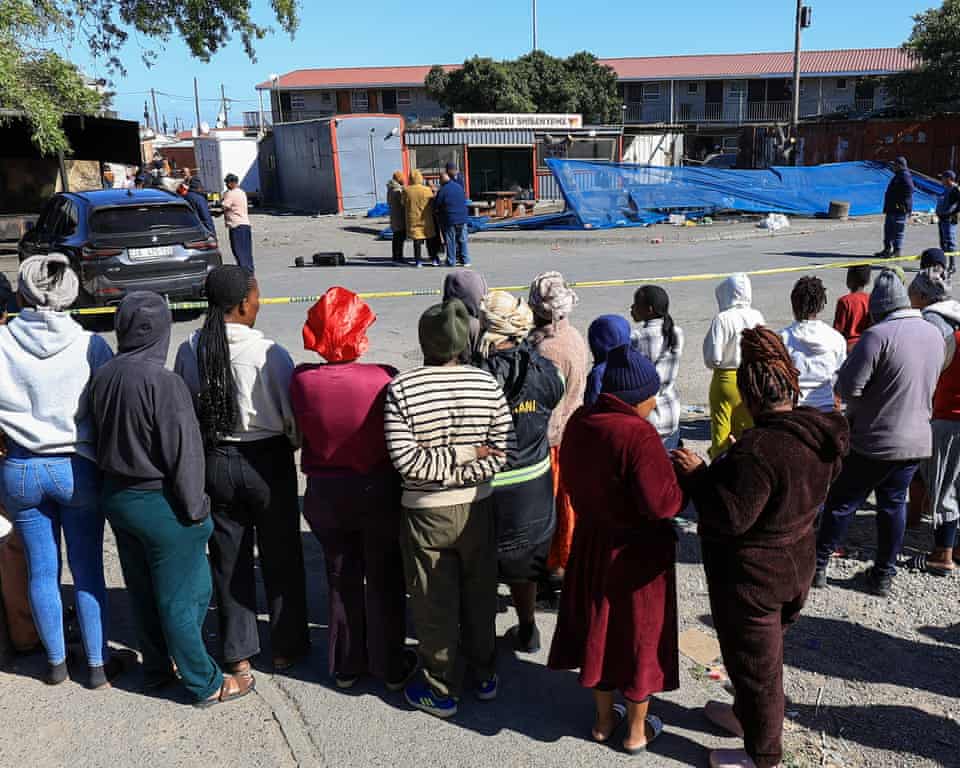
Seventeen people were killed when eight gunmen stormed a bar close to Johannesburg on Saturday evening, with 15 more injured.
In a separate shooting in the early hours of Sunday morning, 10 people were killed outside an entertainment venue in a township near Cape Town and a further 11 were injured.
South Africa has one of the highest murder rates in the world and has struggled to contain gang-related gun violence in recent years. Police have not indicated a motive for either of the latest attacks.
In Johannesburg, gunmen opened fire on customers outside the bar before continuing the attack inside and torching two vehicles before fleeing.
Police said thirteen men and four women were killed.
Deputy provincial police commissioner Maj Gen Fred Kekana said the attack may have been a retaliation for an incident last month, in which one person was killed and another wounded, according to AFP news agency.
Speaking at the scene, he said police had clear pictures and in some cases names for the suspects.
In Cape Town, five victims died at the scene and a further five people died in hospital.
No arrests had been made in either case on Sunday morning.
The two mass shootings came days after 11 people were killed in the city of Duban when gunmen stormed a house in the KwaMakhutha township.

Illegal weapons are prevalent in South Africa and gun violence has been a persistent problem for decades, with about 60 murders recorded every day in the country of 62 million.
But a recent spate of mass shootings has raised fears that the problem is deepening, with violence often linked to turf wars between gangs engaged in drug trafficking and illegal mining.
In February, President Cyril Ramaphosa called organised crime “the most immediate threat to our democracy, our society and our economic development”.
Earlier this year the military was deployed alongside police in areas with the highest murder rates in an effort to reduce armed violence.
On Saturday a tenth woman’s body was found in Ekurhuleni, to the east of Johannesburg, with local police saying they were unable to rule out a serial killer operating in the area with similarities between the deaths. (BBC)
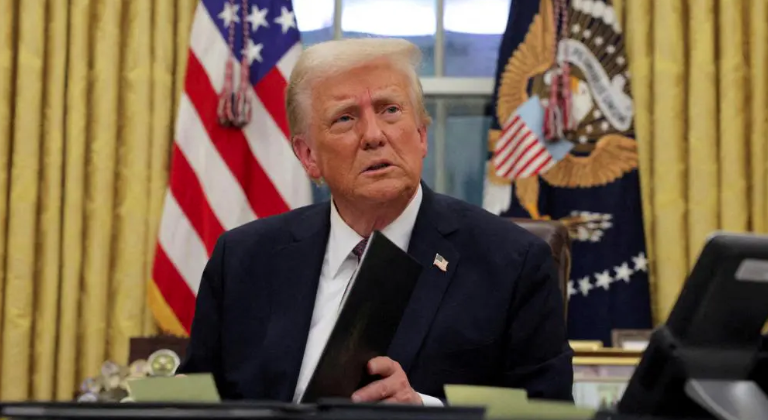
The United States has deported more than 25,000 people under secretive agreements with 35 countries to take migrants with no ties to those nations, according to an investigation published Monday.
Since US President Donald Trump took office in January 2025, Washington has been signing deals with developing countries to take migrants who cannot legally be sent home.
The investigation by Forbidden Stories found the administration has earmarked $410 million to be paid directly to the receiving countries, or to UN agencies to facilitate the returns.
At least 25,447 people had already been deported to third countries by August 31, 2026, according to data compiled by Forbidden Stories with a consortium of international journalists.
The vast majority — around 20,000 — were sent to Mexico, but the rest were dispersed to 27 other countries across Latin America, Africa, and the Pacific, and agreements have been finalised with seven more.
The deals vary, including over which nationalities can be deported and whether people with criminal records can be accepted.
An AFP investigation earlier this year found Washington is using visa bans and restrictions on African countries to strongarm them into accepting deportees.
Lawyers told AFP that deportees were being thrown into a “legal black hole”, held without charge in countries where they have no ties and few if any rights.
Forbidden Stories said 49 of Africa’s 54 countries had been approached about accepting third-country deportees.
A little-known State Department division called the Office of Remigration, created in May 2025, has handled most of the negotiations and payments, according to Forbidden Stories.
The office is headed by Christian Jove Ehrhardt, a 41-year-old diplomat who previously worked as a security officer.
The report details his visits to Cameroon, which signed a memorandum of understanding with the US in December on accepting deportees. A week later, it also signed a five-year health assistance programme worth nearly $400 million.
The following month, the State Department said it would provide a further $30 million to the UN Refugee Agency (UNHCR) in Cameroon to “facilitate the voluntary return of refugees and combat illegal immigration.”
The first plane carrying deportees arrived in Cameroon on January 14.
– Payments –
Other agreements have involved direct payments to governments.
Palau, a small Pacific island nation with a population of under 18,000, signed an agreement in December 2025 to accept up to 75 third-country nationals in return for $7.5 million.
However, only three people have so far been sent under the agreement.
In Eswatini, 32 people have arrived since July 2025 out of a possible 160 under an agreement worth more than $5 million. It has accepted deportees with criminal records, the investigation found.
Of the $410 million planned for the agreements, internal State Department records showed that $81 million was earmarked for signatory governments.
The rest was intended for aid organisations, including more than $178 million for the UN’s International Organisation for Migration, and $123 million for UNHCR.
The agencies have faced criticism over their involvement, although UNHCR told Forbidden Stories that it was not party to the bilateral agreements and that US funding was being used in line with its mandate to strengthen asylum systems.
An IOM spokesperson told Forbidden Stories that the agency’s decisions to accept funding rested “on a single question: whether our engagement will improve the lives of the migrants affected. In these instances, we believe strongly it does.”
-
 Faith4 hours ago
BREAKING: Anglican Church Places Archbishop Ibezim on Six-Month Leave, Bars Him From Church Duties
-
News22 hours ago
Senate fumes over death of NYSC Corps member at Enugu Camp, orders probe
-
News1 day ago
How Senator Mandiya died after bathroom fall in Abuja Home – Ningi
-
News2 days ago
2027: Why I wont attend every campaign rally – Tinubu
-
Features2 days ago
Aguleri/Umuoba Anam Crisis: The Bloody Battle Between Close Neighbours
-
News2 days ago
EFCC probes Atiku over alleged corruption committed as Vice President
-
News2 days ago
‘Anyone who attempts suicide and fails will go to jail,’ says Akpabio
-
Politics1 day ago
2027: I can bet my life Obi will humiliate Soludo in Anambra – Momodu