International
Iran’s leader rejects call to surrender, saying US intervention would cause ‘irreparable damage’

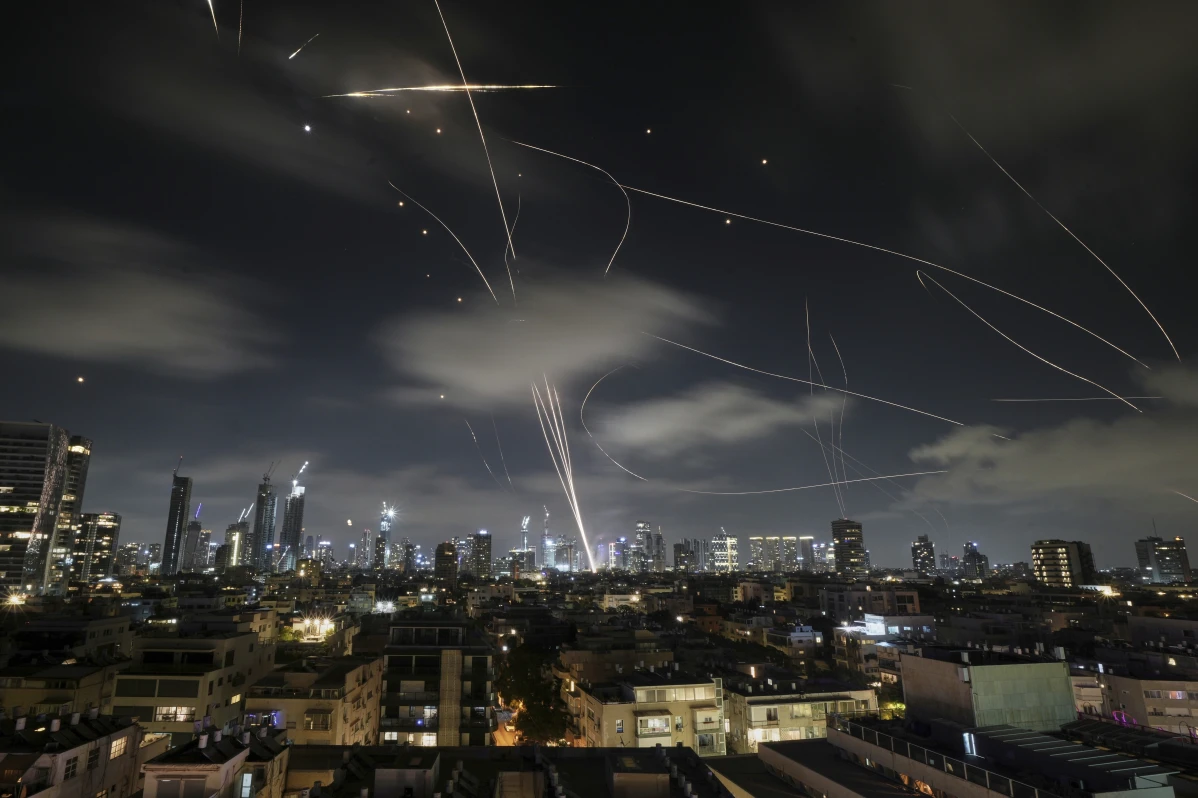
Iran’s supreme leader on Wednesday rejected U.S. calls for surrender in the face of blistering Israeli strikes and warned that any military involvement by the Americans would cause “irreparable damage” to them.
The second public appearance by Ayatollah Ali Khamenei since the Israeli strikes began six days ago came as Israel lifted some restrictions on daily life, suggesting that the missile threat from Iran was easing.

Khamenei’s speech came a day after U.S. President Donald Trump demanded “UNCONDITIONAL SURRENDER” in a social media post and warned Khamenei that the U.S. knows where he is but has no plans to kill him, “at least not for now.”
Trump initially distanced himself from Israel’s surprise attack on Friday that triggered the conflict, but in recent days has hinted at greater American involvement, saying he wants something “much bigger” than a ceasefire. The U.S. has also sent more military aircraft and warships to the region.
‘The Iranian nation is not one to surrender’
Khamenei dismissed the “threatening and absurd statements” by Trump.

“Wise individuals who know Iran, its people, and its history never speak to this nation with the language of threats, because the Iranian nation is not one to surrender,” he said. “Americans should know that any military involvement by the U.S. will undoubtedly result in irreparable damage to them.”
A state TV anchor had read Khamenei’s statement earlier, before the video was aired. Iran followed a similar sequence in releasing an earlier statement from the supreme leader, perhaps as a security measure. His location is not known.
His voice echoed as he sat in a room with beige curtains. An Iranian flag and a portrait of Grand Ayatollah Ruhollah Khomeini, who Khamenei succeeded in 1989, hung behind him.
An Iranian official had earlier Wednesday warned that U.S. intervention would risk “all-out war.”
Foreign Ministry spokesman Esmail Baghaei did not elaborate, but thousands of American troops are based in nearby countries within range of Iran’s weapons. The U.S. has threatened a massive response to any attack.
Another Iranian official said the country would keep enriching uranium for peaceful purposes, apparently ruling out Trump’s demands that Iran give up its disputed nuclear program.
Strikes in and around Tehran
The latest Israeli strikes hit a facility used to make uranium centrifuges and another that made missile components, the Israeli military said. It said it had intercepted 10 missiles overnight as Iran’s retaliatory barrages diminish. The U.N. nuclear watchdog said Israel had struck two centrifuge production facilities in and near Tehran.
The Israeli military said it also carried out strikes in western Iran, hitting missile storage sites and a loaded missile launcher.
Israeli strikes have hit several nuclear and military sites, killing top generals and nuclear scientists. A Washington-based Iranian human rights group said at least 585 people, including 239 civilians, have been killed and more than 1,300 wounded.
Iran has fired some 400 missiles and hundreds of drones in retaliatory strikes that have killed at least 24 people in Israel and wounded hundreds. Some have hit apartment buildings in central Israel, causing heavy damage, and air raid sirens have repeatedly forced Israelis to run for shelter.
Iran has fired fewer missiles as the conflict has worn on. It has not explained the decline, but Israel has targeted launchers and other infrastructure related to the missiles.
Casualties mount in Iran
The Washington-based group Human Rights Activists said it had identified 239 of those killed in Israeli strikes as civilians and 126 as security personnel.
The group, which also provided detailed casualty figures during 2022 protests over the death of Mahsa Amini, crosschecks local reports against a network of sources it has developed in Iran.
Iran has not been publishing regular death tolls during the conflict and has minimized casualties in the past. Its last update, issued Monday, put the toll at 224 people killed and 1,277 others wounded.
Shops have been closed across Tehran, including in its famed Grand Bazaar, as people wait in gas lines and pack roads leading out of the city to escape the onslaught.
A major explosion could be heard around 5 a.m. in Tehran Wednesday morning, following other explosions earlier in the predawn darkness. Authorities in Iran offered no acknowledgement of the attacks, which has become increasingly common as the Israeli airstrikes have intensified.
At least one strike appeared to target Tehran’s eastern neighborhood of Hakimiyeh, where the paramilitary Revolutionary Guard has an academy.
Iran says it will keep enriching uranium
Israel says it launched the strikes to prevent Iran from building a nuclear weapon, after talks between the United States and Iran over a diplomatic resolution had made little visible progress over two months but were still ongoing. Trump has said Israel’s campaign came after a 60-day window he set for the talks.
Iran long has insisted its nuclear program was peaceful, though it is the only non-nuclear-armed state to enrich uranium up to 60%, a short, technical step away from weapons-grade levels of 90%. U.S. intelligence agencies have said they did not believe Iran was actively pursuing the bomb.
Israel is the only country in the Middle East with nuclear weapons but has never publicly acknowledged them.
Iran’s ambassador to Geneva, Ali Bahreini, told reporters that Iran “will continue to produce the enriched uranium as far as we need for peaceful purposes.”
He rejected any talk of a setback to Iran’s nuclear research and development from the Israeli strikes, saying, “Our scientists will continue their work.”
Israel welcomes first repatriation flights
Israelis began returning on flights for the first time since the country’s international airport shut down at the start of the conflict.
Two flights from Larnaca, Cyprus, landed at Tel Aviv’s Ben Gurion International Airport on Wednesday morning, said Lisa Dvir, an airport spokesperson.
Israel closed its airspace to commercial flights because of the ballistic missile attacks, leaving tens of thousands of Israelis stranded abroad. The conflict has disrupted flight patterns across the region. (AP News)










Seventeen people were killed when eight gunmen stormed a bar close to Johannesburg on Saturday evening, with 15 more injured.
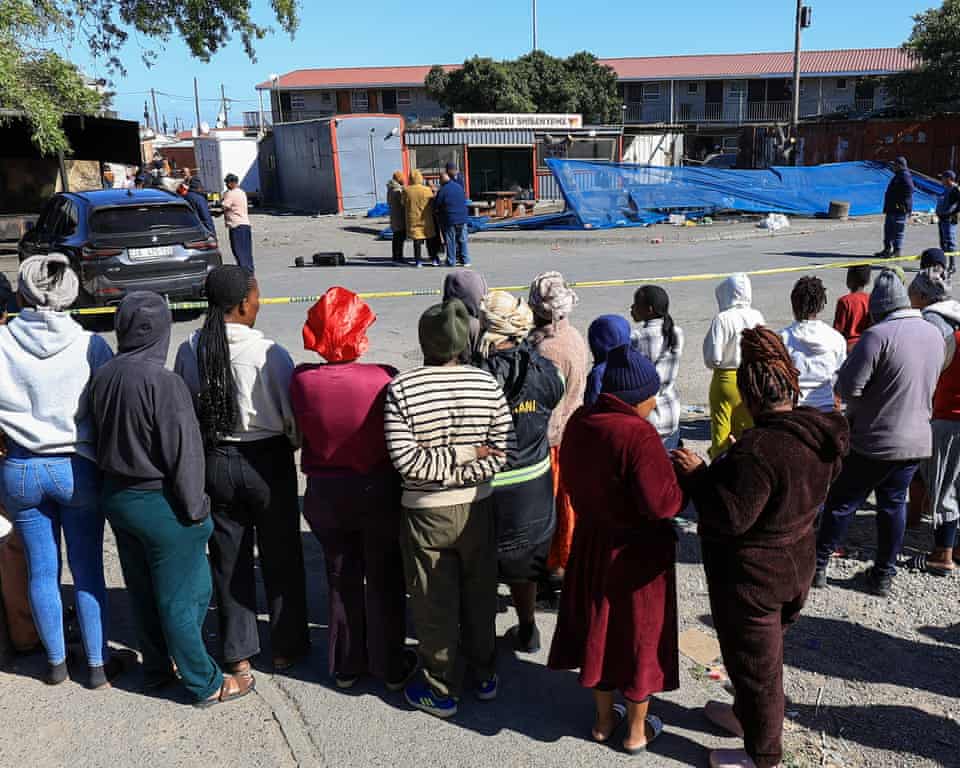
In a separate shooting in the early hours of Sunday morning, 10 people were killed outside an entertainment venue in a township near Cape Town and a further 11 were injured.
South Africa has one of the highest murder rates in the world and has struggled to contain gang-related gun violence in recent years. Police have not indicated a motive for either of the latest attacks.
In Johannesburg, gunmen opened fire on customers outside the bar before continuing the attack inside and torching two vehicles before fleeing.
Police said thirteen men and four women were killed.
Deputy provincial police commissioner Maj Gen Fred Kekana said the attack may have been a retaliation for an incident last month, in which one person was killed and another wounded, according to AFP news agency.
Speaking at the scene, he said police had clear pictures and in some cases names for the suspects.
In Cape Town, five victims died at the scene and a further five people died in hospital.
No arrests had been made in either case on Sunday morning.
The two mass shootings came days after 11 people were killed in the city of Duban when gunmen stormed a house in the KwaMakhutha township.

Illegal weapons are prevalent in South Africa and gun violence has been a persistent problem for decades, with about 60 murders recorded every day in the country of 62 million.
But a recent spate of mass shootings has raised fears that the problem is deepening, with violence often linked to turf wars between gangs engaged in drug trafficking and illegal mining.
In February, President Cyril Ramaphosa called organised crime “the most immediate threat to our democracy, our society and our economic development”.
Earlier this year the military was deployed alongside police in areas with the highest murder rates in an effort to reduce armed violence.
On Saturday a tenth woman’s body was found in Ekurhuleni, to the east of Johannesburg, with local police saying they were unable to rule out a serial killer operating in the area with similarities between the deaths. (BBC)
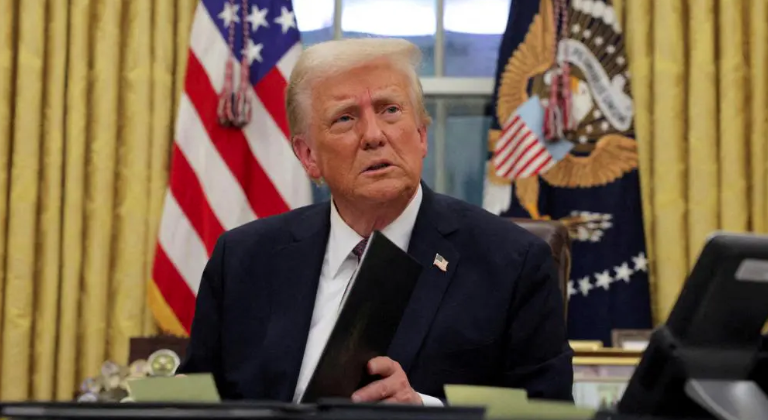
The United States has deported more than 25,000 people under secretive agreements with 35 countries to take migrants with no ties to those nations, according to an investigation published Monday.
Since US President Donald Trump took office in January 2025, Washington has been signing deals with developing countries to take migrants who cannot legally be sent home.
The investigation by Forbidden Stories found the administration has earmarked $410 million to be paid directly to the receiving countries, or to UN agencies to facilitate the returns.
At least 25,447 people had already been deported to third countries by August 31, 2026, according to data compiled by Forbidden Stories with a consortium of international journalists.
The vast majority — around 20,000 — were sent to Mexico, but the rest were dispersed to 27 other countries across Latin America, Africa, and the Pacific, and agreements have been finalised with seven more.
The deals vary, including over which nationalities can be deported and whether people with criminal records can be accepted.
An AFP investigation earlier this year found Washington is using visa bans and restrictions on African countries to strongarm them into accepting deportees.
Lawyers told AFP that deportees were being thrown into a “legal black hole”, held without charge in countries where they have no ties and few if any rights.
Forbidden Stories said 49 of Africa’s 54 countries had been approached about accepting third-country deportees.
A little-known State Department division called the Office of Remigration, created in May 2025, has handled most of the negotiations and payments, according to Forbidden Stories.
The office is headed by Christian Jove Ehrhardt, a 41-year-old diplomat who previously worked as a security officer.
The report details his visits to Cameroon, which signed a memorandum of understanding with the US in December on accepting deportees. A week later, it also signed a five-year health assistance programme worth nearly $400 million.
The following month, the State Department said it would provide a further $30 million to the UN Refugee Agency (UNHCR) in Cameroon to “facilitate the voluntary return of refugees and combat illegal immigration.”
The first plane carrying deportees arrived in Cameroon on January 14.
– Payments –
Other agreements have involved direct payments to governments.
Palau, a small Pacific island nation with a population of under 18,000, signed an agreement in December 2025 to accept up to 75 third-country nationals in return for $7.5 million.
However, only three people have so far been sent under the agreement.
In Eswatini, 32 people have arrived since July 2025 out of a possible 160 under an agreement worth more than $5 million. It has accepted deportees with criminal records, the investigation found.
Of the $410 million planned for the agreements, internal State Department records showed that $81 million was earmarked for signatory governments.
The rest was intended for aid organisations, including more than $178 million for the UN’s International Organisation for Migration, and $123 million for UNHCR.
The agencies have faced criticism over their involvement, although UNHCR told Forbidden Stories that it was not party to the bilateral agreements and that US funding was being used in line with its mandate to strengthen asylum systems.
An IOM spokesperson told Forbidden Stories that the agency’s decisions to accept funding rested “on a single question: whether our engagement will improve the lives of the migrants affected. In these instances, we believe strongly it does.”

The mother of a black woman whose body was found hanging from a tree in Jackson, Mississippi, has told the BBC she is still waiting for answers from officials more than a month later.
Her demands have been echoed by a community in the southern US state that has been left shocked and angry.
After weeks of silence, police on Tuesday confirmed for the first time that they were investigating the death of Tasia Fortune, 29, as a potential homicide – while clarifying that her official cause of death has yet to be confirmed.
Authorities discovered Fortune’s body on 3 August, hanging from a tree in the lot of an abandoned home.
Local concern over her death has been heightened by the fact that the state has a dark history of racial violence and lynchings.
The majority-black city has been left on edge. As the question lingers as to how Fortune died, petitions online signed by tens of thousands of people have called for more transparency, and members of US Congress have asked for federal intervention.
“It’s making me angry,” Fortune’s mother, Christy Spivey, said. “What is the hold up?”
Spivey described desperate attempts to understand the status of the investigation and how multiple enquiries to police had gone unanswered.
The first update she had received from authorities in weeks came in a public city meeting on Tuesday evening as Jackson Police Chief RaShall Brackney discussed the case and said the department “has been investigating this case from day one as a homicide”.
Brackney, in a statement to the BBC, elaborated and said the department always treats any pending death case as a “potential homicide” so that crucial evidence is not lost as police wait on autopsy results.
The department, though, had only previously described the case as a death investigation.
Tuesday’s statement from Brackney said “we are conducting the investigation at the highest appropriate level while we await the medical examiner’s findings”, which would include an official cause and manner of death.
The medical examiner’s office said it would not comment on the pending case.
Christy Spivey Tasia Fortune holds a finger to her lips and smiles in a family handout photoChristy Spivey
Spivey last saw her daughter alive on 26 July, when Fortune had travelled from Mississippi, where she had lived for roughly the last decade, to Kentucky, where Spivey lives, for a family reunion.
The next time she saw her daughter – in a funeral home, days before her burial – she could barely look at her body.
“I didn’t look straight at her. Her daddy did,” she said. “I kind of looked from the side.”
Spivey remembered their last conversation. “She was talking about, you know, maybe even coming home,” she explained.
Fortune’s death has left the community concerned that racial violence in Mississippi could be on the rise again. And in the absence of concrete details about the case, their suspicions are left to fester.
Fortune’s death was the third incident in Mississippi in less than a year where police found someone dead and hanged from a tree.
The other two bodies – one black male, one white – were discovered in September 2025, on the exact same day.
Both were ruled a suicide, though the mother of one of the deceased – Trey Reed – contests those findings.
Fed-up residents have launched an online petition, which has gathered more than 50,000 signatures, for an independent investigation into the state’s chief medical examiner, Dr Staci Turner, over the handling of a recent spate of cases involving people of colour. Another petition asks for the FBI to launch an investigation into Fortune’s death
The BBC has asked Turner for comment.
Jackson City Councilman Kenneth Stokes has also expressed concerns about the police investigation, saying he’d been outside the home where Fortune was thought to have lived multiple times and has never seen officers.
“All cases are important, but this one – a hanging in Mississippi – should rise to the top of the food chain,” Stokes said.
He told the BBC he sent letters to both federal prosecutors at the Mississippi US attorney’s office and the FBI weeks ago, urging that the investigation was “in dire need of assistance”. He has yet to hear back from either.
“Nothing from nobody,” Stokes said. “It’s like nobody cares.”
The BBC has reached out to the Mississippi US attorney’s office and the local FBI office for comment.
US Congresswoman Jasmine Crockett has similarly requested federal intervention. In a letter to the US Department of Justice, she asked for an investigation into recent deaths in Mississippi – including that of Tasia Fortune – calling them “possible cases of modern-day lynchings”. She cited the state’s “appalling historical reputation of violent terrorism against black Americans”.
ADVERTISEMENT
In addition to Mississippi, there have been multiple other cases nationally of black Americans found hanged from trees, including four in North Carolina this year alone. Three were ruled a suicide. An autopsy is pending for the fourth death.
The BBC has reached out to the justice department for comment.
Stokes is clear that he does not know whether Fortune’s death was a lynching, or whether race played a part at all. Nor does he care. He just wants answers.
Brandon King, president of the student National Association for the Advancement of Colored People (NAACP) chapter at nearby Jackson State University, said the mystery of Fortune’s death, combined with minimal updates from police, has led him and others to be “extra cautious” around campus.
The feeling, King said, was that “hey, you could be next. This is in Jackson. This is in your backyard”.
The thought is extra worrying, he continued, because “this is supposed to be the capital. This is where I’m supposed to feel the most safe”.
As for Spivey, she cried before heading to a funeral home for her daughter, dreading having to fill out a death certificate and decide whether to cremate or bury her firstborn child.
She wanted to cremate her daughter but decided, in the end, for a burial. She said she was holding out hope there would be updates in the investigation, which might mean needing to exhume her corpse. BBC
-
 News3 days ago
Ojukwu Property Dispute: OTL petitions IGP over demolition, construction at Macpherson Avenue Property
-
News2 days ago
Fuel Price Hike: Workers to begin strike in October
-
News3 days ago
‘I’m strong, ready to work’ – Tinubu speaks after return from vacation
-
News1 day ago
We can’t erase decades-long problems in 4 years, says Tinubu
-
News3 days ago
Xenophobia: Nigerian Consulate condemns killing of three Nigerians in South Africa
-
News10 hours ago
Police confirm NYSC members among abducted passengers on Owerri-Onitsha Road, rescue 10
-
News2 days ago
Military records 367 attacks, kills 52 terrorists in September
-
News10 hours ago
NYSC members, other travellers ‘abducted’ along Owerri-Onitsha Expressway