International
Here are all the changes Donald Trump signed during his first day as US president


It was anticipated Mr Trump would sign up to 100 orders on his first day back in the White House.
In the end, the figure was just shy of 50.

Mr Trump has spoken openly about his plans to grow domestic energy production, crack down on the Mexican border and end diversity, equity and inclusion programs within the federal government.
Here’s what we know.
What is an executive order?
They are essentially statements about how the president wants the federal government to be managed, which can mean instructions to federal agencies or requests for reports.

Executive orders can also play an important role in laying out major policy agendas.
While these orders are legally binding, they are not legislation as they don’t require approval from Congress.
It doesn’t necessarily mean the president can enact orders without challenge, as Congress could still block an order from being fulfilled by removing funding or creating other hurdles.
Only a sitting US president can overturn an existing executive order.
New presidents will often issue orders to cancel the orders of their predecessors.
Other presidential documents — such as proclamations and political memorandums — can also be similar to executive orders, but have different purposes.
However, all three are used by presidents to pursue actions they can’t get through Congress.
What are the limitations to executive orders?
There have been several thousand executive orders signed throughout US history, according to data collected by the American Presidency Project at the University of California.
During his first term, Mr Trump signed 220 orders and Joe Biden had signed 160, as of December 20.
But there are limitations to executive orders, as both Congress and the courts can potentially block orders.
In 1992, Congress revoked an executive order by then-president George HW Bush that would establish a human foetal tissue bank for scientific research.
Congress did this by passing a measure that meant the order would “not have any legal effect”.
And, Congress can also deny funding to agencies and those behind the enforcement of an order.
These orders could also be legally challenged based on the argument that a president went beyond their legal authority.
This was seen when the US Supreme Court said then-president Harry Truman lacked the authority to take private property without authorisation from Congress, when he tried to seize steel mills during the Korean War.
What executive orders has Donald Trump signed so far?
Mr Trump has signed a wide-ranging number of executive orders, with some aimed at walking back from climate action and others focused on “restoring free speech” in the US.
National ‘border emergency’
Mr Trump’s rhetoric around migration continued with the signing of an executive order that declared a “national emergency” at the US and Mexico border.
“America’s sovereignty is under attack,” the order said.
“Our southern border is overrun by cartels, criminal gangs, known terrorists, human traffickers, smugglers, unvetted military-age males from foreign adversaries, and illicit narcotics that harm Americans, including America.
“To protect the security and safety of United States citizens, to protect each of the states against invasion, and to uphold my duty to take care that the laws be faithfully executed, it is my responsibility as president to ensure that the illegal entry of aliens into the United States via the southern border be immediately and entirely stopped.”
Mr Trump rolled back a number of immigration policies announced by the Biden administration, and ordered the shut down of the CBP One app.
The app allowed migrants to schedule appointments to gain entry into the US and was previously credited by officials as streamlining the border crossing process.
Mr Trump also ordered an end to releasing migrants in the US while they await immigration court hearings — part of his Remain in Mexico policy — and an end to asylum.
It is expected his border policies could result in mass deportations, and Mexico President Claudia Sheinbaum has previously signalled her desire to help those impacted by the changes.
He also moved to consider designating cartels as “foreign terrorist organisations”, and called them an international security threat.
Mr Trump said securing the southern border was a part of his plan to bring them under control.
‘Only’ two genders
Mr Trump has declared the federal government would recognise only two genders — male and female — and would roll back previous legislation that enshrines the protection of transgender people.
The order would also remove the word “gender” from federal documents, and replace it with “sex”.
While the federal government has no control over how people identify, it can enforce the declaration on documents such as passports and visas.
American civil rights organisation focused on LGBTQI+ activism Lambda Legal said it would look to sue over the order.
“While much of what is called for by the executive orders signed today will take time to implement, we will vigilantly monitor and be ready to challenge when they take effect,” a spokesperson said.
“We are exploring every legal avenue to challenge these unlawful and unconstitutional actions. This is not only about politics and ideology — but also about real people’s lives.”
End to automatic citizenship
Mr Trump has ordered the overturning of birthright citizenship.
Birthright citizenship is enshrined in the 14th amendment of the US Constitution, and dictates:
“All persons born or naturalised in the United States, and subject to the jurisdiction thereof, are citizens of the United States and of the state wherein they reside.”
It was adopted in 1868 to ensure citizenship for Black people.
Mr Trump said automatic citizenship was “just ridiculous” and said he was on “good legal ground” to change it.
However he has already been challenged by the American Civil Liberties Union and other advocates.
They have initiated a lawsuit over the order, arguing Mr Trump would be wrongly denying a right enshrined in the constitution.
The lawsuit was filed by the ACLU, Asian Law Caucus, State Democracy Defenders Fund and Legal Defense Fund on behalf of organisations with members whose children were born on US soil and would be denied citizenship.
“Birthright citizenship embodies America’s most fundamental promise: that all children born on our soil begin life as full and equal members of our national community, regardless of their parents’ origins, status, or circumstances,” according to the complaint filed in Concord, New Hampshire.
“This principle has enabled generations of children to pursue their dreams and build a stronger America.”
Pardoned January 6 convictions
Mr Trump will pardon or commute the sentences of 1,500 people in connection with the Capitol riots on January 6, 2021.
Hundreds of Trump’s supporters stormed the US Capitol after he made baseless claims that an election victory had been “stolen” from him.
The Capitol riots were widely condemned by those on both sides of politics, and people were arrested in connection with the attack.
Mr Trump has commuted the sentences of 14 people so far — including those of far-right activists — making them eligible to be freed straight away.
He called the arrests and convictions a “grave national injustice”.
The order has already been condemned by Senate Democratic Leader Chuck Schumer.
“The people who invaded the Capitol on January 6th, whether they committed violence or not, should not have been pardoned,” he said.
“Donald Trump is ushering in a Golden Age for people that break the law and attempt to overthrow the government.”
Republican Senator Mike Rounds said while January 6 was a “bad day for America”, he respected Mr Trump’s right to issue pardons.
Withdrawing from the Paris Climate Agreement
The Paris Climate Agreement is an international treaty which legally binds its signatories to fight climate change.
It is the second time Mr Trump has withdrawn the US from the agreement.
“The United States will not sabotage our own industries while China pollutes with impunity,” Mr Trump said.
Amnesty International has already condemned the order as “reckless” and “short-sighted” while the World Resources Institute said the Paris Agreement remained essential to combating climate change.
“It simply makes no sense for the United States to voluntarily give up political influence and pass up opportunities to shape the exploding green energy market,” an institute spokesperson said.
“Sitting on the sidelines also means the United States will have fewer levers to hold other major economies accountable for living up to their commitments.”
The ‘restoration of free speech’
Mr Trump has been supported throughout his campaign and inauguration events by social media giants like Mark Zuckerberg and Elon Musk.
Mr Trump said the administration over the last four years had restricted free speech, particularly online.
“[The administration] trampled free speech rights by censoring Americans’ speech on online platforms, often by exerting substantial coercive pressure on third parties, such as social media companies, to moderate, deplatform, or otherwise suppress speech that the federal government did not approve,” the order said.
The order highlighted particular concerns over the government censoring information ‘under the guise’ of misinformation.
Mr Trump’s order comes just weeks after Meta announced it would no longer continue with its fact-checking service, with chief executive officer Mark Zuckerberg claiming he had been inspired by Elon Musk’s work at X — formerly known as Twitter.
Mr Musk will head up a role in Mr Trump’s government, responsible for the Department of Government Efficiency.
The order also called for an investigation into the Biden administration’s impact on freedom of speech.
Keep TikTok online
Despite previously proposing a law to shut down social media app TikTok, Mr Trump has now extended it a lifeline.
TikTok went dark earlier this week in the US after continued discussions about its Chinese ownership.
Under a law passed last year, the platform was ordered to cut ties with ByteDance or shut down its US operation to resolve concerns it posed a threat to US national security.
When it failed to do so, the app went dark on Sunday with a message about working with Donald Trump to ensure a possible solution.
It quickly came back online on Monday, with the app again posting a message thanking the incoming president for his support.
Mr Trump said the app had a short reprieve, and had 75 days to find a US-based buyer.
Mr Trump previously suggested that an American buyer should purchase half of the company and run it as a 50-50 joint venture with its current owners, on his Truth Social account.
However US outlets said it would remain unclear if this ownership arrangement could satisfy those in Congress who have ongoing national security concerns.
Renaming the Gulf of Mexico
Mr Trump said it was appropriate to rename the Gulf of Mexico to the Gulf of America, because “we do most of the work there”.
The Gulf is an ocean basin bounded by the US, Cuba and Mexico, and is an important centre of economic activity including maritime transport and oil and gas production.
The name would be changed on US-used maps and in federal references, but other nations would not have an obligation to follow suit.
Republican Congresswoman Marjorie Taylor Greene has previously signalled her support for the move, saying her staff would be working on the legislation.
“Mexican cartels currently use the Gulf of Mexico to traffic humans, drugs, weapons, and God knows what else while the Mexican government allows them to do it,” she said.
The Mexican government has previously taken action against drug cartels in the Gulf region.
“The American people are footing the bill to protect and secure the maritime waterways for commerce to be conducted,” Ms Taylor Greene said.
No more work-from-home
Mr Trump ordered all federal employees return to work “as soon as practicable”.
The order is despite a report by the U.S. Office of Personnel Management, which found a majority of federal employees already work in their offices full-time.
The report found about 10 per cent of federal employees work remotely.
American Federation of Government Employees president Everett Kelley said the move would not be helpful in attracting new employees.
“To justify this backward action, lawmakers and members of President Trump’s transition team have spent months exaggerating the number of federal employees who telework and accusing those who do of failing to perform the duties of their jobs,” he said.
“The truth is that less than half of all federal jobs are eligible for telework, and the workers who are eligible to telework still spend most of their work hours at their regular duty stations.
“Rather than undoing decades of progress in workplace policies that have benefited both employees and their employers, I encourage the Trump administration to rethink its approach and focus on what it can do to make government programs work better for the American people.”
Mr Trump also announced the termination of a number of diversity, inclusion and accessibility programs in workplaces.
Other executive orders signed by Mr Trump in his first day include:
- Withdrawing the US from the World Health Organization.
- Ensuring states carrying out the death penalty have a “sufficient supply” of lethal injection drugs.
- Rescinding 78 Biden-era orders, including a ban on off-shore drilling.
ABC News









International
France braces for another weekend of protests as authorities launch massive security operation
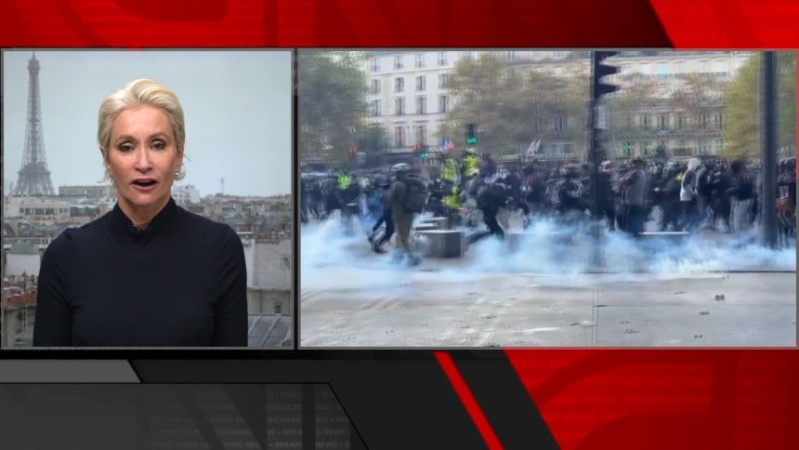
France is bracing for yet another wave of protests this weekend with authorities racing to prevent a repeat of the kind of violence and riots that hit the nation last week.
French authorities will be launching a massive security operation with some 70,000 police officers deployed across the country over the weekend, according to the interior ministry.
Specialist SWAT units, helicopters, armored vehicles, police dogs and water cannons will all be part of the operation. On top of that, the number of French army soldiers that normally patrol Paris as part of the country’s counter-terrorism measures will be increased to free the police from stationary guard duties.
Interior Minister Laurent Nuñez issued a stark warning on Friday to anyone looking for trouble, saying the government would be “uncompromising with those who engage in destruction.”
Last week’s violence followed weeks of protests over education, dismal job prospects and the cost of living. Initially peaceful and attended mostly by students, the demonstrations quickly turned into the worst wave of deadly, nationwide violence in years.
This week, curfews were imposed in some cities to help maintain calm.
Bracing for Saturday
A large demonstration has been called for Saturday afternoon in Paris and French media are expecting hundreds of thousands of people to attend.
The protest is organized by France’s main student union, UNEF, with one of the country’s biggest trade unions, CGT, announcing it would join. Other groups are expected to attend, including farmers, climate activists and the Yellow Vests, the movement that first emerged in 2018 during the protests over fuel costs.
While the protest in Paris has been authorized by the authorities, French President Emmanuel Macron on Thursday banned all non-trade union protests on Saturday as he seeks to control the civil unrest.
But the preparations go well beyond bans and police warnings, especially since last week’s riots sparked criticism of the authorities for not taking the threat seriously enough.
A police officer ties in place a perimeter tape near Chatelet – Les Halles to enforce a curfew, in central Paris on October 20.
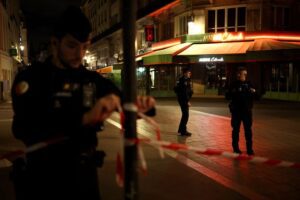
A police officer ties in place a perimeter tape near Chatelet – Les Halles to enforce a curfew, in central Paris on October 20.
Simon Wohlfahrt/AFP/Getty Images
The City of Paris announced earlier this week it was clearing public spaces of equipment and materials that could be used to cause damage, including barriers, bins, construction material and other items.
Many of the main tourist sites in the French capital, including world-famous museums like the Louvre, the Musée d’Orsay and the Musée de l’Orangerie will be closed on Saturday.
Art Basel finished the Paris version of its fair on Friday, two days earlier than scheduled. The Paris National Opera cancelled its performances on Saturday, citing the protests as the reason, and at least two dozen metro stations will also be closed for much of the day, according to Paris municipal authorities.
An NFL game between Pittsburgh Steelers and New Orleans Saints is set to take place at the Stade de France just outside of the capital on Sunday. While the match is scheduled to go ahead, a Steelers fan event in Paris was cancelled by the NFL.
During last weekend’s riots, at least two people died and multiple others suffered serious injuries, including two people who lost their hands. French Justice Minister Gérald Darmanin said some 2,700 people were held for questioning and 232 have been incarcerated in connection to the riots. (CNN)
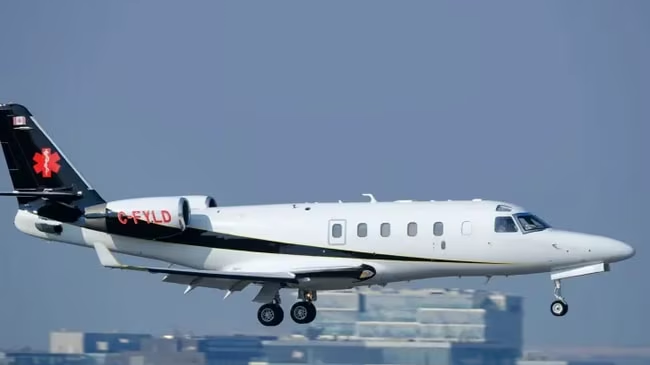
There are grave fears for the passengers of a private plane that suddenly vanished mid-flight, sparking a major search off the coast of the US.
US authorities say the Gulfstream G100 lost contact with air traffic control about 2am local time on Saturday (4pm Saturday AET) while flying from L.F. Wade International Airport in Bermuda to Boston Logan International Airport.
The US Coast Guard said the Federal Aviation Administration alerted it after contact was lost with the aircraft – which plummeted from 23,500 feet to 11,000 feet in just three minutes, according to FlightAware data.
“We are praying for a safe outcome,” a spokesperson for Latitude Air Ambulance, which operates the missing plane, told City News.
A search is now under way off Nantucket in the air and on water as crews work to locate the missing jet, the Coast Guard said. Data from FlightRadar24 showed a number of aircraft searching south of the island.
Six people are missing after a private jet vanished, sparking a major search off the coast of Nantucket in the US.
The plane was en route from Bermuda to Boston when it vanished.
“Air & surface crews have launched in search of the aircraft. Updates will be provided here as info becomes available,” the Coast Guard Northeast District said on X.
The plane was carrying out a medical evacuation in Bermuda – a British overseas territory in the north Atlantic Ocean, according to Clarence Togeretz, Director of Flight Operations at Latitude Air Ambulance.
“We always get rather concerned when our crew doesn’t report to us in a timely manner,” he told NBC News.
“But I will say that again, optimistically and positively, that doesn’t mean that the worst has happened.”
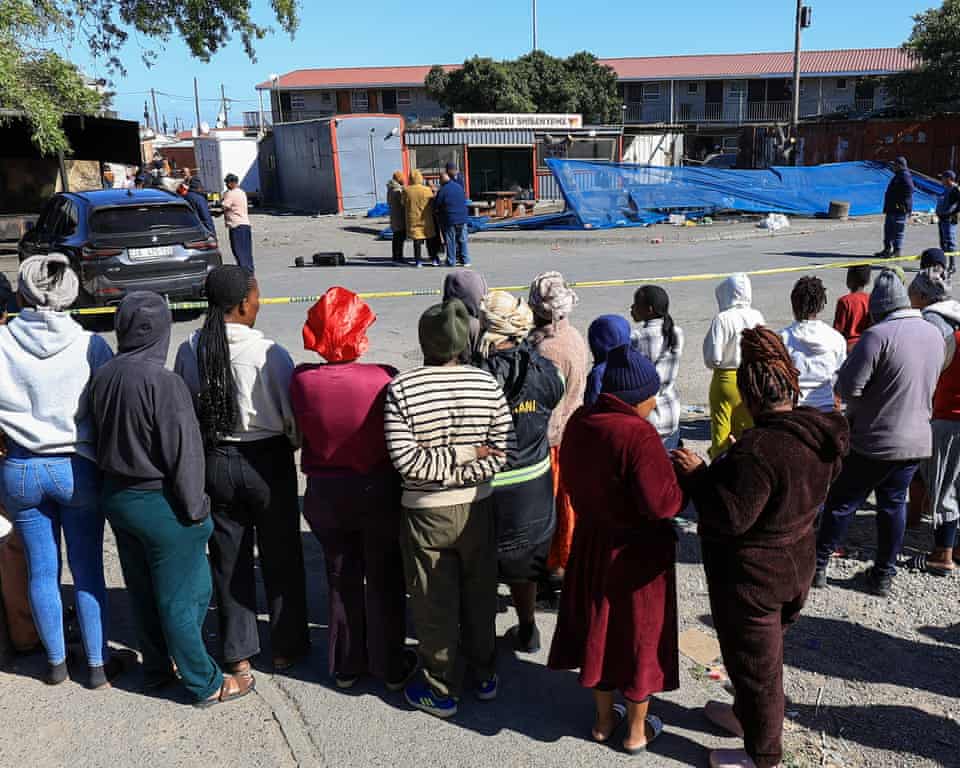
Seventeen people were killed when eight gunmen stormed a bar close to Johannesburg on Saturday evening, with 15 more injured.
In a separate shooting in the early hours of Sunday morning, 10 people were killed outside an entertainment venue in a township near Cape Town and a further 11 were injured.
South Africa has one of the highest murder rates in the world and has struggled to contain gang-related gun violence in recent years. Police have not indicated a motive for either of the latest attacks.
In Johannesburg, gunmen opened fire on customers outside the bar before continuing the attack inside and torching two vehicles before fleeing.
Police said thirteen men and four women were killed.
Deputy provincial police commissioner Maj Gen Fred Kekana said the attack may have been a retaliation for an incident last month, in which one person was killed and another wounded, according to AFP news agency.
Speaking at the scene, he said police had clear pictures and in some cases names for the suspects.
In Cape Town, five victims died at the scene and a further five people died in hospital.
No arrests had been made in either case on Sunday morning.
The two mass shootings came days after 11 people were killed in the city of Duban when gunmen stormed a house in the KwaMakhutha township.

Illegal weapons are prevalent in South Africa and gun violence has been a persistent problem for decades, with about 60 murders recorded every day in the country of 62 million.
But a recent spate of mass shootings has raised fears that the problem is deepening, with violence often linked to turf wars between gangs engaged in drug trafficking and illegal mining.
In February, President Cyril Ramaphosa called organised crime “the most immediate threat to our democracy, our society and our economic development”.
Earlier this year the military was deployed alongside police in areas with the highest murder rates in an effort to reduce armed violence.
On Saturday a tenth woman’s body was found in Ekurhuleni, to the east of Johannesburg, with local police saying they were unable to rule out a serial killer operating in the area with similarities between the deaths. (BBC)
-
 Features2 days ago
Mmesoma Umeorini: When Love Turns Deadly, and a Young Woman Pays With Her Life
-
Features2 days ago
Why Igbos Celebrate New Yam Festival Worldwide: The History, Cultural Significance and Lessons For The Younger Generation
-
News1 day ago
Kogi Police Probe Alleged Murder-Suicide Involving Two Officers
-
News9 hours ago
BREAKING: Tension as Video Shows Islamic Group Members Allegedly Calling for AK-47 to Kill Christians in Enugu, Jos
-
News3 days ago
Mbah: Why We Built 268 Smart Green Schools Across Enugu State
-
News1 day ago
NCDC Reports Two Suspected Ebola Cases as Contacts Rise to 53
-
News3 days ago
Anambra Police Arrest Suspect Over Murder of 23-Year-Old Woman in Uga
-
News1 day ago
Enugu Traders Pledge Support for Mbah’s Second Term, Cite Market Reforms