News
EFCC uncovers religious organisation laundering money for terrorists


The Economic and Financial Crimes Commission (EFCC) says it has uncovered a religious organisation laundering money for terrorists wreaking havocs in the country.
The chairman of the anti-graft agency, Ola Olukoyede, made this revelation during a one-day dialogue in Abuja, on Wednesday.

Speaking at a programme with the theme: “Youth, Religion, and the Fight against Corruption”, Olukoyede said the religious body was found culpable while protecting a money launderer after some money suspected to have been laundered was traced to the organisation’s bank account.
“A religious sect in this country had been found to be laundering money for terrorists. We were able to trace some laundered money to a religious organisation.”
“When we approached the religious organisation about it and we were carrying out our investigation, we got a restraining order stopping us from carrying out our investigation,” the EFCC boss said.

The one-day event was aimed at addressing the challenges of youth involvement in cybercrimes and how religion could be used for their reorientation.
The theme, which also featured the launch of the Interfaith Preaching and Teaching Manual developed by the Interfaith Anti-Corruption Advisory Committee of the Commission, was to instigate abhorrence for corruption among adherents of Islam and Christianity.
Speaking at the event, the EFCC boss also disclosed that not less than N7 billion fraud proceeds was traced to another religious organisation, explaining that one of such religious bodies dragged the commission to court to protect its leader after laundered money was traced to its bank account.
The anti-graft czar vowed that the agency won’t succumb to pressure from various quarters, adding that the EFCC would block and prosecute those culpable in the terrorism financing in line with the laws of the land.
Olukoyede stated, “We will not give up on recovering the stolen funds. It is so sad that as I stand before the eminent audience today, that our experience in fighting corruption has to do with the religious leaders and even traditional rulers.
“As I stand before you there is a matter we are handling of over 30 billion fleeced from Nigeria, and we were able to trace N7 billion to a particular religious body. As we wrote a letter to the leader, the next thing we saw was a restraining order, stopping us from inviting them, stopping us from recovering the money.”
According to him, the EFCC had appealed the restraining order against the commission and other critical steps to strengthen the fight have been put in place to win the fight against those who he described as “enemies of Nigeria”
He also revealed that since he assumed office about three months ago, the anti-graft commission had secured 747 convictions, but over 60 per cent of the convictions were cybercrime cases.
“To our faith leaders, my appeal is that those who lead our society from churches and mosques should develop messages that glorify industry, hard work, probity and contentment over riches, irrespective of how it was made.”
“We all must stand up and be counted in the efforts to reset the mentality of our youths that the fast lane to affluence is fraud. Aside from our commitment to using faith to tackle corruption in various levels of society.
“We have also developed a remarkable tool which we intend to deploy to prevent corruption in our Ministries, Department and Agencies,” he said.
According to him, the tool, a Fraud Risk Assessment Project, is meant to assist government agencies to address systemic vulnerabilities at the personal, institutional and environmental levels.
“When fully deployed, it will save the nation billions of Naira in stolen wealth, time and resources spent in investigating grand corruption cases.
“The project is intended to commence, in the first instance, with 20 extremely vulnerable agencies of government.
“We believe that with the support of the government and the cooperation of the leadership of the selected agencies, we will be able to drastically close the space for brazen graft in the public sector,” he said.
Our correspondent reports that the anti-graft agency’s Fraud Risk Assessment Prevention and Control Project for Ministries, Departments and Agencies was also inaugurated during the event.



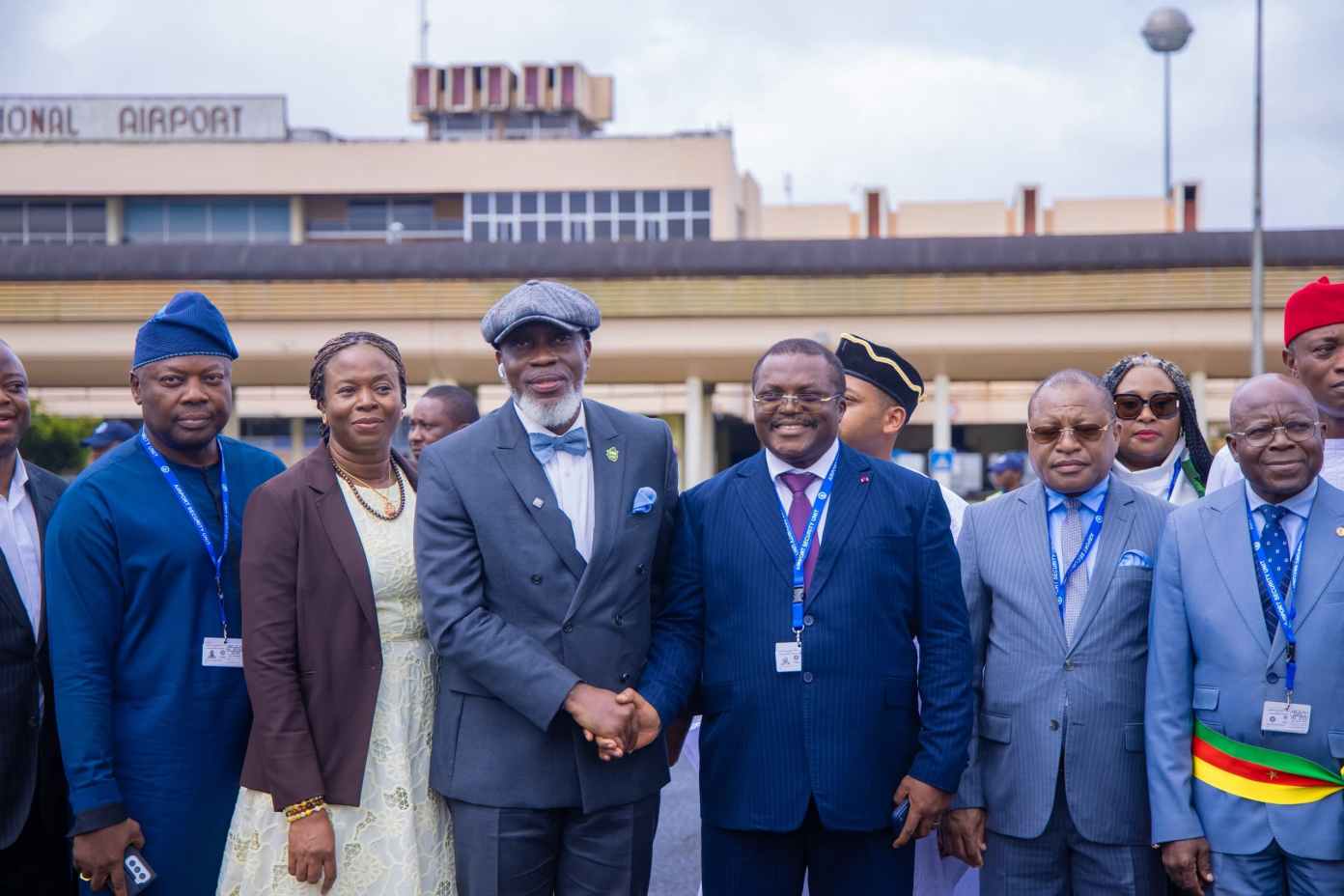
DOUALA, CAMEROON — A new chapter in air connectivity between Nigeria and Cameroon was opened on Wednesday, September 23, 2026, as Enugu Air touched down at Douala International Airport on its maiden international flight.
The historic arrival established a direct air link between South-East Nigeria and Central Africa, bringing together Nigerian and Cameroonian government officials, aviation stakeholders, business leaders and members of the Nigerian community in Douala.
The new route is expected to strengthen trade, tourism, investment, sports and cultural exchanges while making the movement of people and goods between Enugu and Cameroon easier and faster.
Representing Enugu State Governor, Dr. Peter Ndubuisi Mbah, the Secretary to the State Government, Professor Chidiebere Onyia, said the international route was part of the governor’s deliberate effort to reposition Enugu as a major economic and tourism hub.
According to Onyia, Governor Mbah has set a target of attracting three million visitors to Enugu annually, making improved connectivity and a conducive business environment critical to achieving the goal.
“Enugu Air is a product of that vision,” he said, adding that the direct connection would deepen tourism, commerce, sports and cultural exchanges between Enugu and Cameroon.
Onyia noted that passengers could now travel from Douala to Enugu in about an hour, while residents of Enugu would have easier access to Cameroon’s commercial and economic opportunities.
He also assured travellers that the new international service would be sustained, stressing that Enugu Air was not established for a temporary operation.
“Enugu Air is consistent,” he said, assuring that the airline would not launch a route only to discontinue it shortly afterwards.
Cameroon Welcomes New Partnership
The Governor of Cameroon’s Littoral Region, Samuel Dieudonné Ivaha Diboua, described Enugu Air’s arrival as the beginning of a fresh partnership between Cameroon and Enugu State.
Diboua recalled the longstanding relationship between Enugu and Cameroon, particularly in the area of sports, but said the new direct flight had created an opportunity to expand the relationship into stronger economic cooperation.
He noted that a significant number of Nigerian businessmen live and operate in Douala, saying the new air connection would facilitate the movement of people and goods between the two destinations.
“With these new flights, we think that the economy will grow,” he said.
Douala Airport Records Strong Passenger, Cargo Traffic
The Director of Douala International Airport, Jacob Bahayang Mbargaso, described the inaugural Enugu-Douala flight as an event of “triple significance”—diplomatic, economic and commercial.
Mbargaso said the new route was made possible through collaboration among Cameroon Airports, the Cameroon Civil Aviation Authority, ASECNA, Enugu Air and other aviation stakeholders.
He described Enugu Air’s arrival as a sign of confidence in Douala’s growing importance as a gateway and Central African aviation hub.
According to him, Douala International Airport recorded 8,500 aircraft movements, 595,971 passengers and 6,200 tonnes of freight during the first half of 2026.
He added that Enugu Air had become the airport’s 20th regular airline for the Summer 2026 season.
“Aviation indeed constitutes a powerful lever for regional integration,” Mbargaso said.
Nigerian High Commissioner Hails New Connection
The Nigerian High Commissioner to Cameroon, Sani Umar Jibrilla, described the occasion as more than the arrival of an aircraft on Cameroonian soil, saying it represented the beginning of a new chapter in relations between Nigeria and Cameroon.
Jibrilla said the Enugu-Douala connection would be particularly beneficial to traders and entrepreneurs from South-East Nigeria by providing a faster and more structured link to one of Central Africa’s major commercial centres.
He said the route would facilitate business, tourism and cultural exchanges while contributing to broader African integration.
The envoy commended Enugu Air and the Cameroonian authorities for making the new connection possible.
Enugu Air Promises Continuity
For the Chief Executive Officer of Enugu Air, Captain Tolu Ita, the inaugural landing was evidence that the airline’s ambitious expansion plans were rapidly becoming reality.
Ita disclosed that Enugu Air had joined the African Airlines Association (AFRAA) within six months, despite the association’s usual one-year expectation, saying the airline’s performance had attracted recognition.
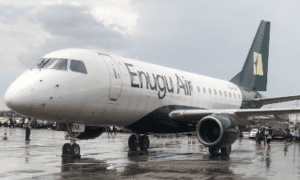
She assured passengers that the airline was committed to maintaining the Douala service.
“We are not like one of the airlines that will start and stop,” Ita said. “We go and we see and we are committed to make sure that this connectivity that we promised today continues.”
Nigerian Community in Douala Celebrates
For Lady Love Arum, an indigene of Enugu State who has lived in Douala for more than 16 years, the arrival of Enugu Air represented the end of years of difficult journeys between Cameroon and home.
Arum said residents previously had to travel by road or route their journeys through Lagos, making trips particularly stressful for families.
“I am so happy. We are blessed,” she said, adding that residents could now travel home with their children “without fear of bad roads or bandits.”
She said she initially doubted that the direct flight would become a reality until she witnessed Enugu Air land in Douala.
Arum praised Governor Mbah for making what she described as an unlikely development possible.
Enugu Delegation
The Enugu delegation at the historic event included the Attorney-General and Commissioner for Justice, Barrister Osinachi Njeze; Commissioner for Information, Dr. Malachy Agbo; Commissioner for Tourism, Dame Ugochi Madueke; the Commissioner for Finance; and leading private-sector real estate developer, Dr. Ugo Chime, among other officials.
The landing marked Enugu Air’s first international operation and established a direct aviation corridor between South-East Nigeria and Cameroon.
Beyond its significance to aviation, the new route is expected to create easier access for traders, tourists, investors, families and other travellers, transforming what was previously a long and circuitous journey into a direct connection between Enugu and Douala.
For Enugu and Cameroon, the inaugural flight therefore represents not just a new airline route, but a new channel for expanding business, tourism, cultural exchange and people-to-people relations across the region.

The Senator representing Anambra Central Senatorial District, Senator Dr. Victor Umeh, on Friday paid a condolence visit to the family of Engr. Christian Ezenwafor in Nibo, Awka South Local Government Area, following the tragic death of their six-year-old son, Master Success Ezenwafor.
The incident occurred earlier in the week when floodwaters swept away a vehicle conveying pupils of Nnamdi Azikiwe University Primary School, Awka. Among the victims was young Success, whose life was cut short in heartbreaking circumstances.
Senator Umeh, who was in Awka on an on-the-spot assessment of the growing menace of flooding and erosion in the area, made a stop at Nibo to personally console the bereaved family.

The victim, Master Success Ezenwafor
Expressing deep sadness over the loss, Senator Umeh offered words of solace to the grieving parents and family members during the visit.
“It is heartbreaking that such a young and promising life was cut short in such tragic circumstances,” Senator Umeh said. “Words are insufficient to heal this kind of pain, but we pray that God Almighty grants your family the fortitude and strength to bear this irreparable loss.”
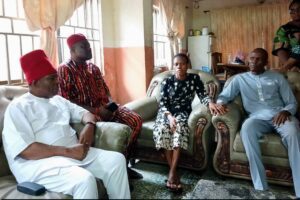
Senator Dr Umeh with the bereaved family
The senator also reiterated his commitment to working with relevant authorities to tackle the recurring flooding and erosion challenges in Anambra Central, stressing that urgent intervention is needed to prevent further loss of lives and property.
News
Enugu Council Election: Residents comply with movement restriction directive, as roads, markets, shops closed

Residents of Enugu metropolis on Saturday complied to the restriction of human and vehicular movement in the ongoing Local Government Election in the state.
It was observed that most roads remained empty of vehicular movement, while markets and shops were closed.
It was also observed that security men on election duties were seen in strategic locations within the metropolis.
Reacting, the Police Public Relations Officer in Enugu State, SP Daniel Ndukwe, noted that security agencies had maintained that the restriction of movement must work to ensure a smooth and hitch-free election.
Ndukwe said that security agencies had begun strict enforcement of the restriction order and would “definite close all shops and penalize motorist found wanting”.
“So, far, the security situation has been generally peaceful and the election process is ongoing smoothly as anticipated.
“We are hopeful it will remain peaceful till 4p.m. when the process will be over.
“From our observation, the restriction of movement has been generally complied with and we will definitely deal with those that act in the contrary today.
“We call on all in the state to be calm, cast their votes peacefully and maintain decorum throughout the process,” he said.
It would be recalled that the police, on behalf of other security agencies, ordered the restriction of human and vehicular movements across the state from 8 a.m. to 4 p.m. on election day, except for persons on essential duties and duly accredited election officials.
The Enugu State Independent Electoral Commission,(ENSIEC) is conducting election into the 17 Chairmanship and 260 Ward Councillorship positions in the state.
Seven political parties, who signed the Peace Pact for the election on Monday, are currently participating at the election.
-
 Features1 day ago
Dr. Joseph Okwuabudike Ojukwu, MFR: A Life of Service, Humility and Quiet Distinction
-
News2 days ago
Enugu govt suspends another traditional ruler, gives reasons
-
News2 days ago
How God saved me from assassination attempt – Abia Gov, Otti
-
News20 hours ago
Toxic Red: Inside deadly trade in dye-laced palm oil, coloured pepper
-
Politics2 days ago
I left Anambra debt-free, Obi insists as NDC, OK Movement tackle Soludo
-
News19 hours ago
Police officer who said Obi, Igbo man can never be president arrested, in trouble
-
News9 hours ago
Enugu Air Lands in Douala, Opens New Air Corridor Between South-East Nigeria, Cameroon
-
News2 days ago
Obi vows to make political leaders seek treatment in Nigeria