International
A white man fatally shoots 3 Black people at a Florida store in a hate crime, then kills himself

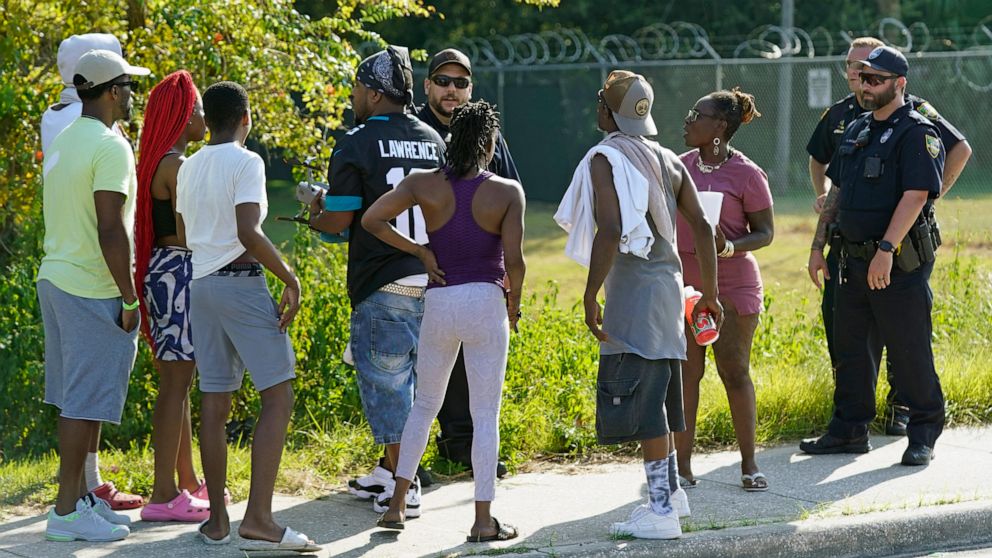
A masked white man fatally shot three Black people inside a Jacksonville, Florida, Dollar General store in a predominately African-American neighborhood on Saturday, in an attack where he used a gun painted with a swastika, officials said.
The shooter, who had also posted racist writings, then killed himself.

Jacksonville Sheriff T.K. Waters told a news conference that the attack that left two men and one woman dead was definitely “racially motivated.”
“He hated Black people,” Waters said after reviewing the man’s writings, which were sent to federal law enforcement officials and at least one media outlet shortly before the attack. He added that the gunman acted alone and “there is absolutely no evidence the shooter is part of any larger group.”
Waters said the shooter, who was in his 20s, used a Glock handgun and an AR-15 semi-automatic rifle with at least one of them painted with a swastika. He was wearing a bullet-resistant vest. He said the shooter had once been involved in a 2016 domestic violence incident and was once involuntarily committed to a mental hospital for examination. He did not provide further details on those incidents.

Officials didn’t immediately release the names of the victims or the shooter.
The sheriff said the gunman had left behind in his writings evidence that leads investigators to believe that he committed the shooting because it was the fifth anniversary of when another gunman opened fire during a video game tournament in Jacksonville, killing two people before fatally shooting himself.
The shooting happened just before 2 p.m. at a Dollar General about three-quarters of a mile from Edward Waters University, a small historically Black university.
In a statement, the university said that shortly before the shooting, one of its security officers saw the man near the school’s library and asked him to identify himself. When he refused, he was asked to leave. The man returned to his car.
Sheriff Waters said the man was spotted putting on his vest and mask before leaving. He said it is unknown if he had originally planned to attack the school.
“I can’t tell you what his mindset was while he was there, but he did go there,” the sheriff said.
The shooter had driven to Jacksonville from neighboring Clay County, where he lived with his parents, the sheriff said. That house was being searched late Saturday.
Shortly before the attack, the shooter sent his father a text message telling him to check his computer. The father found the writings and the family notified 911, but the shooting had already begun, Sheriff Waters said.
“This is a dark day in Jacksonville’s history. There is no place for hate in this community,” the sheriff said. “I am sickened by this cowardly shooter’s personal ideology.” He said the investigation will continue. The FBI was helping the sheriff’s office and said it had opened a hate crime investigation.
Mayor Donna Deegan said she is “heartbroken.”
“This is a community that has suffered again and again. So many times this is where we end up,” Deegan said. “This is something that should not and must not continue to happen in our community.”
Gov. Ron DeSantis, after speaking by phone with the sheriff, called the shooter a “scumbag” and denounced his racist motivation.
“This guy killed himself rather than face the music and accept responsibility for his actions. He took the coward’s way out,” said DeSantis, who was in Iowa campaigning for the Republican presidential nomination.
Both President Joe Biden and Attorney General Merrick Garland were briefed on the shooting, officials said.
Dollar General’s corporate office said in a statement that the company was supporting its Jacksonville employees “as we work closely with law enforcement.”
Virginia Bradford lives in the neighborhood of modest brick and cinder block houses near the store. She frequently shops at the Dollar General, and said she meant to go there Saturday for detergent and bleach, but got sidetracked by other plans.
“That’s my store,” Bradford told reporters, looking past patrol cars with flashing lights blocking the street to the store a block away. “I know everyone in the store. It’s sad.”
Unsettled by the racist killings, Bradford, who is Black, said she doubts she’ll ever go back.
“I won’t even send my kids up there anymore,” she said. “My nerves are bad.”
Penny Jones told The Associated Press in a phone interview that she worked at the store, located a few blocks away from her home, until a few months ago.
“I’m just waiting to hear about my co-workers that I used to work with,” Jones said. “I don’t know if it’s safe to move about the neighborhood.”
Jones added that she was “feeling awkward, scared.”
Rudolph McKissick, a national board member of the Rev. Al Sharpton’s National Action Network, was in Jacksonville on Saturday when the shooting occurred.
“As it began to unfold, and I began to see the truth of it, my heart ached on several levels,” said McKissick, who is a Baptist bishop and senior pastor of the Bethel Church in Jacksonville.
The neighborhood of the shooting is known as Newton. “It’s a Black neighborhood, and what we don’t want is for it to be painted in some kind of light, that it is filled with plight, violence and decadence,” McKissick said.
The shooting took place within hours of the conclusion of a commemorative March on Washington in the nation’s capital, where organizers drew attention to the growing threat of hate-motivated violence against people of color.
Reached by The Associated Press on Saturday evening, march attendee and Jacksonville native Marsha Dean Phelts said learning of the shooting was “a death blow.”
“It hurts,” Phelts said by phone while on a charter bus home from Washington. Many fellow bus riders began hearing about the deadly shooting in their community, just before they all boarded to make the long journey back, she said.
“It’s a neighborhood, a Black community that we come out of,” said Phelts, 79, who is Black. “It’s where our college is, Edward Waters University.”
LaTonya Thomas, 52, who also was riding a charter bus from the march home to Jacksonville, said she wouldn’t allow the shooting to completely dampen her spirits. But she did feel sadness.
“We took this long journey from Jacksonville, Florida, to be a part of history,” she said. “When I was told that there was a white shooter in a predominantly Black area, I felt like that was a targeted situation.”
The attack on a shopping center in a predominately Black neighborhood will undoubtedly evoke fears of past shootings targeting Black Americans, like the one at a Buffalo, New York, supermarket in 2022, and one at a historic African Methodist Episcopal church in Charleston, South Carolina, in 2015.
The Buffalo supermarket shooting, in particular, stands apart as one of the deadliest targeted attacks on Black people by a white lone gunman in U.S. history. Ten people were killed by the gunman, who has been sentenced to life in prison without the possibility of parole.
The shooting happened one day before the 63rd anniversary of one of Jacksonville’s most notorious racist incidents, “Ax Handle Saturday.” A group of Black protesters were conducting a peaceful sit-in at a city park to protest the Jim Crow laws that kept them out of white-owned stores and restaurants. That’s when they were attacked by 200 members of the Ku Klux Klan, who hit them with bats and ax handles as police stood by.
Only when members of a Black street gang arrived to fight the Klansmen did the police intercede. Only Black people were arrested. (ABC News)



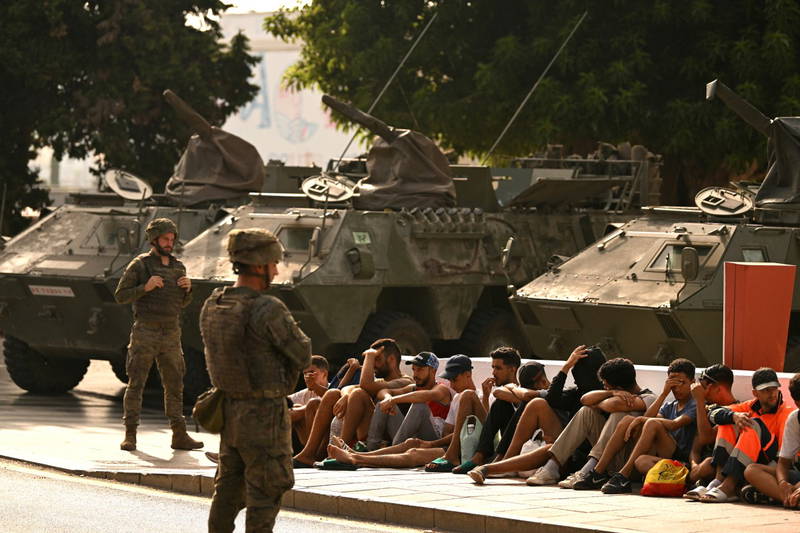
Thousands of people turned back from the Spanish enclave of Ceuta and returned to Morocco’s Fnideq began boarding buses home on Friday, with the operation continuing on Saturday, according to AFP journalists at the scene.
A Moroccan source close to the operation told AFP on condition of anonymity that the people sent back by Spain are to be transported home directly by bus or via the railway station in Tangier, 70 kilometres (45 miles) away.
According to the source, the Fnideq border crossing is now “completely secure”, as are the hills overlooking it, from which hundreds of people, mostly young men, had thrown stones at security forces on Friday.
The Spanish government announced on Friday evening that at least 48,000 of the 60,000 people who entered Ceuta in recent days had returned to Morocco.
Late Friday, AFP journalists saw around twenty 54-person-capacity buses depart, for a total of about a thousand people.
Fnideq is a small town of just 70,000 inhabitants, roughly equivalent to the population of the enclave of Ceuta, one of Spain’s two North African enclaves.
The buses were headed for Tangier, Tetouan, or the economic capital Casablanca, all equipped with rail facilities to redirect people who had come from as far away as Marrakech, more than 500 kilometres to the south.
“I heard that buses had arrived to take us back home. Honestly, I just want to see my children again. I regret having come all the way here,” said Rachid Aouchari, 32, from Ksar el Kebir, 170 kilometres from Fnideq, who was turned back from Ceuta during the night from Thursday to Friday.
Until midday Friday, clashes had pitted the security forces against migrants seeking to cross into Spain, either by swimming or on foot along a narrow wall leading to the Ceuta crossing point.
Police responded with water cannons and tear gas against hundreds of young men, arresting dozens of them, according to an AFP journalist.
AFP
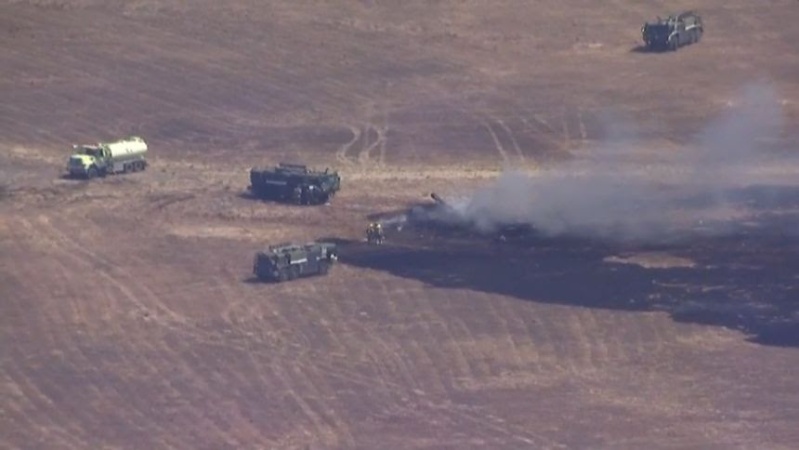
A fighter jet crashed and erupted into flames at Marine Corps Air Station Miramar in California on Friday, sending smoke billowing into the sky that could be seen from miles away.
The single-seat F-35B Lightning II aircraft from Marine Aircraft Group 11, 3rd Marine Aircraft Wing, went down short of the runway just before 10 a.m. PT.
“The pilot ejected (and) was transported to a local medical facility in stable condition for evaluation and treatment of non-life-threatening injuries,” according to a statement from the wing.
Airport fire crews sprayed the wreckage with firefighting foam and worked to extinguish a grass fire surrounding the crash site.
“F-35 short final crash,” the Miramar air traffic control tower told firefighters in audio recorded by LiveATC.net. “It appeared that the parachute did deploy … and a pilot ejected.”
The cause of the crash was not immediately clear. Military plane crashes are typically investigated by the military as opposed to civilian crashes which are investigated by the National Transportation Safety Board.
Billed as “the most advanced jet fighter in the world” by its manufacturer, the F-35B is a stealth aircraft that can land like a conventional plane, or vertically, similar to a helicopter. The more than 50-foot-long jet is operated by the US Marines, the United Kingdom and the Italian Air Force. The planes cost about $102 million each, according to the manufacturer.
About 15,000 service members from all branches of the military are based at Marine Corps Air Station Miramar, located in San Diego. (CNN)

India’s Education Minister, Dharmendra Pradhan, has resigned following days of youth-led demonstrations demanding sweeping reforms to the country’s education system.
Thousands of young people had taken to the streets of New Delhi and other parts of the country under the banner of the social media-driven Cockroach Janta Party, mounting pressure on the government to address their demands and remove Pradhan from office.
The protests, which were largely centred around the Jantar Mantar demonstration site in central New Delhi, intensified during the week as demonstrators attempted to march towards parliament.
Police fired tear gas and used batons against some protesters during the demonstrations.
Announcing his decision, Pradhan said the unrest witnessed over the previous 10 days had caused him concern, stressing that remaining in office was not a matter of personal prestige.
“I am pained to see the events of the past 10 days. This is not a matter of personal prestige for me,” Pradhan said in a statement posted on X.
The minister subsequently confirmed that he had submitted his resignation to the Prime Minister.
“I have sent my resignation letter to the prime minister,” he said in the letter written in Hindi.
Pradhan also acknowledged the importance of young people to India’s development, pledging that their concerns should not be ignored.
“India’s youth power is the real strength of this nation. My resolve is that we will not let the country’s youth get trapped in a vicious cycle of confusion,” he added.
The Indian government had opened negotiations with leaders of the CJP in an attempt to end the demonstrations.
Two rounds of talks were held on Monday and Friday, but the initial negotiations reportedly failed to produce significant progress as the youth-led movement insisted that its demands must be addressed.
The protesters had demanded reforms to the education system alongside Pradhan’s resignation.
The minister announced his resignation ahead of a planned third round of negotiations between government representatives and the protest leaders.
Following Pradhan’s resignation, the CJP announced that its demands had been met after another round of discussions with the government.
The group subsequently called off the protests at Jantar Mantar and other locations.
The demonstrations had attracted thousands of young Indians and gained momentum through social media, putting the government under mounting pressure over the country’s education system.
-
 News1 day ago
Mammoth crowd as Peter Obi makes triumphant entry into Benin, dares Gov Okpebholo [VIDEO]
-
News1 day ago
ICPC exposes Payroll Scandal: Official paying 14 family members, another worker collects 13 salaries
-
News2 days ago
Ebonyi Assembly passes bill regulating scrap trade, rents, agent fees
-
Peller and newly wedded wifePeller and newly wedded wifeEntertainment3 days ago
Peller drags his parents for attending wedding with their partners
-
News2 days ago
Vanguard Alumni to Unveil Book Chronicling Newspaper’s 40-Year Journey, Legacy
-
News2 days ago
ADC raises the alarm over plan to arrest Aregbesola
-
News3 days ago
Police recover nine dead bodies in Niger community – Police
-
Education2 days ago
Enugu govt approves N82,000 minimum wage for ESUT staff