International
Organ harvesting: Ekweremadu jailed over nine years in UK

A former Deputy President of the Nigerian Senate, Senator Ike Ekweremadu, his wife, Beatrice and their “middleman” Dr Obinna Obetta have been jailed for an organ-trafficking plot, after bringing a man to the UK from Lagos.
Senator Ike Ekweremadu, 60, and his wife Beatrice, 56, wanted a new kidney for their 25-year-old daughter Sonia, the Old Bailey heard.

The pair and Dr Obinna Obeta, 50, were previously convicted of conspiring to exploit the man identified as 21 years old David Nwamini.

It is said to be the first such case under modern slavery laws.

Ike Ekweremadu, who was described by the judge as the “driving force throughout”, was sentenced to nine years and eight months in prison.
Dr Obeta was sentenced to 10 years after the judge found he had targeted the potential donor who was young, poor and vulnerable.
Beatrice Ekweremadu was jailed for four years and six months due to her more limited involvement.
“Middleman” Dr Obinna Obeta and the senator’s wife, Beatrice, were also previously found guilty.

Dr Obinna and Mrs Beatrice Ekweremadu
Their victim, Nwamini, a poor street trader in Lagos, was brought to the UK to provide a kidney for the Ekweremadus’ daughter.
He fled in fear of his life and walked into a police station exactly a year ago to report what had happened after the Royal Free Hospital called a halt to the private £80,000 procedure.
During a televised sentence hearing, Mr Justice Johnson recognised Ike Ekweremadu’s “substantial fall from grace”.
He described the politician as someone of high office with multiple properties, domestic staff, maids, chefs and drivers, compared with the victim who could not afford a £25 ticket to travel to Abuja.
‘Form of slavery’
Obeta, he said, had lied to doctors and falsely claimed the young potential donor was a cousin of the senator’s daughter who urgently needed a transplant.
The three had left the potential donor facing a “substantial and long term impact on his daily life”, he said.
“People-trafficking across international borders for the harvesting of human organs is a form of slavery,” the judge added.

Sonia Ekweremadu was cleared of wrongdoing and watched her parents being sentenced from the public gallery
Sonia Ekweremadu was cleared of wrongdoing and watched her parents being sentenced from the public gallery
In a victim personal statement, the 21-year-old Nigerian market trader, told the court he used to “pray every day” to be given the opportunity to come to the UK to work or study.
He said to “make it happen” he agreed to medical tests in Lagos and meetings with doctors in London, believing they were required for his UK visa during the Covid pandemic.
The 21-year-old said he only realised what was planned when he met doctors at the Royal Free Hospital in London who began discussing a kidney transplant.
He told the court he would not had have agreed to it, adding: “My body is not for sale.”
The victim is now being helped by a charity in the UK, according to his lawyer in Nigeria.
In his statement he said he “can’t think about going home to Nigeria”, as “these people are extremely powerful and I worry for my safety”.
He also refused to apply for financial compensation from the Ekweremadu family, telling a detective he “did not need or want anything from the bad people”.
‘First conviction’
Hugh Davies KC, prosecuting, said all three defendants were guilty of trafficking with the highest level of culpability.
Lynette Woodrow, deputy chief crown prosecutor and national modern slavery lead at the Crown Prosecution Service (CPS), said it had been “our first conviction for trafficking for the purposes of organ removal in England and Wales”.
She said it highlighted an important legal principle which made it irrelevant whether the trafficking victim knew he was coming to the UK to provide a kidney.
“With all trafficking offences,” Ms Woodrow said, “the consent of the person trafficked is no defence. The law is clear; you cannot consent to your own exploitation.”
In the wake of the case the Metropolitan Police and CPS have been working with hospitals and the Human Tissue Authority about actions they should take when concerns about organ trafficking are raised.
• Additional report from BBC










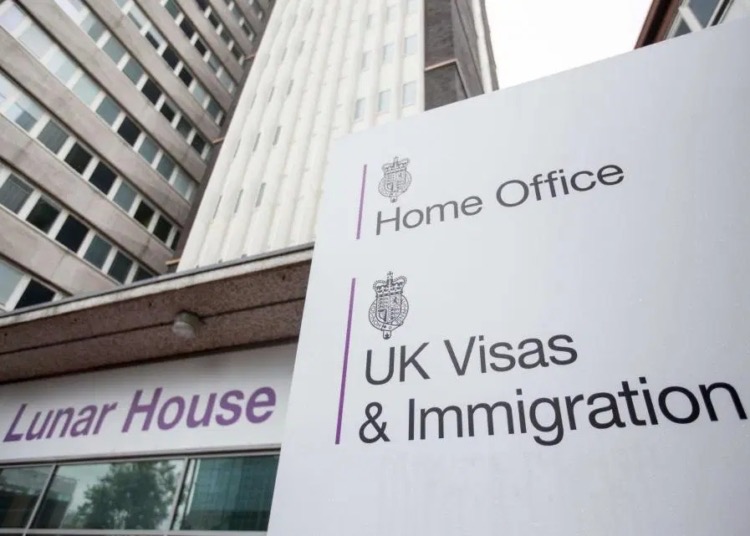
The United Kingdom (UK) has announced plans to retain the two-year post-study work visa for international graduates of selected universities, partially reversing an earlier decision to reduce the duration of the scheme.
Under the revised policy, graduates of universities with strong immigration compliance records and positive employment outcomes will continue to qualify for a two-year Graduate visa, while other international graduates will be eligible for an 18-month visa from January 2027.
The UK government disclosed the change in its 2026 Budget, although it has yet to publish the list of qualifying universities or explain the criteria institutions must meet to retain the two-year visa option.
The policy introduces a two-tier system under which the university an international student attends could determine how long they can remain in Britain after completing their studies.
“The government will also increase the duration of the Graduate visa to two years for graduates from high compliance universities where there are strong labour market outcomes,” the Budget document stated.
The development follows an earlier government announcement to reduce the standard Graduate visa duration from two years to 18 months for international students completing bachelor’s and master’s degree programmes, effective January 1, 2027.
However, international graduates who complete doctoral programmes will continue to qualify for a three-year Graduate visa.
The revised policy means that Nigerian students and other international students planning to study in the UK may need to consider their chosen university’s eligibility under the new criteria when making decisions about their education and post-study employment opportunities.
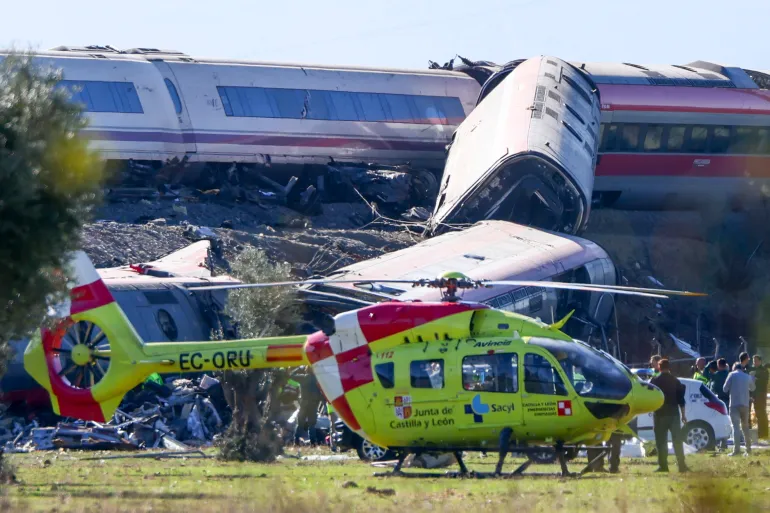
At least 64 people have been killed and about 80 others injured after two high-speed trains collided in central Spain, according to regional authorities.
The accident occurred early Wednesday near Urda in Toledo province, south of Madrid, along the high-speed railway line connecting the Spanish capital with Seville.
The head of the Castilla-La Mancha regional government, Emiliano García-Page, said about 50 of the injured were in serious condition, while 15 others were critically injured. He warned that some of the most seriously injured victims might not survive.
Spain’s Health Minister, Mónica García, said the injured were being transported to several hospitals across the region for treatment.
The collision involved a Renfe-operated AVE high-speed train travelling from Madrid to Seville and another train operated by private railway company Iryo.
Esther Padilla, a spokeswoman for the Castilla-La Mancha regional government, told Spanish public broadcaster TVE that both trains were travelling in the same direction when one struck the rear of the other, which had stopped.
The impact caused carriages to derail, with two carriages of the Iryo train reportedly plunging down an embankment.
Authorities said 397 passengers were aboard the Renfe train, while 147 were travelling on the Iryo train, bringing the total number of passengers involved to 544.
Signalling System Failure Under Investigation
Spain’s Transport Minister, Óscar Puente, said a failure of the railway’s signalling and control system preceded the accident.
Puente explained at a press conference that the LZB train control system went down at about 8:30 a.m. along a 63-kilometre stretch of railway, affecting six trains, although he said the exact number remained uncertain.
Following the failure, control was transferred to the Atocha control post, where a decision was made to allow the Renfe train to resume its journey.
“The decision to resume traffic without the system having been restored corresponds to the control centre,” Puente said, describing the circumstances as “inexplicable”.
Emergency workers were concentrating on rescuing survivors and recovering bodies from the most severely damaged carriages.
More than 200 members of Spain’s Military Emergencies Unit were deployed to the crash site, while local authorities mobilised food and other essential supplies for those affected.
Footage circulating on social media showed wreckage scattered along a slope, with rescue workers and members of the public gathered around the damaged train.
High-Speed Rail Services Suspended
Spain’s railway infrastructure operator, ADIF, suspended high-speed rail services between Madrid and the southern region of Andalusia following the collision.
The disruption resulted in delays and cancellations, with passengers waiting at railway stations, including Sevilla Santa Justa station.
The Civil Guard also deployed a disaster investigation team to the scene to assist with the investigation into the circumstances surrounding the crash.
Madrid Mayor José Luis Martínez-Almeida said the capital was sending emergency medical teams and firefighters to support rescue operations.
Government, European Leaders React
Spanish Prime Minister Pedro Sánchez said he was shocked by the tragedy and was in contact with Transport Minister Puente and Castilla-La Mancha regional leader García-Page as emergency crews continued their work.
“Shocked by the serious train accident in Toledo. My affection, solidarity, and support to all the victims and their families,” Sánchez said in a post on X.
European Commission President Ursula von der Leyen also expressed her condolences to the victims and their families.
“Today, Europe mourns with you,” she said.
French President Emmanuel Macron expressed solidarity with Spain, saying his thoughts were with the victims, their families, the injured and the emergency workers responding to the disaster.
The crash comes nine months after another accident involving high-speed trains operated by the same companies on the same railway line reportedly killed 46 people.
Journalist Graham Keeley, speaking to Al Jazeera from Spain, said the latest tragedy had come at a difficult time for the Spanish government, with an election expected in just over a month.
He noted that following the January accident, the government had promised to conduct safety checks across the country’s railway network.
The investigation is expected to examine the signalling failure, the decision to resume train movements and the sequence of events that led to the collision.
International
France braces for another weekend of protests as authorities launch massive security operation
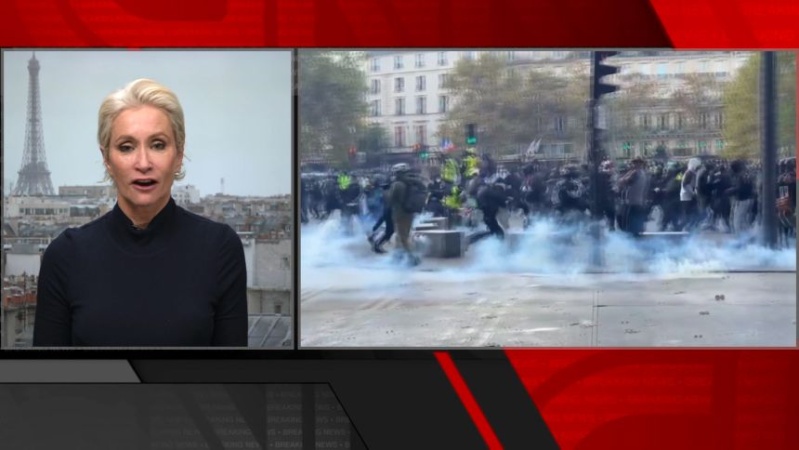
France is bracing for yet another wave of protests this weekend with authorities racing to prevent a repeat of the kind of violence and riots that hit the nation last week.
French authorities will be launching a massive security operation with some 70,000 police officers deployed across the country over the weekend, according to the interior ministry.
Specialist SWAT units, helicopters, armored vehicles, police dogs and water cannons will all be part of the operation. On top of that, the number of French army soldiers that normally patrol Paris as part of the country’s counter-terrorism measures will be increased to free the police from stationary guard duties.
Interior Minister Laurent Nuñez issued a stark warning on Friday to anyone looking for trouble, saying the government would be “uncompromising with those who engage in destruction.”
Last week’s violence followed weeks of protests over education, dismal job prospects and the cost of living. Initially peaceful and attended mostly by students, the demonstrations quickly turned into the worst wave of deadly, nationwide violence in years.
This week, curfews were imposed in some cities to help maintain calm.
Bracing for Saturday
A large demonstration has been called for Saturday afternoon in Paris and French media are expecting hundreds of thousands of people to attend.
The protest is organized by France’s main student union, UNEF, with one of the country’s biggest trade unions, CGT, announcing it would join. Other groups are expected to attend, including farmers, climate activists and the Yellow Vests, the movement that first emerged in 2018 during the protests over fuel costs.
While the protest in Paris has been authorized by the authorities, French President Emmanuel Macron on Thursday banned all non-trade union protests on Saturday as he seeks to control the civil unrest.
But the preparations go well beyond bans and police warnings, especially since last week’s riots sparked criticism of the authorities for not taking the threat seriously enough.
A police officer ties in place a perimeter tape near Chatelet – Les Halles to enforce a curfew, in central Paris on October 20.
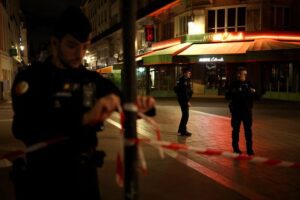
A police officer ties in place a perimeter tape near Chatelet – Les Halles to enforce a curfew, in central Paris on October 20.
Simon Wohlfahrt/AFP/Getty Images
The City of Paris announced earlier this week it was clearing public spaces of equipment and materials that could be used to cause damage, including barriers, bins, construction material and other items.
Many of the main tourist sites in the French capital, including world-famous museums like the Louvre, the Musée d’Orsay and the Musée de l’Orangerie will be closed on Saturday.
Art Basel finished the Paris version of its fair on Friday, two days earlier than scheduled. The Paris National Opera cancelled its performances on Saturday, citing the protests as the reason, and at least two dozen metro stations will also be closed for much of the day, according to Paris municipal authorities.
An NFL game between Pittsburgh Steelers and New Orleans Saints is set to take place at the Stade de France just outside of the capital on Sunday. While the match is scheduled to go ahead, a Steelers fan event in Paris was cancelled by the NFL.
During last weekend’s riots, at least two people died and multiple others suffered serious injuries, including two people who lost their hands. French Justice Minister Gérald Darmanin said some 2,700 people were held for questioning and 232 have been incarcerated in connection to the riots. (CNN)
-
 News3 days ago
BREAKING: Enugu Billionaire, Ferotex Boss Festus Oshaba-Onuh Feared Dead in Road Accident
-
News2 days ago
Gunmen Machete Football Legend Segun Odegbami in Abeokuta Home Attack
-
News3 days ago
Festus Onu’s Death: Enugu APC Campaign Council Suspends Activities
-
News3 days ago
Anambra Billboard Saga: Onyima Challenges Soludo Govt to Cite Law Behind Umeh’s Billboard Removal
-
News2 days ago
2027: Obi Urges Nigerians to ‘Sacrifice One Day for Nigeria to Be Good Again’
-
Editorial2 days ago
FAKE DRUGS: Nigeria’s Deadly Trade in Human Lives Must End
-
News3 days ago
Rev Chidi Okorafor Emerges New Assemblies of God General Superintendent
-
News2 days ago
“We’ve Lost a Great Son,” Mbah Mourns Ferotex CEO, Oshaba-Onuh