Connect with us

News

US asks American business executives to be wary of insecurity, corruption, detention risk in Nigeria

Published

on

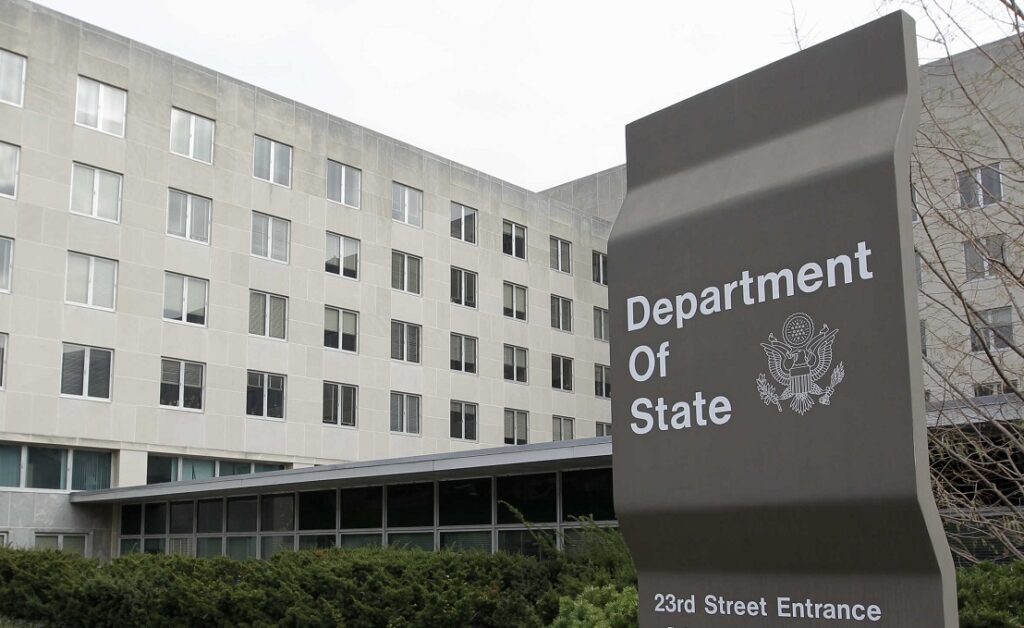
The State Department in Washington | Photo: AP/Luis M. Alvarez
Spread the love
A report by the United States Department of State has identified insecurity, corruption, port inefficiencies and regulatory uncertainty as major obstacles to investment in Nigeria, warning that these challenges continue to weigh on the country’s business environment despite signs of macroeconomic stability.

In its ‘2026 Investment Climate Statements on Nigeria’, the department said the country’s investment landscape has been shaped by the outcomes of “painful but necessary” structural reforms introduced by the President Bola Tinubu administration.

The report said the removal of fuel subsidies and liberalisation of the foreign exchange market initially triggered significant economic volatility, although indicators in early 2026 suggested some stabilisation.

However, it warned that security concerns, administrative bottlenecks and the social consequences of economic reforms remain significant considerations for foreign investors.
“The security environment is a primary variable which gives pause to potential investors,” the report said.

Maduka College Advert

It noted that although attacks on oil infrastructure in the Niger Delta have decreased, oil theft and illegal bunkering persist.

“In the North, the expansion of terrorist and ‘bandit’ groups continues to degrade the climate for agribusiness and mining,” the document added.

The report also raised concerns about the treatment of foreign business executives in regulatory disputes, citing the detention of Tigran Gambaryan, a US citizen and Binance executive, for nearly eight months in 2024.

“Furthermore, the use of coercive exit bans and detentions — highlighted by the high-profile nearly eight-month detention in 2024 of U.S. citizen Binance employee Tigran Gambaryan — serves as a cautionary note for foreign executives regarding the risks of aggressive regulatory friction,” it said.

The report said such cases could influence the perception of Nigeria as a destination for foreign investment.

PORT DELAYS DESCRIBED AS ‘HIDDEN TAX’ ON INVESTMENT

The department identified inefficiencies at Nigerian seaports as another major challenge for businesses, particularly those dependent on imports and exports.

“Port inefficiency remains a significant ‘hidden tax’ on investment,” the report said.

It noted that the Lekki Deep Seaport handled $9.6 billion in trade in 2025 and operated at 50 percent capacity, helping to ease pressure on older facilities.

However, it said traditional ports in Apapa and Tin Can Island continue to experience cargo dwell times exceeding 20 days because of manual examinations.

“To address this, the government launched phase one of the National Single Window (NSW) on March 27, 2026,” the report said.

The platform is designed to integrate trade agencies, including the Nigeria Customs Service, the National Agency for Food and Drug Administration and Control and the Standards Organisation of Nigeria, into a single digital workflow.

According to the report, the initiative targets a reduction in cargo dwell time to fewer than seven days and the elimination of 80 percent of manual paperwork by the end of 2026.

92% OF CAPITAL INFLOWS WAS PORTFOLIO INVESTMENT

The report acknowledged an increase in capital inflows but said the figures did not necessarily reflect a corresponding surge in long-term investment in physical infrastructure.

“Nigeria’s capital importation reached $21 billion in October 2025, a large increase from 2024,” it said.

“However, 92 percent was made up of foreign portfolio investment (‘hot money’) seeking high interest rates, while actual foreign direct investment (FDI) in physical infrastructure remained modest.”

The report said Nigeria continues to permit full foreign ownership in most sectors, subject to restrictions in certain industries and licensing requirements.

It also noted that the Nigerian Investment Promotion Commission’s One-Stop Investment Centre coordinates 27 government agencies to help investors navigate administrative processes.

The report said US foreign direct investment in Nigeria reached $7.9 billion by the end of 2024, representing a 25 percent increase from the previous year.

It added that bilateral trade between Nigeria and the United States reached $14.8 billion in 2025.

The department said Nigeria’s economic reforms had improved some macroeconomic indicators but imposed high costs on households.

“The fiscal correction came at a high social cost,” the report said.

It added that the removal of fuel subsidies had caused petrol prices to “quintuple from 2023 levels”, contributing to an estimated national poverty rate of 63 percent in 2025, citing an April 2026 World Bank report.

The report said Nigeria’s gross domestic product growth rose from 3.3 percent in 2023 to 4.1 percent in 2024 before easing slightly to four percent in 2025.

It also noted that the Central Bank of Nigeria reported foreign exchange reserves of $50.45 billion in February 2026, which it described as a 13-year peak.

On inflation, the report said headline inflation reached 34.8 percent in late 2024 before falling to 15.15 percent by December 2025 following the rebasing of the Consumer Price Index and subsequent methodological changes.

Food inflation stood at 10.84 percent in December 2025 under the rebased index, it added.

‘CORRUPTION REMAINS A SYSTEMIC BARRIER’

The report identified corruption as a persistent obstacle to investment, including in port operations.

“Corruption remains a systemic barrier, including at seaports where customs delays impede trade,” it said.

It also described Nigeria’s trade regime as “somewhat protectionist”, pointing to high tariffs and import restrictions intended to protect domestic industries.

According to the report, some companies are required to invest in local production in exchange for permits and quotas to import the same products.

It said the government had introduced reforms to improve the regulatory environment, but implementation remains uneven.

“Nigeria’s regulatory environment has transitioned toward a ‘structural reset’ designed to improve predictability, though implementation remains uneven,” the report said.

The department also highlighted the transition from the Pioneer Status Incentive scheme to the Economic Development Tax Incentive, which took effect in January 2026, as an area requiring administrative adjustment for foreign businesses. (The Cable)


News

Festus Onu’s Death: Enugu APC Campaign Council Suspends Activities

Published

on

Late Festus Onu Ferotex MD
Spread the love

…Normal Activities to resume on Monday

The Enugu State APC Campaign Council has suspended all its scheduled activities indefinitely following the death of its Director of Finance, Chief Festus Onu-Oshaba, in a fatal road accident.

Onu reportedly died on Thursday, November 19, 2026, while travelling from Port Harcourt to Enugu.

The Director-General of the Campaign Council, Chief Charles Mba, announced the suspension in a statement issued on Thursday, describing the death of the prominent businessman as a painful loss to the council and the APC family.

Mba said the deceased was not only a valued member of the campaign leadership but also a dependable ally and committed patriot whose contributions to the council would remain indelible.

Maduka College Advert

“His sudden and painful departure has thrown the entire Campaign Council into deep mourning. We have lost not just a valued member of our leadership team but a brother, dependable ally and committed patriot whose dedication, generosity and invaluable contributions to our collective cause will remain indelible,” he stated.

The Director-General noted that Onu brought his wealth of experience, business acumen and commitment to bear on his responsibilities as Director of Finance, adding that his friendship and contributions would be greatly missed.

“In honour of his memory and in solidarity with his grieving family, the Campaign Council has resolved to suspend all its scheduled activities until further notice,” Mba said.

The council also extended its condolences to the deceased’s wife, children, immediate family, the Umuagama community in Enugu-Ezike, Igbo-Eze North Local Government Area of Enugu State, as well as his business associates, friends and other sympathisers.

Mba said the council stood with the bereaved family at the difficult moment and prayed for divine strength to bear the loss.

“We pray that Almighty God grants them the fortitude to bear this irreparable loss and grants the departed eternal rest,” he added.

The statement concluded with a prayer for the repose of the deceased’s soul, adding that normal campaign activities will resume on Monday, 23rd November, 2026.

“May his gentle soul rest in perfect peace,” the Director-General stated.

Continue Reading

News

BREAKING: Enugu Billionaire, Ferotex Boss Festus Oshaba-Onuh Feared Dead in Road Accident

Published

on

Ferotex Boss Festus Oshaba-Onuh
Spread the love

A prominent Enugu businessman and Chief Executive Officer of Ferotex Group, Chief Festus Oshaba-Onuh, has reportedly died in a fatal road accident along the Enugu-Port Harcourt Expressway.

Oshaba-Onuh, popularly known as Ferotex or Oshobaba, was said to have been involved in the accident on Thursday morning, November 19, 2026, while travelling back to Enugu State from Port Harcourt, Rivers State.

Reports of his alleged death emerged on social media following the circulation of a video showing the wreckage of a badly damaged silver vehicle at an accident scene.

The vehicle, which was lying off the road in a bushy area, appeared to have suffered extensive damage to its front and side sections. A heavy-duty truck with a blue trailer was also seen close to the wreckage, while several people gathered around the scene.

Maduka College Advert

An Enugu-based social media influencer, Chijinkem Ugwuanyi, who shared the video on Facebook, expressed grief over the incident, describing the development as a major loss.

In his post, Ugwuanyi said the businessman was returning home to Enugu when the accident occurred.

Describing the deceased as one of the wealthiest businessmen from the Nsukka cultural zone, the influencer wrote: “Sun Set At Noon…”

He added: “The fatal motor accident that killed Mambule, also known as Oshobaba, along Enugu/Port Harcourt Express road this morning.

“The richest man from Nsukka zone was travelling back home to Enugu State this morning when this happened.

“This is a total loss for the whole world.”

Oshaba-Onuh hailed from Umuagama community in Enugu-Ezike, Igbo-Eze North Local Government Area of Enugu State. He was widely recognised for his business interests and investments through the Ferotex Group.

The company is associated with road construction, civil engineering, equipment leasing and oilfield services, among other business activities.

His business activities reportedly earned him considerable prominence within the business community in Enugu State and beyond.

In January 2026, the businessman was also in the news following the burial of his mother-in-law, the late Mrs Susan Oyibo Ugwu.

The circumstances surrounding Thursday’s accident and the reported death were still awaiting official confirmation as of the time of filing this report.

His reported demise has sparked grief among associates and members of the business community, particularly in Enugu-Ezike and the wider Nsukka area.

If confirmed, his death would mark a significant loss to the business community in Enugu State.

Continue Reading

News

‘Ban Nigerians from Our Country’ — Demonstrators Stage Fresh Anti-Migrant Protest in South Africa

Published

on

Spread the love

Demonstrators under the March and March anti-migrant group on Wednesday staged a fresh protest in Pretoria, South Africa, demanding a ban on Nigerians entering the country.

The protesters, led by the group’s leader, Jacinta Ngobese-Zuma, called on the South African government to stop Nigerians from entering the country, accusing some Nigerian immigrants of engaging in drug-related activities.

Speaking during the protest, Ngobese-Zuma challenged Nigerians living in Sunnyside, a suburb of Pretoria, to explain why the area has been nicknamed “Little Lagos” because of the large Nigerian population.

“I’m being told here that we’ve entered Sunnyside, the home of Nigerians. I’m inviting Nigerians to come out. Let’s talk to each other. We want to know who gave you this place and called it Nigeria. Who gave you permission to call this place Lagos or whatever you call it?” she asked.

Maduka College Advert

She further questioned why Nigerians had allegedly adopted names associated with their home country for parts of South Africa.

Also speaking, Xolani Zuma, the group’s legal representative, called on the South African government to impose an entry ban on Nigerians.

“The state must ban Nigerians from South Africa. They must ban Nigerians until they stop selling drugs to our people. The rest of Africa, we are fine, but we do not want Nigerians in South Africa anymore. That is what we are saying,” Zuma said.

Ngobese-Zuma also demanded that South Africa withdraw from the 1951 United Nations Convention Relating to the Status of Refugees.

She described the international agreement as “not sustainable and not feasible”, arguing that the presence of migrants places additional pressure on public resources and fuels frustration among South African citizens.

One of the convention’s central principles is non-refoulement, which prohibits countries from returning refugees to territories where they face serious threats to their lives or freedom.

The group said it was marching to the Home Affairs Department to formally present its demands to the government.

The latest demonstration comes amid heightened diplomatic tensions between Nigeria and South Africa over issues affecting the Nigerian community in the country.

Last week, the Nigerian High Commission and the South African Presidency exchanged positions over the omission of a speech by Nigeria’s High Commissioner, Femi Fani-Kayode, during the presentation of his credentials.

Fani-Kayode described the omission as disrespectful to Nigeria but later said the matter had been put behind following the intervention of South African President Cyril Ramaphosa and an invitation from the Department of International Relations and Cooperation (DIRCO) to address the disagreement.

The high commissioner also disclosed that he had begun looking into issues affecting Nigerians in South Africa since his arrival in the country.

He described those behind xenophobic attacks as a “tiny minority”, insisting that they did not represent the majority of South Africans, whom he characterised as decent and accommodating.

Meanwhile, more than 1,500 Nigerians were reportedly repatriated from South Africa this year amid renewed xenophobic tensions, with at least four Nigerians said to have been killed in related attacks.

Despite the growing concerns, Fani-Kayode has maintained that Nigeria has no intention of severing diplomatic relations with South Africa, although he warned that patience was wearing thin within the corridors of power.

Continue Reading

Trending

Maduka College Advert