





Connect with us

News

Anyaoku: Mbah genuinely, quietly transforming Enugu State

Published

on

Spread the love

… As Gen. Nwachukwu, Anyaoku renew call for true federal constitution

… Mbah, Prof. Gambari harp on good governance

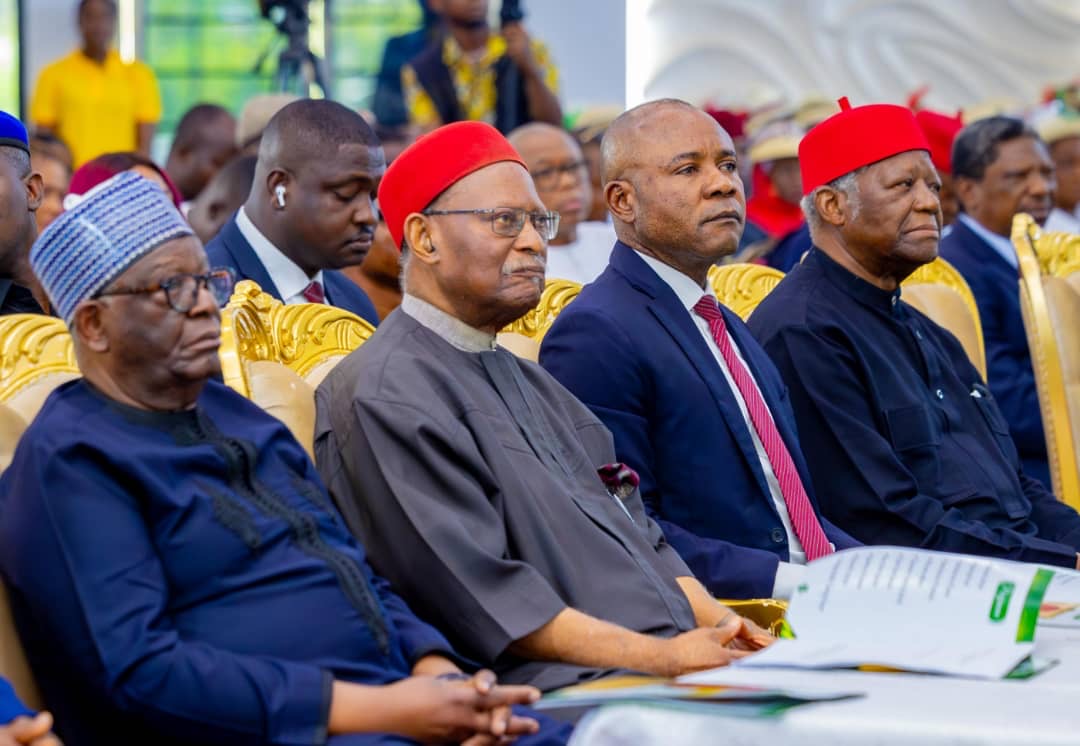
Former Secretary General of the Commonwealth of Nations, Chief Emeka Anyaoku, has described Governor Peter Mbah of Enugu State as an epitome of good governance, noting that the governor was genuinely and quietly transforming the state.

Anyaoku, however, stressed that visionary leadership and speedy development, such as being witnessed in Enugu State under Mbah, would become a mere routine with a genuine federal constitution.

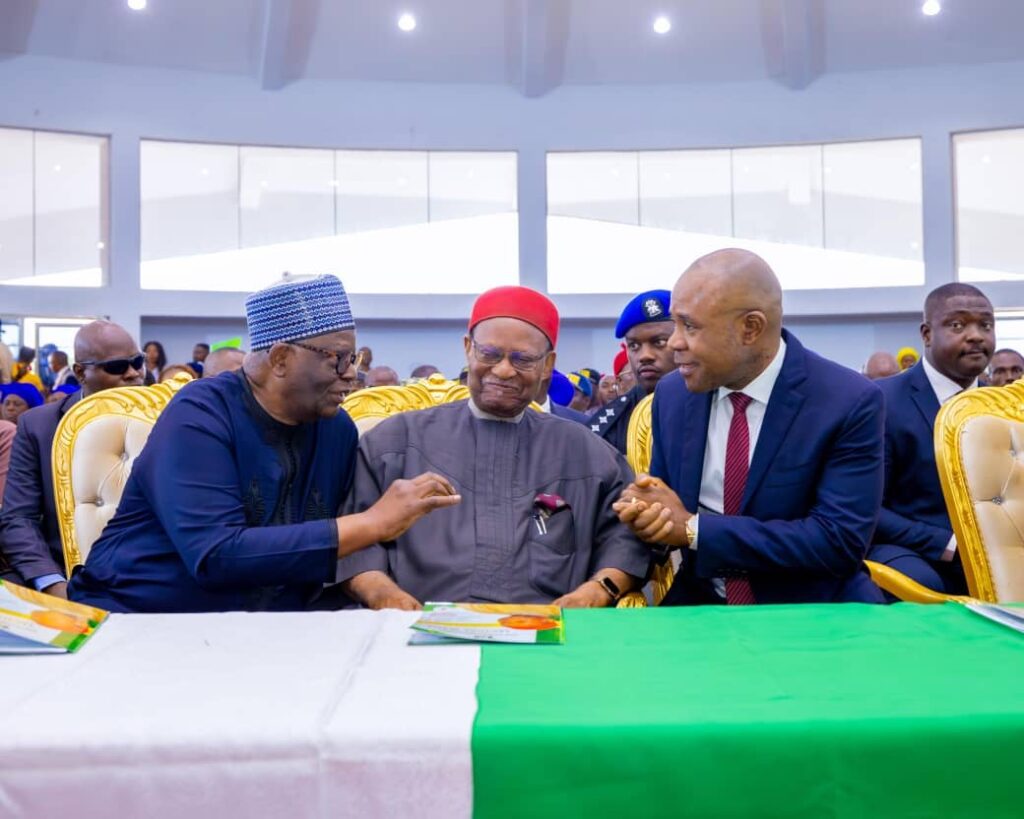
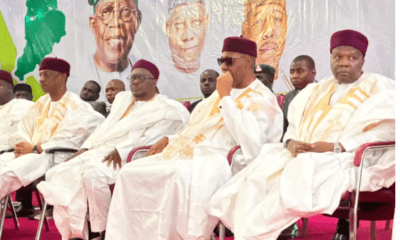
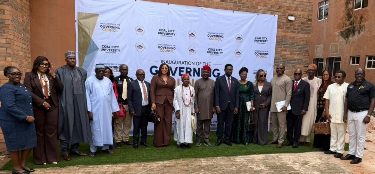
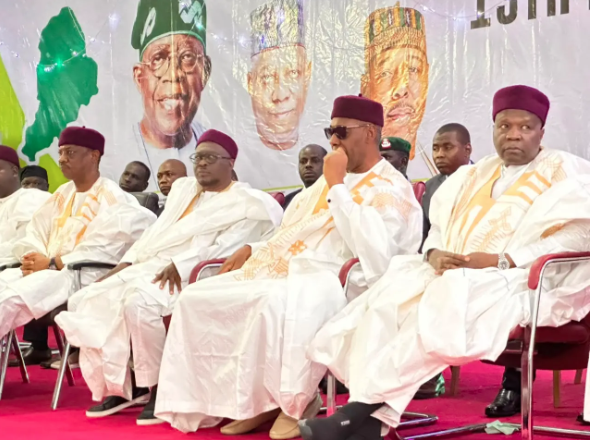
The diplomat spoke at the 14th Chief Emeka Anyaoku Lecture Series on Good Governance, themed “The Imperative of Good Governance: Nigeria in a Global Comparative perspective” and organised by the board of Youth Affairs International Foundation at the Enugu International Conference Centre on Tuesday.

“Allow me the privilege of describing him (Mbah) as a truly performing governor. Yesterday, I was given glimpses of projects that have either been completed or in active progress towards completion. I saw, for example, this magnificent International Conference Centre. I saw an array of CNG buses at the Okpara Square. I saw the Smart Green Schools, which I gather that the governor’s plan is to replicate in every electoral constituency (wards), and I learnt that there are as many as 260 of them. I was also able to visit a state-of-the-art bus station, the Holy Ghost Terminal.

Maduka College Advert

“So, I would say that Governor Peter Mbah is genuinely transforming Enugu State, which used to be described as a civil service state. He is transforming it into an industrial, educational hub and agricultural innovation.

“The surprising thing is that all these developments are going on with little publicity. I had expected, as my experience visiting many other states in this country has shown me that in places where you have two to three projects going, you will have massive publicity of them. But not so in Enugu. So, Governor Peter Mbah is not just a performing governor, but he is also a quite and noiseless performing governor,” he said.

However, he said that at 92, he regretted that Nigeria was still struggling with her pluralism and numerous challenges, warning that many countries that failed to address their pluralism with genuine federal constitution had since disintegrated.

“So, I have been quite consistent in advocating for a new democratic constitution for Nigeria, which addresses our plurality. This country was more peaceful and was developing faster in the first six years of our independence because it had a genuine federal constitution, which allowed the four regions to take care of their regional development, their social amenities, education, health, and internal security,” the octogenarian said.

To address the many challenges facing Nigeria and Africa, the Guest Speaker and Nigeria’s former Permanent Representative to the United Nations, Prof. Ibrahim Gambari, called for a radical restructuring of the Nigerian federal arrangement to significantly devolve power to the people, a rejig of the leadership recruitment process, retooling of the state as a guarantor of security, unity, and ideals of equal citizenship as well as fashioning out of a new elite consensus, a complete overhaul of political parties, and a greater attention to constitutionalism, among others.

Speaking, Governor Mbah emphasised that “good governance – or lack of it – is often the fine margins between an ascendant state and one on a downward trajectory.” He, therefore, charged leaders to move beyond the realm of ideas into the realm of practicality and renewed his call for people-centred governance and investment in the youth.

“Good intentions alone do not translate to good leadership. Good leadership proceeds from the understanding that the people should be the centerpiece of state policies and projects,” he said.

Setting the tone for the day, chairman of the event and Nigeria’s former Minister of Foreign Affairs, Major General Ike Nwachukwu (rtd.), stressed the need for transformative leadership, which he said could not happen under the present structure of Nigeria.

“This is why I have long been advocating for the restructuring of Nigeria to become a proper federation, allowing State autonomy and bringing governance closer to the people. This also allows access to the mineral, natural, and human resources for their development.

“I stand for respect for the Rule of Law, the need for a forthright and independent Judiciary, a more effective, and responsive military, police and intelligence services.

“I also stand for the creation of State Police and local policing for our communities. And above all, a school system that allows relevant human resource development,” Nwachukwu stated.

News

Soludo threatens to arrest, prosecute fake Traditional Rulers in Anambra

Published

on

Anambra Gov Chukwuma Soludo
Spread the love
The Governor Chukwuma Soludo-led Government of Anambra State has warned persons allegedly parading themselves as traditional rulers without official recognition to immediately desist from the act or risk arrest and prosecution under the state’s Traditional Rulers Law.

The government also directed residents and Presidents-General of town unions across the state to report individuals who unlawfully assume traditional ruler titles or perform functions reserved for duly recognised traditional rulers.

The warning was contained in a letter dated July 22, 2026, signed by the Commissioner for Local Government and Community Affairs, Mr. Ifeanyi Ezeaka, Esq., and addressed to Presidents-General of town unions in the state.

According to the commissioner, the directive followed reports received by the state government concerning individuals who allegedly parade themselves, allow themselves to be addressed or portrayed as traditional rulers, or perform functions legally reserved for recognised traditional rulers despite not having been formally recognised by the Anambra State Government.

The government stressed that under the Traditional Rulers Law of Anambra State, 2007, only a person duly selected, appointed and formally recognised by the state government in accordance with the law is entitled to function as, or present himself as the recognised traditional ruler of a town or community.

According to the government, the law makes it a criminal offence punishable with imprisonment for any person who has not been recognised by the Governor as a traditional ruler to parade himself as one, permit himself to be portrayed or addressed as a traditional ruler, or perform any function or ceremony reserved for a recognised traditional ruler.

Maduka College Advert

The state government consequently announced its decision to prosecute individuals found to be unlawfully parading themselves as traditional rulers, assuming reserved traditional titles or performing functions legally designated for recognised traditional rulers.

The Commissioner therefore directed Presidents-General of town unions to submit complaints to the Ministry of Local Government and Community Affairs and the Ministry of Justice against persons within their communities who are allegedly violating the provisions of the law.

The letter:

Continue Reading

News

40 abducted as bandits raid 11 communities in Zamfara

Published

on

Spread the love

No fewer than 40 residents from 11 communities in the Mayanchi District of Maru Local Government Area of Zamfara State have been abducted by armed bandits.

It was gathered that the attackers are loyalists of a notorious bandit kingpin, Kachalla Sa’idu, with most of the abducted victims reportedly women and children.

Sources said Kachalla Sa’idu has long terrorised communities in Maru, Maradun and Talata Mafara local government areas of the state.

A visit to some of the affected communities revealed scores of women and children hurriedly packing their belongings and fleeing for fear of further attacks and abductions.

A resident, Alhaji Lauwali Abdullahi, said that about a week ago, gunmen loyal to Kachalla Sa’idu invaded Garagi village in an attempt to abduct residents.

Maduka College Advert

According to him, villagers resisted the attack, killing one of the bandits and seizing his rifle.

He said the bandit leader subsequently threatened to attack all neighbouring communities up to Mayanchi town unless the rifle was returned.

Another source disclosed that Kachalla Sa’idu sent a message to community leaders threatening to kill all those currently being held captive if his seized rifle was not returned or replaced with another firearm.

Chairman of Maru Local Government Area, Hon. Bello Jabaka, confirmed the incident, saying the council was aware of the security situation in the Mayanchi District.

He said the local government, in collaboration with security agencies, was taking steps to restore peace and address the worsening insecurity in the area.

Jabaka acknowledged that bandits had continued to terrorise communities across the local government, stressing that urgent measures were needed to tackle the menace.

Mayanchi District is a strategic area linking Sokoto State with the Niger Republic, as well as Zuru Local Government Area of Kebbi State and parts of Niger State. (The Guardian)

Continue Reading

News

Mbah advocates experiential learning, unveils Enugu’s human development model at UNN convocation

Published

on

Enugu Gov Peter Mbah
Spread the love

Governor Peter Mbah of Enugu State has called for a fundamental overhaul of Nigeria’s education system, urging schools to focus on producing problem-solvers and innovators rather than graduates armed only with certificates.

Speaking on Thursday while delivering the 55th Convocation Lecture of the University of Nigeria, Nsukka (UNN), Mbah said education must become the driving force for restoring human dignity through experiential learning, innovation and inclusive prosperity.

Delivering the lecture titled, “Restoring the Dignity of Man: Enugu’s Quantum Leap in Human Development and Inclusive Prosperity Through Experiential Learning,” the governor described UNN’s motto as a timeless mission whose relevance has become even greater in the era of artificial intelligence, biotechnology and the knowledge economy.

He argued that true development should be measured by citizens’ ability to transform knowledge into productivity and shared prosperity rather than by physical infrastructure alone.

“True dignity exists when people possess not merely the freedom to aspire, but the capability to transform aspiration into achievement, potential into productivity, and possibility into shared prosperity,” he said.

Maduka College Advert

Mbah said Enugu’s education reforms were inspired by the Igbo apprenticeship system, which, according to him, embodies learning by doing, mentorship, trust, discipline and entrepreneurship.

“Our purpose is not to romanticise the past, but to apply its deepest principle to the future. This is why we embraced experiential learning—not as a foreign educational idea, but as a modern expression of our knowledge tradition and a twenty-first-century development imperative,” he said.

The governor explained that through experiential learning, the state seeks to democratise opportunities by ensuring that access to quality education, technology, healthcare, infrastructure, mentorship, capital and connectivity is no longer determined by birthplace, income or social status.

He disclosed that the Centre for Experiential Learning and Innovation (CELI), Enugu, is driving reforms in curriculum development, teacher training, research, digital literacy, technical education and industry partnerships to bridge what he described as the “activation gap” between knowledge and opportunity.

Mbah said his administration’s vision of growing Enugu’s economy from about $4.4 billion to $30 billion is anchored on human capital development rather than conventional infrastructure projects alone.

He noted that about one-thirds of the state’s annual budget has consistently been allocated to education, leading to the construction of 268 Smart Green Schools across the state’s 260 political wards, equipped with smart classrooms, laboratories, digital libraries, innovation studios, clinics, smart farms, solar power and internet connectivity.

According to him, over 23,000 teachers have undergone digital literacy training, while the state has approved the recruitment of 4,698 teachers to strengthen the Smart Green School initiative.

The governor added that students in the state’s Technical and Vocational Education and Training (TVET) colleges were already receiving practical industry training in ICT, mechatronics, aquaponics, precision welding, fashion and design through partnerships with industries, including the Enugu Haier Factory.

He also announced plans to establish three specialised universities dedicated to Artificial Intelligence and Technology, Education and Technology, and Agriculture, Agro-industrialisation and Technology, while new degree programmes in Automation, Artificial Intelligence and Mechatronics have already been introduced at ESUT and IMT.

To demonstrate the impact of experiential learning, Mbah narrated the story of Arinze Edeoga, a pupil of a Smart Green School in rural Owo community, who recently taught digital literacy to pupils in Enugu metropolis.

“A village child became a teacher of urban peers. In Arinze, you see restored confidence, democratized opportunity and a child once defined by geography becoming a creator of knowledge rather than merely a consumer of it. You see the dignity of man,” he said.

Mbah, however, said education reforms alone would not guarantee prosperity unless supported by investments in healthcare, electricity, roads, aviation, tourism and technology, stressing that Enugu’s development strategy integrates all sectors into a single human development architecture.

He cited projects such as the 300-bed Enugu International Hospital, the transport terminals, Enugu Air, the expansion of primary healthcare centre, the Enugu Command tourism infrastructure, and the proposed 660-megawatt power plant, as interconnected investments designed to unlock productivity, attract investment and improve citizens’ quality of life.

Mbah concluded by urging governments, universities, communities and the private sector to reject what he described as the “poverty of imagination,” insisting that the future belongs to societies willing to invest boldly in human capability.

“Let us measure leadership by the capabilities it develops in others, education by the lives learners become able to shape, and development by the dignity and opportunity it extends to every citizen,” he said.

Meanwhile, in their various remarks, the Vice Chancellor of UNN, Prof. Simon Ortuanya and Chairman of the event and former Minister of Power, Prof. Chinedu Nebo commended Mbah’s milestones in human capital development.

They noted that Mbah had, in three years, made a resounding impact in development across all sectors.

The event was attended by notable dignitaries, including the Deputy Governor of Enugu State, Barr. Ifeanyi Ossai; Deputy Speaker, Enugu State House of Assembly, Hon. Ezenta Ezeani; Minister of Innovation, Science and Technology, Dr. Kingsley Udeh and Catholic Bishop of Nsukka Diocese, Most Rev Godfrey Igwebuike Onah and Senator Ikeje Asogwa.

Continue Reading

Trending

Maduka College Advert