News
Stop terrorism or resign, Nigerians tell FG


Nigeria is under siege of the terrorists. The nation’s highways are no longer safe for travellers as commuters are kidnapped, taken into the bush and ransom demanded before their release.
In some cases, the victims are still killed even after ransom has been paid. Several communities have been sacked and farmers denied access to their farms. Military formations and police stations are not spared. The terrorists have now taken their onslaught to the nation’s seat of power in Abuja, invading the homes of residents in broad daylight kidnapping, killing and maiming.

Vice President Kashim Shettima has however attributed the root cause of insecurity in the country to corrupt governance by the leaders.
The vice president made the remarks at the 10th Annual Sir Ahmadu Bello Foundation lecture and award hosted by Borno State governor, Prof Babagana Umara Zulum in Maiduguri. He was represented by his Special Adviser on political matters, Baba-Ahmed. His remarks elicited reactions from a cross section of Nigerians.
While some aligned themselves with Shettima’s claim and proffered what they perceived as the way forward, others berated the Nigerian leaders saying they should solve the problem or leave office, recalling their promises before and during their electioneering campaign.

It will be recalled that last month, terrorists invaded the home of Mansoor Al-Kadriyah in the Bwari Area Council of the Federal Capital Territory, FCT, abducting him alongside five of his daughters. His eldest daughter, Nabeeha Al-Kadriya, a 400-level Biological Science student of Ahmadu Bello University, ABU, Zaria was later killed when the father couldn’t meet the deadline to pay the N60m ransom demanded. Few days ago, two monarchs in Ekiti state were abducted on the highway and later killed. In the same Ekiti, some school children who were being conveyed in their school bus were kidnapped last Monday with their teachers and the school driver. Similarly last Wednesday, many children were kidnapped in Benue state.
The children were among scores declared missing after armed herdsmen attacked Ugboju commuity in Agatu Local Government Area of Benue state and killed no fewer than 15 persons. Also, two teenage sisters were kidnapped last Sunday from the Guita community in Chikakore, Kubwa, Bwari Area Council of the Federal Capital Territory, Abuja despite the military and police presence in the vicinity. The kidnappers have demanded N30m ransom to release them. Reacting to the latest kidnappings, President Bola Tinubu, in far away France, as usual, was said to have ordered the Inspector General of Police to ensure the release of the school children and arrest the abductors. Nigerians can no longer sleep with their two eyes closed. They have therefore expressed their frustrations with some suggesting that if the leaders have no solution to the frightening wave of insecurity in the country, they should resign from office.
Shettima and the govt he serves should resign —Gbemre
According to the renowned activist, Zik Gbemre, Coordinator, Niger Delta Peace Coalition (NDPC), “Is this not the same Shettima who said during campaigns that he would tackle insecurity and bring it to the barest minimum while his principal, President Bola, would restore a stable, productive economy? “Shettima and the entire government he serves as VP should resign from office and let others take over to try new ideas. Shettima, Tinubu or anyone serving the current administration were not elected to tell us problems we already know. They were elected to proffer solutions they boasted they would provide before the elections.
“Is there any Nigerian who doesn’t know corruption is at the heart of the drivers of insecurity in Nigeria? Is there anyone who doesn’t know that corruption is why the Nigerian military cannot fight armed gangs terrorising the entire nation even with effrontery to invade security formations including the NDA to abduct officers unhindered? “Shettima should stop telling Nigerians what they already know.
To tackle corruption is simple. Intensify genuine consequence action against corrupt officeholders. The solution is to try and punish corrupt officeholders and their collaborators.
Shetimma and the government he serves have no will to fight corruption. If they have no solution, they should resign.”
Current leaders lack political will to fight corruption — Omare
Also, Eric Omare, former President of Ijaw Youth Council (IYC) worldwide said: “It is correct that the root cause of most of our national problems including illiteracy and poverty in the north is as a result of corruption. However, the current leaders lack the political will to fight corruption. The leaders are only interested in grabbing power and enjoying the spoils of office without taking responsibility of fighting corruption. What is required to fight corruption is political will and nothing more.”
Shettima’s position is an admission of failure— Ambakederimo
Elder Joseph Ambakederimo, Convener, South South Reawakening Group, SSRG, said: “Vice President Kashim Shettima has inadvertently passed a no confidence vote on the government he serves. Did he forget that security is in the exclusive list under the purview of the Federal Government? Or is the Vice President accusing the state governors of misappropriation and misapplication of resources despite allocating humongous resources as security votes with the security situation deteriorating daily? No one is holding anyone to account anymore. We are all in an organised chaos and heading for the cliff. If we do not allow the third tier of government to be functional then we should kiss the safety of this country goodbye. Until we allow the third tier of government to work we may not find peace, the constitution of our country has been violated with no end in sight, therefore we must call ourselves to order.
Engage mercenaries to stem the tide if our military is helpless——Adinna
An activist, Mr. Blessing Adima said: “I expect that by now, the Vice President will have all it takes to tackle banditry as he witnessed it when female students in Chibok were abducted under his watch as governor of Borno state. I expect him to meet with the President and give him a template to work with, because he has seen it. If he says it is corruption, who are the people? What is the work of the DSS? How much intelligence have they gathered? What have they learnt since 2014 when insecurity started escalating to the point of no control that we are in today? I think the government should stop giving excuses and work quietly to end insecurity. If you know who their leaders are, hit them, take them out of the equation.
However you want to deal with them, deal with them. If you know your security apparatus has been compromised, then employ the services of mercenaries to deal with the problem of insecurity once and for all. If government is sincere, l think they should go beyond talking.”
Abdul-Azeez Suleiman, Spokesperson of Northern Elders Forum said, “corruption is a concern that the Northern Elders Forum and many Nigerians share, as it is evident that endemic institutional corruption in most Northern state governments has contributed to the escalation of security challenges..
The Nigerian government must take decisive action to tackle corruption by the leaders in order to address the root cause of insecurity and banditry. First, there must be a comprehensive overhaul of existing institutional mechanisms involved in dealing with corruption. These include strengthening anti-corruption agencies, such as the Economic and Financial Crimes Commission (EFCC) and the Independent Corrupt Practices and Other Related Offences Commission (ICPC), by providing them with adequate resources, training, and independence to carry out their duties effectively.
Furthermore, the government must prioritize the reform of the judiciary and other critical institutions. Corruption finds it easy to thrive in these institutions due to weak systems and lack of accountability. By strengthening the judiciary and ensuring the appointment of competent and incorruptible judges, the government can send a strong message that corruption will not be tolerated.
In order to effectively tackle corruption by leaders, the government should also promote a culture of transparency and accountability. This can be achieved through the implementation of robust anti-corruption policies, such as the enforcement of asset declaration by public officials, the establishment of a public procurement system that is transparent and competitive, and the protection of whistleblowers. Moreover, the government should prioritize the recovery of stolen assets. This can be done by collaborating with international partners to trace and repatriate stolen funds and assets. The recovered funds can then be reinvested in critical sectors such as education, healthcare, and infrastructure, which will ultimately contribute to the overall development of the country.
Government should focus on reorientation of the next generation —Akporuno
In his submission, a security analyst, Frederick Akporuno said “the way out of the insecurity situation in the north is for the government to aggressively pursue reorientation programmes for the young ones from underprivileged homes. Political leaders have often than not promoted the leaders-serf relationship in the north. This has created a huge dichotomy between the haves and the have not.
The ruling class encourages their children to embrace western education while children of the poor are not encouraged along similar pursuits. The result is part of the criminal situation we call banditry. Government should aggressively pursue western education for all the children to university level as well as focus on reorientation of the next generation”.
Government can never reform itself —Prof Welson
A university lecturer, Prof Ekiyo Welson, simply said: “Government can do nothing as the government can never reform itself. The people should send all of them packing and create a brand new social and political structure through a brand new constitution.”
Majebi Amune, a legal practitioner, said ”a government that is proactive lead by good deeds and by example. It will be highly commendable if the government put in place a committee which term of reference, among others, is to identify these leaders and their extent of culpability. After this is done, the government ensures they are prosecuted and their ill gotten wealth retrieved to the nation’s treasury. The wealth is a common heritage for all of us, it shouldn’t be diverted by a few corrupt leaders. The government should also be audacious enough to blacklist the cronies of any identified corrupt leaders.”
Professor Benson Osadolor, Former Acting Vice Chancellor, Ambrose Alli University, Ekpoma, said:”The Vice President is not being sincere with the situation in the North East, it has nothing to do with corrupt leadership, rather, it is an agenda that is perpetuated by a particular elite or a group of elites who want to use the situation first to corruptly enrich themselves and promote a kind of fundamentalist idea that is not yet known to Nigerians. He is a major player in north east politics. “Corruption has to do with those who are benefiting enormously from the defence budget for counter insurgency. We need good governance in this country and that has to do with government taking responsibility for its action which for now doesn’t exist.
Strong institutions needed to tackle corruption —MBF
The Middle Belt Forum, MBF, said the government can successfully tackle the corruption of leaders that contribute to the growth of banditry and insecurity in the North when institutions are made strong and effective. According to the National President of MBF, Dr. Bitrus Pogu, “the Vice President had been in government (as governor) for eight years while insurgency and banditry continue to ravage his state till date. In spite of the establishment of EFCC and ICPC to fight corruption, political interest does not allow the institutions to work. There has to be a change of behaviour. Corruption will continue to thrive if no effort is made to strengthen the institutions.
Leaders should publicly disclose sources of their wealth —Bishop Onuoha
The Co-chair of Interfaith Dialogue Forum for Peace, Bishop Sunday Onuoha, challenged public office holders and leaders in Nigeria to publicly disclose their sources of wealth. This, according to him, will demonstrate that government is sincere with the anti-graft war. Bishop Onuoha who agreed with the Vice President that corruption is at the root of insecurity in the country, dared Nigeria leaders to declare the sources of their wealth and convince the disenchanted and frustrated youth population that they could be trusted. He said, “if Nigerians are sincere and honest, let every Nigerian and our leaders disclose their sources of wealth. People are frustrated and angry because of hardship in the land. Some people feel that those who have occupied public space have appropriated to themselves what should have gone round, and that is why people are suffering. So, let everyone come out publicly and disclose their sources of wealth”.
Bishop Opoko recommends capital punishment for corrupt public officers
Similarly the Methodist Archbishop of Umuahia Diocese, Archbishop Raphael Opoko, blamed the festering insecurity in the country on insincerity of leaders in the war against corruption. He, however, noted that it would be difficult for leaders to truly fight corruption when they themselves are also corrupt. The cleric dismissed the mouthed anti graft war as cosmetic and mere political rhetoric.
He said:”If some people at the helm of affairs are corrupt, how do you think they can fight corruption? Corruption is however not limited to government circle, the monster has eaten deep into the fabrics of the Nigerian society. There is also corruption outside government including market women. We need a reorientation and to reinstate our value system.
We need to emphasize that money is not everything. Those who built houses that don’t match their salary should be asked questions. We should be talking about firing squad for corrupt public officers. Those benefiting from corruption should also be prosecuted. Education should be free but even the education subsidy has been withdrawn. Students are dropping out of school and tomorrow they joins gangs and become threat to everybody.
If no serious and drastic measures are taken now to kill corruption the entire country might soon be consumed by the consequences of the monster. Nigerians may be patient for long but if they resort to violent uprising, everybody will be consumed”.
Public Analyst, Hon Ayo Fadaka, said, “the North is so comfortable about being the albatross on the neck of Nigeria. It remains a region where leadership is not about providing genuine social service, but about distributing tokenism to its people, an attitude that has since crept to the South as our own political class too, stricken by poverty of ideas are emulating them through their empowerment schemes. Unfortunately, Buhari affected Nigeria so much with this poor mentality, which manifested through the “Trader money” scheme disappointingly championed by erudite Professor Yemi Osinbajo as Vice President.
The creation of the Ministry of Humanitarian Affairs further accentuated same corruption and entrenched it, and disappointing enough, President Bola Tinubu is still maintaining this poor frame and Nigeria continues to bleed. This is manifested through his poorly thought palliative measures that they say targeted a class of Nigerians, but reached no one sufficiently, rather than create institutions that will bolster the economy, they sought to take refuge under an attitude of wholesale bribery that remains ineffectual.
Fundamentally, the North invested in the social deprivation scheme which created a class of children beggars, loitering at the premises of the wealthy for their daily sustenance and they use religion to sustain this anomaly. Those children, now grown into adulthood, reacting against their unjust upbringing and system are revolting, they are the bandits and terrorists of today. If cogent actions are not taken very soon, we can begin to forget Nigeria.
Former Ondo state chairman of Social Democratic Party, Hon Stephen Adewale said, “The best way to stop corruption is for our leaders to lead by examples by building a culture of integrity. Rhetoric will not solve the corruption until our leaders put their words into practice.
In order to fight corruption the Federal Government must know the institutional tools that are available or that need to be created in the country. They have to understand the conditions that facilitate corruption because corruption is a cycle. To this effect, efforts have to be made to rebuild trust between the government officials and the general populace. If we don’t rebuild trust, it will be very difficult to be effective in collective action. And we need collective action because the crises are intertwined, so leaders cannot fight the corruption alone.
Mr. Alake Moses, an Estate Valuer based in Ibadan said, “there’s nothing new in what the vice president said. Successive leaders have been saying it. Let President Tinubu and his team begin from the National Assembly. The way they spend money now is a matter of concern. They should empower the Independent Corrupt Practices and Other Related Offences Commission, ICPC and Economic and Financial Crimes Commission, EFCC, the two organs created for the purpose of curbing corruption.
A business woman, Mrs Adetifa Babatunde, argued that the government should begin reorientation of all Nigerians saying, “it appears everyone believes until you steal or mismanage public funds, you can’t make it in life.” She suggested that capital punishment should be introduced like most Asian countries do. “It may not stop corruption but it will automatically reduce it. For instance, the life imprisonment imposed on rape offence in Lagos State will help reduce the urge to commit the crime”.
Jide Arogundade, an activist also supports death sentence if the leaders are serious in stopping corruption. “Anyone who steals more than N2m should be made to face firing squad. I believe this is not too much if we consider the ripple effect of corruption on citizenry”, he said.
Saturday Vanguard










News
Court Orders Interior Minister Tunji-Ojo to Respond to Suit Seeking Release of His NYSC Records
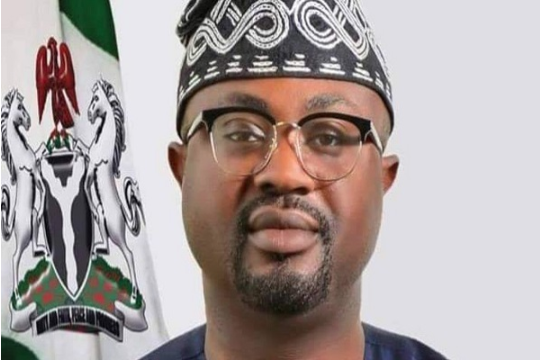
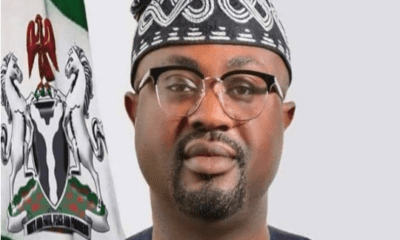
The Federal High Court in Abuja on Monday ordered the Minister of Interior, Olubunmi Tunji-Ojo, to respond to a suit seeking to compel the release of records of his National Youth Service Corps (NYSC) scheme.
Justice Salim Ibrahim gave the order when the matter came up for hearing.
The Incorporated Trustees of Pathway to Equity and Charity Foundation had filed the suit, marked FHC/ABJ/CS/1812/2026.
The group prayed the court to compel the NYSC to disclose documents supporting the minister’s claim that he completed the mandatory one-year national service.
The foundation also sought an order of mandamus directing the Federal Capital Territory Administration (FCTA), the 2nd respondent, to produce records showing that the minister did his primary assignment at the FCTA.
When the case was called, counsel to the applicant, Chief Solomon Akuma, SAN, told the court he was ready to proceed with the hearing.
However, Abiola Olaniji, who appeared for the minister, said he had filed an application for Tunji-Ojo to be joined as the 3rd respondent.
Olaniji said the applicant (foundation) had responded with a counter affidavit raising serious issues, to which he needed time to reply.
The lawyer stated that the minister was ready to take part in the proceedings as an interested party.
But Akuma opposed the application, arguing that the minister was not a proper party.
He said the suit only sought an order of mandamus compelling the respondents (NYSC and FCTA) to produce documents that are not in the minister’s custody.
Justice Ibrahim directed the minister to file and serve his reply to the applicant’s counter affidavit, which opposed his application to be joined as a party in the suit before the next hearing date.
The judge then adjourned the matter until Oct. 18 for hearing.
The applicant had sought from the NYSC the mobilisation or call-up letter issued to Tunji-Ojo in 2006 or any other year; the posting letter to the FCTA in 2006 or any other year; and his application for mobilisation.
It also sought the evidence of approval of his remobilisation by the NYSC’s Director-General; evidence of payment of allowances to him; the record of his Community Development Service and his discharge certificate.
The foundation equally sought from the FCTA, the mobilisation or call-up letter, the posting letter, his attendance record during the service year, evidence of any allowance paid to him, among others.
It said the application was brought under Section 14 of the Federal High Court Act, Order 34 Rules 1, 2 and 5 of the Federal High Court (Civil Procedure) Rules 2019.
It also cited Sections 20, 21 and 25 of the Freedom of Information (FOI) Act, 2011.
(NAN)

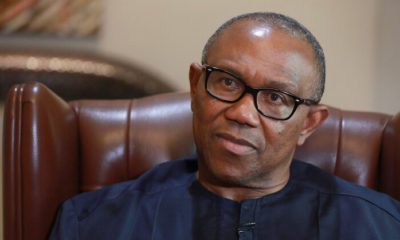
The presidential candidate of the Nigeria Democratic Congress, Peter Obi, has advised Nigerians residing in the United Kingdom to stop sending money to people who seek financial help at home.
Obi also advised them to urge their relatives to vote for productive leaders.
He made the remarks at a town hall meeting with diaspora supporters in Manchester, United Kingdom, on Sunday.
He stressed that Nigeria’s prevailing economic hardship resulted from bad leadership, arguing that continuous financial assistance only cushions the effects of poor governance without addressing the root causes.
“You have people at home in Nigeria today who are begging you for money. Tell them no!” he said.
The former Anambra State governor insisted that his record in public office distinguished him from other governors, claiming none of them matched his achievements in saving public funds.
“I’m not saying I’m a saint, but I saved money. I’ve not seen one governor who has saved 10 per cent of what I saved. No governor has done it.
“Let’s start with this one that is less corrupt. That’s how other countries change.”
He maintained that his conversations with the people reinforced the need for collective responsibility, stressing that building a new Nigeria would require citizens to take an active role in addressing challenges facing the country.
Obi also urged Nigerians to take the 2027 election seriously, describing the contest as a critical moment for the nation.
Contrary to false and misleading reports on social media that a Federal High Court (FHC) sitting in Abuja had nullified the N150 million fee prescribed by the Enugu State Structures for Signage and Advertisement Agency (ENSSAA) for political campaign billboards, findings have revealed that the court actually ruled in favour of the agency, upholding its powers to prescribe the fee.
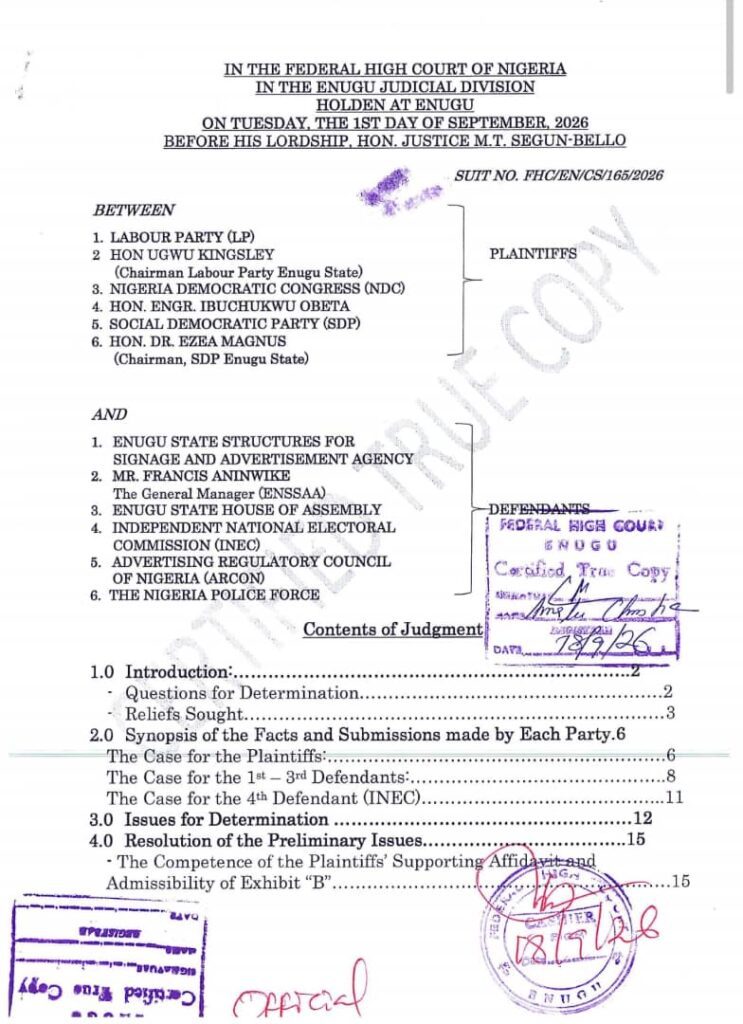
According to a certified true copy (CTC) of a judgment of FHC sitting in Enugu, the court had on September 1, 2026, dismissed a suit by opposition parties and figures challenging ENSSAA’s authority to impose a mandatory N150 million fee on each political party seeking to erect campaign billboards or display posters ahead of the 2027 general election.
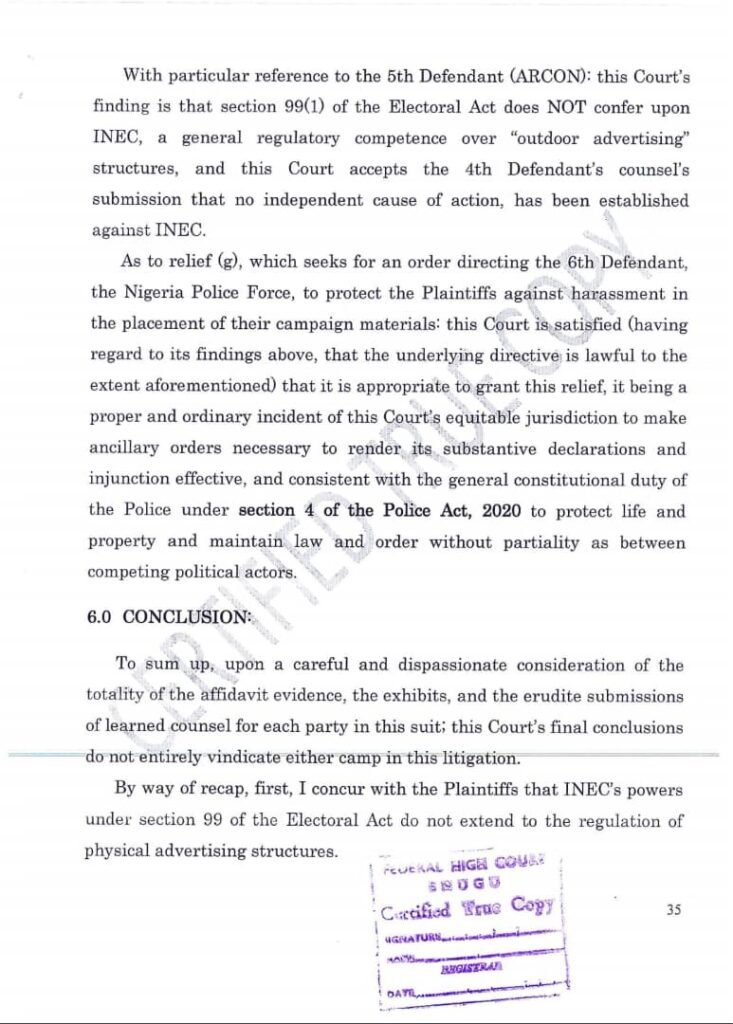
The judgment rendered by Justice Mabel Segun-Bello held that it was within the legislative competence of the Enugu State House of Assembly to make laws on outdoor advertising and for ENSSAA to exercise powers donated to it by state law.
The suit marked FHC/EN/CS/165/2026 had the Labour Party; Chairman of the Labour Party (LP) in Enugu, Hon. Kingsley Ugwu; Nigeria Democratic Congress (NDC); NDC factional state Chairman, Engr. Ibuchukwu Obetta; the Social Democratic Party (SDP) and its state Chairman, Hon. Magnus Ezea, as plaintiffs, while ENSSAA; its General Manager, Mr. Francis Aninwike; the Enugu State House of Assembly; Independent National Electoral Commission (INEC); Advertising Regulatory Council of Nigeria (ARCON); and Nigeria Police Force were the respondents or defendants.
The plaintiffs had in June 2026 approached the court seeking a declaration that, by virtue of Sections 99 (1) and (2) of the Electoral Act, 2026, and Section 153 of the 1999 Constitution, which donated exclusive powers to INEC to regulate electoral campaigns of political parties in Nigeria, it was ultra vires the powers of ENSSAA and its General Manager to make executive decisions and publications imposing a mandatory payment of N150 million by political parties and their candidates in the state as an advertisement permit fee for the placement of billboards for the council election and the 2027 election.
They equally sought a declaration by the court that it was unlawful and ultra vires the legislative powers of the Enugu State House of Assembly to make laws regulating the advertisement of political campaigns in the state.
Consequently, the plaintiffs sought an order of the court setting aside the mandatory N150 million fee, as well as an injunction restraining the agency and its GM, the Enugu State Government, its agents and representatives from enforcing ENSSAA’s executive directive.
They finally sought an order of the court mandating the Nigeria Police Force to protect political parties in Enugu State against possible harassment for the placement of billboards and posters for the council election and the 2027 elections.
However, delivering her judgment in September, after a careful consideration of the totality of the affidavit evidence, the exhibits, and submissions by both parties, the presiding judge, Justice Mabel Segun-Bello, held, among other things, that the National Assembly does not hold exclusive legislative powers over outdoor advertising.
“I accede to the 1st, 2nd and 3rd Defendants’ contention that the subject matter of ‘outdoor advertising’ is NOT reserved exclusively to the National Assembly or to ARCON.
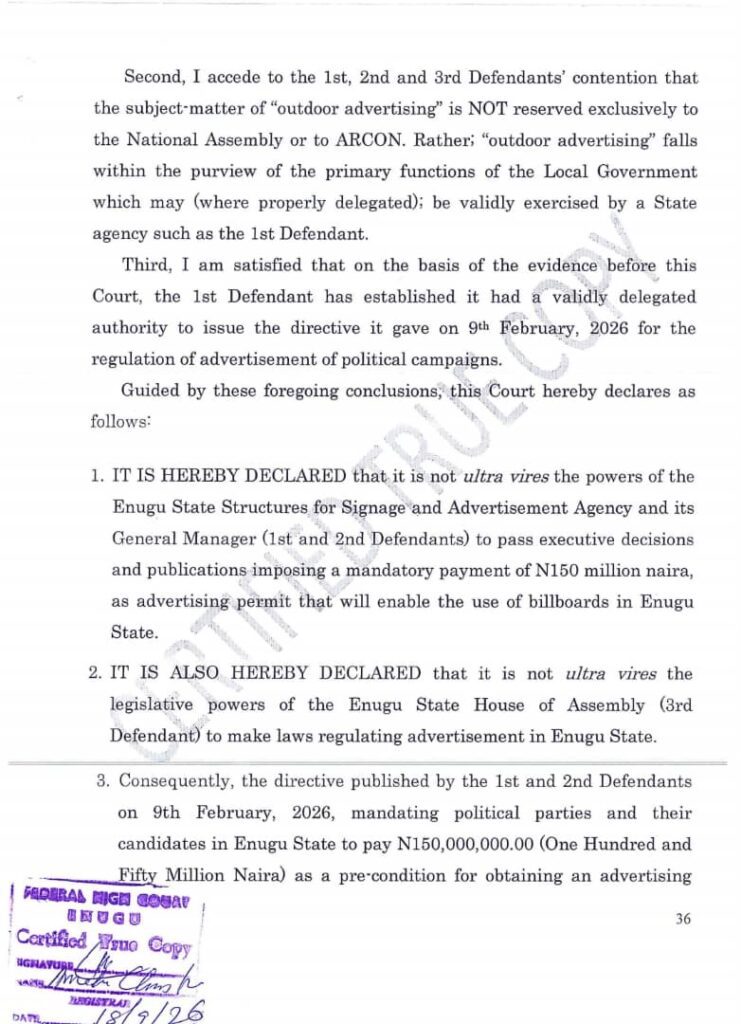
“Rather, ‘outdoor advertising’ falls within the purview of the primary functions of the Local Government, which may (where properly delegated) be validly exercised by a State agency such as the 1st Defendant (ENSSAA).
“Third, I am satisfied that on the basis of the evidence before this Court, the 1st Defendant has established it had a validly delegated authority to issue the directive it gave on 9th February, 2026, for the regulation of advertisement of political campaigns,” she stated.
Guided by these foregoing conclusions, Justice Segun-Bello held that “it is not ultra vires the powers of the Enugu State Structures for Signage and Advertisement Agency and its General Manager (1st and 2nd Defendants) to pass executive decisions and publications imposing a mandatory payment of N150 million naira, as advertising permit that will enable the use of billboards in Enugu State.”
Continuing, she said, “It is also hereby declared that it is not ultra vires the legislative powers of the Enugu State House of Assembly (3rd Defendant) to make laws regulating advertisement in Enugu State.
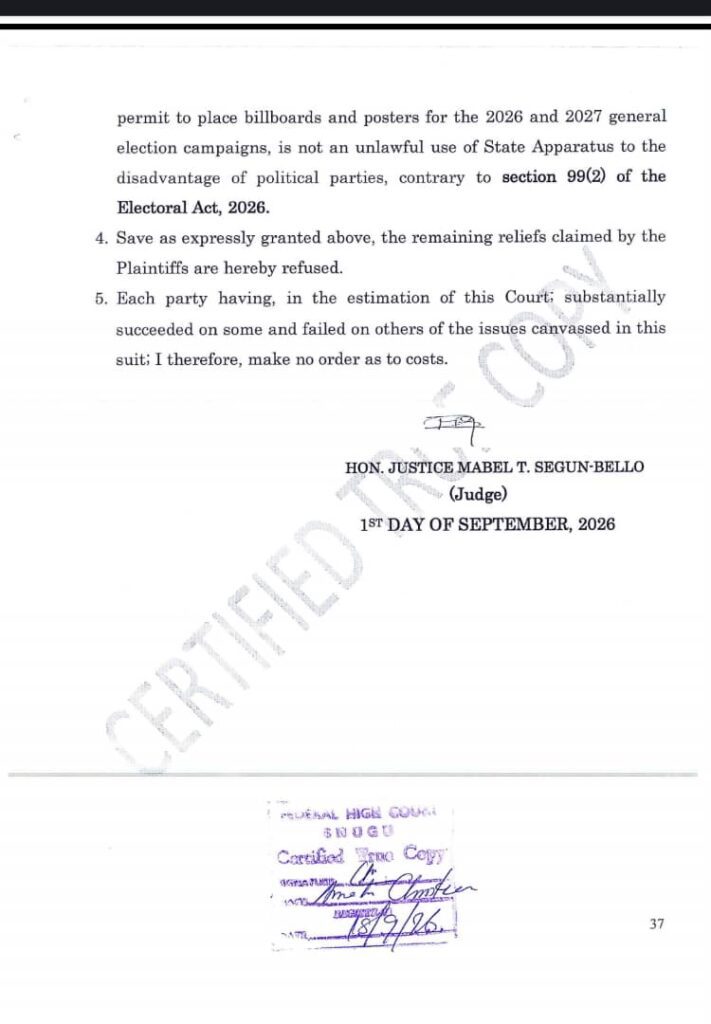
“Consequently, the directive published by the 1st and 2nd Defendants on 9th February, 2026, mandating political parties and their candidates in Enugu State to pay N150,000,000.00 (One Hundred and Fifty Million Naira) as a pre-condition for obtaining an advertising permit to place billboards and posters for the 2026 and 2027 general election campaigns, is not an unlawful use of State Apparatus to the disadvantage of political parties, contrary to Section 99(2) of the Electoral Act, 2026.
“Save as expressly granted above, the remaining reliefs claimed by the Plaintiffs are hereby refused.”
Meanwhile, the Enugu State Government says that unlike the practice in most states, the N150 million fee is for each political party, not for candidates, as misrepresented on social media and by some commentators.
The Secretary to the State Government, Prof. Chidiebere Onyia, made the clarification recently while fielding questions from Government House correspondents in Enugu, adding that there was no court judgment on the fee by any FHC in Abuja, as falsely circulated.
In a related development, finding show that the Abia State Structures for Signage and Advertising Agency (ABSSAA) prescribed feea for candidates ranging from N20 million for State House of Assembly candidates to N200 million for presidential candidates.
Imo State fees range from N3.55 million for each House of Representatives candidate to N55 million for each governorship candidate, while the permit fees range from N300,000 for local council candidates to N150 million for presidential candidates.
The campaign permit fee ranges from N100,000 for each councillorship candidate to N50 million for each presidential candidate, while Kwara State fixed its fees at N2 million for each House of Assembly candidate and N100 million for presidential candidates.
The Certified True Copy of the Court Judgement :
-
 News1 day ago
JUST IN: Former Delta Governor, Uduaghan, dies
-
Faith2 days ago
Awka Anglican Diocese Rejects Ibezim’s Suspension, Threatens to Leave Church of Nigeria
-
News3 days ago
BREAKING: Mbah Extends Enugu Movement Restriction to 10pm, Scraps Keke Ticketing
-
Politics2 days ago
Nigeria’s Weak Opposition and the Cost of One-Party Dominance: Can the Opposition Rebuild Before 2027?
-
News3 days ago
2027: Keke Riders Endorse Mbah, Tinubu
-
News24 hours ago
Federal High Court Upholds ENSSAA’s N150m Political Campaign Billboard Fee, CTC Reveals
-
News2 days ago
Corruption turning Nigerian Courts to ‘market stalls’ — Retired Justice Augie
-
Politics1 day ago
AA Assembly Candidate, Ugbaje Friday, Unveils Development Agenda for Ibaji