Connect with us

News

BREAKING: 27 Rivers Lawmakers defect to APC

Published

on

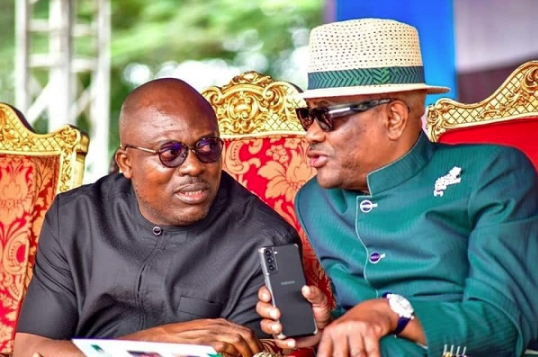
BREAKING: Fubara is architect of Rivers violence, he defied court order – Wike
Gov Fubara and FCT Minister Nyesom Wi
Spread the love

The ongoing political drama in Rivers State has taken a very interesting turn as 27 members of the Rivers State House of Assembly have defected from the Peoples Democratic Party (PDP) to the All Progressives Congress (APC).

A member of the Assembly, Enemi George, confirmed that the 27 lawmakers were under the leadership of Martin Amaewhule.

He said the decision was taken during their sitting on Monday morning.

The lawmakers, who were elected on the platform of the People’s Democratic Party, PDP, announced their decision at the Monday plenary at the Rivers Assembly Complex.
The lawmakers are those under the leadership of Rt. Hon. Martin Amaehwule. It is gathered that the lawmaker are loyal to the Minister of Federal Capital Territory, Chief Nyesom Wike.
The legislative arm of the state has been in serious crisis, following the move to impeach the governor of the state, Sir Siminalayi Fubara.


News

Obi vows to make political leaders seek treatment in Nigeria

Published

on

Peter Obi donates ₦10 million to Nursing College
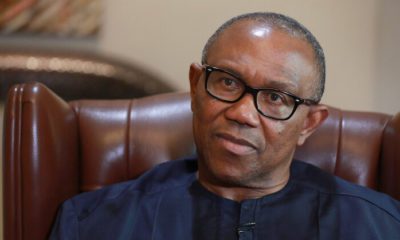
Peter Obi
Spread the love
Presidential candidate of the Nigeria Democratic Congress (NDC) in the 2027 general election, Peter Obi, has vowed to ensure political office holders seek medical treatment in Nigeria if elected President.

Obi also promised to spend his holidays in Nigeria, saying he would promote the use of domestic facilities and local destinations rather than travel abroad for vacations.

He spoke on Thursday in Asaba, Delta State, during the inauguration of the NDC secretariat in the state.

Obi said his administration would prioritise the development of Nigeria’s healthcare system and ensure that political leaders use local medical facilities.

He said: “We will ensure that those of them who are in power must seek medical care here. Anybody that will go abroad will be for referral.”

The former Anambra State governor also criticised President Bola Tinubu’s extended stay abroad, saying Nigerian leaders should remain more connected to the country and its challenges.

Maduka College Advert

According to Obi, “Today, our President is in France. He went for three weeks and he has spent more than three weeks.”

He added: “As President of Nigeria, all my holidays will be in Nigeria. I will go to Agbor for holiday; I will go to Warri for holidays, not France.”

The Presidency had said Tinubu’s stay in France formed part of his working vacation and that he remained in contact with officials at home while away.

Obi, however, said his administration would “fix” the healthcare system and make it functional for Nigerians.

He also lamented what he described as the neglect of the Niger Delta despite the region’s contribution to the nation’s economy.

“One thing that I can assure you is that the days you don’t see the impact of your wealth is gone. Niger Delta must see the impact of the wealth it is creating for the nation,” he said.

Obi also criticised the condition of the East-West Road and other federal roads in the region.

“You cannot pass anywhere in the Niger Delta, yet they are producing the wealth the country shares every month,” he said.

He promised that an NDC administration would change the situation through what he described as transparent management of public resources.

“We will ensure that this will change and it will change by the way we manage the resources; it will change because we are going to be transparent. We will tell you where every penny is going to,” Obi said.

Continue Reading

News

Panic as NMDPRA cracks down on filling stations under-dispensing petrol

Published

on

Spread the love
Filling station operators across the country are under pressure to check and recalibrate their dispensing equipment as the Nigerian Midstream and Downstream Petroleum Regulatory Authority intensifies its crackdown on outlets accused of under-dispensing petrol to motorists.

The regulator’s latest directive followed a series of enforcement operations carried out in the past, in which several filling stations were sealed for short-measuring customers, with the authority warning that persistent offenders risk losing their operating licences.

About 20 filling stations were reportedly sealed by the regulator between 2025 and 2026 for under-dispensing.

Following the NMDPRA warning, petroleum marketers said they had risen to ensure fuel retailers give customers the right value for their money. While some of them said pump attendants might be responsible for such sharp practices, others said faulty fuel pumps could be responsible for under-dispensing.

The NMDPRA, in an industry notice issued on Tuesday, directed all retail outlet operators to immediately calibrate and verify their dispensers and totalisers to ensure that consumers receive the full quantity of petroleum products for which they pay.

The authority said it had observed incidents of under-dispensing at retail outlets nationwide, describing the practice as a serious breach of consumer trust.

Maduka College Advert

The regulator warned that outlets found under-dispensing, operating improperly calibrated equipment or otherwise compromising dispensing accuracy would be required to take immediate corrective action.

It added that persistent or serious violations would attract sanctions, “up to and including revocation of the outlet’s licence”.

IPMAN alerts members

Reacting to the directive, the Publicity Secretary of the Independent Petroleum Marketers Association of Nigeria, Chinedu Ukadike, said the association had circulated the NMDPRA notice to its members nationwide.

Ukadike said marketers were operating in a competitive environment where product quality, price and quantity were important factors in attracting and retaining customers.

He explained that the deregulated nature of the downstream sector made it important for independent marketers to protect their reputation and retain customers.

“I’m aware of the NMDPRA notice. We have also distributed the information to our members nationwide, drawing their attention to the NMDPRA notice. But I still want to let you know that we are in a very competitive environment. What drives the market is: one, quality of the product; two, price of the product; three, quantity of the product.

“These are the things that drive this kind of market now. We are in a deregulated economy. And what drives your market is your ability to convince your customers and sustain your customers. You have seen the innovations that we have done in all our businesses nationwide. We are ready for this deregulation and this competition. So nobody will indulge in underselling or cheating customers,” Ukadike said.

However, he acknowledged that sharp practices by individual pump attendants could not be completely ruled out, saying IPMAN was working to reorient its members and their employees.

“But sometimes you cannot rule out some sharp practices from some of our pump attendants, which is why we are trying to go nationwide now, to see how we can reorientate them, to be steadfast and truthful to customers,” he noted.

Ukadike disclosed that the association would not allow customers to be cheated at the pump, stressing that marketers had a responsibility to ensure that their dispensing equipment remained accurate.

“I don’t know if there is any reason that could prompt a manager to adjust the pump below the normal value. But this is an announcement by NMDPRA. We have set out our eyes to ensure that such a thing does not happen. And if there are sharp practices, we are ready to curtail them. So, some pump attendants adjusting prices and engaging in sharp practices may not be ruled out. But we are ready to ensure no customer is cheated at the pumps,” he said.

He added, “Don’t quote me incorrectly. I say you cannot rule out sharp practices from a few individuals like some attendants. For us, the independent marketers, we want to build our brand, and the three cardinal points of building our brand are low pricing, quality, and service.”

Another IPMAN major dealer, who spoke in confidence due to the lack of authorisation to speak on the matter, stated that the association had identified some lapses among pump attendants and would intensify its orientation programme to address the problem.

“No independent marketer will like to indulge in any sharp practices, but because we employ people who are working for us, we have identified some of the lapses, and the executive council will move into this orientation policy to ensure that some of these sharp practices by some pump attendants will be cut out,” he said.

PETROAN intensifies checks

The Petroleum Products Retail Outlets Association of Nigeria also directed its members to inspect their dispensing meters following the NMDPRA warning.

Speaking on Channels Television’s The Morning Brief on Wednesday, the National President of PETROAN, Billy Gillis-Harry, said the association had convened an emergency meeting of its National Executive Council on Tuesday after receiving the regulator’s warning.

He said the meeting lasted until about 10 pm, after which members were instructed to check their dispensing equipment. “PETRON circulated a message around the country, calling our members to check their meters as quickly as possible,” Gillis-Harry said.

He explained that prolonged use could cause dispensing equipment to develop faults, resulting in either under-dispensing or over-dispensing. “Equipment can be faulty over time because of usage,” he said.

Gillis-Harry assured motorists that PETROAN members would ensure that customers received the quantity of fuel they paid for. “But I can tell you that PETRON members will, at all times, insist on making sure that they sell their products one litre for one litre,” he said.

He advised motorists to monitor the quantity displayed on the dispenser whenever they buy fuel and request receipts after transactions.

The PETROAN president also urged consumers to familiarise themselves with their vehicles’ fuel capacities and compare them with the quantity shown on the dispensing meter.

“Oftentimes, we educate our staff to call the attention of the customer to check the meter while it is being dispensed. And also to get the customer to check after the product has been dispensed,” he said.

Gillis-Harry said PETROAN worked with the Weights and Measures Division of the Ministry of Industry, Trade and Investment and the NMDPRA on the maintenance and accuracy of dispensing meters.

“PETRON consistently works with the Weights and Measures Division of the Ministry of Trade and Investment, and also the NMDPRA. These are the two regulatory authorities that ensure that our meters are functional. And they are up to date and accurate,” he said.

He stressed that the association had commenced engagement with its members following the regulator’s warning. “We took what the NMDPRA called our attention to yesterday very seriously. And we already started working on that,” he said.

NMDPRA seals stations

The NMDPRA’s latest directive comes after the regulator had stepped up enforcement against filling stations found to be short-measuring customers.

In February, the authority sealed 11 petrol stations in Rivers State for alleged under-dispensing, failed pumps and other regulatory infractions.

The exercise, conducted in Obio-Akpor and Port Harcourt City Local Government Areas, was part of the NMDPRA’s “Operation One Litre for One Litre” surveillance initiative. The authority said the affected stations would remain shut until the integrity of their pumps was confirmed.

The NMDPRA’s South-South Coordinator, Victor Owodiasa, warned at the time that persistent offenders could have their licences revoked.

He also said under-dispensing could sometimes result from mechanical faults, but insisted that operators had a responsibility to regularly check their meters rather than wait for regulators to detect the problem.

In July, the NMDPRA Abeokuta Field Office also sealed two filling stations in the Akute/Ajuwon area of Ifo Local Government Area of Ogun State for under-dispensing and other sharp practices.

The authority said one of the stations had repeatedly violated regulatory requirements, including allegedly removing official seals placed on the facility and resuming operations without authorisation. It disclosed that the station had been sealed at least six times since 2025.

The regulator warned that further violations could lead to penalties, suspension of operating licences and criminal prosecution where applicable.

Earlier, in October 2025, the NMDPRA Eket Field Office sealed five petrol stations in Akwa Ibom State over various infractions, including alleged under-dispensing, diversion and operating without a licence.

The issue has also affected major oil marketers. In August 2025, NNPC Retail sanctioned employees at its Ikorodu, Lagos, station after an investigation confirmed an incident involving a pump attendant who allegedly attempted to short-change a customer.

The company said the attendant was disengaged, the station manager was suspended, and a formal warning was issued to the dealer.

With the latest directive, the NMDPRA has now directed industry associations, including IPMAN, PETROAN, the Major Energy Marketers Association of Nigeria and the Depot and Petroleum Products Marketers Association of Nigeria, to notify their members and support compliance.

The regulator said its intensified inspections were aimed at protecting consumers, promoting transparency and ensuring that motorists receive the quantity of petroleum products for which they pay.

The directive comes against the backdrop of the Federal Government’s broader efforts to strengthen regulatory oversight of the downstream petroleum sector following the removal of the petrol subsidy and the transition to a market-based pricing regime.

With petrol now sold at prices determined largely by market conditions, accurate dispensing has become an important part of consumer protection, particularly as motorists and other users pay varying pump prices across locations.

Under-dispensing occurs when a retail outlet’s dispensing equipment delivers less product than the quantity displayed or paid for by the consumer. Faulty or improperly calibrated pumps can therefore result in consumers paying for a volume of petrol that they do not receive.

The NMDPRA said its latest enforcement action was aimed at preventing such practices and improving confidence in petroleum product transactions. The Authority also directed major industry associations to ensure that their members comply with the directive.

“MEMAN, DAPPMAN, IPMAN and PETROAN are kindly requested to promptly notify their members of this directive and to support full compliance across the industry,” the regulator stated.

The NMDPRA stressed that consumer protection remained a key part of its regulatory responsibility, particularly in ensuring that petroleum transactions were transparent and accurately measured.

It said, “NMDPRA remains committed to protecting consumers, promoting transparency, and upholding the integrity of petroleum product transactions nationwide.”

The directive means filling stations now face closer scrutiny of their dispensing equipment, while operators will be expected to correct any identified defects promptly or risk regulatory sanctions. (PUNCH excluding caption)

Continue Reading

News

Mbah: Media, Govt Must Meet at Point of Truth

Published

on

Enugu Governor, Dr Peter Mbah
Spread the love

Enugu State Governor, Peter Mbah, has challenged the government and the media to meet at the point of truth, urging journalists to go beyond headlines and political narratives by independently establishing facts through evidence, investigation and context.

Mbah said government had a responsibility to be transparent about its actions and accountable for its results, while the press must independently scrutinise those actions and report the truth, whether the findings exposed shortcomings or revealed progress.

The governor stated this on Thursday while welcoming over 300 editors to the 22nd All Nigeria Editors Conference organised by the Nigerian Guild of Editors in Enugu.

The conference has as its theme, “The Ballot, the Media and the Task of Keeping Democracy Alive,” while its sub-theme is “When Lies Look Real: Detecting and Debunking AI Misinformation Before, During and After Elections.”

Mbah said the relationship between government and the media should not always be defined by confrontation, stressing that both institutions had different responsibilities but a common obligation to serve the Nigerian people.

Maduka College Advert

“Government must be transparent about what it is doing and be accountable for the results. The press must establish the facts and report the truth.

“Sometimes that truth will expose failure. Sometimes it will reveal progress. The obligation for us both is the same in either case – serving the people of Nigeria,” he said.

The governor urged journalists to deepen investigative reporting, particularly at a time when artificial intelligence and other technologies were making it increasingly difficult to distinguish between genuine and fabricated information.

He said AI could be used to fabricate photographs, clone voices and manipulate videos to make people appear to say things they never said, warning that the development had increased the responsibility of professional journalists.

“My challenge to you, therefore, is simple – go deeper,” Mbah told the editors.
He said investigative journalism should not become a luxury, urging editors to create room for journalists to devote time and resources to understanding complex issues and establishing facts.

According to him, rigorous journalism should not involve searching for evidence to support a position that had already been taken.

“Its value lies precisely in its independence: examine the evidence, test competing claims, establish what happened, and report what you find,” he said.

Mbah added that the same standard should apply to government and its critics, stressing that government achievements should not be ignored simply because they did not fit a particular political narrative.

“We have tried to build an Enugu government that is open about what it is doing and clear about what it is trying to achieve. Where we fall short, that should call for scrutiny and be reported. But the same principle applies when the evidence reveals progress,” he said.

The governor also used the occasion to highlight some of his administration’s projects, including more than 1,500 kilometres of roads constructed or reconstructed, over 7,000 classrooms, Smart Green Schools and Type-2 Primary Healthcare Centres across the state’s 260 wards.

He listed other interventions as water infrastructure, new transport terminals and CNG buses, Enugu Air, the revival of dormant industries and the development of a new city.

Mbah said the administration was working to position Enugu as an economic gateway to the South-East, with the ambition of making the state one of Nigeria’s leading economies and a national leader in human development and quality of life.

He also acknowledged the support of President Bola Tinubu and the Federal Government, particularly in areas of roads, aviation, energy and regional development.

The governor urged the editors to use their presence in Enugu to independently assess the developments in the state.
“Take some time to explore the city, speak to the people who live and work here, and get a sense of the direction in which Enugu is moving,” he said.

Also speaking at the conference, the Minister of Information and National Orientation, Mohammed Idris, warned that the misuse of Artificial Intelligence to create fake photographs, videos, audio recordings and documents posed a serious challenge to public trust and the electoral process.

Idris, who delivered his goodwill message through the Managing Director of the News Agency of Nigeria, Ali M. Ali, said the danger was not only that citizens could believe false information, but that they could eventually stop believing anything.

He urged media organisations to make verification a permanent part of newsroom culture, asking journalists to establish who made a claim, what evidence supported it, when an image was taken, whether a video was original and whether the source had been independently verified.

Idris also charged the media to subject government performance to rigorous scrutiny without exaggerating achievements or ignoring shortcomings.

“A responsible press should neither exaggerate achievements nor ignore them. It should examine them, verify them, ask the difficult questions, and allow citizens to understand both the progress and the shortcomings. This is how public trust is built,” he said.

The minister further urged journalists to explain the implications of amendments to the Electoral Act signed into law in February 2026, saying Nigerians needed to understand what had changed and what remained the same.

He cautioned journalists against becoming participants in political contests, saying their responsibility was to establish facts, provide context and allow citizens to make their own judgments.

In his keynote lecture, the Archbishop Emeritus of Abuja, John Onaiyekan, called for reforms in the appointment of the chairman and commissioners of the Independent National Electoral Commission.

Onaiyekan argued that the appointment process should be reviewed to strengthen the independence of the electoral body, particularly because the President and governors are political actors in elections.

“We need to review the method of appointment of the INEC chairman and the commissioners. They should not depend on Mr President and the governors, who are themselves contestants in elections,” he said.

He also advocated the establishment of a special election tribunal dedicated exclusively to electoral disputes, with a defined timeframe for resolving cases.

Onaiyekan argued that election petitions should, as much as possible, be concluded before elected officials are sworn into office.

He further called for changes to allow ordinary voters to challenge election results where they believed their votes had not been properly counted.

“Our laws should make provision for the citizen as citizen and as electors to challenge results of the election at tribunals,” he said.

The cleric said strengthening electoral institutions, improving dispute resolution and ensuring credible information remained essential to sustaining public confidence in Nigeria’s democracy.

The conference brought together editors and senior media professionals to examine the role of journalism in protecting democratic values, strengthening public accountability and safeguarding the integrity of Nigeria’s electoral process.

Continue Reading

Trending

Maduka College Advert