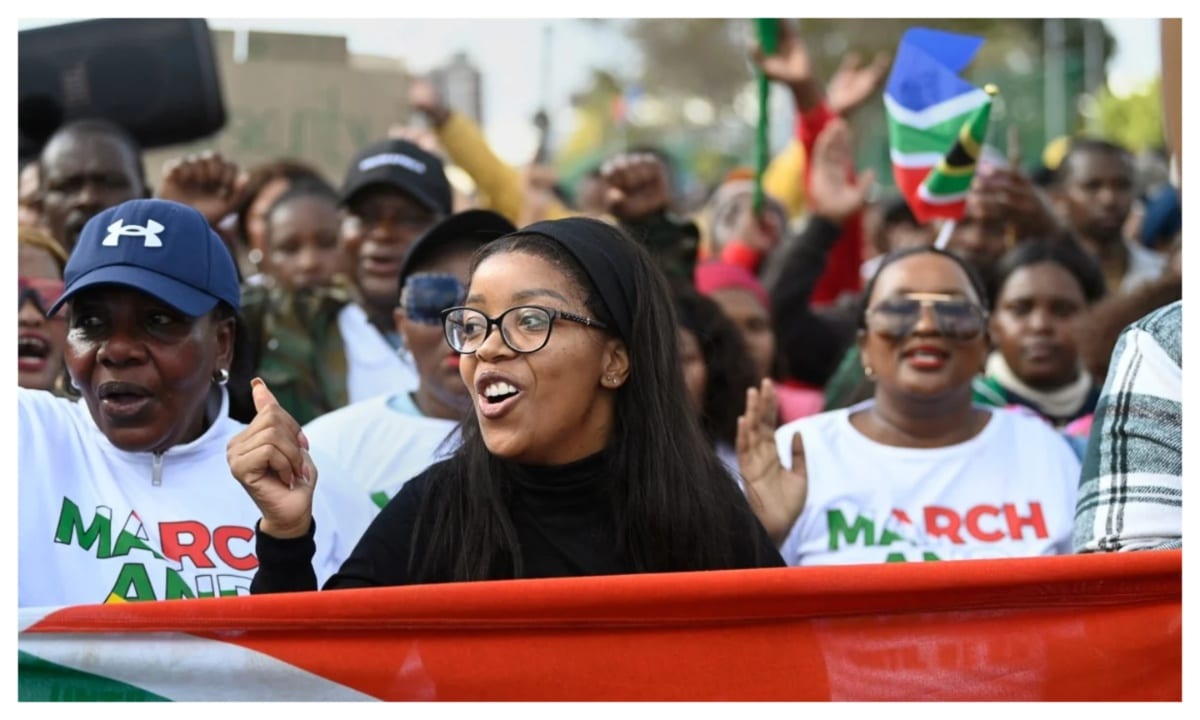
Demonstrators under the March and March anti-migrant group on Wednesday staged a fresh protest in Pretoria, South Africa, demanding a ban on Nigerians entering the country.
The protesters, led by the group’s leader, Jacinta Ngobese-Zuma, called on the South African government to stop Nigerians from entering the country, accusing some Nigerian immigrants of engaging in drug-related activities.
Speaking during the protest, Ngobese-Zuma challenged Nigerians living in Sunnyside, a suburb of Pretoria, to explain why the area has been nicknamed “Little Lagos” because of the large Nigerian population.
“I’m being told here that we’ve entered Sunnyside, the home of Nigerians. I’m inviting Nigerians to come out. Let’s talk to each other. We want to know who gave you this place and called it Nigeria. Who gave you permission to call this place Lagos or whatever you call it?” she asked.
She further questioned why Nigerians had allegedly adopted names associated with their home country for parts of South Africa.
Also speaking, Xolani Zuma, the group’s legal representative, called on the South African government to impose an entry ban on Nigerians.
“The state must ban Nigerians from South Africa. They must ban Nigerians until they stop selling drugs to our people. The rest of Africa, we are fine, but we do not want Nigerians in South Africa anymore. That is what we are saying,” Zuma said.
Ngobese-Zuma also demanded that South Africa withdraw from the 1951 United Nations Convention Relating to the Status of Refugees.
She described the international agreement as “not sustainable and not feasible”, arguing that the presence of migrants places additional pressure on public resources and fuels frustration among South African citizens.
One of the convention’s central principles is non-refoulement, which prohibits countries from returning refugees to territories where they face serious threats to their lives or freedom.
The group said it was marching to the Home Affairs Department to formally present its demands to the government.
The latest demonstration comes amid heightened diplomatic tensions between Nigeria and South Africa over issues affecting the Nigerian community in the country.
Last week, the Nigerian High Commission and the South African Presidency exchanged positions over the omission of a speech by Nigeria’s High Commissioner, Femi Fani-Kayode, during the presentation of his credentials.
Fani-Kayode described the omission as disrespectful to Nigeria but later said the matter had been put behind following the intervention of South African President Cyril Ramaphosa and an invitation from the Department of International Relations and Cooperation (DIRCO) to address the disagreement.
The high commissioner also disclosed that he had begun looking into issues affecting Nigerians in South Africa since his arrival in the country.
He described those behind xenophobic attacks as a “tiny minority”, insisting that they did not represent the majority of South Africans, whom he characterised as decent and accommodating.
Meanwhile, more than 1,500 Nigerians were reportedly repatriated from South Africa this year amid renewed xenophobic tensions, with at least four Nigerians said to have been killed in related attacks.
Despite the growing concerns, Fani-Kayode has maintained that Nigeria has no intention of severing diplomatic relations with South Africa, although he warned that patience was wearing thin within the corridors of power.