• Billboard Controversy Deepens As Critics Faults Soludo Govt’s Action
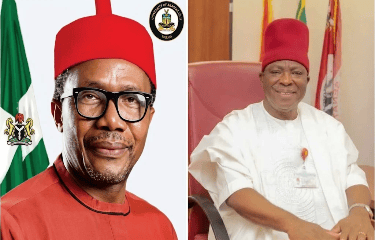
The controversy surrounding the removal of a campaign billboard belonging to Senator Victor Umeh in Anambra State has deepened, following criticism of the state government’s explanation by prominent Nigerian journalist, Dr Tony Onyima.
The Anambra State Government had dismissed allegations that the billboard was removed because it featured the image of former Governor Peter Obi, insisting that the action was based on an alleged violation of the Anambra State Signage Act, 2010.
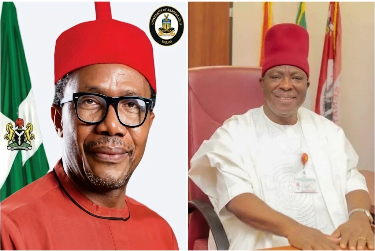
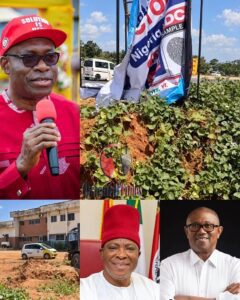
The billboard, which reportedly featured Senator Umeh, who represents Anambra Central Senatorial District, alongside Peter Obi, the presidential candidate of the National Democratic Congress (NDC), was defaced by officials of the Anambra State Signage and Advertisement Agency (ANSAA).

The incident generated widespread reactions after a video showing officials defacing the billboard was shared on social media by Charles Ifeanyi Obi, an aide to Senator Umeh.
The aide questioned the action, particularly as the senator had allegedly fulfilled his financial obligations to the agency. He also shared a photograph purportedly showing representatives of the senator making a payment of N20 million as statutory political advertising fees.
Reacting to the controversy, the Commissioner for Information and Value Reformation, Dr Law Mefor, said the enforcement action had nothing to do with Peter Obi’s image or political affiliation.
In a statement issued in Awka on Thursday, November 19, 2026, Mefor acknowledged that Senator Umeh had paid the required signage fee but alleged that Peter Obi had not fulfilled the relevant payment requirements.
According to him, featuring the NDC presidential candidate on the billboard without meeting the statutory obligations constituted a violation of the state’s signage regulations.
Mefor further explained that the law being enforced was enacted in 2010 during Peter Obi’s administration as governor of Anambra State.
He warned that any combined billboard campaign featuring political candidates who had failed to meet their signage obligations would attract similar enforcement, irrespective of their political status or party affiliation.
However, Onyima, in a reaction titled, ‘Mefor’s Explanation Raises More Questions Than Answers’, faulted the government’s position, describing its justification as contradictory and raising questions about the legal basis for removing a billboard sponsored by someone who had reportedly paid the required fees.
He argued that if the removal had nothing to do with Peter Obi’s image, the government should explain why the former governor’s alleged failure to pay signage fees formed the central justification for the action.
Onyima also questioned whether the Anambra State Signage Act, 2010, permits the removal of a billboard sponsored by an advertiser who has fulfilled his financial obligations simply because another person featured in the advertisement allegedly failed to pay the required fees.
He challenged the commissioner to identify the specific provision of the law that authorises such enforcement.
The journalist further suggested that the controversy had a political dimension, arguing that the growing public appeal and political influence of Peter Obi could not be diminished through the removal of billboards.
He maintained that the fact that the signage law was enacted during Obi’s administration did not automatically justify its application, insisting that what mattered was whether the legislation was being enforced fairly and consistently.
“Nobody is suggesting that Peter Obi or anyone else should be exempt from applicable signage fees. The issue is simple: Senator Umeh paid for his billboard. On what specific legal grounds, therefore, was it removed?” Onyima queried.
He urged the Soludo administration to provide the statutory provisions supporting its action rather than rely on political arguments.
Onyima warned that the rule of law must not become an instrument of political intimidation, adding that while a billboard could be pulled down, the political influence and public image of Peter Obi among his supporters could not be demolished.
The incident has continued to generate debate over the regulation of political advertising in Anambra State, with questions emerging about the responsibilities of advertisers, candidates featured in campaign materials and the extent of enforcement powers available to ANSAA.
The controversy is also unfolding against the backdrop of increasing political activities ahead of the 2027 general elections, with the state government’s insistence on regulatory compliance facing scrutiny from critics who want greater clarity on the legal basis for the enforcement action.