News
FG distributes agro-inputs worth N2.8b to 14,000 farmers in Anambra, Enugu

The Federal Government, on Tuesday, distributed agro-inputs to 14,000 farmers worth N2.8 billion in Anambra and Enugu States under the Adani-Omor Zone of Agricultural Transformation Agenda Support Programme, Phase One (ATASP-1).
The Minister of Agriculture and Food Security, Sen. Abubakar Kyari, disclosed this during the agro inputs distribution part of the National Agricultural Growth Scheme Agro Pocket (NAGS-AP) in ATASP-1 Adani-Omor Zone in Ikem within Isi-Uzo Council Area.

Kyari, represented by Dr Peter Kursh, said the distributed farm inputs to ATASP-1 farmers were redeemed at subsidized rate, adding: ‘This exercise has cost the programme about N5 billion.”
The minister said that Adani-Omor Zone had not benefited because it was off season at the time of planning, hence the need to implement this laudable programme in Enugu and Anambra States of the Adani-Omor Zone.
“The programme competitively procured Agro-Dealers that will provide Agricultural Inputs to about 14,000 ATASP-1 farmers in Adani-Omor i.e Enugu and Anambra States at 50 per cent subsidy with a total cost of about N2.8 billion.

“Each of the benefitting farmer will receive a package of two bags of inorganic NPK/Urea fertilizer, one bag of organic fertilizer, 10kg of seeds of either maize/rice/sorghum and four litres of Agro-chemicals delivered through ICT platform,” he said.
Kyari noted that the agricultural policy of Federal Government aims at the attainment of self-sustaining growth in all the sub- sectors of agriculture and the structural transformation necessary for the overall socio-economic development.
According to him, the policy also meant to ensure improvement in the quality of life of Nigerians.
He said: “Under the Renewed Hope Agenda of President Bola Tinubu, Federal Government is currently implementing the National Agricultural Growth Scheme Agro-Pocket (NAGS-AP) across the nation.
“Farmers have been registered and agro-inputs are being distributed to the farmers in the last dry season and the current rainy season.
“This significant milestone marks a crucial step in our commitment to empowering our farmers and enhancing agricultural productivity.
“By providing quality inputs, we aim to support our farmers in achieving higher yields and ensuring food security for Nigeria.”
Flagging the distribution, Gov. Peter Mbah of Enugu State appreciated Tinubu for his visionary agricultural policies as well as the Federal Ministry of Agriculture and Food Security and African Development Bank (AFDB) for their support to the state through AtASP-1.
Mbah, represented by the Commissioner for Agriculture, Mr Patrick Ubru, said that subsidised Input distribution is one of such interventions coming on the platform of the National Agriculture Growth Scheme (NAGS)-AP, through ATASP-1 project.
According to the governor, this is a crucial step towards enhancing agricultural productivity and ensuring food security in our state.
He said: “The objective of the NAGS-AP project aligns perfectly with our vision of achieving food security, nutrition security, and sustainable development through agriculture.
“I commend the Federal Government for its commitment to providing agricultural inputs to our smallholder farmers, a move that resonates with the agenda of my administration in agriculture.”
Earlier, Gov. Chukwuma Soludo lauded President Bola Tinubu and
African Development Bank (AFDB) for assisting smallholder farmers to grow and provision of infrastructure to boost food production through ATASP-1.
Soludo, represented by the Commissioner for Agriculture in Anambra, Dr Foster Ihejiofor, said that the distribution is a fulfillment of Federal Government earlier promise to smallholder farmers in 2023.
“The ATASP-1 has been highly beneficial to the participating communities in Anambra State and contributed to the educational and health wellbeing of our people,” the governor said.
The National Programme Coordinator ATASP-1, Mr Mohammed Arabi, noted that “ATASP is a game changer” in agricultural development focusing on wheat, rice, cassava and sorghum within the country.
Arabi noted that ATASP-1 had recorded tremendous progress in the past years of its operation.
According to him, notably among the achievements are construction of socio-economic infrastructures such as primary schools, community health centres, boreholes and hand pump, VIP latrines and community markets.
“Other achievements included technology demonstration centres, feeder roads and construction and rehabilitation of irrigation facilities across the seven states of the programme,” he said.
Dr Romanus Egba, Zonal Programme Co-ordinator of ATASP-1 Adani-Omor Zone, appreciated the Federal, Anambra and Enugu State governments for providing enabling environment to work together to give subsidised agro-inputs to farmers in the zone.
Egba said that today, “an average person is a farmer and these agro-inputs will go a long for bumper harvest, food production and food sufficiency in the country.”
One of the beneficiaries, Mr Paulinus Orji, a sorghum farmer, thanked the Federal Government and ATASP-1 for making the subsidised agro-inputs possible.
“These inputs we collect today, we are going to get bumper and bountiful harvest from it in few months to come,” Orji said.




Tension has gripped parts of Kwara State following the reported abduction of members of the Iru Ekun Security Group, a security outfit spearheaded by Yoruba nation agitator Sunday Adeyemo, popularly known as Sunday Igboho.
The assailants reportedly abducted the security operatives and forced them to renounce their activities of protecting communities in the state.
According to reports, the abducted members pleaded for their release and were compelled to renounce their community protection activities.
The Iru Ekun Security Group was established to protect Yoruba communities in Kwara State against terrorist attacks and kidnappings.
The reported abduction has sparked fear among residents who rely on the group for protection against insecurity in their communities.
As of the time of filing this report, Igboho had yet to issue a statement on the reported abduction of the security group members.

Fidelia Ezinwanne Chigbogu, the immediate elder sister of the late Senator Ifeanyi Ubah, has died at the age of 61.
Mrs Chigbogu, fondly called “Darling” by her husband, reportedly slumped and died on Sunday morning in Lagos while preparing to attend church.
Her husband, Chudi Chidinma Chigbogu, a native of Nnewi in Nnewi North Local Government Area of Anambra State, described her death as a devastating shock, saying she had shown no signs of illness before the incident.
“It was like a shock to me because, even as I am talking to you now, I never believed it,” he said.
Narrating the circumstances surrounding her death, Mr Chigbogu said the family had experienced an electrical incident the previous Thursday when their electricity meter exploded and burnt their changeover room.
He said they had contacted officials of the electricity distribution company, who promised to visit on Monday to replace and relocate the meter.
“We were busy waiting for them. My wife said she would give testimony in church on Sunday, and we were preparing for that,” he said.
According to him, his wife woke up on Sunday morning without any apparent health complaints and was preparing to leave for church when the incident occurred.
“That Sunday morning, she woke up. There was nothing like a headache, nothing like fever, nothing. She finished bathing and was preparing to go to church. She usually leaves home between 7 a.m. and 7:30 a.m. because of the roles she plays in the church,” he said.
Mr Chigbogu explained that he was washing his car because of dust when he became concerned that his wife had not come downstairs.
“I went to wash the car because of dust. Around 8 a.m., I called my son and said, ‘Why has mummy not come down? Go and check.’
“Only for the boy to go and start screaming that he called his mummy and she did not answer. He lifted her hand, and her hand dropped,” he recounted.
He said he immediately rushed upstairs and found his wife lying unresponsive on the bed.
“I called her names, no way. I alerted neighbours, and we carried her to six hospitals. Anywhere we went, they would take me aside and say I didn’t bring her on time, that she had passed on.
“I said no, it was not possible, until we got to Navy Hospital, where they refused to admit her,” he said.
Mr Chigbogu said prayers continued at their home for several hours as the family struggled to come to terms with the tragedy.
He recalled that around 4 p.m., someone told him she had seen his wife in a vision, moving swiftly without looking back, which she interpreted as a sign that the deceased had made it to heaven.
“That was when I changed my mind and allowed an ambulance to come. She left here after 6 p.m. and got to the village around 7 a.m. the next day,” he said.
Describing his late wife, Mr Chigbogu said she was a natural leader, peacemaker and philanthropist who played a significant role in her family, church and community.
“Aside from calling her Darling, I called her many names because she was a leader. No matter the case in the family, she would settle it.
“She is the founder of a women’s group, played a very big role in the church and was known for her charitable work. Before her passing, she was working on her orphanage.
“Even though she is no more, I will not let her down. I will make sure that project comes to pass,” he said.
On her family background, Mr Chigbogu said her parents had seven children—three boys and four girls—and that his late wife was the second daughter.
He added that she was also one of the trustees of the Ubah family.

By Tony Edike
Enugu State Governor, Dr Peter Ndubuisi Mbah, has pledged to sign into law a proposed amendment to the state’s Landlord and Tenant Law aimed at curbing excessive agency and legal fees imposed on prospective tenants.
Mbah gave the assurance while speaking at a recent town hall meeting, where he outlined his administration’s plans to address housing challenges in the state through legislative reforms and increased housing supply.

Enugu Housing scheme
The governor said his administration was working with the Enugu State House of Assembly to ensure the proposed legislation was passed within four weeks, promising to sign it as soon as it was transmitted to him.
He said the government could effectively regulate charges imposed by property agents and lawyers but warned against imposing rent controls that could discourage investment in the housing sector and worsen accommodation shortages.
“One thing that government can regulate effectively is controlling the cost an agent charges as commission, controlling the legal fees. You can clearly make laws to guide that,” Mbah said.
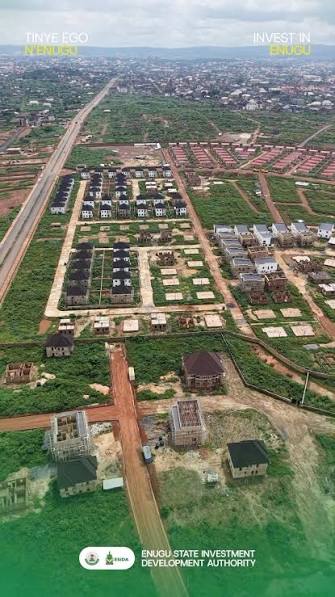
The Enugu Smart City
He explained that fixing a ceiling on the rent landlords could charge might discourage people from investing in residential property, potentially reducing housing supply and pushing rental prices even higher.
“It is extremely difficult to make laws to cap the fee the rent a landlord charges because once you do that, what you’re going to see is scarcity,” he said.
The governor added that his administration was adopting a supply-driven approach to addressing the housing crisis by expanding the city, developing new residential areas and increasing the availability of housing units.

Proposed structures at the Enugu Smart City
“So what we do as government is to try and push supplies in the market to see that we build new houses to ensure that there are enough homes so that that supply would drive down the rent,” he stated.
Mbah said his administration was working with the legislature to regulate tenancy-related fees while protecting residents from excessive charges.
“I’m committing to you that we’re going to work with the House of Assembly to ensure that within the next four weeks we’ll ensure that bill is passed into law, and I’ll be in a hurry to sign it so that we can protect Ndi Enugu,” the governor added.

Housing units ready for relocation of slum residents
The proposed amendment to the Landlord and Tenant Law, Cap. 101, Revised Laws of Enugu State, 2004, was disclosed by the Speaker of the House of Assembly, Rt. Hon. Uche Ugwu, in a Facebook post on Monday, October 26, 2026.
According to Ugwu, the executive bill seeks to establish clearer rules for tenancy transactions, regulate estate agents, limit agency and legal fees, and provide a structured mechanism for handling caution fees and refunds.
The proposed legislation also seeks to reduce disputes between landlords and tenants over property damage through joint inventories and professional valuations where necessary, check arbitrary rent increases and create a more transparent framework for tenancy-related charges.

Screenshot
The executive bill comes after an earlier bill sponsored by the member representing Nkanu East State Constituency, Hon. Okey Mbah, which had passed its first and second readings, with a public hearing also conducted by the House.
While advocating the earlier bill in March 2025, Okey Mbah raised concerns about the high costs prospective tenants were required to pay, including agency commissions, legal fees, caution fees and other charges.
He argued that the absence of effective regulation had created opportunities for exploitation, with some individuals allegedly posing as property agents to collect money from unsuspecting accommodation seekers without providing the promised services.
The earlier proposal sought to limit agency and legal fees to a maximum of 10 per cent of the rent, prohibit caution fees and introduce safeguards against irregular and fraudulent evictions. However, the final provisions will depend on the version of the legislation passed by the House.
Ugwu said the renewed legislative effort aligned with Mbah’s vision of making Enugu a preferred destination for business, investment, tourism and residential living.
The proposed amendment comes amid persistent complaints about the rising cost of accommodation in Enugu, where prospective tenants often face substantial additional charges beyond the rent demanded by landlords.
If passed and signed into law, the legislation could introduce greater transparency into tenancy transactions and provide a regulatory framework for the activities of property agents, while helping to protect tenants from excessive fees.
However, the effectiveness of the proposed reforms will depend on the final provisions of the law, the establishment of appropriate enforcement mechanisms and compliance by landlords, estate agents and legal practitioners.
-
 Features2 days ago
Mmesoma Umeorini: When Love Turns Deadly, and a Young Woman Pays With Her Life
-
Features2 days ago
Why Igbos Celebrate New Yam Festival Worldwide: The History, Cultural Significance and Lessons For The Younger Generation
-
News1 day ago
Kogi Police Probe Alleged Murder-Suicide Involving Two Officers
-
News8 hours ago
BREAKING: Tension as Video Shows Islamic Group Members Allegedly Calling for AK-47 to Kill Christians in Enugu, Jos
-
News3 days ago
Mbah: Why We Built 268 Smart Green Schools Across Enugu State
-
News3 days ago
UBA Commences Contempt Proceedings Against WEMPCO Directors over Alleged Disobidence of Court Order
-
News3 days ago
Anambra Police Arrest Suspect Over Murder of 23-Year-Old Woman in Uga
-
News1 day ago
NCDC Reports Two Suspected Ebola Cases as Contacts Rise to 53