Connect with us

International

How United Kingdom deliberately infected thousands with HIV, Hepatitis – Report

Published

on

Infected blood victim Brendan West poses for a photograph at his home in Farnborough, Hampshire, England, Thursday March 28, 2024. Mr West lost his leg in 1979 and was given a blood transfusion while at a British Military Hospital in Germany. After trying to give blood three years ago he learned he has been infected with Hepatitis C for decades. (Andrew MatthewsPA via AP)
Spread the love
British authorities and the country’s public health service knowingly exposed tens of thousands of patients to deadly infections through contaminated blood and blood products, and hid the truth about the disaster for decades, an inquiry into the U.K.’s infected blood scandal found Monday.

An estimated 3,000 people in the United Kingdom are believed to have died and many others were left with lifelong illnesses after receiving blood or blood products tainted with HIV or hepatitis in the 1970s to the early 1990s.

The scandal is widely seen as the deadliest disaster in the history of Britain’s state-run National Health Service since its inception in 1948.

Former judge Brian Langstaff, who chaired the inquiry, slammed successive governments and medical professionals for “a catalogue of failures” and refusal to admit responsibility to save face and expense. He found that deliberate attempts were made to conceal the scandal, and there was evidence of government officials destroying documents.

“This disaster was not an accident. The infections happened because those in authority — doctors, the blood services and successive governments — did not put patient safety first,” he said. “The response of those in authority served to compound people’s suffering.”

Prime Minister Rishi Sunak apologised to the victims and said the report’s publication marked “a day of shame for the British state.”

Maduka College Advert

Campaigners have fought for decades to bring official failings to light and secure government compensation. The inquiry was finally approved in 2017, and over the past four years it reviewed evidence from more than 5,000 witnesses and more than 100,000 documents.

Many of those affected were people with hemophilia, a condition affecting the blood’s ability to clot. In the 1970s, patients were given a new treatment that the U.K. imported from the United States. Some of the plasma used to make the blood products was traced to high-risk donors, including prison inmates, who were paid to give blood samples.

Because manufacturers of the treatment mixed plasma from thousands of donations, one infected donor would compromise the whole batch.

The report said around 1,250 people with bleeding disorders, including 380 children, were infected with HIV -tainted blood products. Three-quarters of them have died. Up to 5,000 others who received the blood products developed chronic hepatitis C, a type of liver infection.

Meanwhile, an estimated 26,800 others were also infected with hepatitis C after receiving blood transfusions, often given in hospitals after childbirth, surgery or an accident, the report said.

“I am truly sorry,” Sunak told a packed and silent House of Commons. “Today’s report shows a decades-long moral failure at the heart of our national life. From the National Health Service to the civil service to ministers in successive governments, at every level, the people and institutions in which we place our trust failed in the most harrowing and devastating way.”

He vowed to “right this historic wrong” and said details of a compensation package, expected to total 10 billion pounds ($12.7 billion), would be announced Tuesday.

The report said many of the deaths and illnesses could have been avoided had the government taken steps to address the risks linked to blood transfusions or the use of blood products. Since the 1940s and the early 1980s it has been known that hepatitis and the cause of AIDS respectively could be transmitted this way, the inquiry said.

Langstaff said that, unlike a long list of developed countries, officials in the U.K. failed to ensure rigorous blood donor selection and screening of blood products. At one school attended by children with haemophilia, public health officials gave the children “multiple, riskier” treatments as part of the research, the report said.

He added that over the years authorities “compounded the agony by refusing to accept that wrong had been done,” falsely telling patients they had received the best treatment available and that blood screening had been introduced at the earliest opportunity. When people were found to be infected, officials delayed informing them about what happened.

Langstaff said that while each failure on its own was serious, taken “together they are a calamity.”

Andy Evans, of campaign group Tainted Blood, told reporters that he and others “felt like we were shouting into the wind during the last 40 years.”

“We have been gaslit for generations. This report today brings an end to that. It looks to the future as well and says this cannot continue,” he said.

Diana Johnson, a lawmaker who has long campaigned for the victims, said she hoped that those found responsible for the disaster will face justice — including prosecution — though the investigations have taken so long that some of the key players may well have died since.

“There has to be accountability for the actions that were taken, even if it was 30, 40, 50 years ago,” she said.


International

Spain Train Crash Kills at Least 64, Leaves 80 Injured

Published

on

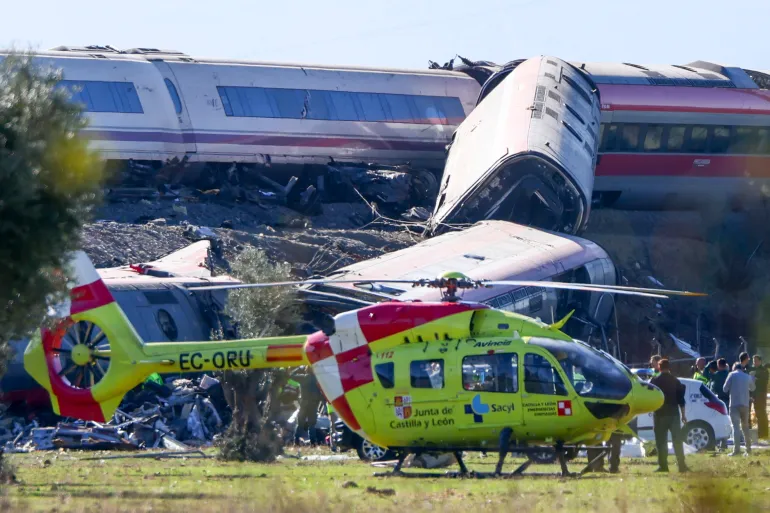
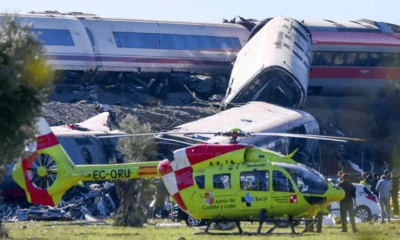
Rescue team members arrive at the scene where two high-speed trains crashed in the village of Urda in Toledo, Spain, on October 28, 2026 [Ismael Herrero/EPA]
Spread the love

At least 64 people have been killed and about 80 others injured after two high-speed trains collided in central Spain, according to regional authorities.

The accident occurred early Wednesday near Urda in Toledo province, south of Madrid, along the high-speed railway line connecting the Spanish capital with Seville.

The head of the Castilla-La Mancha regional government, Emiliano García-Page, said about 50 of the injured were in serious condition, while 15 others were critically injured. He warned that some of the most seriously injured victims might not survive.

Spain’s Health Minister, Mónica García, said the injured were being transported to several hospitals across the region for treatment.

The collision involved a Renfe-operated AVE high-speed train travelling from Madrid to Seville and another train operated by private railway company Iryo.

Maduka College Advert

Esther Padilla, a spokeswoman for the Castilla-La Mancha regional government, told Spanish public broadcaster TVE that both trains were travelling in the same direction when one struck the rear of the other, which had stopped.

The impact caused carriages to derail, with two carriages of the Iryo train reportedly plunging down an embankment.

Authorities said 397 passengers were aboard the Renfe train, while 147 were travelling on the Iryo train, bringing the total number of passengers involved to 544.

Signalling System Failure Under Investigation

Spain’s Transport Minister, Óscar Puente, said a failure of the railway’s signalling and control system preceded the accident.

Puente explained at a press conference that the LZB train control system went down at about 8:30 a.m. along a 63-kilometre stretch of railway, affecting six trains, although he said the exact number remained uncertain.

Following the failure, control was transferred to the Atocha control post, where a decision was made to allow the Renfe train to resume its journey.

“The decision to resume traffic without the system having been restored corresponds to the control centre,” Puente said, describing the circumstances as “inexplicable”.

Emergency workers were concentrating on rescuing survivors and recovering bodies from the most severely damaged carriages.

More than 200 members of Spain’s Military Emergencies Unit were deployed to the crash site, while local authorities mobilised food and other essential supplies for those affected.

Footage circulating on social media showed wreckage scattered along a slope, with rescue workers and members of the public gathered around the damaged train.

High-Speed Rail Services Suspended

Spain’s railway infrastructure operator, ADIF, suspended high-speed rail services between Madrid and the southern region of Andalusia following the collision.

The disruption resulted in delays and cancellations, with passengers waiting at railway stations, including Sevilla Santa Justa station.

The Civil Guard also deployed a disaster investigation team to the scene to assist with the investigation into the circumstances surrounding the crash.

Madrid Mayor José Luis Martínez-Almeida said the capital was sending emergency medical teams and firefighters to support rescue operations.

Government, European Leaders React

Spanish Prime Minister Pedro Sánchez said he was shocked by the tragedy and was in contact with Transport Minister Puente and Castilla-La Mancha regional leader García-Page as emergency crews continued their work.

“Shocked by the serious train accident in Toledo. My affection, solidarity, and support to all the victims and their families,” Sánchez said in a post on X.

European Commission President Ursula von der Leyen also expressed her condolences to the victims and their families.

“Today, Europe mourns with you,” she said.
French President Emmanuel Macron expressed solidarity with Spain, saying his thoughts were with the victims, their families, the injured and the emergency workers responding to the disaster.

The crash comes nine months after another accident involving high-speed trains operated by the same companies on the same railway line reportedly killed 46 people.

Journalist Graham Keeley, speaking to Al Jazeera from Spain, said the latest tragedy had come at a difficult time for the Spanish government, with an election expected in just over a month.

He noted that following the January accident, the government had promised to conduct safety checks across the country’s railway network.

The investigation is expected to examine the signalling failure, the decision to resume train movements and the sequence of events that led to the collision.

Continue Reading

International

France braces for another weekend of protests as authorities launch massive security operation

Published

on

Spread the love

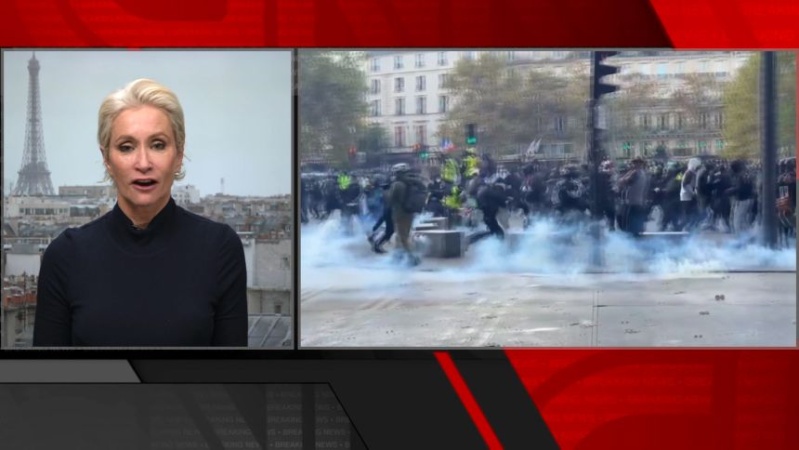
France is bracing for yet another wave of protests this weekend with authorities racing to prevent a repeat of the kind of violence and riots that hit the nation last week.

French authorities will be launching a massive security operation with some 70,000 police officers deployed across the country over the weekend, according to the interior ministry.

Specialist SWAT units, helicopters, armored vehicles, police dogs and water cannons will all be part of the operation. On top of that, the number of French army soldiers that normally patrol Paris as part of the country’s counter-terrorism measures will be increased to free the police from stationary guard duties.

Interior Minister Laurent Nuñez issued a stark warning on Friday to anyone looking for trouble, saying the government would be “uncompromising with those who engage in destruction.”

Last week’s violence followed weeks of protests over education, dismal job prospects and the cost of living. Initially peaceful and attended mostly by students, the demonstrations quickly turned into the worst wave of deadly, nationwide violence in years.

Maduka College Advert

This week, curfews were imposed in some cities to help maintain calm.

Bracing for Saturday

A large demonstration has been called for Saturday afternoon in Paris and French media are expecting hundreds of thousands of people to attend.

The protest is organized by France’s main student union, UNEF, with one of the country’s biggest trade unions, CGT, announcing it would join. Other groups are expected to attend, including farmers, climate activists and the Yellow Vests, the movement that first emerged in 2018 during the protests over fuel costs.

While the protest in Paris has been authorized by the authorities, French President Emmanuel Macron on Thursday banned all non-trade union protests on Saturday as he seeks to control the civil unrest.

But the preparations go well beyond bans and police warnings, especially since last week’s riots sparked criticism of the authorities for not taking the threat seriously enough.

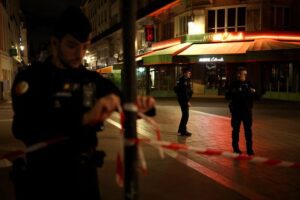
A police officer ties in place a perimeter tape near Chatelet – Les Halles to enforce a curfew, in central Paris on October 20.

A police officer ties in place a perimeter tape near Chatelet – Les Halles to enforce a curfew, in central Paris on October 20.
Simon Wohlfahrt/AFP/Getty Images

The City of Paris announced earlier this week it was clearing public spaces of equipment and materials that could be used to cause damage, including barriers, bins, construction material and other items.

Many of the main tourist sites in the French capital, including world-famous museums like the Louvre, the Musée d’Orsay and the Musée de l’Orangerie will be closed on Saturday.

Art Basel finished the Paris version of its fair on Friday, two days earlier than scheduled. The Paris National Opera cancelled its performances on Saturday, citing the protests as the reason, and at least two dozen metro stations will also be closed for much of the day, according to Paris municipal authorities.

An NFL game between Pittsburgh Steelers and New Orleans Saints is set to take place at the Stade de France just outside of the capital on Sunday. While the match is scheduled to go ahead, a Steelers fan event in Paris was cancelled by the NFL.

During last weekend’s riots, at least two people died and multiple others suffered serious injuries, including two people who lost their hands. French Justice Minister Gérald ​Darmanin said some 2,700 people were held for questioning and 232 have been incarcerated in connection to the riots. (CNN)

Continue Reading

International

Six people missing as plane vanishes from Bermuda to Boston

Published

on

Six people are missing after a private jet vanished, sparking a major search off the coast of Nantucket in the US. Picture: X
Spread the love

There are grave fears for the passengers of a private plane that suddenly vanished mid-flight, sparking a major search off the coast of the US.

Six people are missing after a private jet vanished en route from Bermuda to Boston, sparking a major search off the coast of Nantucket in the US.

US authorities say the Gulfstream G100 lost contact with air traffic control about 2am local time on Saturday (4pm Saturday AET) while flying from L.F. Wade International Airport in Bermuda to Boston Logan International Airport.

The US Coast Guard said the Federal Aviation Administration alerted it after contact was lost with the aircraft – which plummeted from 23,500 feet to 11,000 feet in just three minutes, according to FlightAware data.

“We are praying for a safe outcome,” a spokesperson for Latitude Air Ambulance, which operates the missing plane, told City News.

A search is now under way off Nantucket in the air and on water as crews work to locate the missing jet, the Coast Guard said. Data from FlightRadar24 showed a number of aircraft searching south of the island.

Maduka College Advert

Six people are missing after a private jet vanished, sparking a major search off the coast of Nantucket in the US.

The plane was en route from Bermuda to Boston when it vanished.

“Air & surface crews have launched in search of the aircraft. Updates will be provided here as info becomes available,” the Coast Guard Northeast District said on X.

The plane was carrying out a medical evacuation in Bermuda – a British overseas territory in the north Atlantic Ocean, according to Clarence Togeretz, Director of Flight Operations at Latitude Air Ambulance.

“We always get rather concerned when our crew doesn’t report to us in a timely manner,” he told NBC News.

“But I will say that again, optimistically and positively, that doesn’t mean that the worst has happened.”

Continue Reading

Trending

Maduka College Advert