Politics
Disquiet in APC over Adamu’s alleged resignation

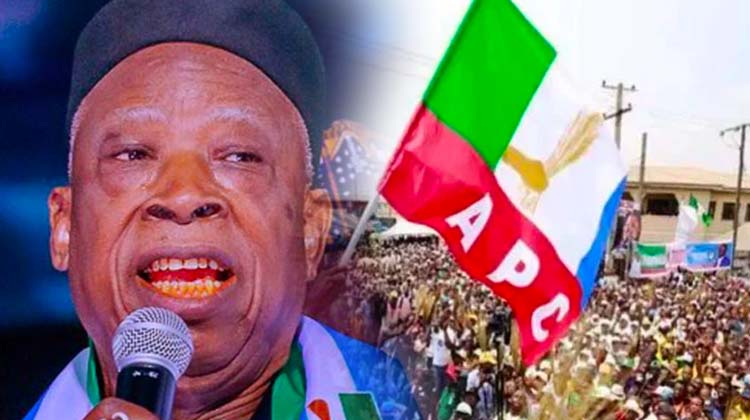
There were controversies, on Sunday, over the alleged resignation of the National Chairman of the All Progressives Congress, Senator Abdullahi Adamu.
While some sources confirmed that the embattled chairman had resigned from his position, others said it was a rumour.

The alleged resignation could not be officially confirmed at press time, while top APC chieftains contacted by our correspondents gave conflicting information.
This is coming two days before the long-awaited crucial National Caucus and National Executive Committee meetings of the party.
An APC NWC member confirmed the alleged resignation to our correspondent on Sunday night on condition of anonymity.
Also, our correspondent could not immediately confirm when Adamu threw in the towel, but he was said to have been ordered to quit by President Bola Tinubu.

It was gathered that his resignation letter was delivered to the President by Imo State Governor, Hope Uzodimma.
The APC spokesman, Felix Mouka, did not respond to calls and a message seeking clarification on the development but sources attributed it to Adamu’s failure to support Tinubu’s presidential aspiration ahead of the party’s convention.
The party’s Director of Publicity, Bala Ibrahim, said he could not deny or confirm the development.
He said, “I cannot say anything for now. I read the purported resignation of our National Chairman like most Nigerians but this is all I can say for now.”
Also contacted was former Minister of State for Labour and Employment, Mr Festus Keyamo, who promised to get back; a pledge he had yet to fulfil as of the time of filing this report.
However, the NWC source disclosed that they were disappointed by the action of the former Nasarawa governor, who he said did not deem it important to even address them before submitting his resignation letter.
He said, “We just heard the news this evening too like every other person that the chairman has resigned. I understand it was a directive from the presidency. I learnt it was the Chairman of the Progressive Governors’ Forum, Hope Uzodinma, who personally handed over the president’s letter to him.
“But we find his action demeaning. He could have, at least, briefed us as members of the same NWC before taking the decision.
“With his resignation, I don’t think he will be at the meeting tomorrow. In his absence, the Deputy National Chairman for North, Senator Abubakar Kyari, will take over in line with the Constitution. It is the norm that once a national chairman resigns, the deputy national chairman from his zone will take over in an acting capacity. Although we can’t have the official confirmation until tomorrow, my sources are very reliable,” he said.
We could not independently confirm the claim by the NWC member. The paper could not also confirm if Kyari would chair the meeting.
It was also gathered that the governors asked Adamu to resign to avoid being sacked at the forthcoming party’s National Executive Committee meeting.
A top source, who was privy to the development, said though the former governor of Nasarawa State was reluctant to resign, the overwhelming decision of the governors made him change his decision.
However, a source very close to the APC chairman told The PUNCH that, “It is not true. But some people, I learnt, have decided to see him today or tomorrow to pressurise him to resign.”
In the run-up to the presidential convention of the party on June 8, 2022, Adamu had thrown his weight behind the then-President of the Senate, Ahmad Lawan.
He reportedly presented Lawan to former President Muhammadu Buhari as the party’s consensus candidate, but his move to get Buhari’s support was truncated by the APC governors who allegedly informed the President that they were not involved in Adamu’s plot against the former Lagos State governor.
Last week, Adamu admitted in an interview on Arise Television that he didn’t support Tinubu’s ambition, pointing out that he had the right to support whoever he wanted.
He also dismissed the rumoured differences between him and the president as unfounded.
He stated that he was also misrepresented about his position on the recently elected principal officers of the National Assembly, saying that what the APC had issues with was the manner the communication was handled by the lawmakers.
Adamu had claimed ignorance of the emergence of the principal officers, saying he was not carried along in the process by the lawmakers.
Responding to a question on his plot to prevent Tinubu from emerging as the candidate of the party, he stated, “I think that’s a soft selling point for you media people. It is true that at the time that I made a presentation to the National Working Committee, the name of Senator Ahmed Lawan was thrown up.
“That was before the convention. So many things took place between then and the actual date of the convention and you saw what culminated in the convention unanimously. I was there and I led the convention of the party.
“A day after the convention, I took the entire working committee to his (Tinubu’s) house in Asokoro and assured him of our support and said we would stand shoulder to shoulder with him and ensure that the mandate was sold properly to the people of Nigeria. We won the election. Instead of being praised, we are vilified,” he said.
He stated that it wasn’t the time for vilification, expressing the view that since he led the party to success, he should be commended.
Apart from this, Adamu had also been involved in a running battle with the North-West National Vice Chairman of the party, Salihu Lukman, who accused the party chair of running the APC like an army barrack without recourse to the NWC.
The Kaduna politician expressed concerns that the day-to-day administration of the secretariat and key decisions that involve party activities were taken at the discretion of the national chairman.
Lukman revealed in a statement issued in Abuja on Friday titled ‘Rebuilding the APC to Reform Nigerian Politics: Task Before President Asiwaju Bola Ahmed Tinubu,’ issued on June 16.
But Adamu in defence said those who had issues against him had always had the opportunity to air their views at their national meetings, explaining that Lukman had always attended those meetings.
He stated that the decision of Lukman to take the party to court was a grave offence even though he later signed a deal that his case had been withdrawn from the court and apologised for his misdemeanour.
Adamu said he would be will willing to disagree with the president on any matter because there was freedom of speech in the country, explaining that the so-called altercation with the president remained a media creation.
Shortly after the news of Adamu’s possible resignation broke, the National Youth Leader of the APC, Dayo Israel, posted “Fake News” on his Twitter handle, @dayoisrael.
Although he was not specific on the report he referred to as fake news, most of the responses posted by his followers were on the resignation rumour.








….GMN challenges ruling party to publish register, accuses APC of preparing ground for 2027 rigging
The Grassroots Mobilization Network (GMN), a support group of the African Democratic Congress (ADC), has dismissed the All Progressives Congress (APC)’s claim of 12.9 million registered members as “a scam and outright fraud,” challenging the ruling party to publish its membership register for public verification.
The group alleged that the membership figure was fabricated to create a false impression of massive nationwide support for the APC ahead of the 2027 general elections and potentially provide cover for an alleged plan to manipulate the polls.
The allegation was contained in a statement issued on Monday in Abuja by GMN spokesperson, Comrade Peter Emeka.
Emeka said the APC’s claim was an attempt to deceive Nigerians and the international community about the party’s actual strength, arguing that genuine political popularity could not be manufactured through unverified figures.
“The APC’s so-called 12.9 million membership claim is nothing but fraud and a scam by a party that has lost the confidence of Nigerians,” the group said.
“You cannot manufacture members on paper when your government has failed to deliver food, security and jobs to the people.”
GMN further alleged that the figures could be deployed as part of preparations to manipulate the 2027 presidential election.
“The main aim of manufacturing these figures by the desperate APC is to use it to support their impending rigging plans,” Emeka alleged.
“But that plan will fail. Nigerians are ready to foil whatever illegal and dubious plans to frustrate or win the 2027 presidential election.”
The group also accused the APC of attempting to create a misleading picture of its grassroots support base before the Independent National Electoral Commission (INEC), election observers and the wider international community.
“It’s simply a gimmick to hoodwink Nigerians and the world, but it’s a mockery of our democracy,” Emeka said.
GMN challenged the APC to substantiate its claim by making its membership database available for scrutiny.
“If APC truly has 12.9 million members, let them publish the register, state by state, ward by ward, for Nigerians to verify. The party has not done that because there is nothing to show,” the statement said.
The group argued that political parties should build their support through credible leadership, performance and public trust rather than what it described as propaganda and inflated statistics.
“If APC truly wants to grow its membership, it should first address hunger, insecurity and economic hardship.
“Nigerians will join a party that gives them hope, not one that gives them lies,” it added.
GMN warned that unverified membership figures could further damage public confidence in Nigeria’s electoral system and deepen voter apathy.
“Nigerians are not children. We can see the empty rallies, the deserted party offices and the anger on the streets,” the group said.
“This fake membership claim will only deepen the disconnect between the government and Nigerians.”
The ADC support group accused the APC-led Federal Government of using propaganda to divert attention from what it described as worsening poverty, inflation, unemployment and insecurity.
“Governance is not a census of ghosts. Leadership must be accountable, measurable and people-centred,” GMN declared.
“The APC should stop chasing headlines and face the real problems confronting Nigerians.
GMN called on civil society organisations and the media to demand evidence from the APC and subject its claimed 12.9 million membership figure to independent scrutiny.
The group maintained that Nigerians deserve a credible and transparent electoral process ahead of the 2027 elections, rather than what it described as “manufactured statistics” designed to create a perception of electoral dominance.
The Nigeria Democratic Congress (NDC) has disowned a purported announcement of a Presidential Campaign Council (PCC) under the name “OK Movement”, saying the publication credited to one John Ugulu did not emanate from the party.
The National Chairman of the party, Senator Cleopas Moses, made the position known in a statement on Saturday, stressing that only the party’s leadership has the authority to constitute and announce a Presidential Campaign Council.
Moses said the NDC “dissociates itself in totality” from the purported announcement and urged members of the public and the media to disregard it.
According to him, all candidates contesting under the platform of the NDC must recognise that they are not independent candidates but products of the party and are therefore subject to its authority and discipline.
“The party wishes to state categorically that only the party’s leadership can constitute and announce a Presidential Campaign Council, PCC,” he said.
The NDC chairman warned that no member, candidate or support group should take actions capable of undermining or demarketing the party, adding that no individual or group was authorised to announce, constitute or publish any campaign council, structure or organ in the name of the party without prior approval from the National Working Committee (NWC).
Moses acknowledged the contributions of support groups to the party, saying the NDC appreciated their efforts and remained open to welcoming more groups committed to its mission of “rescuing Nigeria”.
He, however, cautioned support groups against presenting themselves as alternative structures or parallel organs of the party.
The chairman also urged members and support groups with grievances against the party to use established internal channels rather than resorting to public attacks.
“We expect a stop to unnecessary attacks against the party on whose platform our candidates are running. If there are any differences or grievances, support groups and members are advised to refer such matters to the party through appropriate internal channels for resolution rather than resorting to public attacks,” Moses said.
On Ugulu, the NDC chairman said the party had decided to refer him to its appropriate disciplinary organ over what he described as “this act of affront and his excesses during the primary election in Lagos State” as well as his alleged repeated disregard for party authority.
He said the disciplinary action would be taken in accordance with the provisions of the party’s constitution.
Moses reaffirmed the NDC’s commitment to its issue-based campaign, saying the party remained focused on delivering what it described as “a New Nigeria that is Possible.”

Independent National Electoral Commission (INEC) has published the final list of presidential candidates and their running mates for the January 2027 general elections.
The list, signed by the Secretary to the Commission, Rose Oriaran-Anthony, released on Saturday in Abuja, featured candidates sponsored by 18 political parties competing for the office.
The News Agency of Nigeria (NAN) reports that the gender distribution of the list showed that out of the 18 presidential flag bearers, 16 are male, representing 88.9 per cent, while two are female.
NAN also reports that the male contenders on the list include: Bola Tinubu of All Progressives Congress (APC), Abubakar Atiku of African Democratic Congress (ADC), and Peter Obi of Nigerian Democratic Congress (NDC).
Others are: Adewole Adebayo of Social Democratic Party (SDP), Oluseyi Makinde of Allied People’s Movement (APM), Donald Duke of People’s Redemption Party (PRP), Chibuzor Okereke of Labour Party (LP) and Omoyele Sowore of African Action Congress (AAC).
The only two female presidential candidates, which constitute 11.1 per cent of the number, are: Okwori Fredrick of National Democratic Party (NDP) and Dr Esther Okereke of National Redemption Party (NRM).News
The gender statistics of the vice-presidential candidates also shows that a total of 14 running mates are male, representing 77.8 per cent, while only four, representing 22.2 per cent, are female.
The female vice-presidential candidates are: Ofordile Egobia (APP), Abubakar Usaku (DLA), Konto Bintu (LP) and Patience Ndidi (YPP).
NAN reports that the commission also released the final list of candidates for the senate and the House of Representatives.(NAN)
-
 Editorial2 days ago
Why Nigerian Graduates and Youths Are Jobless — and Increasingly Vulnerable to Crime and Other Vices
-
News1 day ago
Former Kogi Gov, Ibrahim Idris, dies in UK at 77
-
News3 days ago
Lecturer arrested over ‘WhatsApp post’ on Kogi road project
-
News2 days ago
Woman allegedly kills husband over plans to marry second wife
-
News1 day ago
NDLEA intercepts N3.4bn drugs, arrests fake police officer
-
Politics2 days ago
NDC disowns purported OK Movement PCC, moves to sanction John Ugulu
-
News2 days ago
Student dies by suicide days after Oyo Police detention over ₦8,000 debt
-
News2 days ago
Thugs reportedly attack Peter Obi supporters in Warri