Connect with us

News

N20, N10, N5 rendered ‘irrelevant’ as inflation bites harder

Published

on

N20, N10, N5 rendered ‘irrelevant’ as inflation bites harder
Naira
Spread the love

Across major markets, prices of goods are moving away from the lower denomination of the Naira currencies as inflation bites harder.

Not too long ago, a sachet of pure water cost N5.

However, in the past couple of years, these notes have struggled to get items they could be attached to.

A market survey by DAILY POST showed that more than half of Nigeria’s legal tenders cannot make purchases.

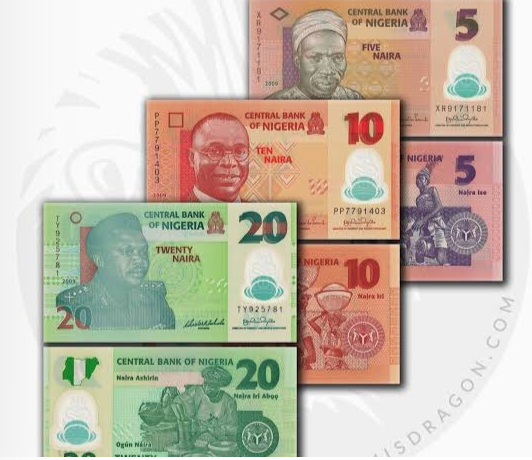
Despite this, the Central Bank of Nigeria, CBN, recognizes the following denominations; 50 kobo, N1 and N2 which are coins, and N5, N10, N20 and N50 which are printed on polymer materials.

Maduka College Advert

A sachet of pure water now sells for N30. Retailed sugar no longer sells for N10, while candies like Tom Tom are retailed at two pieces for N50. To further compound the woes of these notes, goods are now rounded up to 50 or 100, which further makes these currencies irrelevant.

In the past six months, the Naira has depreciated considerably. At one point, it was about N1,900 to a single dollar until the intervention by the CBN with the naira now trading at about N1050 to a dollar.

The implication of it is that N1000, which is Nigeria’s highest denomination, is less than a single dollar.

Anyone with $1000 is a millionaire in naira based on the current exchange rate, and anyone with $1 has more than N1,000.

Despite the recent surge in the value of naira, prices of commodities have not shown any significant signs of climbing down.

Experts believe that Nigeria’s inflation is a product of many factors, with FX being one of the numerous factors.

But despite this, the Nigerian government is still printing some of the lower denomination currencies at a huge cost.

According to reports, in 2016, CBN had to temporarily halt the printing of N5, 10, N20 and N50 due to the cost of production.

The report said it costs N1000 to print each lower denomination because Nigeria Security Printing and Minting plc (NSPM) is unable to print on polymer.

Now experts are calling on the CBN to discontinue the printing of the lower denominations and review the currencies in line with realities.

Abiodun Ayangbemi, an economist, emphasised that the CBN must discontinue the printing of the lower denomination because the majority of those currencies have failed the basic principles of money— means of exchange and store of value.

“The monetary authorities cannot continue to print those denominations when there is basically nothing to use them for,” he said.

Lekan Olaleye, a monetary policy expert, asked the federal government to take a copy of the re-denomination policy adopted by Ghana some years back.

He argued that the CBN should remove two zeros from the existing notes.

It would be recalled that Ghana had in 2007, re-denominated the Cedis by striking out four zeros from their currency and producing the new Ghana Cedis.

A former CBN Governor, Sanusi Lamido had in 2012 announced a plan to introduce N5000 notes. In the same vein, there was also a plan to coin the lower bank notes of N5, N10 and N20.

However, the policy was met with a strong outcry from the public, who condemned the plan. Thus, the government shelved the plan.

Years after the botched plan, prices of goods and services have spiked beyond the 2012 level. (Daily Post)

News

SDGs: Mbah moves Enugu beyond projects, targets lasting development impact

Published

on

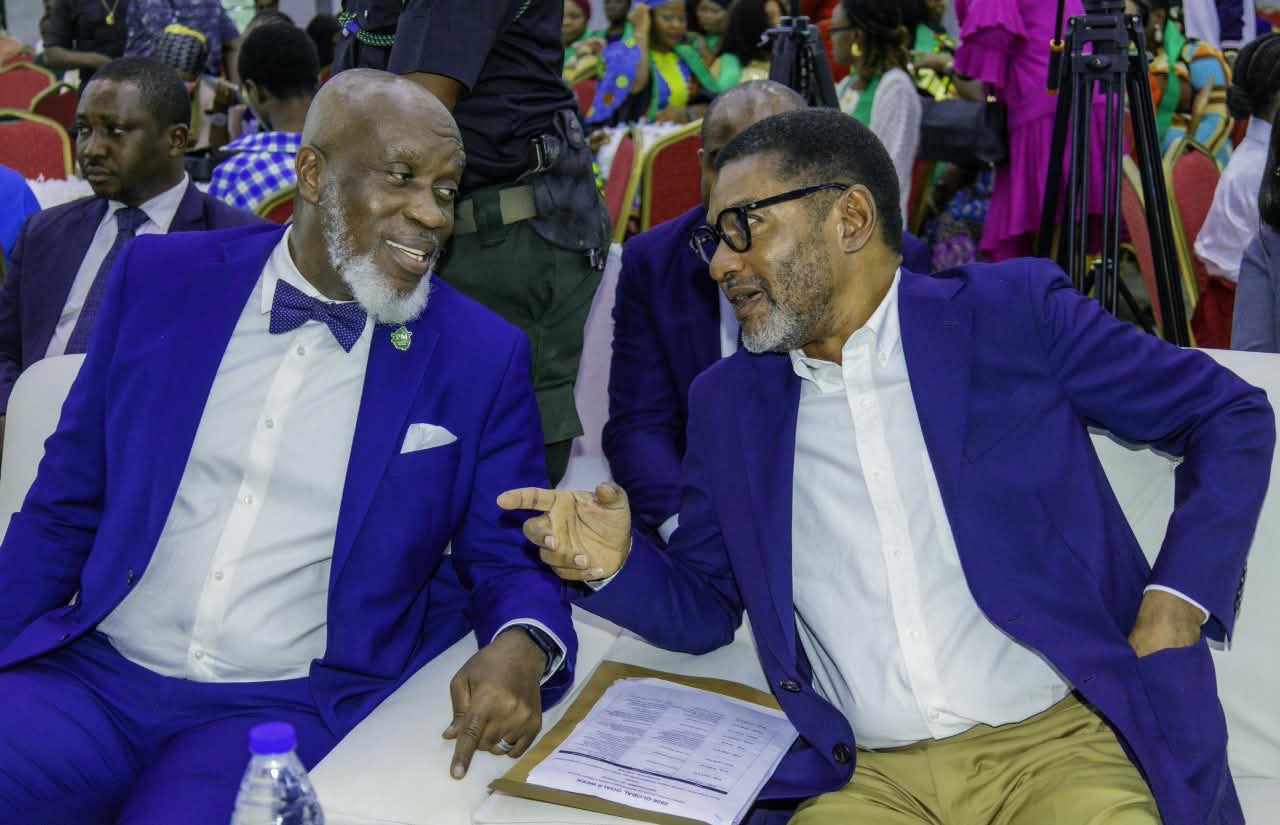
Enugu SSG, Prof Chidiebere Onyia and Frank Nweke Jnr
Spread the love

…Unveils 25-year plan to sustain transformation beyond individual administrations

The Enugu State Government has unveiled a 25-year development plan aimed at ensuring that the state’s ongoing transformation outlives individual administrations, with Governor Peter Mbah declaring that the government’s focus is shifting from simply delivering projects to building strong institutions and achieving lasting improvements in the lives of citizens.

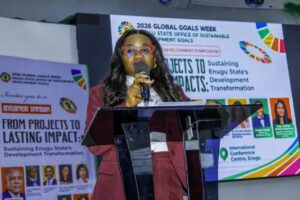
Mbah made the declaration at the 2026 Enugu State Global Goals Week Symposium, held at the International Conference Centre (ICC), Enugu, with the theme, “From Projects to Lasting Impact: Sustaining Enugu State’s Development Transformation.”

Governor Mbah, who was represented by the Secretary to the State Government, Prof. Chidiebere Onyia, said the state’s development agenda was being deliberately aligned with the Sustainable Development Goals (SDGs) to ensure that investments in infrastructure, human capital and critical services produced measurable and enduring impact.

He said the administration had continued to prioritise investments in education, healthcare, roads, agriculture, water, technology, security and other critical sectors, stressing that the projects were not ends in themselves but part of a broader strategy to build systems capable of sustaining development over the long term.

Maduka College Advert

“Our objective is not merely to execute projects, but to build systems and institutions capable of delivering enduring development and ensuring that the transformation we are driving today is sustained beyond the tenure of any single administration,” Mbah said.

He said the 25-year development plan would provide continuity, guide long-term investments, strengthen institutions, expand economic opportunities, improve human capital and promote inclusive development across the state.

Mbah noted that the state’s commitment to the SDGs was reflected in the spread of development interventions across the 260 electoral wards, particularly through the Smart Green Schools and Primary Healthcare Centres.

He assured that the government would continue to strengthen institutions, improve service delivery and put in place mechanisms to sustain the development gains achieved under the administration.

In a welcome address, the Senior Special Assistant to the Governor on Sustainable Development Goals and Enugu State SDGs Focal Person, Onyinye Akubuilo-Okpalanma, said the state’s transformation must remain people-centred, inclusive and sustainable.

She said government programmes should be judged not simply by the number of projects completed or funds spent, but by their impact on residents, the opportunities created and the communities strengthened.

“The success of government programmes should not be measured only by the number of projects completed or the amount of money spent, but by the extent to which those interventions improve the daily lives of our people, expand opportunities and strengthen communities,” she said.

Akubuilo-Okpalanma called for stronger community participation, continuous monitoring, reliable data and greater transparency in public finance and project implementation. She also urged greater attention to vulnerable groups and sustained investment in education, primary healthcare and environmental protection.

She called on development partners, civil society organisations, traditional institutions, the private sector and community leaders to work with government to sustain development gains, stressing the importance of continuity, institutional memory and long-term planning.

“Enugu’s transformation will be judged not only by the projects visible today, but also by the quality of institutions, opportunities and services available to future generations,” she said.

In a keynote address titled “From Projects to Lasting Impact: Sustaining Enugu State’s Development Transformation,” former Minister of Information, Frank Nweke Jnr., commended the scale and pace of public investment in the state over the past three years.

Nweke said the Mbah administration had reported more than 1,500 kilometres of roads constructed or reconstructed, over 7,000 classrooms and 260 Type-2 Primary Healthcare Centres.

He also cited the 2025 budget, in which ₦837.9 billion, representing 86 per cent of the budget, was allocated to capital expenditure, while ₦320.6 billion, representing more than one-third of the total budget, was allocated to education.

He stressed that improved domestic revenue mobilisation was essential to sustaining ambitious development, noting that the financial capacity to fund projects, maintain public assets and support institutions was critical to long-term transformation.

“Projects can transform places, but strong institutions are necessary to ensure that the transformation endures,” Nweke said.

He identified five priorities for sustaining Enugu’s development: linking investments to clearly defined problems and measurable outcomes; embedding the SDGs in planning and budgeting; measuring outcomes rather than expenditure alone; providing for the maintenance of public assets from the outset; and strengthening institutions, professional capacity and accountability mechanisms.

In separate goodwill messages, the UNICEF Field Office, Enugu representative, Juliet Chiluwe; the Special Adviser on Legislative Matters, Rt. Hon. Paul Nnajiofor; and Amb. Amaka Nweke commended the state’s development efforts and emphasised the need for inclusive, accountable and sustainable development that would continue to benefit present and future generations.

The event brought together government officials, development partners, traditional and community stakeholders, civil society representatives and members of the National Youth Service Corps (NYSC), among other participants.


Continue Reading

News

FG slashes interest rate on late tax payment

Published

on

Spread the love

The Federal Government (FG) has reduced the penalty interest rate for late settlement of tax liabilities, with the new regime taking effect from October 1, 2026.

Under the new arrangement, interest on tax liabilities payable in naira will be pegged to the Central Bank of Nigeria’s (CBN) Monetary Policy Rate (MPR) plus one percentage point, down from the previous five-percentage-point penalty.

The measure is contained in the Nigeria Tax Administration (Interest on Late Payment of Tax) Order, 2026, issued yesterday by the Minister of Finance and Coordinating Minister of the Economy, Mr Taiwo Oyedele, pursuant to Section 65 of the Nigeria Tax Administration Act, 2025.

According to the minister, the new Order will apply uniformly to taxpayers dealing with federal, state and Federal Capital Territory (FCT) tax authorities.

However, the applicable interest rate on naira-denominated tax liabilities will not fall below the yield on 364-day Treasury Bills, reflecting the Federal Government’s cost of borrowing when tax payments are delayed.

Maduka College Advert

For tax liabilities payable in foreign currencies, interest will be charged at the Secured Overnight Financing Rate (SOFR) plus six percentage points.

The Order further provides that where SOFR is discontinued, its officially designated successor rate will apply.

Explaining the rationale for the new regime, Oyedele said the objective was to align the cost of late tax payments more closely with prevailing market conditions while providing taxpayers with greater certainty about their obligations.

“Tax that is due belongs to the public. When it is paid late, Government may have to borrow to fill the gap, and the cost falls on everyone.

“This Order ties the cost of late payment to real market rates, so that delaying tax does not become a cheaper form of credit than the market itself,” he stated.

Continue Reading

News

APC wins all Chairmanship, Councillorship seats in Enugu

Published

on

Spread the love

The All Progressives Congress (APC) has won all chairmanship and Councillorship seats contested in the Sept. 26 Local Government Election in Enugu State.

The Enugu State Independent Electoral Commission (ENSIEC) conducted election into the 17 Chairmanship and 260 Ward Councillorship positions in the state on Saturday.

Declaring the election results at the ENSIEC headquarters in Enugu on Sunday, the Chairman of the Commission, Prof Christian Ngwu, said that the election was free and fair.

Ngwu said that the election was conducted according to rules guiding the Commission, and “subsequently, we are issuing the winners with certificate of returns.”

Speaking after collecting his certificate of return, Chairman of Enugu South Local Government Area, Chief Caleb Ani, attributed the landslide victory of the candidates of APC to the massive developmental works of Gov. Peter Mbah.

Maduka College Advert

Ani urged the residents of the state to vote for Mbah en masse in the forthcoming 2027 General Election to continue the good works.

“Gov. Mbah has done well in all ramifications, this is partly while the APC candidates won overwhelmingly.

“I urge the people to vote for him, come 2027 General Elections so that he will continue with his good works and do more,” he said.

Reacting, the APC Chairman in Enugu State, Dr Martin Chukwunweike, said that the resounding victory at the polls indicated the dominance of the national ruling party, APC, in the state.

“We will not rest as we push the developmental efforts of President Bola Tinubu and our amiable governor, His Excellency Dr Peter Ndubuisi Mbah, for the world to see.

“Tinubu, Mbah and all the APC candidates will be reelected in 2027 as they have performed exceptionally well in the past three years,” he said.

In the numerical figures of the results pronounced, APC chairmanship candidates won with margins while the opposition parties trailed behind with minimal votes.

For instance, in Udenu, Igbo-Eze North and Igbo-Eze South local Government Areas respectively, the APC chairmen elect secured virtually the whole votes cast.

Continue Reading

Trending

Maduka College Advert