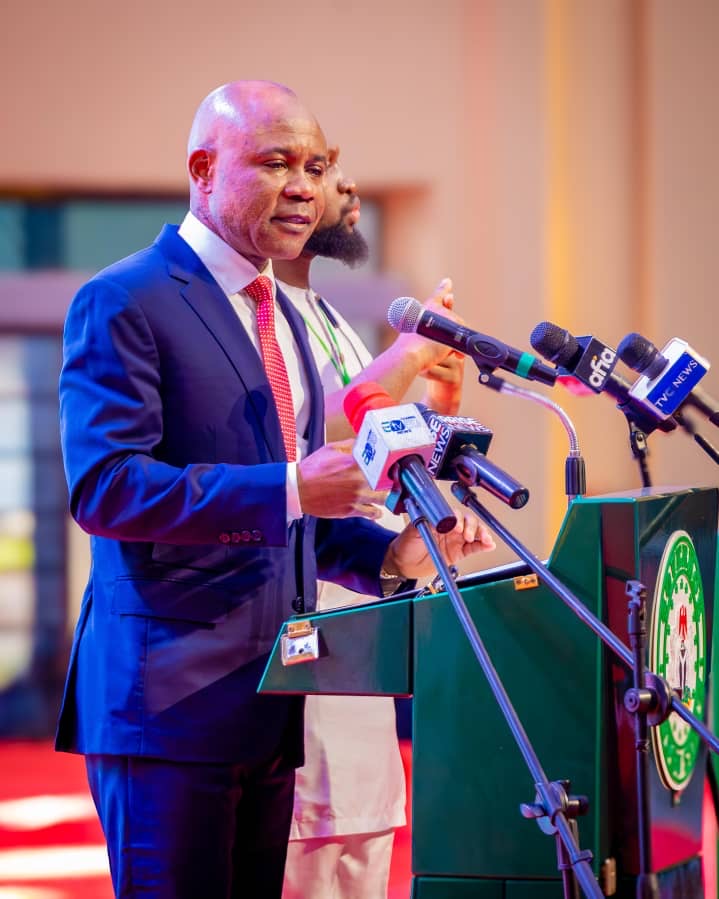
Enugu State Governor, Peter Mbah, has challenged the government and the media to meet at the point of truth, urging journalists to go beyond headlines and political narratives by independently establishing facts through evidence, investigation and context.
Mbah said government had a responsibility to be transparent about its actions and accountable for its results, while the press must independently scrutinise those actions and report the truth, whether the findings exposed shortcomings or revealed progress.
The governor stated this on Thursday while welcoming over 300 editors to the 22nd All Nigeria Editors Conference organised by the Nigerian Guild of Editors in Enugu.
The conference has as its theme, “The Ballot, the Media and the Task of Keeping Democracy Alive,” while its sub-theme is “When Lies Look Real: Detecting and Debunking AI Misinformation Before, During and After Elections.”
Mbah said the relationship between government and the media should not always be defined by confrontation, stressing that both institutions had different responsibilities but a common obligation to serve the Nigerian people.
“Government must be transparent about what it is doing and be accountable for the results. The press must establish the facts and report the truth.
“Sometimes that truth will expose failure. Sometimes it will reveal progress. The obligation for us both is the same in either case – serving the people of Nigeria,” he said.
The governor urged journalists to deepen investigative reporting, particularly at a time when artificial intelligence and other technologies were making it increasingly difficult to distinguish between genuine and fabricated information.
He said AI could be used to fabricate photographs, clone voices and manipulate videos to make people appear to say things they never said, warning that the development had increased the responsibility of professional journalists.
“My challenge to you, therefore, is simple – go deeper,” Mbah told the editors.
He said investigative journalism should not become a luxury, urging editors to create room for journalists to devote time and resources to understanding complex issues and establishing facts.
According to him, rigorous journalism should not involve searching for evidence to support a position that had already been taken.
“Its value lies precisely in its independence: examine the evidence, test competing claims, establish what happened, and report what you find,” he said.
Mbah added that the same standard should apply to government and its critics, stressing that government achievements should not be ignored simply because they did not fit a particular political narrative.
“We have tried to build an Enugu government that is open about what it is doing and clear about what it is trying to achieve. Where we fall short, that should call for scrutiny and be reported. But the same principle applies when the evidence reveals progress,” he said.
The governor also used the occasion to highlight some of his administration’s projects, including more than 1,500 kilometres of roads constructed or reconstructed, over 7,000 classrooms, Smart Green Schools and Type-2 Primary Healthcare Centres across the state’s 260 wards.
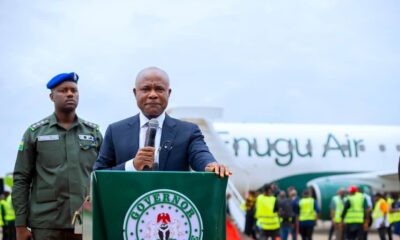
He listed other interventions as water infrastructure, new transport terminals and CNG buses, Enugu Air, the revival of dormant industries and the development of a new city.
Mbah said the administration was working to position Enugu as an economic gateway to the South-East, with the ambition of making the state one of Nigeria’s leading economies and a national leader in human development and quality of life.
He also acknowledged the support of President Bola Tinubu and the Federal Government, particularly in areas of roads, aviation, energy and regional development.
The governor urged the editors to use their presence in Enugu to independently assess the developments in the state.
“Take some time to explore the city, speak to the people who live and work here, and get a sense of the direction in which Enugu is moving,” he said.
Also speaking at the conference, the Minister of Information and National Orientation, Mohammed Idris, warned that the misuse of Artificial Intelligence to create fake photographs, videos, audio recordings and documents posed a serious challenge to public trust and the electoral process.
Idris, who delivered his goodwill message through the Managing Director of the News Agency of Nigeria, Ali M. Ali, said the danger was not only that citizens could believe false information, but that they could eventually stop believing anything.
He urged media organisations to make verification a permanent part of newsroom culture, asking journalists to establish who made a claim, what evidence supported it, when an image was taken, whether a video was original and whether the source had been independently verified.
Idris also charged the media to subject government performance to rigorous scrutiny without exaggerating achievements or ignoring shortcomings.
“A responsible press should neither exaggerate achievements nor ignore them. It should examine them, verify them, ask the difficult questions, and allow citizens to understand both the progress and the shortcomings. This is how public trust is built,” he said.
The minister further urged journalists to explain the implications of amendments to the Electoral Act signed into law in February 2026, saying Nigerians needed to understand what had changed and what remained the same.
He cautioned journalists against becoming participants in political contests, saying their responsibility was to establish facts, provide context and allow citizens to make their own judgments.
In his keynote lecture, the Archbishop Emeritus of Abuja, John Onaiyekan, called for reforms in the appointment of the chairman and commissioners of the Independent National Electoral Commission.
Onaiyekan argued that the appointment process should be reviewed to strengthen the independence of the electoral body, particularly because the President and governors are political actors in elections.
“We need to review the method of appointment of the INEC chairman and the commissioners. They should not depend on Mr President and the governors, who are themselves contestants in elections,” he said.
He also advocated the establishment of a special election tribunal dedicated exclusively to electoral disputes, with a defined timeframe for resolving cases.
Onaiyekan argued that election petitions should, as much as possible, be concluded before elected officials are sworn into office.
He further called for changes to allow ordinary voters to challenge election results where they believed their votes had not been properly counted.
“Our laws should make provision for the citizen as citizen and as electors to challenge results of the election at tribunals,” he said.
The cleric said strengthening electoral institutions, improving dispute resolution and ensuring credible information remained essential to sustaining public confidence in Nigeria’s democracy.
The conference brought together editors and senior media professionals to examine the role of journalism in protecting democratic values, strengthening public accountability and safeguarding the integrity of Nigeria’s electoral process.