Connect with us

News

First of two patrol ships for Nigerian Navy launched in Turkey

Published

on

First of two patrol ships for Nigerian Navy launched in Turkey
Spread the love

The  first of the Nigerian Navy’s  2 x 76m, 1200 Tons High Endurance Offshore Patrol Vessels (HE OPVs) was formally launched at the Dearsan Shipyard, Tuzla, Istanbul, Turkey on  October 26,  2023.

Chief of the Naval Staff (CNS), Vice Admiral Emmanuel Ikechukwu Ogalla, performed the launching ceremony of the newly built HE OPV P203.

Director of Information, Naval Headquarters,  Commodore AO Ayo-Vaughan, who made this known in a statement on Sunday, recalled that the NN signed a contract with Dearsan Shipyard, Turkey for the construction of 2 units of 76m HE OPV on 3 November 2021 and the Keel Laying Ceremony of the 2 ships which signified the commencement of their construction took place on 16 September 2022.

According to him, “the CNS therefore noted that the Launching Ceremony of the first HE OPV P203 marks yet another important milestone in their construction, having progressed significantly through a very well-planned and executed design and construction process.”

While reminding dignitaries on the import of launching ceremony of a naval vessel, Vice Admiral Ogalla said that  the launching of a naval ship was an age-long tradition which signifies the birth of the ship.

The statement also quoted Vice Admiral Ogalla to have said: “today’s ceremony is, therefore, a solemn one in which the ship is dedicated and committed to the sea, while also praying for blessings of good fortune for the ship, its crew and its passengers.”

Maduka College Advert

“These ships when fully completed and commissioned into the Service of the NN, would complement and further sustain the efforts of the Fleet in ensuring naval presence at sea.  This would help to curb the menace of oil theft and other illegalities in Nigeria’s maritime environment in particular and the Gulf of Guinea in general.

“The OPV would assist the NN in managing Nigeria’s Exclusive Economic Zone, including provision of maritime security of areas and effective disaster relief.”

The CNS used the opportunity to thank President Bola Ahmed Tinubu for his support to the project and commitment to the recapitalization of the NN Fleet.

He categorically re-iterated that the Federal Government of Nigeria was highly committed to its obligations towards the successful completion of the 2 OPVs, just he appreciated the Nigerian Ambassador to Turkey, the Nigerian Defence Adviser to Ankara, Dearsan Shipyard, the Nigerian Navy Project Control Team resident in Turkey and other invited guests for their various positive contributions towards making the project and launching ceremony a reality and success.

The statement further disclosed that  following  the formal launch of the first 76m HE OPV P203, “it is expected that all the ship’s installations would be fixed, connected and worked between January – May 2024.”

“Other expectations include conducting harbour acceptance test for the ship between July – August 2024 and delivery of the ship in August 2024 or September 2024.

“It is also planned that the launching ceremony of the second 76m HE OPVP 204 will hold in February 2024 at the Dearsan Shipyard, Turkey,” it added.

Commodore Ayo-Vaughan further noted that the occasion of the launching ceremony of HE OPV P203 further buttressed  the resolve of the Dearsan Shipyard in ensuring timely delivery of the 2 HE OPVs to NN and sustaining the mutually beneficial cooperation between the Governments of Nigeria and Turkey.

The memorable Launching Ceremony of the magnificent ship was witnessed by very important dignitaries such as the Chief Executive Officer of Dearsan Shipyard – Murat Gordi, the Vice President of Turkish Defence Industry – Gokhan Ucar and the Turkish Commander Military Shipyards, Istanbul –  Rear Admiral Recep Erdinc Yetkin.

Others present at the event were the Nigerian Ambassador to Turkey represented by Alhaji Ado Yakassai, some Principal Staff Officers and directors from Naval Headquarters in the Chief of the Naval Staff entourage; R Adm KG Levi, Cdre OA Adeleke, Cdre BH Sabo, Cdre OO Olukoya and Cdre AC Uko as well as the Nigerian Defence Adviser, Turkiye, Brig Gen ML Abubakar.


News

Over 50 Bandit Attacks Recorded in a Week as FG Spends N57.78bn on Security

Published

on

Spread the love

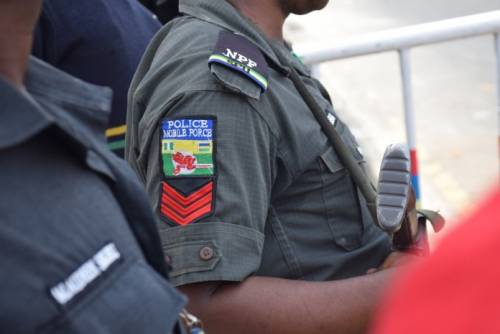
The Federal Government spent N57.78bn on security-related projects and operations in the first four months of 2026, despite worsening insecurity across the country, with no fewer than 98 criminal incidents including 51 attacks and abductions recorded nationwide in just one week.

Data obtained from the Open Treasury Portal showed that the spending, which covered defence equipment procurement, security infrastructure, military barracks, police facilities and other security-related projects, represented a 127.97 per cent increase from the N25.35bn spent during the corresponding period of 2025.

The expenditure comes amid persistent attacks by terrorists, bandits, kidnappers and armed criminals across several states, raising concerns among security experts over the effectiveness of government efforts to tackle the crisis.

Analysis of the Treasury Portal data showed that N57.78bn had been spent as of April 2026 from a total security allocation of N4.66tn, indicating that only 1.24 per cent of the approved budget had been utilised within the first four months of the year.

The largest share of the expenditure, N21.39bn, was spent on defence equipment procurement, accounting for about 37 per cent of total security spending during the period.

Another N14.16bn was spent on security equipment, while N5.84bn went to the construction and provision of military barracks. The government also spent N5.17bn on police stations and barracks, N3.26bn on rehabilitation of defence equipment, N2.39bn on defence facilities and N2.16bn on repairs of military barracks.

Maduka College Advert

For routine operations, N3bn was spent on security services, while N320.94m was disbursed as security votes.

However, no expenditure was recorded under the military operations budget line tagged “Operation Lafiya Dole and Other Operations of the Armed Forces,” despite a N500m provision in the 2026 budget.

Similarly, no funds had been released for the kitting of Armed Forces personnel, although N2.53bn was earmarked for the programme.

A year-on-year comparison showed that spending on defence equipment rose from N9.48bn in the first four months of 2025 to N21.39bn in 2026, while military barracks construction increased from zero to N5.84bn.

Despite the increase in spending, budget implementation remained low across most security projects, with many critical programmes recording execution rates below three per cent.

The spending figures emerged as a police security report obtained by The PUNCH revealed that at least 98 criminal incidents were recorded across Nigeria within the last seven days.

The report showed that the incidents comprised 37 homicide cases, 27 banditry attacks, 24 kidnappings, eight armed robbery incidents and two terrorism-related attacks.

The incidents were reported across Kaduna, Katsina, Zamfara, Kebbi and several other states, involving mass abductions, attacks on rural communities and kidnappings along major highways.

Among the most disturbing incidents was the abduction of 39 residents in Zamfara State after they reportedly travelled into the Fadama Forest to negotiate peace with a notorious bandit leader, Jimo Smally.

In Katsina State, bandits blocked the Katsina-Kankara highway and intercepted a commercial vehicle carrying 11 passengers. Police later rescued nine victims, while the driver and another passenger remained missing.

Reacting to the development, security analyst, Lekan Jackson-Ojo, described the situation as the worst insecurity crisis in Nigeria’s history.

“This is the highest level of insecurity in the military and political history of the Federal Republic of Nigeria,” he said.

“It is an indirect pronouncement that Nigeria is an unsafe territory now. We are having a battered economy, and there is no economy anywhere in the world that thrives under insecurity.”

Jackson-Ojo said the country had suffered unprecedented security losses in recent months.

“During the civil war, I did not remember if a general died. In the war between Ukraine and Russia, a general has not lost his life. In the war between Iran, America and Israel, a general has not lost his life. But within the past three months, we have lost almost four generals — and there is no reprisal attack,” he stated.

The analyst also criticised the reintegration of repentant terrorists into society.

“I’ve never heard it anywhere in the world that terrorists who have terrorised, damaged and killed will be integrated back into society. To me, I think the government is totally helpless — total incapability, lack of political will. Something, or many things are wrong now,” he added.

He further lamented what he described as the political elite’s preoccupation with electoral activities rather than security challenges.

“What preoccupies our political class is campaign, campaign, campaign and campaign. This is a sad situation,” he stressed.

Another security analyst, Chidi Omeje, argued that the military remained overstretched despite increased government spending.

“The military, on their own, are completely overstretched. You can count almost over 30 terrorist operations in this country where military guys are deployed,” he said.

“One MRAP alone is almost N100 billion. If you put an aircraft in the sky to do an operation, do you know how much it costs for just one hour? By the time you put that N56 billion in dollars, it amounts to nothing.”

According to him, military operations alone would not solve Nigeria’s security challenges.

“Unless we are able to deal with the root causes, we will keep going in circles. Most of the issues are born out of bad governance, wrong prioritisation, corruption and pervasive poverty, which has made people see crime and criminality as an option for survival,” Omeje said.

He also blamed porous borders and instability across the Sahel region for worsening insecurity in Nigeria.

“From Mali to Burkina Faso to Nigeria — those places are the epicentre of terrorism. Nigeria is an attractive destination because we have porous borders and poor border management,” he stated.

Omeje urged the government to take decisive action.

“The government seems almost clueless about how to go about this matter. They are paid to find solutions — so they must find solutions,” he said.

The latest figures suggest that while the Federal Government has significantly increased security spending compared to last year, insecurity remains widespread, with violent attacks continuing across the country and a large portion of budgeted security funds yet to be utilised. (PUNCH)

Continue Reading

News

Insecurity: Ministers, Senators, Governors may become targets — Buratai warns

Published

on

Lt. Gen Tukur Buratai (Rtd)
Spread the love

A former Chief of Army Staff, Lt.-Gen. Tukur Buratai (retd.), has warned that Nigeria’s worsening security situation could deteriorate further if urgent and decisive measures are not taken, cautioning that political leaders, including ministers, senators, and governors, may become targets of bandits and insurgents.

The former COAS gave the warning in a statement titled: “A frank and patriotic advice on Nigeria’s escalating security crisis.”

This followed reports surrounding the abduction and killing of a senior military officer, Maj.-Gen. Rabe Abubakar.

According to the former army chief, the killing of a senior military officer by non-state actors signals a dangerous escalation in the country’s security challenges and should serve as a wake-up call to authorities at all levels.

“When a general falls into the hands of non-state actors, it signals a serious erosion of tactical deterrence. If this trend continues unchecked, the next targets may not be soldiers or civilians alone. They could include ministers, senators, and even state governors,” he warned.

Buratai recalled that in 2021, he had predicted that insurgency and banditry could persist for up to two decades if drastic measures were not implemented, adding that current developments appear to validate those concerns.

Maduka College Advert

The former Nigerian envoy to the Benin Republic urged the Federal Government to acknowledge the limitations of its current security strategy, arguing that bandits and insurgents now operate with sophisticated intelligence capabilities, heavy weaponry, and a level of audacity that increasingly challenges state authority.

He called for an end to the practice of negotiating with criminal groups and advocated for a comprehensive military and intelligence offensive against terrorist and bandit networks.

According to him, the coordinated military operations carried out between 2015 and 2019 demonstrated that sustained pressure could significantly degrade insurgent capabilities.

Buratai also proposed the establishment of a National Emergency Command with direct authority over all security agencies operating in high-risk areas, saying such a structure would eliminate bureaucratic bottlenecks and improve operational effectiveness.

“Insecurity is no longer a regional problem; it is a national emergency,” he said, adding that the proposed command should report directly to the President and be given a clear mandate to dismantle terrorist and bandit strongholds.

The retired general further stressed the need to target the financiers and collaborators who sustain criminal networks, including illegal miners, ransom negotiators, and local informants.

“Bandits do not survive on weapons alone. They depend on support networks that must be identified, dismantled, and prosecuted,” he stated.

Buratai also challenged state governors to assume greater responsibility in addressing insecurity, advocating for stronger support for state-level policing initiatives, vetted vigilante groups, and community intelligence systems integrated into broader security structures.

While calling for enhanced protection of public officials through improved intelligence sharing and counter-ambush measures, he insisted that the ultimate objective should be the dismantling of the criminal ecosystem fueling insecurity across the country.

Describing himself as a patriot with no political motive, Buratai urged leaders to act decisively before the security crisis worsens.

“If we do not radically change our approach today, the headlines of tomorrow may make today’s tragedy seem like only a warning,” he said.

He added that while the abduction of senior political leaders is not inevitable, it could become a realistic threat if the country continues with what he described as “business as usual.”

Buratai concluded by calling on authorities to ensure that the death of Maj.-Gen. Abubakar becomes “the last preventable sacrifice” in Nigeria’s ongoing battle against insecurity.

Continue Reading

News

Bandits kill three, burn houses in Niger – Police

Published

on

Over 100 peasants abducted as gunmen invade Zamfara communities
Spread the love

The Niger Police Command has confirmed the killing of three people by suspected bandits in Pissa village, Borgu Local Government Area.

The command’s Spokesperson, SP Wasiu Abiodun, told the News Agency of Nigeria (NAN) on Saturday that the bandits attacked the village at about 9:00 a.m.

He said some houses were set ablaze during the attack; however, he added that the bandits were engaged by the military, but details of the encounter remained sketchy.

“The report received indicated that suspected bandits invaded Pissa village in Borgu LGA.

“Three people were reportedly killed during the attack, and some houses were set ablaze.

“However, the military responded and engaged the terrorists, but further details are still sketchy,” he said.

Maduka College Advert
Continue Reading

Trending

Maduka College Advert