Connect with us

International

Israel bombs Gaza Region where civilians were told to seek refuge

Published

on

Israel bombs Gaza Region where civilians were told to seek refuge
Spread the love
The Israeli military said it was targeting Hamas hideouts, infrastructure and command centres.

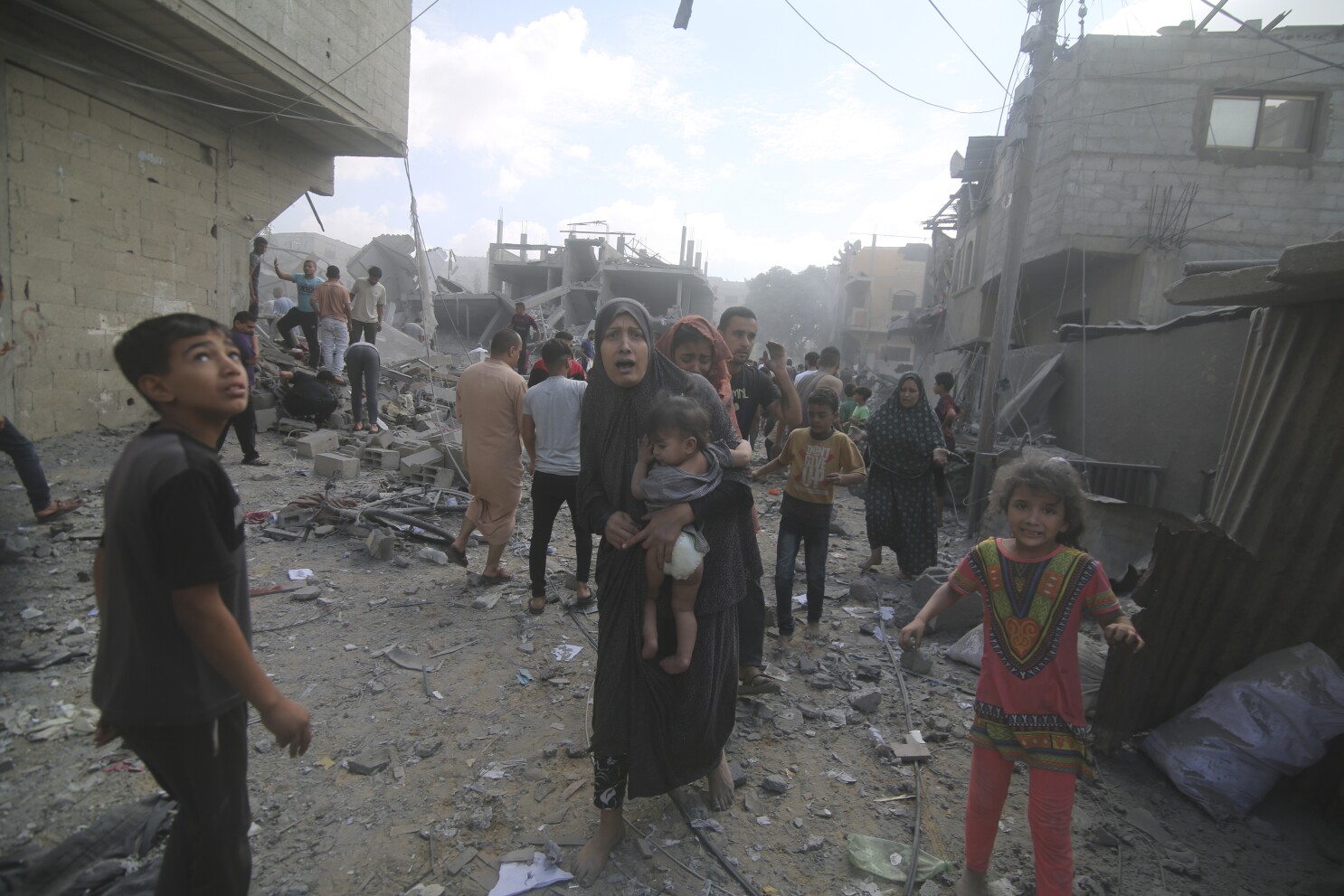
Israel bombed areas of southern Gaza where it had told Palestinians to flee to ahead of an expected ground invasion, killing dozens of people on Tuesday in attacks it says are targeted at Hamas militants that rule the besieged territory.

With no water, fuel or food being delivered to Gaza since Hamas’ brutal attack on Israel last week, mediators struggled to break a deadlock over delivering supplies to increasingly desperate civilians, aid groups and hospitals.

U.S. President Joe Biden prepared to head to the region as he and other world leaders tried to prevent the war from sparking a broader regional conflict. Violence flared Tuesday along Israel’s border with Lebanon, where Iranian-backed Hezbollah militants operate.

In Gaza, dozens of injured were rushed to hospitals after heavy attacks outside the southern cities of Rafah and Khan Younis, residents reported. Basem Naim, a senior Hamas official and former health minister, reported 27 people were killed in Rafah and 30 in Khan Younis.

An Associated Press reporter saw around 50 bodies brought to Nasser Hospital in Khan Younis. Family members came to claim the bodies, wrapped in white bedsheets, some soaked in blood.

Maduka College Advert

An airstrike in Deir al Balah reduced a house to rubble, killing nine members of the family living there. Three members of another family that had evacuated from Gaza City were killed in a neighboring home. The dead included one man and 11 women and children. Witnesses said there was no warning before the strike.

The Israeli military said it was targeting Hamas hideouts, infrastructure and command centers. “When we see a target, when we see something moving that is Hamas, we’ll take care of it,” Lt. Col. Richard Hecht, an Israeli military spokesman, said.

A strike in the Bureij refugee camp in central Gaza killed a top Hamas commander, Ayman Nofal, the group’s military wing said — the most high-profile militant known to have been killed so far in the war. Nofal was in charge of Hamas militant activities in the central Gaza Strip and was associated with the creation of the group’s “joint operations” room that coordinated between Hamas, the Palestinian Islamic Jihad and other militants in the territory.

The U.N. human rights office decried “appalling reports” that civilians who were trying to flee to southern Gaza were killed by a military strike. Spokeswoman Ravina Shamdasani urged Israeli forces to avoid “aerial bombardments, indiscriminate or disproportionate attacks” and to “take precautions to avoid – and in any case, to minimize – loss of civilian life, injury to civilians and damage to civilian objects.”

Israel sealed off Gaza since the militant attack on southern Israel Oct. 7 killed over 1,400 people, mostly civilians, and resulted in some 200 taken captive in Gaza. Hamas militants in Gaza have launched rockets every day since, aiming at cities across Israel.

Israeli strikes on Gaza have killed at least 2,778 people and wounded 9,700, according to the Gaza Health Ministry. Nearly two-thirds of those killed were children, a ministry official said.

Another 1,200 people across Gaza are believed to be buried under the rubble, alive or dead, health authorities said. Emergency teams struggled to rescue people while cut off from the internet and mobile networks, running out of fuel and exposed to unceasing airstrikes.

On Monday Israeli warplanes struck the headquarters of the Civil Defense in Gaza City, killing seven paramedics. Another 16 medics and doctors have been killed on the job, Gaza officials said.

Israeli Prime Minister Benjamin Netanyahu said Tuesday that his country’s retaliation against Hamas aims to eradicate the group’s political and military rule over Gaza.

’’We are not fighting just our war. We’re fighting the war of all civilized countries and all civilized peoples,” he said.

Israel has massed troops at the border for an expected ground offensive, but Hecht said Tuesday no concrete decisions have been made despite Israel’s mass evacuation order for the north of the Gaza Strip.

More than 1 million Palestinians have fled their homes — roughly half of Gaza’s population — and 60% are now in the approximately 14-kilometer (8-mile) long area south of the evacuation zone, the U.N. said.

Aid workers warned that the territory was near complete collapse. Hospitals were on the verge of losing electricity, threatening the lives of thousands of patients, and hundreds of thousands of people searched for bread and water.

The U.N. agency for Palestinians said more than 400,000 displaced people are crowded into schools and other facilities in the south. The agency said it has only 1 liter of water a day for each of its staff members trapped in the territory.

Israel opened a water line into the south for three hours that benefitted only 14 percent of Gaza’s population, the U.N. said.

At the Rafah crossing, Gaza’s only connection to Egypt, truckloads of aid were waiting to enter. The World Food Program said that it had more than 300 tons of food waiting to cross into Gaza.

Civilians with foreign citizenship — many of them Palestinians with dual nationalities — also waited in Rafah, desperate to get out.

“We come to the border crossing hoping that it will open, but so far there is no information,” said Jameel Abdullah, a Swedish citizen.

An agreement to open the border appeared to have been reached Monday, but Israel denied reports of a cease-fire in Rafah, which would be a precondition. On Tuesday morning, gates were still closed.

An Egyptian official said Tuesday that Egypt and Israel agreed that the aid convoys at the border would travel into Israel for inspection at the Kerem Shalom crossing between Gaza and Israel. The aid would then be allowed into Gaza. A brief humanitarian cease-fire would take place and foreign nationals would be allowed to exit Gaza via Rafah, the official said, speaking on condition of anonymity because he was not allowed to speak with the media.

Officials for Hamas and Israel cast doubt on an immediate opening, saying they were unaware of an agreement.

U.S. Secretary of State Antony Blinken, who visited Israel for the second time in a week on Monday after a six-country tour through Arab nations, said in Tel Aviv that the U.S. and Israel had agreed to develop a plan to enable humanitarian aid to reach civilians in Gaza. There were few details, but the plan would include “the possibility of creating areas to help keep civilians out of harm’s way.”

Gen. Erik Kurilla, the head of U.S. Central Command, arrived in Tel Aviv for meetings with Israeli military authorities ahead of a Biden visit planned for Wednesday to signal White House support for Israel. Biden will also travel to Jordan to meet with Arab leaders amid fears the fighting could spread in the region.

Israel evacuated towns near its northern border with Lebanon, where the military has exchanged fire repeatedly with Hezbollah militants.

Israel said it killed four militants wearing explosive vests who were attempting to cross into the country from Lebanon on Tuesday morning. Video from a reconnaissance drone the army shared showed the militants near the border wall before they were targeted, causing an explosion. No group immediately claimed responsibility.

“Whoever approaches the border with Lebanon will be killed,” said Israeli military spokesman Rear Adm. Daniel Hagari.

Israel has warned Lebanon it will strongly retaliate against attacks from across the border.

Israel fought a vicious monthlong war with Hezbollah in 2006 that ended in a stalemate and a tense detente between the two sides.

Iran’s Supreme Leader Ayatollah Ali Khamenei warned that Israel’s continuing offensive in Gaza could cause a violent reaction across the region.

“Bombardments should be immediately stopped. Muslim nations are angry,” Khamenei said, according to state media.

Hamas’ military wing released a hostage video on Monday showing a dazed woman having her arm wrapped with bandages. The woman, who identified herself as Mia Schem, 21, rocked slightly as she spoke, the sound of explosions reverberating in the background.

The plight of the hostages — Hamas claims it has more than 200 of them — has dominated the Israeli media since the attack. Interviews with relatives of hostages are shown over and over on television. Israeli officials have vowed to maintain the siege of Gaza until the hostages are released.

AP

International

$300bn reconstruction aid, sanctions lift’ – US-Iran MoU details emerge

Published

on

Spread the love

The following is the text of the US-Iran Memorandum of Understanding, as read out by a senior US official to reporters on Wednesday:

“The United States of America and Islamic Republic of Iran have jointly agreed in good faith on (a date yet to be determined, the official said), on the following:

“Paragraph 1 – The United States of America and the Islamic Republic of Iran and their allies in the current war, by signing this MOU, declare an immediate and permanent termination of military operations on all fronts, including in Lebanon, and undertake from now on not to initiate any war or any military operation against each other and to refrain from the threat or use of force against each other, and ensuring the territorial integrity and sovereignty of Lebanon. The final deal will confirm the permanent termination of the war on all fronts, including in Lebanon, and other provisions of this paragraph.

“Paragraph 2 – The United States of America and the Islamic Republic of Iran undertake to respect each other’s sovereignty and territorial integrity and to refrain from interfering in each other’s internal affairs.

“Paragraph 3 – The United States of America and the Islamic Republic of Iran commit to negotiating and achieving the final deal in maximum 60 days extendable with mutual consent.

“Paragraph 4 – Immediately upon the signing of this MOU, the United States of America will begin the removal of its naval blockade and any disturbances or impediments against the Islamic Republic of Iran, and will fully end the naval blockade within 30 days. During this period, the traffic of vessels will be in proportion to the numbers of pre-war traffic being restored by the Islamic Republic of Iran. The United States of America further undertakes to remove its forces from the proximity of the Islamic Republic of Iran within 30 days after the final deal.

Maduka College Advert

“Paragraph 5 – Upon the signing of this MOU, the Islamic Republic of Iran will make arrangements using its best efforts for the safe passage of commercial vessels with no charge for 60 days only, from the Persian Gulf to the Sea of Oman, and vice versa. The traffic of commercial vessels will immediately start, and considering the need for removing the technical and military obstacles, and de-mining by the Islamic Republic of Iran, will be instated within 30 days. The Islamic Republic of Iran will conduct dialogue with the Sultanate of Oman to define the future administration and maritime services in the Strait of Hormuz, in discussion with other Persian Gulf littoral states, in line with the applicable international law and the sovereign rights of coastal states of the Strait of Hormuz.

“Paragraph 6 – The United States of America undertakes with regional partners to develop a definitive mutually agreed plan with at least USD 300 billion for the reconstruction and economic development of the Islamic Republic of Iran. The mechanism for the implementation of this plan will be finalized as part of a final deal within 60 days. All required licenses, waivers, and permissions needed for the relevant financial transactions will be granted by the United States of America.

“Paragraph 7 – The United States of America undertakes to terminate all types of sanctions against the Islamic Republic of Iran, including the United Nations Security Council resolutions, IAEA Board of Governors resolutions, and all unilateral US sanctions, primary and secondary, in an agreed-upon schedule as part of the final deal. The Islamic Republic of Iran and the United States of America acknowledge the critical importance of the sanctions termination issue above mentioned, and express their intentions to immediately address these issues in the negotiations in order to achieve mutual agreement on them.

“Paragraph 8 – The Islamic Republic of Iran reaffirms that it shall not procure or develop nuclear weapons. The United States of America and the Islamic Republic of Iran have agreed to resolve the disposition of stockpiled enriched material pursuant to a mechanism that will be mutually agreed upon in accordance with the schedule mentioned in Paragraph 7, with the minimum methodology to be down-blending on site under the supervision of the IAEA. The two parties also agreed to discuss the issue of enrichment and other mutually agreed matters related to the Islamic Republic of Iran’s nuclear needs, based on a satisfactory framework being agreed upon in the final deal. The final deal will confirm the provisions of this paragraph. The United States of America and the Islamic Republic of Iran acknowledge the critical importance of the nuclear issues above mentioned, and express their intention to immediately address these issues in the negotiation in order to achieve mutual agreement on them.

“Paragraph 9 – Pending the final deal, the United States of America and the Islamic Republic of Iran agree to maintain the status quo. The Islamic Republic of Iran will maintain the current status quo of its nuclear program, and the United States of America will not impose any new sanctions, and will not deploy additional forces in the region.

“Paragraph 10 – The United States of America undertakes that immediately upon the signing of this MOU, and until the termination of sanctions, US Department of Treasury will issue waivers for the export of Iranian crude oil, petroleum products and derivatives, and all associated services, including banking transactions, insurances, transportation, etc.

“Paragraph 11 – The United States of America undertakes to make fully available for use the frozen or restricted funds and assets of the Islamic Republic of Iran upon the implementation of this MOU. The United States of America and the Islamic Republic of Iran will mutually agree on the procedures related to the release of these funds during the negotiations. Such funds, whether retained in the original account or transferred, shall be made fully usable for payment to any ultimate beneficiary designated by the Central Bank of the Islamic Republic of Iran. The United States of America undertakes to issue all necessary licenses and authorizations accordingly.

“Paragraph 12 – The United States of America and Islamic Republic of Iran agree that an executive mechanism will be established to monitor the successful implementation of this MOU and the future compliance of the final deal.

“Paragraph 13 – After signing this MOU and subject to the beginning of the implementation of Paragraphs 1, 4, 5, 10 and 11 of this MOU, and the continuing implementation of these measures, the United States of America and the Islamic Republic of Iran will start negotiations regarding the final deal exclusively on the other paragraphs.

“Paragraph 14 – The final deal will be endorsed by a binding UNSC resolution.”

Continue Reading

International

Iran threatens retaliation, says US strikes violated ceasefire

Published

on

US President Donald Trump
Spread the love

Iran’s foreign ministry on Tuesday accused the United States of violating a fragile ceasefire during the past 48 hours in the southern coastal province of Hormozgan, without specifying the incident.

The accusation comes after US Central Command said its forces had on Monday attacked missile sites and boats in southern Iran that were trying to lay mines in the Gulf, while Iran’s Revolutionary Guards said it fired at US aircraft trying to enter its airspace.

“The US terrorist army, continuing its illegal and unjustified actions since the ceasefire… has, in the past 48 hours, committed a gross violation of the ceasefire in the Hormozgan region,” the Iranian foreign ministry said in a statement.

It added that Tehran “will not leave any evil unanswered and will not hesitate to defend the Iranian nation,” without elaborating.

Tuesday’s statement came as a top Iranian delegation was in Qatar for talks as part of a “diplomatic process” aimed at ending the war with the United States, which broke out on February 28

Continue Reading

International

Dozens of lranian fighters killed, as US resumes strike in Strait of Hormuz, targets IRGC Naval Boats in the Gulf

Published

on

Spread the love

U.S. fighter jets have reportedly struck IRGC naval boats in the Gulf after Iranian forces allegedly targeted a vessel near Bandar Abbas.

U.S. Central Command confirms “self-defense strikes” were carried out against Iranian boats and missile sites near the Strait of Hormuz amid rising tensions in the region.

It was stated that the numbers of dead has increased from 9 to 15, with dozens still missing while others remain injured.

According to emerging reports, the strikes targeted IRGC maritime assets and defensive positions during what rapidly escalated into a major military confrontation in the region. Rescue and emergency operations are said to be ongoing as authorities continue searching for missing personnel.

Iranian and regional media report heavy explosions and gunfire near Bandar Abbas, while negotiations between Washington and Tehran continue in Qatar.

Maduka College Advert

The situation is still developing, and some battlefield claims remain independently unverified.

Continue Reading

Trending

Maduka College Advert