International
Palestinians flee northern Gaza after Israel orders 1 million to evacuate as ground attack looms


JERUSALEM (AP) — Palestinians fled in a mass exodus Friday from northern Gaza after Israel’s military told some 1 million people to evacuate to the southern part of the besieged territory ahead of an expected ground invasion in retaliation for the surprise attack by the ruling Hamas militant group.
The U.N. warned that evacuating almost half of crowded Gaza’s population would be calamitous, and it urged Israel to reverse the unprecedented directive. As airstrikes hammered the territory throughout the day, families in cars, trucks and donkey carts packed with possessions streamed down a main road out of Gaza City.

Hamas’ media office said warplanes struck cars fleeing south, killing more than 70 people. The Israeli military said its troops conducted temporary raids into Gaza to battle militants and hunted for traces of some 150 people abducted in Hamas’s assault on Israel nearly a week ago.
In urging the evacuation, Israel’s military said it planned to target underground Hamas hideouts around Gaza City. But Palestinians and some Egyptian officials fear that Israel ultimately hopes to push Gaza’s people out through the southern border with Egypt.
Hamas told people to ignore the evacuation order, and families in Gaza faced what they saw as a no-win decision to leave or stay, with no safe ground anywhere. Hospital staff said they couldn’t abandon patients.

Unrelenting Israeli strikes over the past week have leveled large swaths of neighborhoods, magnifying the suffering of Gaza, which has also been sealed off from food, water and medical supplies, and under a virtual total power blackout.
“Forget about food, forget about electricity, forget about fuel. The only concern now is just if you’ll make it, if you’re going to live,” said Nebal Farsakh, a spokesperson for the Palestinian Red Crescent in Gaza City, as she broke into heaving sobs.
In the nearly week-old war, the Gaza Health Ministry said Friday that roughly 1,900 people have been killed in the territory — more than half of them under the age of 18, or women. The Hamas assault last Saturday killed more than 1,300 Israelis, most of whom were civilians, and roughly 1,500 Hamas militants were killed during the fighting, the Israeli government said.
ISRAELI TROOPS MAKE FORAY INTO GAZA
Israel’s raid was the first word of troops entering Gaza since Israel launched its round-the-clock bombardment in retaliation for Hamas’ massacre of hundreds of civilians in southern Israel.
A military spokesman said Israeli ground troops left after conducting the raids. The troop movements did not appear to be the beginning of an expected ground invasion.
The evacuation order was taken as a further signal of an expected Israeli ground offensive, although no such decision has been announced. Israel has been massing troops along the Gaza border.
An assault into densely populated and impoverished Gaza would likely bring even higher casualties on both sides in brutal house-to-house fighting.
“We will destroy Hamas,” Israeli Prime Minister Benjamin Netanyahu vowed Friday night in a speech, adding, “This is only the beginning.”
Hamas said Israel’s airstrikes killed 13 of the hostages in the past day. It said the dead included foreigners but did not give their nationalities. Israeli military spokesperson Rear Adm. Daniel Hagari denied the claim.
In Israel, the public remained in shock over the Hamas rampage and frightened by continual rocket fire out of Gaza. The public is overwhelmingly in favor of the military offensive, and Israeli TV stations have set up special broadcasts with slogans like “together we will win” and “strong together.” Their reports focus heavily on the aftermath of the Hamas attack and stories of heroism and national unity, and they make scant mention of the unfolding crisis in Gaza.
In the occupied West Bank, the Palestinian Health Ministry reported 16 Palestinians killed Friday, bringing the total of Palestinians killed there since Hamas’ rampage to 51. The U.N. says attacks by Israeli settlers have surged there since the Hamas assault.
ISRAEL URGES MASS EVACUATION OF GAZA CIVILIANS
The U.N. said the Israeli military’s call for civilians to move south affects 1.1 million people. If carried out, that would mean the territory’s entire population would have to cram into the southern half of the 40-kilometer (25-mile) strip.
An Israeli spokesperson, Jonathan Conricus, said the military would take “extensive efforts to avoid harming civilians” and that residents would be allowed to return when the war is over.
Israel has long accused Hamas of using Palestinians as human shields. Israeli Defense Minister Yoav Gallant said Israel wanted to separate Hamas militants from the civilian population.
“So those who want to save their life, please go south,” he said at a news conference with U.S. Defense Secretary Lloyd Austin.
U.N. spokesperson Stephane Dujarric said it would be impossible to stage such an evacuation without “devastating humanitarian consequences.” He called on Israel to rescind any such orders.
PALESTINIANS IN GAZA GRAPPLE WITH WHERE TO GO
Hamas’ media office said airstrikes hit cars in three locations as they headed south from Gaza City, killing 70 people. There was no immediate comment from the Israeli military on the strike.
Two witnesses reported a strike on fleeing cars near the town of Deir el-Balah, south of the evacuation zone and in the area Israel told people to flee to. Fayza Hamoudi said she and her family were driving from their home in the north when the strike hit some distance ahead on the road and two vehicles burst into flames. A witness from another car on the road gave a similar account.
“Why should we trust that they’re trying to keep us safe?” Hamoudi said, her voice choking. “They are sick.”
The Israeli military did not respond to a request for comment on the strike.
Hamas called the evacuation order “psychological warfare” aimed at breaking Palestinian solidarity and urged people to stay. But there was no sign of it preventing the flight.
Gaza City resident Khaled Abu Sultan at first didn’t believe the evacuation order was real, and now isn’t sure whether to move his family to the south. “We don’t know if there are safe areas there,” he said. “We don’t know anything.”
Many feared they would not be able to return or would be gradually displaced to Egypt’s Sinai Peninsula.
More than half of the Palestinians in Gaza are the descendants of refugees from the 1948 war surrounding Israel’s creation, when hundreds of thousands fled or were expelled from what is now Israel. For many, the mass evacuation order dredged up fears of a second expulsion. Already, at least 423,000 people — nearly 1 in 5 Gazans — have been forced from their homes by Israeli airstrikes, the U.N. said Thursday.
“Where is the sense of security in Gaza? Is this what Hamas is offering us?” said one resident, Tarek Mraish, standing by an avenue as vehicles flowed by. “What has Hamas done to us? It brought us catastrophe,” he said, using the same Arabic word “nakba” used for the 1948 displacement.
The U.N. estimated that tens of thousands had fled homes in the north by Friday night.
HOSPITALS STRUGGLE WITH PATIENTS
Gaza’s Health Ministry said it was impossible to safely transport the many wounded from hospitals, which are already struggling with high numbers of dead and injured. “We cannot evacuate hospitals and leave the wounded and sick to die,” spokesperson Ashraf al-Qidra said.
Farsakh, of the Palestinian Red Crescent, said some medics refused to abandon patients and instead called colleagues to say goodbye.
“We have wounded, we have elderly, we have children who are in hospitals,” she said.
Al Awda Hospital was struggling to evacuate dozens of patients and staff after the military contacted it and told it to do so by Friday night, said the aid group Doctors Without Borders, known as MSF, which supports the facility. The military extended the deadline to Saturday morning, it said.
The U.N. agency for Palestinian refugees, known as UNRWA, said it would not evacuate its schools, where hundreds of thousands have taken shelter. But it relocated its headquarters to southern Gaza, according to spokesperson Juliette Touma.
“The scale and speed of the unfolding humanitarian crisis is bone-chilling. Gaza is fast becoming a hellhole and is on the brink of collapse,” said Philippe Lazzarini, UNRWA’s commissioner general.
Pressed by reporters on whether the army would protect hospitals, U.N. shelters and other civilian locations, Hagari, the Israeli military spokesperson, said the military would keep civilians safe “as much as we can.” But he warned: “It’s a war zone.”
















The United States has deported more than 25,000 people under secretive agreements with 35 countries to take migrants with no ties to those nations, according to an investigation published Monday.
Since US President Donald Trump took office in January 2025, Washington has been signing deals with developing countries to take migrants who cannot legally be sent home.
The investigation by Forbidden Stories found the administration has earmarked $410 million to be paid directly to the receiving countries, or to UN agencies to facilitate the returns.
At least 25,447 people had already been deported to third countries by August 31, 2026, according to data compiled by Forbidden Stories with a consortium of international journalists.
The vast majority — around 20,000 — were sent to Mexico, but the rest were dispersed to 27 other countries across Latin America, Africa, and the Pacific, and agreements have been finalised with seven more.
The deals vary, including over which nationalities can be deported and whether people with criminal records can be accepted.
An AFP investigation earlier this year found Washington is using visa bans and restrictions on African countries to strongarm them into accepting deportees.
Lawyers told AFP that deportees were being thrown into a “legal black hole”, held without charge in countries where they have no ties and few if any rights.
Forbidden Stories said 49 of Africa’s 54 countries had been approached about accepting third-country deportees.
A little-known State Department division called the Office of Remigration, created in May 2025, has handled most of the negotiations and payments, according to Forbidden Stories.
The office is headed by Christian Jove Ehrhardt, a 41-year-old diplomat who previously worked as a security officer.
The report details his visits to Cameroon, which signed a memorandum of understanding with the US in December on accepting deportees. A week later, it also signed a five-year health assistance programme worth nearly $400 million.
The following month, the State Department said it would provide a further $30 million to the UN Refugee Agency (UNHCR) in Cameroon to “facilitate the voluntary return of refugees and combat illegal immigration.”
The first plane carrying deportees arrived in Cameroon on January 14.
– Payments –
Other agreements have involved direct payments to governments.
Palau, a small Pacific island nation with a population of under 18,000, signed an agreement in December 2025 to accept up to 75 third-country nationals in return for $7.5 million.
However, only three people have so far been sent under the agreement.
In Eswatini, 32 people have arrived since July 2025 out of a possible 160 under an agreement worth more than $5 million. It has accepted deportees with criminal records, the investigation found.
Of the $410 million planned for the agreements, internal State Department records showed that $81 million was earmarked for signatory governments.
The rest was intended for aid organisations, including more than $178 million for the UN’s International Organisation for Migration, and $123 million for UNHCR.
The agencies have faced criticism over their involvement, although UNHCR told Forbidden Stories that it was not party to the bilateral agreements and that US funding was being used in line with its mandate to strengthen asylum systems.
An IOM spokesperson told Forbidden Stories that the agency’s decisions to accept funding rested “on a single question: whether our engagement will improve the lives of the migrants affected. In these instances, we believe strongly it does.”

The mother of a black woman whose body was found hanging from a tree in Jackson, Mississippi, has told the BBC she is still waiting for answers from officials more than a month later.
Her demands have been echoed by a community in the southern US state that has been left shocked and angry.
After weeks of silence, police on Tuesday confirmed for the first time that they were investigating the death of Tasia Fortune, 29, as a potential homicide – while clarifying that her official cause of death has yet to be confirmed.
Authorities discovered Fortune’s body on 3 August, hanging from a tree in the lot of an abandoned home.
Local concern over her death has been heightened by the fact that the state has a dark history of racial violence and lynchings.
The majority-black city has been left on edge. As the question lingers as to how Fortune died, petitions online signed by tens of thousands of people have called for more transparency, and members of US Congress have asked for federal intervention.
“It’s making me angry,” Fortune’s mother, Christy Spivey, said. “What is the hold up?”
Spivey described desperate attempts to understand the status of the investigation and how multiple enquiries to police had gone unanswered.
The first update she had received from authorities in weeks came in a public city meeting on Tuesday evening as Jackson Police Chief RaShall Brackney discussed the case and said the department “has been investigating this case from day one as a homicide”.
Brackney, in a statement to the BBC, elaborated and said the department always treats any pending death case as a “potential homicide” so that crucial evidence is not lost as police wait on autopsy results.
The department, though, had only previously described the case as a death investigation.
Tuesday’s statement from Brackney said “we are conducting the investigation at the highest appropriate level while we await the medical examiner’s findings”, which would include an official cause and manner of death.
The medical examiner’s office said it would not comment on the pending case.
Christy Spivey Tasia Fortune holds a finger to her lips and smiles in a family handout photoChristy Spivey
Spivey last saw her daughter alive on 26 July, when Fortune had travelled from Mississippi, where she had lived for roughly the last decade, to Kentucky, where Spivey lives, for a family reunion.
The next time she saw her daughter – in a funeral home, days before her burial – she could barely look at her body.
“I didn’t look straight at her. Her daddy did,” she said. “I kind of looked from the side.”
Spivey remembered their last conversation. “She was talking about, you know, maybe even coming home,” she explained.
Fortune’s death has left the community concerned that racial violence in Mississippi could be on the rise again. And in the absence of concrete details about the case, their suspicions are left to fester.
Fortune’s death was the third incident in Mississippi in less than a year where police found someone dead and hanged from a tree.
The other two bodies – one black male, one white – were discovered in September 2025, on the exact same day.
Both were ruled a suicide, though the mother of one of the deceased – Trey Reed – contests those findings.
Fed-up residents have launched an online petition, which has gathered more than 50,000 signatures, for an independent investigation into the state’s chief medical examiner, Dr Staci Turner, over the handling of a recent spate of cases involving people of colour. Another petition asks for the FBI to launch an investigation into Fortune’s death
The BBC has asked Turner for comment.
Jackson City Councilman Kenneth Stokes has also expressed concerns about the police investigation, saying he’d been outside the home where Fortune was thought to have lived multiple times and has never seen officers.
“All cases are important, but this one – a hanging in Mississippi – should rise to the top of the food chain,” Stokes said.
He told the BBC he sent letters to both federal prosecutors at the Mississippi US attorney’s office and the FBI weeks ago, urging that the investigation was “in dire need of assistance”. He has yet to hear back from either.
“Nothing from nobody,” Stokes said. “It’s like nobody cares.”
The BBC has reached out to the Mississippi US attorney’s office and the local FBI office for comment.
US Congresswoman Jasmine Crockett has similarly requested federal intervention. In a letter to the US Department of Justice, she asked for an investigation into recent deaths in Mississippi – including that of Tasia Fortune – calling them “possible cases of modern-day lynchings”. She cited the state’s “appalling historical reputation of violent terrorism against black Americans”.
ADVERTISEMENT
In addition to Mississippi, there have been multiple other cases nationally of black Americans found hanged from trees, including four in North Carolina this year alone. Three were ruled a suicide. An autopsy is pending for the fourth death.
The BBC has reached out to the justice department for comment.
Stokes is clear that he does not know whether Fortune’s death was a lynching, or whether race played a part at all. Nor does he care. He just wants answers.
Brandon King, president of the student National Association for the Advancement of Colored People (NAACP) chapter at nearby Jackson State University, said the mystery of Fortune’s death, combined with minimal updates from police, has led him and others to be “extra cautious” around campus.
The feeling, King said, was that “hey, you could be next. This is in Jackson. This is in your backyard”.
The thought is extra worrying, he continued, because “this is supposed to be the capital. This is where I’m supposed to feel the most safe”.
As for Spivey, she cried before heading to a funeral home for her daughter, dreading having to fill out a death certificate and decide whether to cremate or bury her firstborn child.
She wanted to cremate her daughter but decided, in the end, for a burial. She said she was holding out hope there would be updates in the investigation, which might mean needing to exhume her corpse. BBC
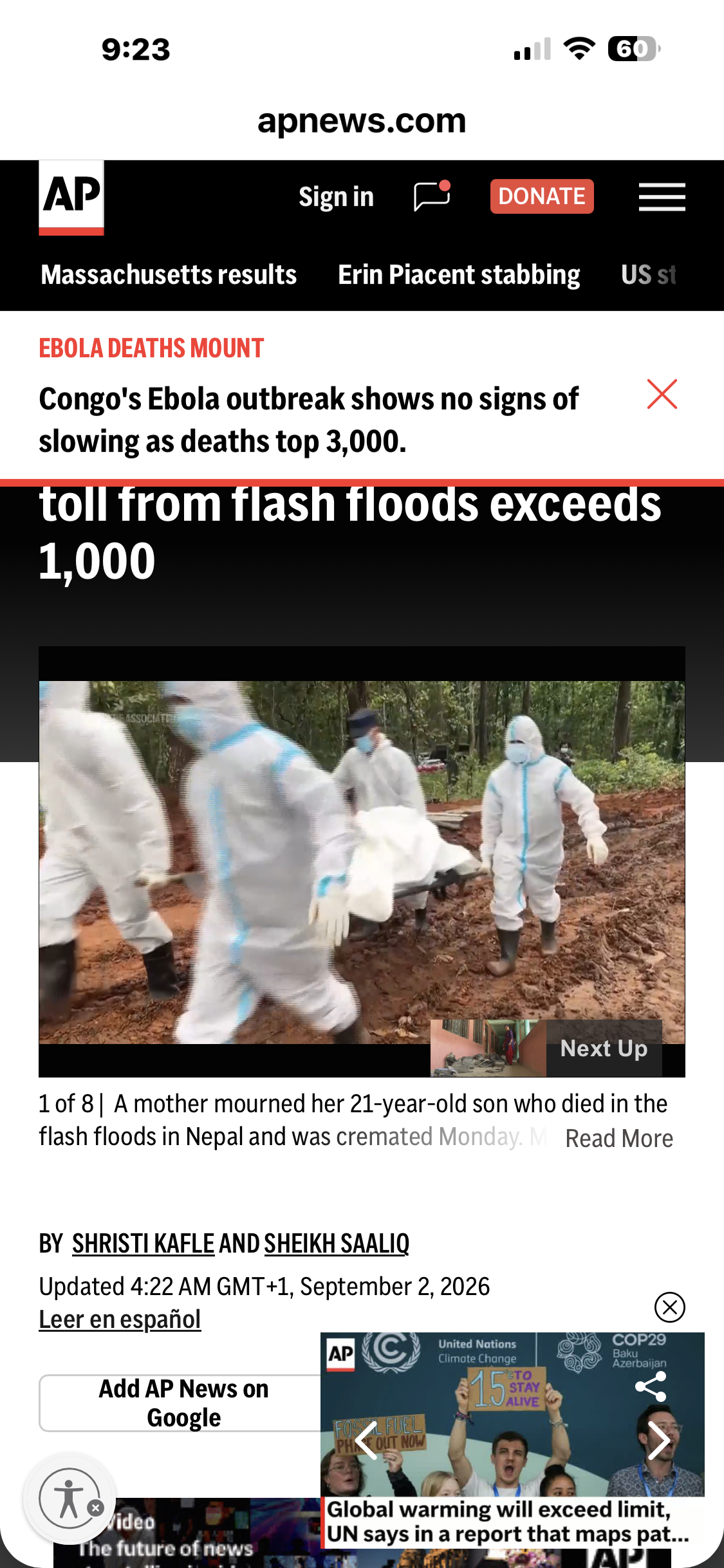
KATHMANDU, Nepal (AP) — Rescue teams with search dogs continued to look through mud, rocks and debris on the Nepal -China border Tuesday for thousands of people missing a week after the catastrophic flash floods that tore through Himalayan communities and left more than 1,000 dead.
As police in Kathmandu buried dozens of bodies in multiple trenches, Nepal’s disaster agency said 1,003 deaths had been counted there, with 3,916 people missing, including 583 foreign nationals. China reported 16 deaths and 546 missing, including 261 foreigners, as of Sunday.
The scale of the Aug. 26 disaster is hampering rescue efforts, with landslides, destroyed roads and widespread damage cutting off remote areas.
Crews faced challenging conditions as they searched unstable terrain and piles of debris, raising fears the death toll could rise as rescuers reach isolated communities.
Race to reach missing hydropower workers
Rescuers are racing to reach hundreds of workers believed to be trapped inside tunnels at hydropower projects in Nepal damaged by the floods. About 900 workers are missing from 12 projects, with roughly 500 believed to be trapped in tunnels, according to local authorities.
Brig. Gen. Raja Ram Basnet, Nepal’s army spokesperson, said teams assisted by foreign experts were working at several hydropower projects. Images released by the army showed rescue teams entering debris-filled tunnels and wading through mud and water in the search for signs of life.
On the Chinese side, rescue crews scoured areas hit by mudslides, particularly around the Gyirong Port border crossing, which was destroyed.
Some rescuers, aided by search dogs, searched gaps among rocks and debris for signs of life. Other teams used heavy machinery to clear a major highway leading to Gyirong Port, hoping to clear the way for equipment, personnel and supplies to reach the disaster zone, according to China’s state-run Global Times newspaper.
Mass burials of unidentified bodies in Kathmandu
In Kathmandu, police worked in heavy rain on Tuesday to bury dozens of bodies in multiple trenches next to a forested area.
Barbed wire was erected around the site, while blue numbered markers identified the graves of people whose names were not yet known.
Authorities in Nepal have been burying bodies in temporary graves until they can be identified. They are preserving DNA samples, photographing distinguishing facial features and recording other identifying details.
Each body is assigned a reference number to help families identify and claim the remains later.
Sign up for Morning Wire: Our flagship newsletter breaks down the biggest headlines of the day.
Relief operations expanded to stranded communities
At least 11,814 people have been rescued so far, according to Nepalese authorities. Emergency crews used helicopters and other aircraft to reach stranded communities in areas where roads and bridges have been destroyed by the flooding and landslides.
Efforts are being stepped up to provide assistance to survivors in areas where roads and other transportation routes had been damaged or cut off.
China’s Foreign Ministry spokesperson, Guo Jiakun, said a second batch of relief supplies was being sent to Nepal, including drones, DNA testing and water purification equipment. Chinese DNA testing experts will also help Nepal identify bodies, he said.
Bimal Sharma, a helicopter pilot who has been flying rescue and relief missions, said he was shocked to see the devastation in Timure, a border town close to Tibet that he has known for years.
“It felt like I was flying over an entirely different landscape,” said Sharma, adding that he has had little opportunity to speak with the people he rescued. “I can see the pain in their eyes. It’s heartbreaking,” he said.
Glacial collapse in the Himalayas
The disaster began in the Himalayas when a glacial collapse sent large amounts of rock, ice and meltwater into valleys below, triggering powerful floods downstream.
Scientists studying satellite imagery said the collapse appears to have involved the failure of bedrock beneath a glacier in the Himalayan region. The rockfall was powerful enough to register as a magnitude 5.2 seismic event.
The resulting surge of water and debris entered rivers that flow through valleys in Tibet and Nepal, causing them to rise rapidly. Floodwaters swept away homes, buildings, roads and bridges and carried mud and rocks downstream.
Nepal’s Prime Minister Balendra Shah said that the disaster highlighted the need for action to combat climate change.
“This incident has indicated that the risks we face in the Himalayan region are increasing with climate change,” Shah said in a social media post Monday night. “Therefore, this region must be alert, and at the same time, it is time for us to strongly raise the issue of disasters caused by climate change before the international community.”
Saaliq reported from New Delhi. Associated Press journalists Victoria Milko in Kathmandu, Nepal, E. Eduardo Castillo in Beijing, Kanis Leung in Hong Kong and Aijaz Hussain in New Delhi contributed to this report.
-
 Politics13 hours ago
WHEN PRIVACY BECOMES CONTENT: The Dangerous Normalisation of Leaked Private Conversations
-
Editorial2 days ago
Why Nigerian Graduates and Youths Are Jobless — and Increasingly Vulnerable to Crime and Other Vices
-
News19 hours ago
BREAKING: Gov Mbah appoints 101 new aides
-
News2 days ago
Former Kogi Gov, Ibrahim Idris, dies in UK at 77
-
News2 days ago
NDLEA intercepts N3.4bn drugs, arrests fake police officer
-
Politics3 days ago
NDC disowns purported OK Movement PCC, moves to sanction John Ugulu
-
News2 days ago
Woman allegedly kills husband over plans to marry second wife
-
News1 day ago
Flood Alert: 8,000 communities, 4,500 schools at risk – FG