By Tony Edike
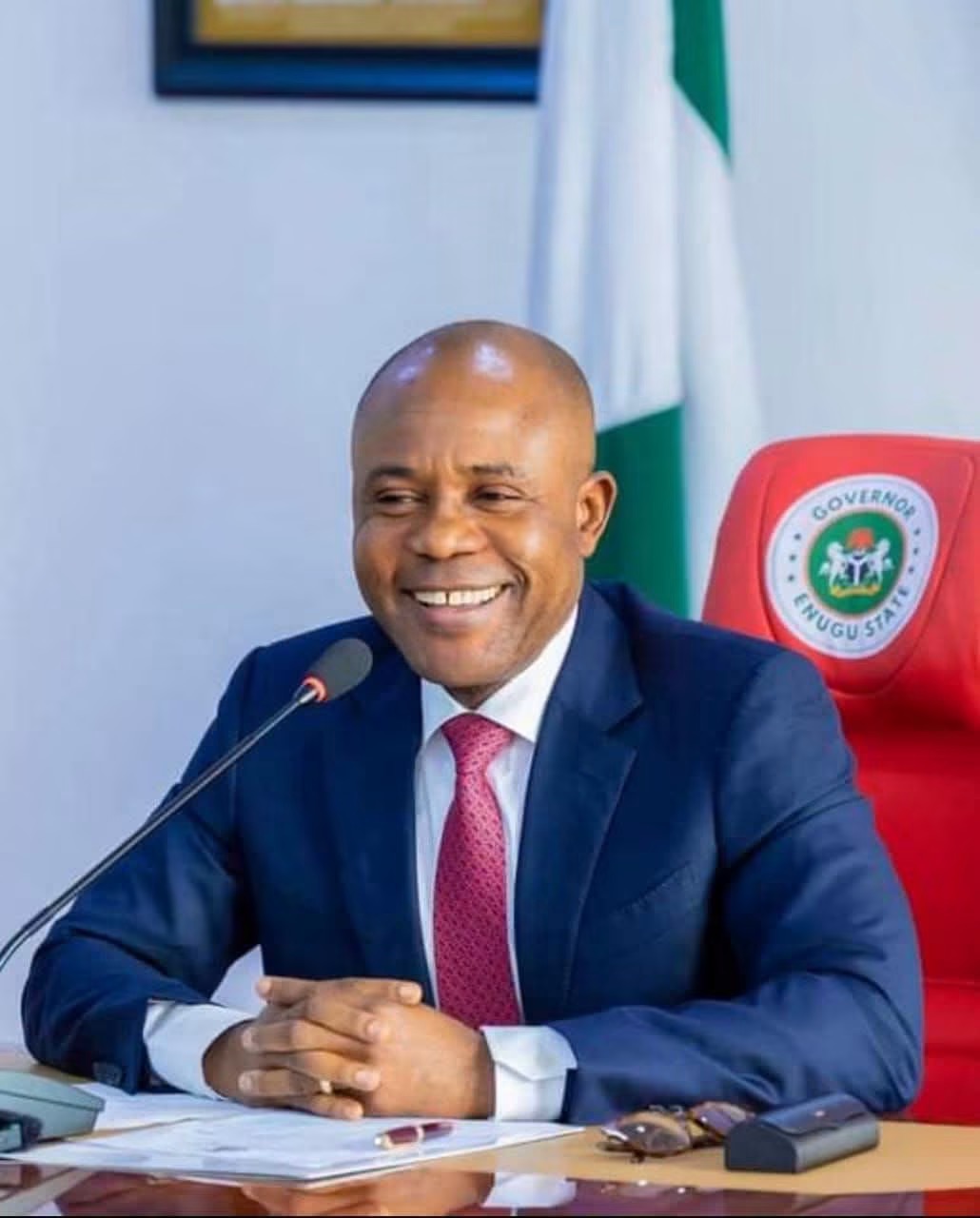
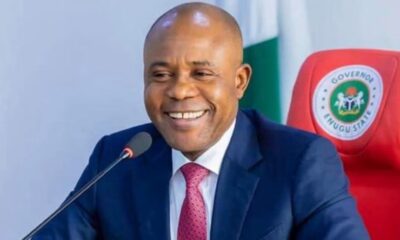
Enugu State Governor, Peter Mbah, has said the state has increased its daily water production capacity from two million litres to 120 million litres, while intensifying efforts to ensure reliable water supply reaches households across Enugu metropolis.
Mbah disclosed this during a town hall meeting held at the International Conference Center in Enugu on Wednesday , where he addressed issues relating to water supply, agricultural development, regional security cooperation and the state’s economic prospects.
The governor explained that although the state had significantly expanded its water production capacity, ageing pipelines, burst pipes, encroached water corridors and other infrastructure challenges had slowed the distribution of water to some communities.
According to him, the state initially needed about 80 million litres of water daily to ensure adequate supply to homes across Enugu metropolis, against the two million litres being produced when his administration took office.
He said the government began procuring critical equipment before his inauguration to accelerate the implementation of its 180-day water supply commitment.
“We front-loaded the procurement because some of the items we needed to procure were long-lead items,” Mbah said, explaining that some equipment, particularly large pumps, required several months to manufacture and deliver.
He added that the government also reactivated the Ninth Mile water scheme, which had remained dormant for years, contributing to the increase in production capacity.
However, Mbah said the expansion exposed weaknesses in the existing distribution network, including brittle pipes that had exceeded their design life, asbestos pipes and sections of the pipeline network obstructed by buildings.
He said the government decided against demolishing citizens’ buildings along affected pipeline routes, opting instead to develop new distribution networks.
According to the governor, Enugu metropolis has been divided into 14 zones, with work ongoing to extend water supply to the last mile.
He said the government had also procured horizontal drilling equipment to enable underground pipe installation without unnecessarily cutting open roads.
“We have a buffer of over 50 per cent to serve the entire city of Enugu. What we’re now dealing with is making sure that the water gets to the last mile,” he said.
Mbah assured residents that his administration remained committed to resolving the water supply challenge, adding that he received daily briefings on progress in the sector.
Enugu Opens Up Agricultural Sector to Investors
The governor also highlighted his administration’s agricultural development initiatives, saying the state was creating opportunities for commercial farming, mechanisation and agro-processing.
He disclosed that Enugu had more than 167,000 hectares of land available as a land bank for commercial agricultural investments, with some communities voluntarily making land available for farming and wealth creation.
Mbah said the government was engaging investors across different parts of the state and had established a tractor assembly plant to support agricultural mechanisation.
He added that the state had more than 60,000 farmers in its database, cultivating over 80,000 hectares of land, with the coordinates of their farms documented.
According to him, the government recently distributed more than 60,000 bags of fertiliser free of charge to farmers, alongside other farming tools, improved seedlings and handheld tractors.
He said the interventions were aimed at increasing agricultural productivity and helping smallholder farmers transition from subsistence farming to mechanised agriculture.
Mbah further disclosed that the government was constructing agro-transformation centres across the state’s three senatorial zones, in addition to a special agro-processing zone intended to support large-scale agricultural production and processing.
He also announced that an integrated livestock facility capable of accommodating more than 20,000 cattle was under construction around the Obollo and Eha-Amufu axis, while Enugu was among three states selected for a federal government integrated poultry project.
The governor said the agricultural initiatives were designed not only to increase food production but also to encourage processing, attract private investment and create employment.
Security: Mbah Cites Federal Support, Regional Intelligence Sharing
On security, Mbah said Enugu State had benefited from its relationship with the Federal Government, particularly through support for security operations and improved collaboration among security agencies.
Responding to concerns about insecurity along interstate border areas, including flashpoints connecting Enugu with neighbouring states, the governor said intelligence sharing and regional cooperation had improved.
He disclosed that the establishment of the state’s Distress Response Squad received approval from the Federal Government.
Mbah also said the state was working closely with the Nigerian Army, Police, Department of State Services, Nigerian Air Force and Nigeria Security and Civil Defence Corps to strengthen security operations.
According to him, although regional collaboration might not always be reflected in a single physical command centre, intelligence sharing and cooperation among security agencies had increased.
He maintained that Enugu’s relationship with the Federal Government had brought benefits beyond security, including opportunities to attract national events, conferences and other activities to the state.
Enugu Repositioning Itself as Regional Hub
The governor said Enugu was regaining its position as a regional hub after years in which it was increasingly being displaced by other locations.
He cited the hosting of national conferences and activities, including the National Council on Agriculture and other major events, as evidence of renewed interest in the state.
Mbah said the return of such activities was creating opportunities for local businesses and residents through increased economic activity.
He argued that reconnecting Enugu to national economic and institutional networks was essential to sustaining its regional importance.
Mbah Defends Federal Economic Reforms
The governor also defended the Federal Government’s economic reforms, arguing that stabilising the macroeconomic environment was necessary to attract private investment and stimulate growth.
He cited Nigeria’s foreign reserves, which he put at about $58 billion, and what he described as improved foreign exchange stability as indicators of progress.
Mbah said allowing the foreign exchange market to respond to market forces had helped address pressures that previously contributed to the depletion of the country’s reserves and weakened confidence in the naira.
He argued that economic stability would encourage private capital to enter the economy, leading to job creation, increased earnings and a reduction in poverty.
According to him, the reforms required political courage and should be assessed by their impact on economic indicators and growth.
“We are on the right path, and I can tell you from the numbers we’re seeing and the growth we are witnessing now, we are seeing the light at the end of the tunnel,” he said.
The governor maintained that the benefits of economic stabilisation would become more evident as investment increased and economic activity expanded.
He said the state government would continue pursuing its infrastructure, agricultural and security initiatives as part of efforts to improve living conditions and strengthen Enugu’s economic position.