



Connect with us

News

Gov Mbah flags off distribution of farm inputs to 63,000 Enugu farmers

Published

on

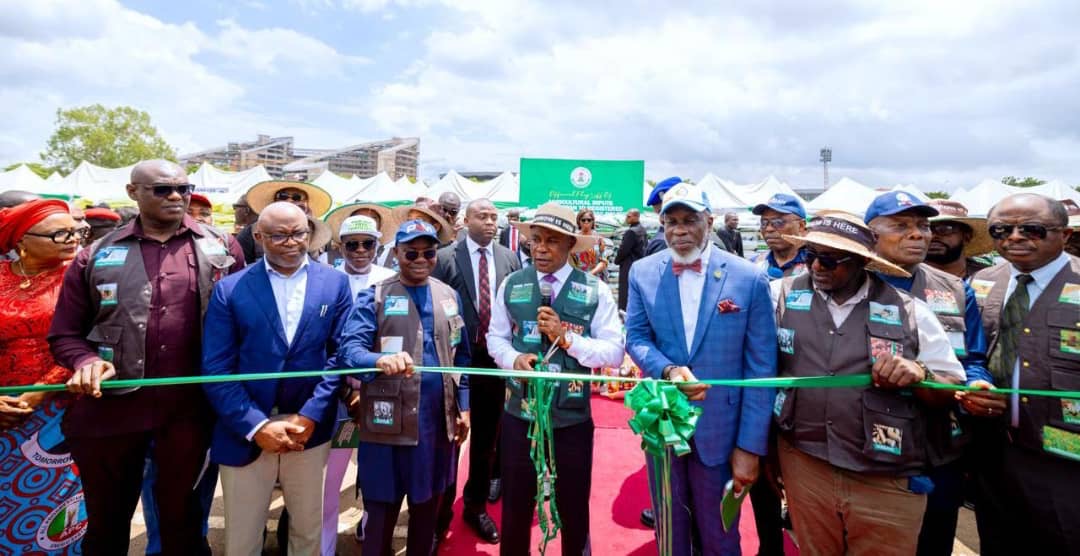
Gov Peter Mbah flagging off distribution of farm inputs to Enugu farmers on Tuesday
Spread the love

…Targets agro-processing, food export

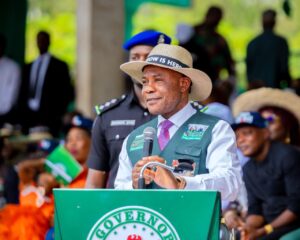
Governor Peter Mbah of Enugu State, on Tuesday, flagged off the 2026 distribution of fertilizers and other farm inputs to 63,000 registered smallholder farmers in the state.

Mbah also said the move was in line with his administration’s commitment to eradicating poverty and growing Enugu State into a $30 billion economy, noting that 40 per cent of the growth would come from agriculture.

Mbah said his administration had always seen agriculture as more than just a mere source of food, but as big business, hence the efforts to migrate Enugu farmers from subsistence to commercial farming.

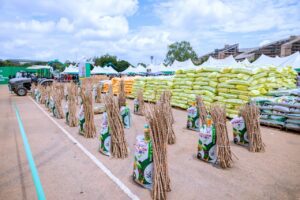
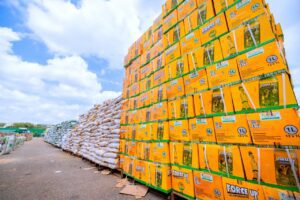
“We have done this in the last three years, essentially providing fertilisers, agrochemicals, stems, seeds, and seedlings to improve our yields. Today, we have 63,000 bags of fertilisers. We have to train our farmers.

Maduka College Advert

“We also have to migrate our smallholder farmers from subsistence farming to mechanised farming, which is why we also invested in machinery. And that means that we are going to start thinking about a full value chain.

“We are looking at exports, playing in all the value chains, being able to export fresh produce from here to other parts of the world, being able to process our produce, add value, package, and then export. This is also why the airport concession and cargo terminal are important to us,” he said.

Mbah called on those saddled with the distribution to ensure that the inputs got to the farmers by sticking to the database and also warned the farmers against selling the inputs.

“We are working with our database. We are also going to implore all our stakeholders, the Local Government Chairmen, and the priests in the various communities to make sure that these inputs get to the end users, free of charge. Please, make sure that these inputs get to our farmers. We do not want middlemen.

“The fertilisers also have ‘Not for Sale’ boldly written on them. So, you must make sure that you use this to scale up our production so that we can have a bumper harvest and drive down the cost of food in Enugu,” he stressed.

He said the Special Agro-Processing Zones, one of the agro-industrialisation initiatives of his administration, would soon come on board to scale up production and cut post-harvest losses.

“We want to make sure that we increase the earning capacity of our various communities where we actually have a lot of our poor people. We’re building our farm roads so that it will be easy for us to evacuate what we have produced,” he stated.

Earlier in his remarks, the Commissioner for Agriculture and Agro-Industrialisation, Dr. Patrick Ubru, announced a significant increase in the 2026 Agricultural Free Inputs Distribution Programme compared to 2024.

“In 2024, over 12,000 bags of fertiliser, improved seeds, and chemicals were distributed, rising to over 40,000 last year.

“Today, over 63,000 bags will be distributed, representing a 58 per cent increase from last year.

“Thousands of farmers across the 17 Local Government Areas will receive free improved rice, maize, tomato and pepper seeds, cassava stems, fertilisers, and agrochemicals to boost productivity and reduce costs,” he said.

Beyond the support through inputs, Ubru said the Mbah administration had established a modern Seed Testing Laboratory and Seed Gallery, digitally profiled over 84,000 farmers, and integrated agricultural data into the state’s Geographic Information System (GIS).

“Over 25,000 farmers have been trained in climate-smart agriculture, while we are also providing Seasonal Climate Prediction Information through our partnership with the Nigerian Meteorological Agency (NiMet).

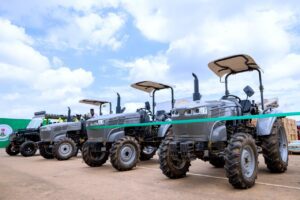
“The 260 Farm Estate Programme is underway in Enugu State, and a tractor assembly plant has been established through a partnership with Nortra Tractors, making mechanisation more accessible.

“Additionally, centre pivot irrigation systems are being rehabilitated to enable year-round cultivation of crops like rice,” he added.

In his remarks, the Agricultural Transformation Agenda Support Programme Phase One (ATASP-1) Coordinator, Romanus Egba, assured the governor of well-planned distribution channels, using clergy and community leaders to ensure that the various items reached the intended beneficiaries.

In addition to a bag of fertiliser, he said, “each farmer will get one bag of maize or rice, cassava cuttings, herbicide, and vegetable seeds such as tomatoes or pepper.”

The representative of the Farmers Association of Nigeria (FAN), Enugu State Chapter, Sir Emmanuel Chukwuemeka Eneh, while thanking Governor Mbah for his consistent massive investment in agriculture, warned any farmer or anybody who colludes to sell any of the farm inputs to be ready to go to jail.

News

Despite fuel subsidy removal, FG struggles to implement budgets, experts lament

Published

on

Spread the love

• Say capital projects development under threat

Economic experts have lamented that despite fuel subsidy removal in 2023, the Federal government struggled to implement 2024 budget with the 2025 budget recording barely 30 percent implementation.

They said the continued delay in the implementation of rollover and the current budget by the government posed a threat to capital projects.

Speaking at the weekend with the Nigerian Tribune, an economic expert, Eze Onyekpere, explained that under the current expenditure, “you have salaries and embodiments of public officers. So the only people you can touch are those people who are working with government, which is very few.

“Another part of recurrent expenditure is debt, which is taking 53 percent of all our revenue. So, those ones are not impacting on anybody. Now, the part of the budget that touch lives of the people is the capital budget, particularly the developmental capital” he stated.

Onyekpere said the developmental capital deals with building bridges, hospitals, schools, water facilities, improving electricity and agriculture.

Maduka College Advert

“So, if you are not implementing capital projects that mean you are only running the bureaucracy, paying salaries, paying debts. You are not doing projects that will impact the life of the original people.”

He explained, ‘Don’t forget that it is from capital budget that you also buy bullets, buy arms, which after paying salaries of the soldiers and the military and the police, they also need equipment to be able to work. So if you are not funding that, there is no way they will be performing optimally.

“So that is the danger of not implementing the capital budget. We are being told that the resources are improving, that the money is there. So why is the government not implementing the budget if the money is there?” He questioned.

The Economic Expert further explained that part of the Ease of Doing Business is building the road that transport the goods, or that there are good railways, or that we are having constant 24-hour electricity instead of factories having to run a generator or start producing their own mini grids to power production, causing commodity price increase.

It is reported that only 30 percent of the 2025 capital budget was funded and executed during its initial cycle due to revenue shortfalls. 70 percent of the unexecuted 2025 capital projects were deferred and rolled over into the 2026 capital budget framework.

Also lamenting the non-implementation of the country’s budget, another Economic Expert and the Co-founder of BudgIT, Oluseun Onigbinde, said the current administration has declared more revenue with low capital releases.

“You don’t need to continue to roll the budget over and over. There are so many items you find in the budget that have no priority; they don’t make any developmental sense to the Nigerian people. For example, you are putting palaces in the budget.

“The Federal Government trying to build palaces, or investing in churches and mosques, or buying musical instruments for a church is not going to bring any developmental opportunity. So there are multiple layers of these issues, and there is no coordinated fiscal program from the federal government.

“The federal government is raising revenues, but there are challenges. One is the issue of debt servicing cost. Because of the devaluation of the currency, debt servicing cost has skyrocketed. It’s around 17 trillion naira as of last year.”

He warned that debt servicing cost is not slowing down any time soon. So the federal government needs to reflect on its fiscal choices and ask itself, how do I generate more revenue? That is the first point.

The second point you have to ask is, how do I prioritise capital spending that gives us impact? And that starts from the budgeting process» he stated.

During the Senate engagement with the Ministry of Finance recently, Senator Mohammed Tahir Monguno raised the alarm.

He questioned why capital projects and critical government programs appear to be lagging if revenue collections are exceeding projection.

The senator also expressed concern over the reported absence of capital releases to security agencies and sought clarification on the retention of about 1.7 trillion naira from recent federation account allocations.

“We have exceeded the target of our revenue collection. It is inherently contradictory for government to woefully fail to implement the budget. Where are these revenues going to? If the budget, for example, 2025 budget, has not been implemented, and we have to roll over 70 percent of 2025 to 2026, and that with the promise that 30 percent will be implemented before March.

«Up to March, even 30 percent was not implemented. National Assembly had to extend the lifespan of the budget up to September to allow government to implement just 30 percent component of 2025 budget”, he lamented.

In response, the Minister of Finance and the Coordinating Minister of the Economy, Taiwo Oyedele said for external loans, “we always need the approval of the National Assembly.

“So, what happens is, when we get the approval of the National Assembly, the media would rightly report it, and many people take that as money borrowed. When we now borrow the money, they report it again. So, in fact, I think it was last year when the National Assembly approved about $20 billion, which was based on MTEF. So people add up big numbers as the money we have borrowed, and that is misleading in terms of the analysis.

“We are currently finalising this breakdown in the Ministry of Finance. We’ll make it available to the public. It will show how much the National Assembly approved and how much of what we have borrowed and how it has been spent” he stated.

Analysts believe that the low budgetary implementation, particularly the capital project aspect, has denied many citizens the benefits of the fuel subsidy removal as only a few who has direct business to do with the government that may have gained from the policy. (Nigerian Tribune)

Continue Reading

News

‘Nigeria is burning’ — Atiku tackles Tinubu over three-week European vacation

Published

on

Atiku and Tinubu
Spread the love

Former Vice-President and 2027 presidential candidate of the African Democratic Congress (ADC), Atiku Abubakar, has criticised President Bola Tinubu’s decision to embark on a three-week vacation in Europe amid the country’s economic and security challenges.

Atiku, in a statement issued after Tinubu’s departure, said the President’s absence from the country at a time of widespread hardship reflected what he described as a “disturbing vacuum of political leadership”.

He acknowledged that there was no constitutional vacuum, but argued that the circumstances surrounding the President’s trip raised questions about his leadership priorities.

“Nigeria may not be facing a constitutional vacuum today, but there is a disturbing vacuum of political leadership,” Atiku said.

The former vice-president contrasted Tinubu’s trip with his own travels, noting that the responsibilities of a sitting president were different from those of a private citizen.

Maduka College Advert

“I have travelled, lived and spent time abroad, and I have never pretended otherwise. But there is a fundamental difference between the travels of a private citizen and the responsibility of the sitting President of the Federal Republic of Nigeria,” he said.

Atiku listed rising living costs, food insecurity, high transport fares and insecurity among the challenges confronting Nigerians, arguing that the situation required the President’s presence in the country.

“Consider what Bola Tinubu is leaving behind. Petrol priced beyond the reach of ordinary people. Families rationing food. Transport fares that have turned a journey to one’s own village into a luxury. Insecurity that buries Nigerians week after week,” he said.

He also noted that Vice-President Kashim Shettima was out of the country on official duty, describing the President’s decision to travel under the circumstances as difficult to understand.

According to Atiku, leadership requires knowing when a country needs the physical presence of its leader.

“Leadership is not merely the constitutional right to occupy an office; it is the judgment to know when your country needs you at home,” he said.

Using a fire analogy, Atiku argued that a leader should remain with his people during a crisis rather than leave the country.

“A father may travel when all is well. But when his roof is burning and his family is trapped inside, he does not pick up his suitcase and head for the airport,” he said.

Atiku stressed that his criticism was not based on the principle that a president should never travel or take time off, but on what he described as the severity of Nigeria’s current challenges.

“It is not that a President must never rest or travel. It is that Nigeria is burning, and the President has chosen a boarding pass over the fire extinguisher,” he said.

He further criticised the economic policies of the Tinubu administration, saying Nigerians were struggling to cope with the rising cost of living.

“Millions of Nigerians are being grounded by hardship while their President is airborne,” Atiku said.

He concluded by contrasting his proposed leadership with the current administration, declaring: “Tinubu made Nigeria expensive. I will make Nigeria affordable again.”

Continue Reading

News

Inferno razes Abuja building materials market, destroys goods worth millions

Published

on

Spread the love
A fire outbreak has destroyed shops and goods reportedly worth millions of Naira at Eda Plaza, a building materials market located opposite Chida Hotel in Jabi, Abuja.

An eyewitness was quoted by the Nigerian Television Authority NTA as stating that the alarm was raised around 3am on Sunday when his brother-in-law, who owns two shops and a packing store within the affected plaza, received a distress call from a colleague at the market.

National Public Relations Officer and Head, Corporate Services at the Federal Fire Service, Deputy Controller of Fire Paul Abraham, who confirmed the incident said a distress call about the fire, identified as the Eda Plaza fire, was received at 2:46am.

He said the Federal Fire Service, alongside the Federal Capital Territory FCT Fire Service, turned out with appliances from its Wuse, Interior Ministry, and Garki stations to battle the blaze, and that a stop message was issued at 10:14am, signaling that the fire had been brought under control.

Abraham added that investigations into the remote and immediate causes of the fire were currently underway.

Earlier, the eyewitness said there were no casualties in the incident.

Maduka College Advert

He said, “We were at home this morning, as early as 3 am, and my brother-in-law received a call from one of his colleagues here in the plaza that the plaza was on fire. So we had to rush down there. On getting here, we discovered that the situation was so bad”.

By the time they arrived at the scene, the eyewitness said, the fire had already spread extensively, leaving only one of his brother-in-law’s two shops standing.

“In this plaza, my brother-in-law had two shops and a packing store. Unfortunately, only one of the shops was saved. The other shop and the packing store were totally damaged by the fire,” he added.

The eyewitness put the value of roofing materials lost in the blaze at over N20 million, lamenting that some of the destroyed materials had been freshly installed the night before the incident.

“Over here, you see some of the roofs that we still have here. We are talking about a roof that is worth over N20 million lost in this fire,” he said, adding, “Because the other shop, we had roofs that were just restocked last night. And then the packing store also, we had roofs that were just restucked last night.”

Notwithstanding the heavy losses recorded, the eyewitness said he was consoled that the incident claimed no casualties.

“In our situation, we give thanks to God that no life was lost in this situation,” he said. (Vanguard)

Continue Reading

Trending

Maduka College Advert