Connect with us

Business

FirstBank lays off 100 senior executives in major shakeup

Published

on

Spread the love

FirstBank of Nigeria, the country’s oldest financial institution and a key entity under FBN Holdings, has exited approximately 100 senior executives as part of a sweeping organizational restructuring.

The move, which insiders describe as a repositioning effort for 2025, underscores the bank’s ongoing transformation under the leadership of Femi Otedola, Chairman of FBN Holdings.

According to sources familiar with the development, the restructuring includes the departure of top executives, including a prominent executive director whose tenure was not renewed under mutually agreed circumstances.

While some of the exits were voluntary, others were reportedly part of a deliberate effort by the board to inject new talent into the bank’s leadership.

The restructuring aligns with the bank’s strategic agenda to enhance governance and operational efficiency. Insiders suggest the changes were approved by FirstBank’s board to recalibrate leadership as the institution prepares for significant growth initiatives.

Maduka College Advert

FirstBank’s leadership overhaul began earlier in the year following Otedola’s assumption of chairmanship at FBN Holdings.

In March 2024, the holding company appointed five elite directors to the board, signaling a commitment to revitalizing its governance structure. This was followed by a series of pivotal changes, including:

These changes are part of an ambitious plan to align the bank’s operations with its long-term growth strategy and reposition it as a leader in the Nigerian banking industry.

FirstBank’s recent restructuring efforts coincide with its broader financial and operational targets. The bank closed its N149.5 billion rights issue on December 30, 2024, positioning itself to meet the Central Bank of Nigeria’s recapitalization mandate.

Industry experts view these changes as essential for sustaining competitiveness in the highly dynamic Nigerian banking sector.

“The restructuring at FirstBank reflects a strategic response to evolving market realities,” noted Dr. Ayodeji Balogun, a financial analyst.

“With Otedola at the helm, the bank is clearly signaling its intent to prioritize governance, innovation, and long-term stability.”

FirstBank has been one of the standout performers among Nigeria’s top-tier banks in 2024, achieving an 18.47% year-to-date increase in share price.

The positive market response is attributed to investor confidence in the bank’s leadership direction and ongoing recapitalization efforts.

As FirstBank ushers in a new era under Otedola’s leadership, the institution appears poised for transformation. The sweeping changes to its leadership and operational structure aim to cement its position as a resilient and innovative financial institution, prepared to navigate Nigeria’s evolving economic landscape.

The coming year will test the bank’s ability to deliver on its repositioning agenda and maintain its legacy as a cornerstone of Nigeria’s financial sector.

Business

Dollar to Naira exchange rate today, September 23, 2026

Published

on

Naira rebounds to 1,275/$ at parallel market
Spread the love
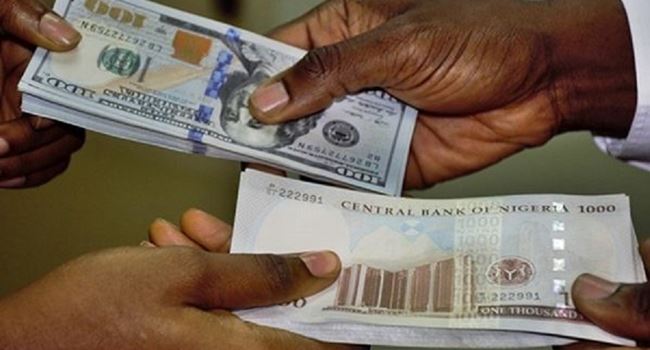
The Nigerian naira is trading at different rates against the United States dollar across the official Nigerian Foreign Exchange Market (NFEM) and the parallel market on Wednesday, September 23, 2026.

The latest available data show that the naira strengthened to N1,327.78 per dollar at the NFEM on Tuesday, from N1,329.80 recorded on Monday.

The latest movement represents a N2.02 appreciation by the naira against the dollar on a day-to-day basis.

In the parallel market, the dollar was quoted at about N1,389 on Tuesday, down from N1,390 recorded the previous day.

The parallel-market rate puts the gap between the official NFEM rate and the street-market selling rate at about N61.22 per dollar.

At the parallel market rate of N1,389, customers buying $100 would need approximately N138,900, while $1,000 would cost about N1.389 million.

Maduka College Advert

The exchange rate available to individuals and businesses may vary depending on the dealer, location, transaction size and prevailing market conditions.

The naira’s recent performance has come amid developments in Nigeria’s foreign exchange market, including changes in dollar liquidity and monetary policy.

The Central Bank of Nigeria has continued to monitor conditions in the foreign exchange market as the naira trades around the N1,300-per-dollar level at the official market. Reuters also reported in September that the naira had remained relatively stable, supported by central bank dollar sales and subdued import demand.

For Wednesday, September 23, the latest confirmed figures put the dollar at N1,327.78 at the NFEM and around N1,389 in the parallel market.

The rates could change during the day as demand and supply conditions shift across both markets.

Continue Reading

Business

Enugu Air Launches New Website

Published

on

Spread the love

…moves online services to www.enuguairlines.ng

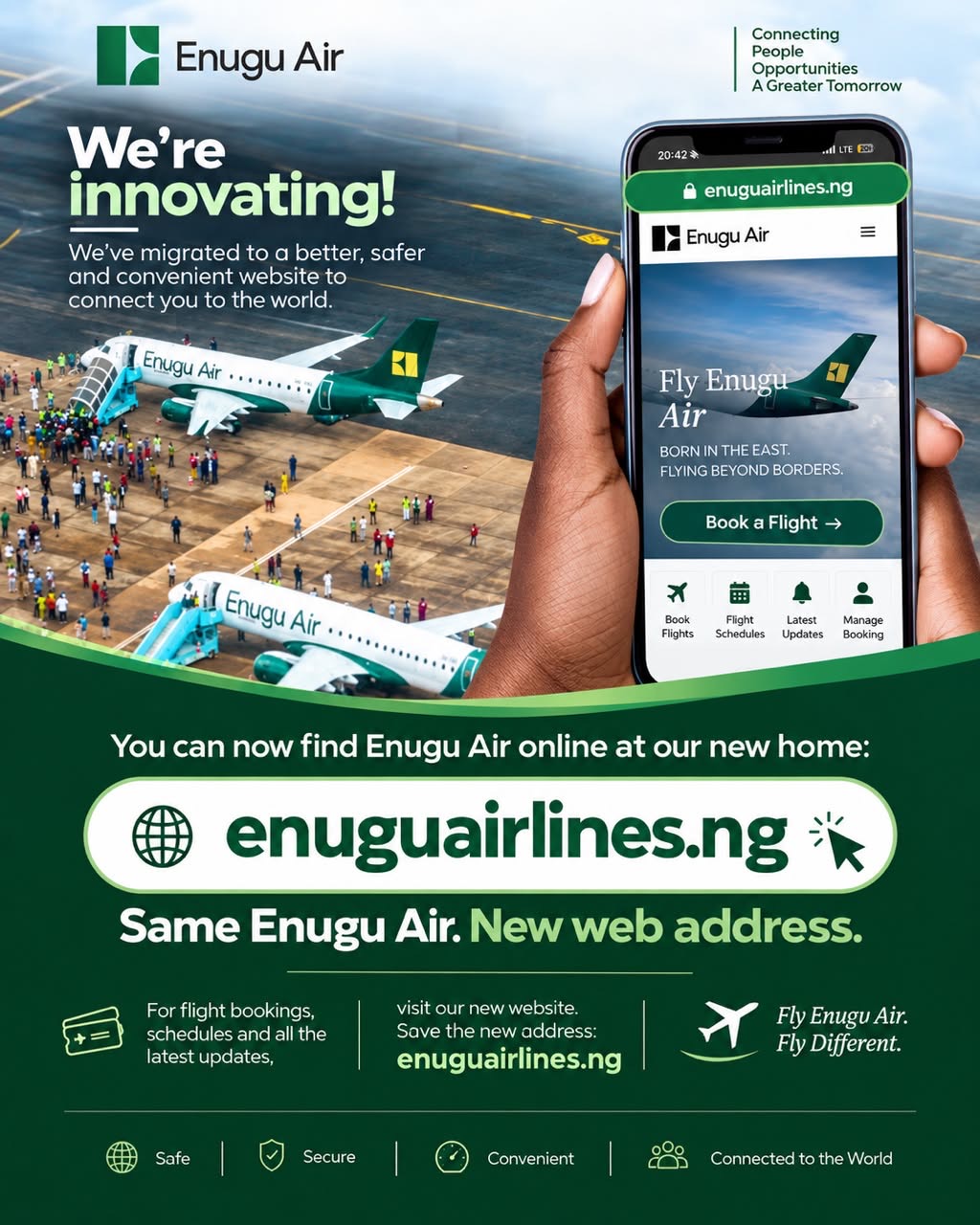
Enugu Air has announced the launch of its new official website, enuguairlines.ng, as part of efforts to provide passengers and customers with a better, safer and more convenient digital experience.

The airline said the migration to the new website is designed to improve how passengers connect with Enugu Air and access its services online, including flight bookings, schedules and the latest updates.

Announcing the development, the airline said: “We’ve moved! We’re innovating! We’ve migrated to a better, safer and convenient website to connect you to the world.”

Passengers can now access Enugu Air’s online services through its new web address, enuguairlines.ng, which the airline described as its new digital home.

The airline urged passengers and prospective travellers to save the new web address and use it for flight bookings, checking schedules and obtaining the latest information about its operations.

Maduka College Advert

“Same Enugu Air. New web address,” the airline stated, emphasising that the change represents an improvement in its digital platform while retaining the Enugu Air brand and services.

The airline further encouraged customers to visit, www.enuguairlines.ng for all flight-related information and online services.

It further stated that the old website, enuguairlines•com has been discarded and no longer in use.

Continue Reading

Business

Nigeria records 8.51m terabytes of data use in first half of 2026

Published

on

Nigerian Communications Commission
Spread the love

Nigerians consumed a record 8.51 million terabytes of data in the first half of 2026, underscoring the country’s accelerating shift toward a digital-first economy.

Data from the Nigerian Communications Commission (NCC) confirmed this. Specifically, in January, consumption was 1.385 million terabytes; February, 1.260 million terabytes and March, 1.422 million terabytes.

In April, consumption was 1.414 million terabytes. It climbed to 1.504 million terabytes in May and 1.532 million terabytes in June.

In 2025 alone, Nigerians consumed over 13.2 million terabytes of data, a 35 per cent increase from 2024, reflecting how connectivity has become essential for daily life.

The surge in consumption was driven largely by the twin giants of the telecom sector, MTN Nigeria and Airtel Nigeria, whose half-year reports revealed data services have firmly overtaken voice as the primary revenue stream.

Maduka College Advert

According to industry figures, average monthly data usage per subscriber rose sharply, reflecting the growing reliance on mobile broadband for work, entertainment, and commerce.

Streaming platforms, social media, fintech apps, and remote work tools have all contributed to the spike in demand.

MTN Nigeria reported that its 55.7 million active data subscribers consumed an average of 14.8 gigabytes per month, representing a 15.2 per cent increase year-on-year. Overall, MTN’s data traffic surged by 25.8 per cent across its network in the period.

This translated into a massive N1.70 trillion in data revenue, a 38.4 per cent jump compared to the same period in 2025. Data now accounts for more than half of MTN’s total service revenue, dwarfing its voice earnings of N993.5 billion, which grew at a modest 12 per cent.

Airtel Nigeria also posted strong numbers, recording N691 billion in data revenue ($507 million). While Airtel’s voice services contributed to a combined N1.42 trillion in voice earnings alongside MTN, the clear trend is that data has become the dominant driver of growth.

Together, MTN and Airtel generated N2.4 trillion from data services in H1 2026, cementing their role as the backbone of Nigeria’s digital economy.

MTN invested N620.5 billion in capital expenditure during the period, focusing on expanding 4G coverage, scaling 5G rollout, and strengthening fibre infrastructure. The company’s aggressive push into next-generation networks is aimed at meeting the surging demand for high-speed connectivity.

Airtel, meanwhile, faced challenges with fibre cuts and vandalism, forcing reinvestments to stabilize its network. The operator is blending 5G expansion with satellite partnerships to extend coverage into rural and semi-urban areas, where demand for reliable Internet is rising.

Despite these investments, many consumers continue to express dissatisfaction with service quality. Complaints of slow speeds, unstable connections, and high costs remain widespread, highlighting the gap between consumption growth and infrastructure capacity.

The NCC has repeatedly urged operators to deepen investments in fibre, towers, and spectrum to sustain the country’s digital transformation. Analysts note that the sector is undergoing a structural shift from voice-first to data-led growth, with internet connectivity now central to economic activity.

Industry experts predict that Nigeria’s data consumption will continue to rise exponentially as smartphone penetration increases and more services migrate online. The rollout of 5G is expected to further accelerate usage, enabling innovations in fintech, e-commerce, healthtech, and entertainment.

The consumption of 8.51 million terabytes in H1 2026 marks a historic high for Nigeria’s telecom industry. It reflects not only the appetite of a digitally hungry population but also the broader transformation of the economy.

With MTN and Airtel leading the charge, the challenge now lies in improving service quality, expanding infrastructure, and ensuring affordable access for millions of Nigerians. As data becomes the lifeblood of communication and commerce, the telecom sector’s ability to keep pace with demand will determine how effectively Nigeria harnesses the opportunities of the digital age.


Continue Reading

Trending

Maduka College Advert