News
We received N80,000 Minimum Wage in November, no strike plan – Enugu labour leaders


The Organised Labour in Enugu State has refuted the media reports that the new minimum wage was yet to be paid in the state, saying that the implementation of the N80,000 minimum wage, which is above the N70,000 national minimum wage, commenced in November 2024.
The workers also said that they had no plan to go on strike.

They said that observed discrepancies in consequential adjustment in the implementation of the N80,000 minimum wage had already been conveyed to Governor Peter Mbah assuring that it would be addressed subsequently, as he had already earned workers’ trust by his commitment to their welfare since his assumption of office.
This was made known in a joint statement in the state capital on Tuesday by the Chairman, Nigeria Labour Congress, NLC, Enugu State Council, Comrade Fabian Nwigbo; Chairman of the Trade Union Congress, TUC, Comrade Ben Asogwa; and the Chairman of the state’s Joint Public Service Negotiating Council, JNC, Comrade Ezekiel Omeh.
The statement read, “The Orgaised Labour in Enugu State wishes to make clarifications in several media reports, which wrongly project Enugu among the states that are yet to pay the national minimum wage.

“We want to acknowledge the fact that the Enugu State Government paid the N80,000 minimum wage approved by the governor in the November 2024 salary.
“However, the minimum wage paid did not reflect the consequential adjustments inherent in minimum wage implementation.
“As labour leaders, we have already communicated to His Excellency the observed discrepancies and in his usual magnanimity to the welfare of workers, we strongly believe that he will address this subsequently.
“Our confidence in the governor remains intact, considering his usual dispositions to the wellbeing of workers.
“It is worthy of note that he continued to pay wage award of N25,000 he approved for workers from December 2023 till October 2024 when the new minimum wage of N80,000 was approved and consequently reflected in the November salary.
“We also recall his good faith in ensuring that local government employees were included from the onset in the new minimum wage of N80,000, having earlier upgraded them to full N30,000 minimum wage upon assumption of office after several years of waiting.
“Likewise, he approved the payment of the N1.9bn four-year accumulated leave allowances owed to teachers of public primary schools in the state and eight-month salary arrears valued at over N467m, which were also owed the academic, non-academic, and casual staff of the Enugu State College of Education Technical, ESCET, Enugu, before his assumption of office.
“Consequently, in the same culture, we trust him to address all the concerns regarding consequential adjustments in the implementation of N80,000 minimum wage.
“So, we have not gone on strike. We do not also contemplate or foresee any strike in the near future because there is no need for that yet.”











• Enugu Air CEO: Enugu becoming a gateway
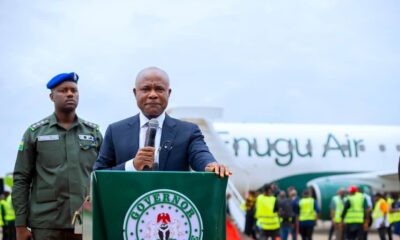
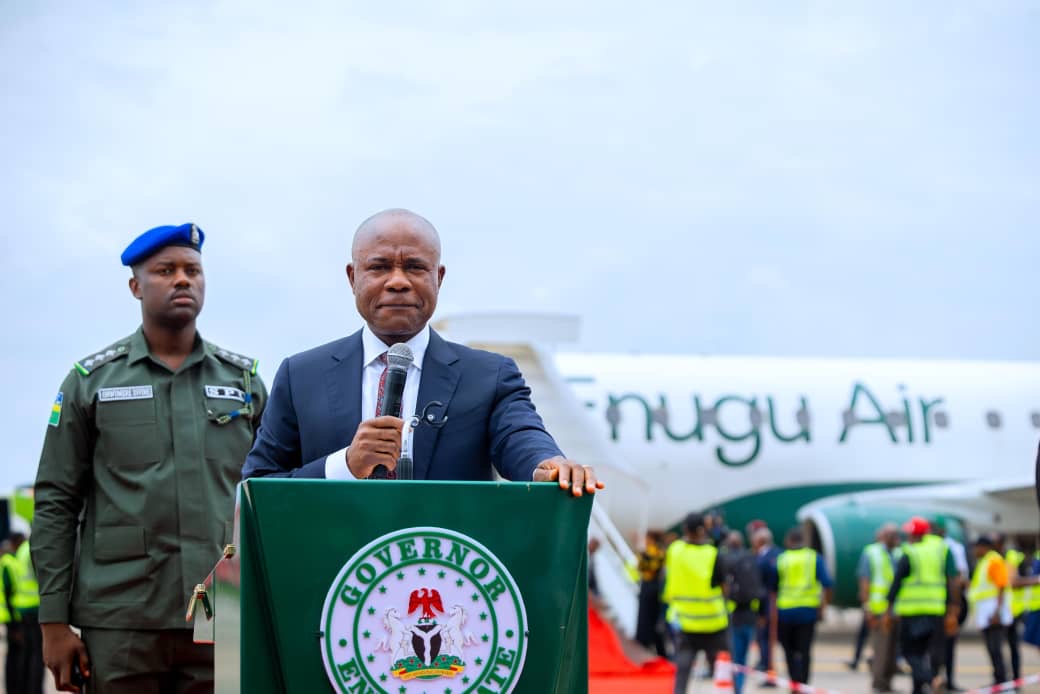
The Governor of Enugu State, Dr. Peter Mbah, has flagged off the first-ever international service by Enugu Air, describing it as a major milestone in his administration’s vision to grow Enugu State into a major aviation hub and make it the preferred destination for investment, business, tourism, and living.
Speaking at a brief ceremony at the Akanu Ibiam International Airport, Enugu, on Wednesday, Mbah, who heaped commendations on the leadership of the state-owned airline for the fast growth of Enugu Air, said it was not an isolated story, but a part of connecting the dots as his administration strives to grow Enugu State into a $30 billion economy.
“Months ago, right here, we watched Enugu take to the skies. In just barely six months after a rigorous regulatory process, Enugu Air obtained her Air Operator’s License. This is not a mean feat.
“Today, 14 months after, we can see that dream flying beyond our expectations, as Enugu Air is one of the fastest-growing airlines in Nigeria, without a doubt.
“But we did not conceive of Enugu Air as a bragging right or because of the clamour, or to gain some political acclaim. Enugu Air is part of the masterplan to make Enugu State the premier destination for investment, living, business and tourism. For us, Enugu Air is part of connecting the dots,” he stated.
Mbah described Enugu Air as a campaign promise kept, saying the Enugu–Douala service was the beginning of many more international flight operations to many parts of the world.
“What you are seeing here today is performance above promises. So, we ask you to judge us by the things we have promised and have delivered to you.
“Besides, today is Douala, but I am hoping tomorrow, we are not only going to be talking about the continent of Africa, we will be talking about Enugu to the world,” he added.
He thanked President Bola Tinubu “for consistently demonstrating his commitment to aviation infrastructure and for the support he is also giving to the states to enable us to create businesses like Enugu Air,” commending also the Minister of Aviation and Aerodrome Development, Festus Keyama, SAN; and the agencies under him such as the Federal Airports Authority of Nigeria (FAAN) and the Nigerian Civil Aviation Authority (NCAA) supporting Enugu Air’s growth and making Nigeria a standard bearer in the African aviation industry.
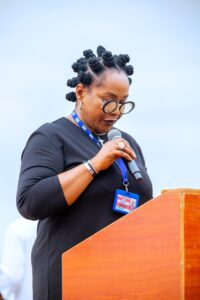
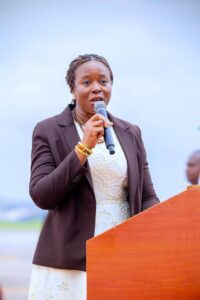
Speaking, Enugu Air CEO, Capt. Tolu Ita, said Enugu Air was not merely launching a flight, stressing, “we are launching a new chapter.”
“This is a chapter in which Enugu is no longer simply where a journey begins or ends. Enugu is becoming a gateway.
“Today, much bigger than an aircraft will be moving across our skies. Opportunity will be moving. Business will be moving. People will be moving. Ideas will be moving. And Enugu will be moving with them. This is what makes today so significant.
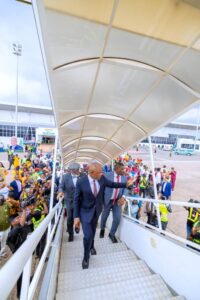
“Enugu Air was never built with the vision to simply put aircraft in the sky. The vision was to build an airline that connects people, connects markets and connects possibilities.
“We began by strengthening our domestic network — connecting Enugu with Lagos, Abuja, Port Harcourt, Kano, Owerri, Asaba, Benin City and Warri.
“Today, we take our first major step beyond Nigeria. Enugu to Douala. Nigeria to Cameroon. The Southeast to Central Africa. And this is only the beginning.
“Our ambition is to continue building a stronger regional network across Africa, while progressively opening the door to wider international markets,” she said.
In growing Enugu Air, Ita reaffirmed the airline’s responsibility and commitment to authorities, passengers, and all stakeholders, upholding the highest operational and ethical standards.
In her goodwill message, the Managing Director/CEO of the FAAN, Mrs. Olubunmi Onabanjo-Kuku, said Enugu Air’s inaugural international flight was “a strong statement of Nigeria’s growing capacity to connect7 people and businesses across West and Central Africa.”
Represented by Mrs. Onyeka Udenze, the7 FAAN DG said, “Akanu Ibiam International Airport now takes a firm step as a regional hub.”
While congratulating Enugu Air for the fast growth in 14 months, she assured that FAAN remained committed to providing the infrastructure, safety standards and support that make such services possible.
The DG of NCAA, represented by the Director of Air Transport Regulations, FAAN, Mrs. Olayinka Babaoye-Iruobe, said connecting Enugu to Douala directly represented would create opportunities for increased trade, investment, tourism, and movement of people, while strengthening social and economic ties between Nigeria and Cameroon.
In his welcome address, the Commissioner for Trade, Investment, and Industry, Dr. Sam Ogbu-Nwobodo, said the new service to Douala marked a monumental leap forward in the state’s trade, investment, and economic integration strategy.
“For decades, the vibrant traders, manufacturers, and entrepreneurs of Enugu and the broader region have navigated complex transit routes to access Central African markets.
“Today, that barrier is dismantled. This direct link directly advances our goal of transforming Enugu State into a premier regional hub for commerce and industrial development. We are now effectively bridging markets, shortening supply chains, and unlocking unprecedented opportunities for cross-border commerce across Central and West Africa,” he said.
The Maiden flight, which departed Akanu Ibiam International Airport in the early hours of the afternoon, touched down safely at the Douala International Airport where it was well received by the Cameroonian authorities in a brief ceremony before it returned to Enugu on the history trip.
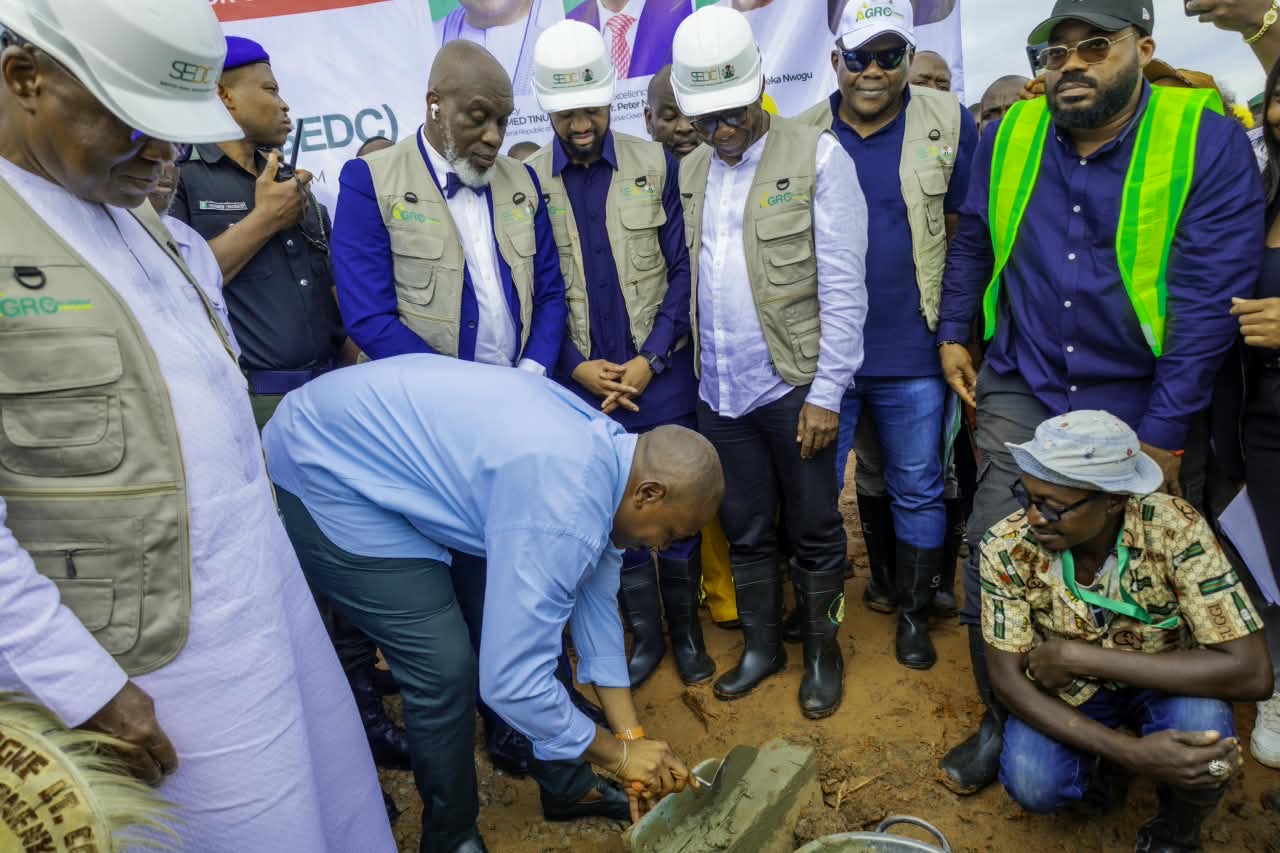
…As SEDC, Enugu begin development of 200-Hectare Integrated Model Farm at Nomeh Unateze
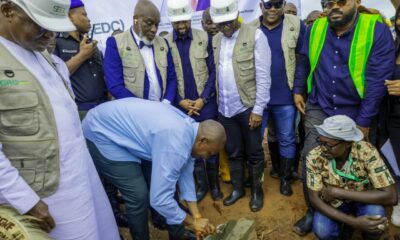
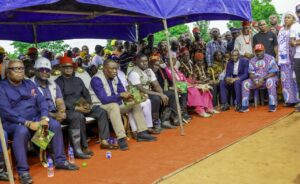
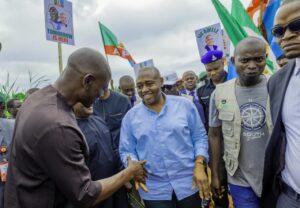
Governor of Enugu State, Dr. Peter Mbah, on Tuesday, officially flagged off the South East Agro-Development Programme (SEADP), a 200-hectare pilot integrated model farm by the South East Development Commission (SEDC) at Nomeh Unateze, Nkanu East Local Government Area (LGA) of Enugu State.
The historic event, which marks a significant transition from planning to physical implementation by the Commission, was witnessed by the Minister of Regional Development, Engr. Abubakar Momoh; Chairman of SEDC, Dr. Emeka Wogu; Managing Director/CEO of the Commission, Mr. Mark Okoye; Secretary to Enugu State Government, Prof. Chidiebere Onyia, as well as traditional and community leaders and other stakeholders, and community members.
Speaking, Governor Peter Mbah, who was represented by the Deputy Governor of Enugu State, Barr. Ifeanyi Ossai, described the project as an important example of what strategic collaboration between South East states and the Commission can achieve, particularly at a time when food production and economic diversification had become increasingly important.
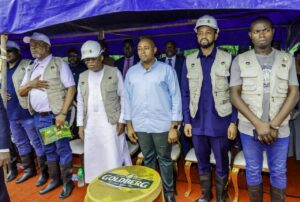
He noted that the Agro-Development Programme fitted perfectly into the state government’s decision to build 200-hectare modern farm estates in the 260 wards of the state, saying the state’s investment in agriculture connects perfectly with other government projects and the commitment to eradicate poverty in the state by 2031.
“When we invest hugely in education, when we invest hugely in expanding our road infrastructure, when we invest in security, health, and transportation, it is to create access to enable investors and partners like the SEDC to have access to land, have access to development opportunities.
“History has also taught us all over the world that communities, states and governments that invest in agriculture with a geometric progression are able to migrate their people faster from poverty to middle-class economy. And what the South East Development Commission is doing today is an example of one of those efforts and the result we can get working together. But that is not more.
“So, we believe that this project can become an important part of the economic development of not just Nomeh Unateze and Enugu East Senatorial Zone, but the entire South East region within the context of Nigeria,” he said, urging the people of Nomeh to also own the project.
The Managing Director/CEO of SEDC, Mr. Okoye, explained that the project was deliberately designed as a development project to redefine how the region approaches agriculture.
“The South East Agro-Development Programme is about building productive capacity of the region. We want to demonstrate what agriculture can look like when land, technology, mechanisation, production, processing, training and markets are brought together in one,” he stated.
Okoye said the project would ultimately be measured by its impact beyond the physical boundaries of the 200-hectare site, stating that the Nomeh Unateze project is intended as a starting point and practical template for the Commission’s wider agricultural and agro-mechanisation interventions across the five states of the South East.
“The real impact is what happens around the farm and beyond the farm. It is the young person who acquires a practical skill here and starts a farm elsewhere; the farmer who supplies maize or soya to the feed mill; the dairy farmer who gets technical support and access to a reliable market, and the smallholder farmer who is able to increase production because the ecosystem around them has improved,” he said.
He commended Governor Mbah for his visionary and proactive approach to governance, also expressing his pleasure at the uncommon level of buy-in and support so far demonstrated by Nomeh Unateze.
Speaking on behalf of the Federal Government, the Minister of Regional Development, Engr. Momoh, said the objective of the project transcended mere food production.
“We must build an agricultural system that is productive, resilient and capable of creating value across the entire chain. We must produce. We must process. We must create markets. We must reduce post-harvest losses. We must improve productivity and incomes. And we must create opportunities for young Nigerians to participate meaningfully in modern agriculture,” he emphasised.
Chairman of the SEDC, Dr. Wogu, assured that the Commission would continue to work with state governments and other stakeholders to ensure that SEDC’s interventions complement existing development efforts.
“Regional development requires partnership. The Commission cannot and should not work in isolation from the state governments, communities, the private sector and development partners. Our responsibility is to create platforms that connect these stakeholders around opportunities that can generate sustainable economic value for the people of the South East,” he stated.
Speaking on behalf of the community, President General of Nomeh Unataeze, Dr. Chukwudi Anyianuka, described the project as a restoration of the glory of the community, assuring the total community support and ownership of the project.
“We welcome this project because we see it as an investment in the future of Nomeh and our people. Our community understands that a project of this scale requires cooperation, responsibility and a shared commitment to its success. We are ready to work with SEDC, the state government, contractors, investors, and all the partners involved to ensure that the project delivers the opportunities that our young people, farmers and community deserve,” he said.
Community leader and media aide to Enugu State Governor Mbah appreciated President Bola Tinubu for answering the age-long prayers of the people of the South East through the creation of the SEDC to coordinate and speed up the region’s development post-civil war.
“Now our place as the host of the pilot project of the SEDC is not lost on us. Because we play the politics of development, our gratitude will translate to votes for President Tinubu, our Governor, and the APC come 2027,” Anichukwu assured.
The Executive Director, Natural Resources, Agriculture, and Rural Development (NRARD) at the SEDC, Dr. Clifford Ogbede, reiterated the Commission’s commitment to reviving the agro-industrial revolution that placed the defunct Eastern Region as the fastest-growing economy between 1954 and 1964, courtesy of the late Dr. Michael Okpara’s visionary leadership.
The African Democratic Congress has described the continued absence of President Bola Ahmed Tinubu, while Vice-President Kashim Shettima is also outside Nigeria, as a dangerous disregard for the Constitution.
The party, in a statement by Mallam Bolaji Abdullahi, the ADC National Publicity Secretary, said that Section 145 of the Constitution requires the President, when proceeding on vacation for a period of up to 21 days, to transmit a written declaration to the President of the Senate and the Speaker of the House of Representatives, after which the Vice-President performs the functions of Acting President.
“President Tinubu left Nigeria on 30 August and has now been away for more than 21 days. We therefore demand to know whether the required declaration was transmitted by the President. If he did not, we would like to know why the National Assembly has ignored Section 145 of the Constitution,” the ADC said.
The opposition party also rejected the Presidency’s explanation that the President was on a “working vacation” or that the Secretary to the Government of the Federation, Senator George Akume, would represent President Tinubu at official events, dismissing it as “an absurdity that raises more questions than it answers.”
“Representing the President at events and ceremonies does not confer constitutional powers. The Secretary to the Government of the Federation is a mere appointee of the President. He may attend events or deliver speeches on the President’s behalf, but he cannot exercise the constitutional powers of the President or Acting President,” the party said.
Shettima arrives New York for UN general assembly
Vice President Kashim Shettima is received on arrival in New York by Lagos State Governor Babajide Sanwo-Olu, Minister of Foreign Affairs Ambassador Bianca Odumegwu-Ojukwu, Deputy Chief of Staff to the President (Office of the Vice President) Senator Ibrahim Hassan Hadejia, Minister of Women Affairs Imaan Sulaiman-Ibrahim, Minister of Solid Minerals Development Dele Alake, Nigeria’s Permanent Representative to the UN Ambassador Jimoh Ibrahim, and other officials.
“Representation is not governance. Attendance at official functions is not presidential authority. Nigeria cannot be governed through ceremonial proxies, telephone calls and press statements issued from foreign capitals.”
The party added that the claim that the President has continued to direct national affairs from abroad only “compounds the absurdity”, saying that a so-called “working vacation” does not remove the President’s constitutional obligations under Section 145.
“There is no constitutional category known as a ‘working vacation’. Presidential authority cannot be transferred by convenience, protocol or press statement. Nigeria is a constitutional democracy, not a private enterprise to be managed remotely from a holiday destination.”
The ADC said it was particularly troubling that the President and Vice-President were simultaneously absent while Nigerians confronted worsening insecurity, unemployment and an unbearable cost-of-living crisis.
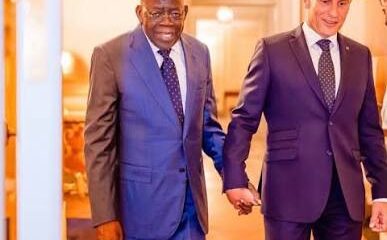
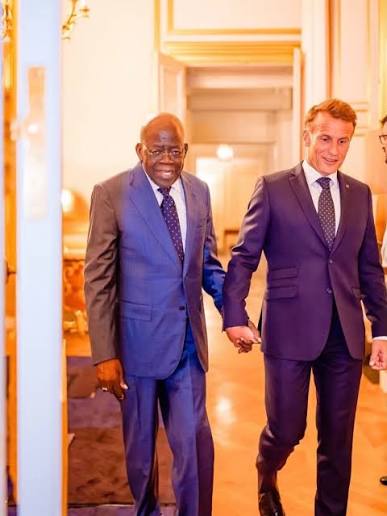
In a similar vein, the ADC also described as a “national disgrace” the fact that President Emmanuel Macron of France is in New York attending the United Nations General Assembly, while President Tinubu is vacationing in Paris, the capital of France.
“The irony would be amusing if it were not a national disgrace. At a time when world leaders are advancing their countries’ interests at the United Nations General Assembly, Nigeria’s President is holed up in the French capital while his host has left to pursue his own country’s national interest.
“President Tinubu cannot be vacationing in Paris while President Macron is in New York representing France and expect Nigerians to accept that it is okay for their President to continue to hang around in a country after the host has left to attend to more important things. This is not merely poor optics. It is a national embarrassment.”
The party called on the Presidency and the National Assembly to provide a direct answer to one question:
“Who presently exercises the constitutional powers of the President of the Federal Republic of Nigeria, and under what provision of the Constitution?”
-
 Politics2 days ago
WHEN PRIVACY BECOMES CONTENT: The Dangerous Normalisation of Leaked Private Conversations
-
News2 days ago
UK excludes Nigerian, Ghanaian-trained teachers from teaching qualification list
-
News2 days ago
BREAKING: Gov Mbah appoints 101 new aides
-
Opinion2 days ago
Who is in Charge of Nigeria?
-
Business2 days ago
Enugu Air Launches New Website
-
News3 days ago
Flood Alert: 8,000 communities, 4,500 schools at risk – FG
-
News21 hours ago
Nigerian cleric flees after body found buried in Cameroon church
-
Politics3 days ago
APC’s 12.9m membership claim fraud, says ADC group