News
Alleged £1.87m Fraud: UK set to deport Nigerian Pastor, Tobi Adegboyega


A Nigerian pastor whose church was shut down over an alleged £1.87 million fraud has lost his fight against deportation, despite claiming it would breach his human rights.
An immigration tribunal has ruled that Tobi Adegboyega, 44, the cousin of John Boyega, the Star Wars actor, should be deported back to his native Nigeria after investigations, including by The Telegraph, exposed misuse of funds by his church.

Mr Adegboyega was head of SPAC Nation, a controversial church shut down after failing to properly account for more than £1.87 million of outgoings and operating with lack of transparency.
He claimed deportation would breach his right under the European Convention of Human Rights (ECHR) to a family life – having married a British woman.
He also said the attempt to remove him by the Home Office failed to take account of his community work with SPAC.

Describing a “charismatic” community leader of a large, well-organised church, his legal team claimed that he had “intervened in the lives of many hundreds of young people, predominantly from the black communities in London, to lead them away from trouble”.
He claimed his work had been “lauded” by politicians including Boris Johnson and senior figures within the Metropolitan Police, although no testimony by them was submitted to the court. He said that without his personal presence in London, projects that he had masterminded would fall apart or reduce in size.
However, the tribunal was told the Home Office contended “all is not as it seems”.
“Various manifestations of [Mr Adegboyega’s] church have been closed down, by either the Charity Commission or the High Court, because of concerns over its finances and lack of transparency,” according to the judgment.
‘Selling their own blood’
“Former members of the church have alleged that it is a cult, in which impoverished young people are encouraged to do anything they can to donate money, including taking out large loans, committing benefit fraud and even selling their own blood.
“It is alleged that the church leadership lead lavish lifestyles and there have, it is said, been instances of abuse. The [Home Office’s] case before us was that all of this needs to be taken into account when evaluating whether [Mr Adegboyega] is in fact of real value to the UK.”
Mr Adegboyega has lived in the UK unlawfully since overstaying on a visitor’s visa that allowed him to enter Britain in 2005. In 2019, he applied for leave to remain under ECHR’s right to a family life. His application was initially dismissed by a first-tier immigration tribunal before he appealed. In the tribunal, he maintained no one had ever faced criminal charges over his church’s finances, that many of the attacks on him and SPAC Nation were politically motivated and that claims it was a cult were unfounded.
However, the tribunal was told the Charity Commission concluded “there had been serious misconduct and/or mismanagement in the administration of the charity which was sustained over a substantial period of time”.
The tribunal also found Mr Adegboyega’s evidence to be “hyperbolic in many instances” and had “sought to grossly inflate his influence”.
“We find it to be implausible that he has the time to undertake all of this work personally,” it said.
The tribunal concluded: “We are not satisfied that the good work that SPAC Nation undertakes generally would collapse or even significantly suffer should the Appellant be required to leave the UK.
“Weighing all of the foregoing in the balance we conclude that the decision to refuse leave to remain was wholly proportionate.
“[Mr Adegboyega] seeks to rely on family and private life relationships, all of which have been established whilst he was in the UK unlawfully, and which would survive his return to Nigeria.



News
Court Orders Interior Minister Tunji-Ojo to Respond to Suit Seeking Release of His NYSC Records
The Federal High Court in Abuja on Monday ordered the Minister of Interior, Olubunmi Tunji-Ojo, to respond to a suit seeking to compel the release of records of his National Youth Service Corps (NYSC) scheme.
Justice Salim Ibrahim gave the order when the matter came up for hearing.
The Incorporated Trustees of Pathway to Equity and Charity Foundation had filed the suit, marked FHC/ABJ/CS/1812/2026.
The group prayed the court to compel the NYSC to disclose documents supporting the minister’s claim that he completed the mandatory one-year national service.
The foundation also sought an order of mandamus directing the Federal Capital Territory Administration (FCTA), the 2nd respondent, to produce records showing that the minister did his primary assignment at the FCTA.
When the case was called, counsel to the applicant, Chief Solomon Akuma, SAN, told the court he was ready to proceed with the hearing.
However, Abiola Olaniji, who appeared for the minister, said he had filed an application for Tunji-Ojo to be joined as the 3rd respondent.
Olaniji said the applicant (foundation) had responded with a counter affidavit raising serious issues, to which he needed time to reply.
The lawyer stated that the minister was ready to take part in the proceedings as an interested party.
But Akuma opposed the application, arguing that the minister was not a proper party.
He said the suit only sought an order of mandamus compelling the respondents (NYSC and FCTA) to produce documents that are not in the minister’s custody.
Justice Ibrahim directed the minister to file and serve his reply to the applicant’s counter affidavit, which opposed his application to be joined as a party in the suit before the next hearing date.
The judge then adjourned the matter until Oct. 18 for hearing.
The applicant had sought from the NYSC the mobilisation or call-up letter issued to Tunji-Ojo in 2006 or any other year; the posting letter to the FCTA in 2006 or any other year; and his application for mobilisation.
It also sought the evidence of approval of his remobilisation by the NYSC’s Director-General; evidence of payment of allowances to him; the record of his Community Development Service and his discharge certificate.
The foundation equally sought from the FCTA, the mobilisation or call-up letter, the posting letter, his attendance record during the service year, evidence of any allowance paid to him, among others.
It said the application was brought under Section 14 of the Federal High Court Act, Order 34 Rules 1, 2 and 5 of the Federal High Court (Civil Procedure) Rules 2019.
It also cited Sections 20, 21 and 25 of the Freedom of Information (FOI) Act, 2011.
(NAN)

The presidential candidate of the Nigeria Democratic Congress, Peter Obi, has advised Nigerians residing in the United Kingdom to stop sending money to people who seek financial help at home.
Obi also advised them to urge their relatives to vote for productive leaders.
He made the remarks at a town hall meeting with diaspora supporters in Manchester, United Kingdom, on Sunday.
He stressed that Nigeria’s prevailing economic hardship resulted from bad leadership, arguing that continuous financial assistance only cushions the effects of poor governance without addressing the root causes.
“You have people at home in Nigeria today who are begging you for money. Tell them no!” he said.
The former Anambra State governor insisted that his record in public office distinguished him from other governors, claiming none of them matched his achievements in saving public funds.
“I’m not saying I’m a saint, but I saved money. I’ve not seen one governor who has saved 10 per cent of what I saved. No governor has done it.
“Let’s start with this one that is less corrupt. That’s how other countries change.”
He maintained that his conversations with the people reinforced the need for collective responsibility, stressing that building a new Nigeria would require citizens to take an active role in addressing challenges facing the country.
Obi also urged Nigerians to take the 2027 election seriously, describing the contest as a critical moment for the nation.
Contrary to false and misleading reports on social media that a Federal High Court (FHC) sitting in Abuja had nullified the N150 million fee prescribed by the Enugu State Structures for Signage and Advertisement Agency (ENSSAA) for political campaign billboards, findings have revealed that the court actually ruled in favour of the agency, upholding its powers to prescribe the fee.
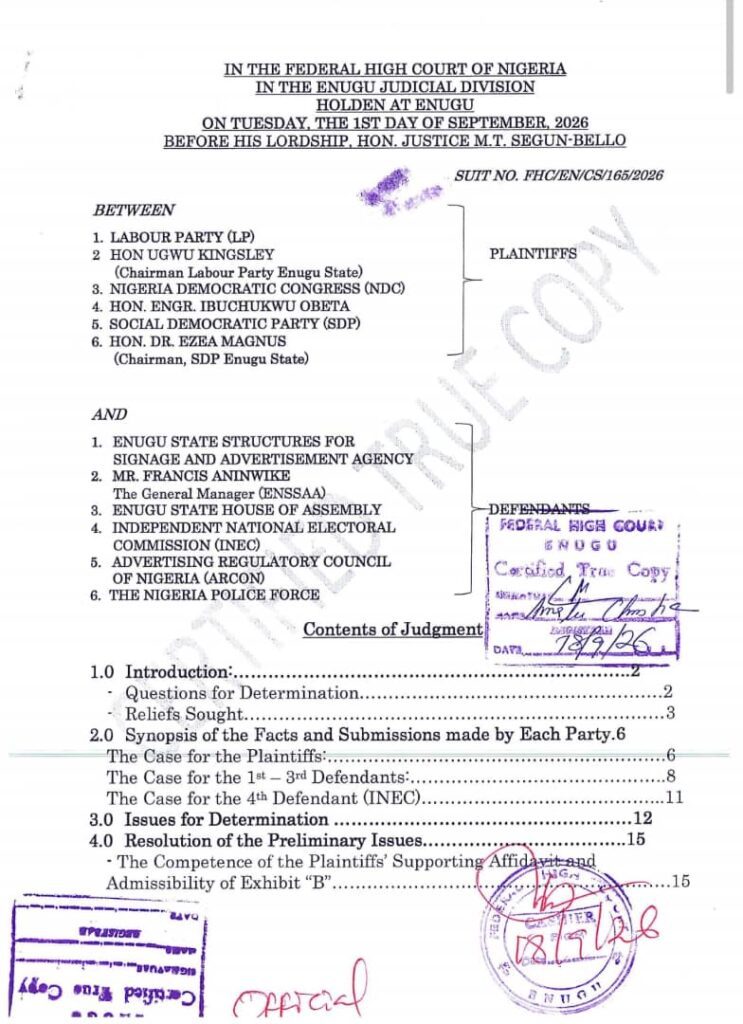
According to a certified true copy (CTC) of a judgment of FHC sitting in Enugu, the court had on September 1, 2026, dismissed a suit by opposition parties and figures challenging ENSSAA’s authority to impose a mandatory N150 million fee on each political party seeking to erect campaign billboards or display posters ahead of the 2027 general election.
The judgment rendered by Justice Mabel Segun-Bello held that it was within the legislative competence of the Enugu State House of Assembly to make laws on outdoor advertising and for ENSSAA to exercise powers donated to it by state law.
The suit marked FHC/EN/CS/165/2026 had the Labour Party; Chairman of the Labour Party (LP) in Enugu, Hon. Kingsley Ugwu; Nigeria Democratic Congress (NDC); NDC factional state Chairman, Engr. Ibuchukwu Obetta; the Social Democratic Party (SDP) and its state Chairman, Hon. Magnus Ezea, as plaintiffs, while ENSSAA; its General Manager, Mr. Francis Aninwike; the Enugu State House of Assembly; Independent National Electoral Commission (INEC); Advertising Regulatory Council of Nigeria (ARCON); and Nigeria Police Force were the respondents or defendants.
The plaintiffs had in June 2026 approached the court seeking a declaration that, by virtue of Sections 99 (1) and (2) of the Electoral Act, 2026, and Section 153 of the 1999 Constitution, which donated exclusive powers to INEC to regulate electoral campaigns of political parties in Nigeria, it was ultra vires the powers of ENSSAA and its General Manager to make executive decisions and publications imposing a mandatory payment of N150 million by political parties and their candidates in the state as an advertisement permit fee for the placement of billboards for the council election and the 2027 election.
They equally sought a declaration by the court that it was unlawful and ultra vires the legislative powers of the Enugu State House of Assembly to make laws regulating the advertisement of political campaigns in the state.
Consequently, the plaintiffs sought an order of the court setting aside the mandatory N150 million fee, as well as an injunction restraining the agency and its GM, the Enugu State Government, its agents and representatives from enforcing ENSSAA’s executive directive.
They finally sought an order of the court mandating the Nigeria Police Force to protect political parties in Enugu State against possible harassment for the placement of billboards and posters for the council election and the 2027 elections.
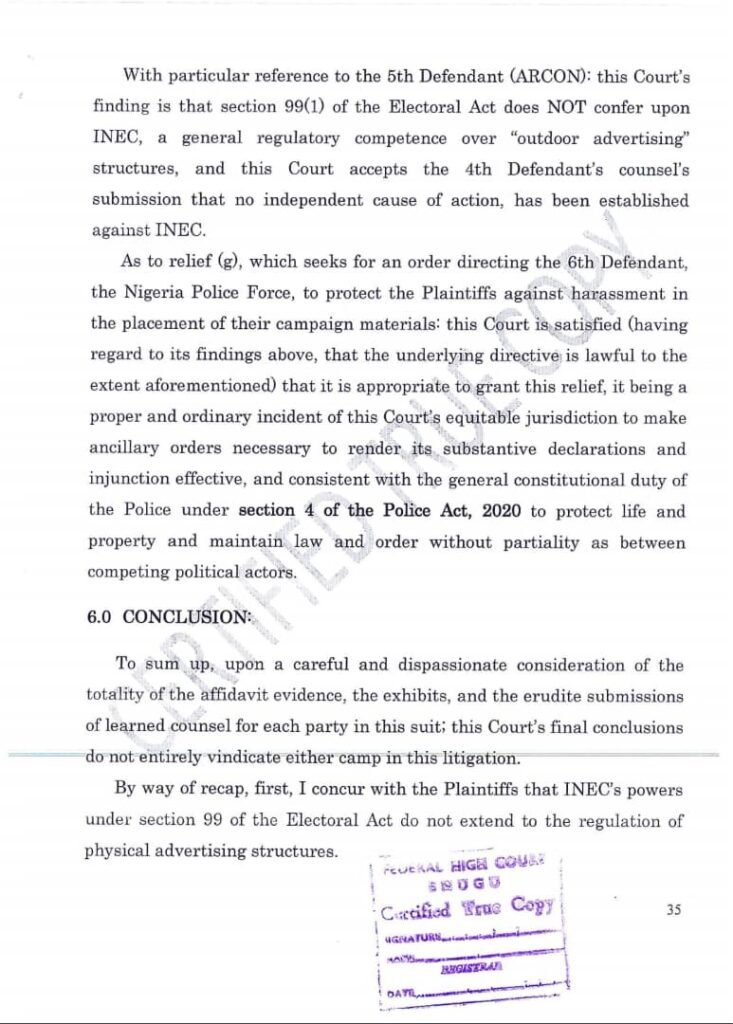
However, delivering her judgment in September, after a careful consideration of the totality of the affidavit evidence, the exhibits, and submissions by both parties, the presiding judge, Justice Mabel Segun-Bello, held, among other things, that the National Assembly does not hold exclusive legislative powers over outdoor advertising.
“I accede to the 1st, 2nd and 3rd Defendants’ contention that the subject matter of ‘outdoor advertising’ is NOT reserved exclusively to the National Assembly or to ARCON.
“Rather, ‘outdoor advertising’ falls within the purview of the primary functions of the Local Government, which may (where properly delegated) be validly exercised by a State agency such as the 1st Defendant (ENSSAA).
“Third, I am satisfied that on the basis of the evidence before this Court, the 1st Defendant has established it had a validly delegated authority to issue the directive it gave on 9th February, 2026, for the regulation of advertisement of political campaigns,” she stated.
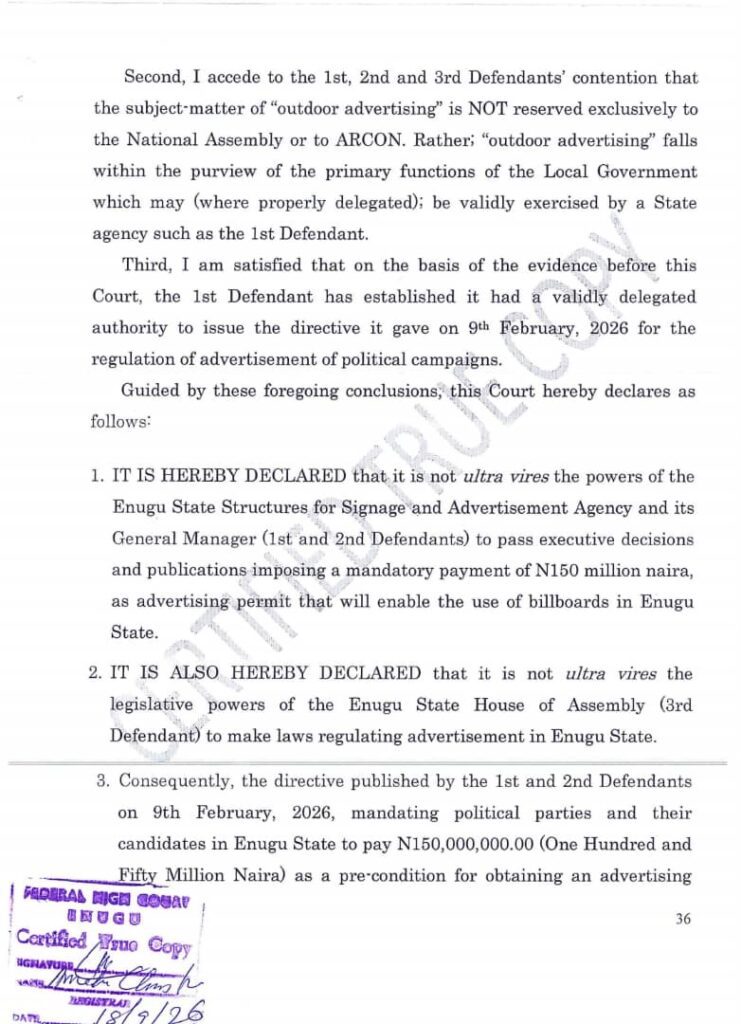
Guided by these foregoing conclusions, Justice Segun-Bello held that “it is not ultra vires the powers of the Enugu State Structures for Signage and Advertisement Agency and its General Manager (1st and 2nd Defendants) to pass executive decisions and publications imposing a mandatory payment of N150 million naira, as advertising permit that will enable the use of billboards in Enugu State.”
Continuing, she said, “It is also hereby declared that it is not ultra vires the legislative powers of the Enugu State House of Assembly (3rd Defendant) to make laws regulating advertisement in Enugu State.
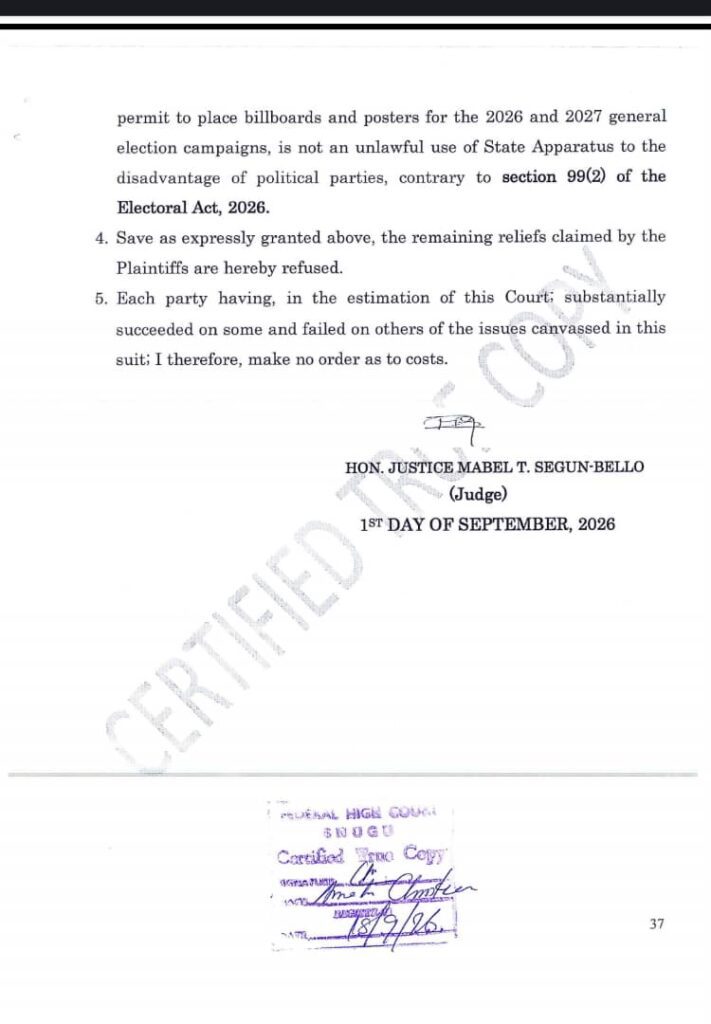
“Consequently, the directive published by the 1st and 2nd Defendants on 9th February, 2026, mandating political parties and their candidates in Enugu State to pay N150,000,000.00 (One Hundred and Fifty Million Naira) as a pre-condition for obtaining an advertising permit to place billboards and posters for the 2026 and 2027 general election campaigns, is not an unlawful use of State Apparatus to the disadvantage of political parties, contrary to Section 99(2) of the Electoral Act, 2026.
“Save as expressly granted above, the remaining reliefs claimed by the Plaintiffs are hereby refused.”
Meanwhile, the Enugu State Government says that unlike the practice in most states, the N150 million fee is for each political party, not for candidates, as misrepresented on social media and by some commentators.
The Secretary to the State Government, Prof. Chidiebere Onyia, made the clarification recently while fielding questions from Government House correspondents in Enugu, adding that there was no court judgment on the fee by any FHC in Abuja, as falsely circulated.
In a related development, finding show that the Abia State Structures for Signage and Advertising Agency (ABSSAA) prescribed feea for candidates ranging from N20 million for State House of Assembly candidates to N200 million for presidential candidates.
Imo State fees range from N3.55 million for each House of Representatives candidate to N55 million for each governorship candidate, while the permit fees range from N300,000 for local council candidates to N150 million for presidential candidates.
The campaign permit fee ranges from N100,000 for each councillorship candidate to N50 million for each presidential candidate, while Kwara State fixed its fees at N2 million for each House of Assembly candidate and N100 million for presidential candidates.
The Certified True Copy of the Court Judgement :
-
 Faith2 days ago
Awka Anglican Diocese Rejects Ibezim’s Suspension, Threatens to Leave Church of Nigeria
-
News2 days ago
BREAKING: Mbah Extends Enugu Movement Restriction to 10pm, Scraps Keke Ticketing
-
News13 hours ago
JUST IN: Former Delta Governor, Uduaghan, dies
-
Politics2 days ago
Nigeria’s Weak Opposition and the Cost of One-Party Dominance: Can the Opposition Rebuild Before 2027?
-
News2 days ago
2027: Keke Riders Endorse Mbah, Tinubu
-
News1 day ago
Corruption turning Nigerian Courts to ‘market stalls’ — Retired Justice Augie
-
News1 day ago
Catholic priest dies as crucifix falls on him during Mass
-
News13 hours ago
Federal High Court Upholds ENSSAA’s N150m Political Campaign Billboard Fee, CTC Reveals