
The Enugu State Internal Revenue Service (ESIRS) has disowned a purported property tax notice circulating across the state. It described the publication as fraudulent and unauthorised.
The document reportedly contains property classifications, corresponding levies, payment instructions and threats of enforcement. However, the agency insists that it did not issue or approve the notice.

In a public disclaimer dated November 20, 2026, ESIRS said the publication carried the title, “Categories of Properties and Their Various Levies.”

The disclaimer bears reference number ENS/BIR/EC/2026/11/126. The agency’s Executive Chairman, Emmanuel Ekene Nnamani, signed the statement.

According to ESIRS, the document has circulated publicly as though it were an official communication from the state revenue authority.
The agency expressed concern that the publication contains monetary demands and purported bank account details. It warned that unsuspecting residents could suffer financial losses by acting on the information.
ESIRS Disowns Circulating Property Tax Notice
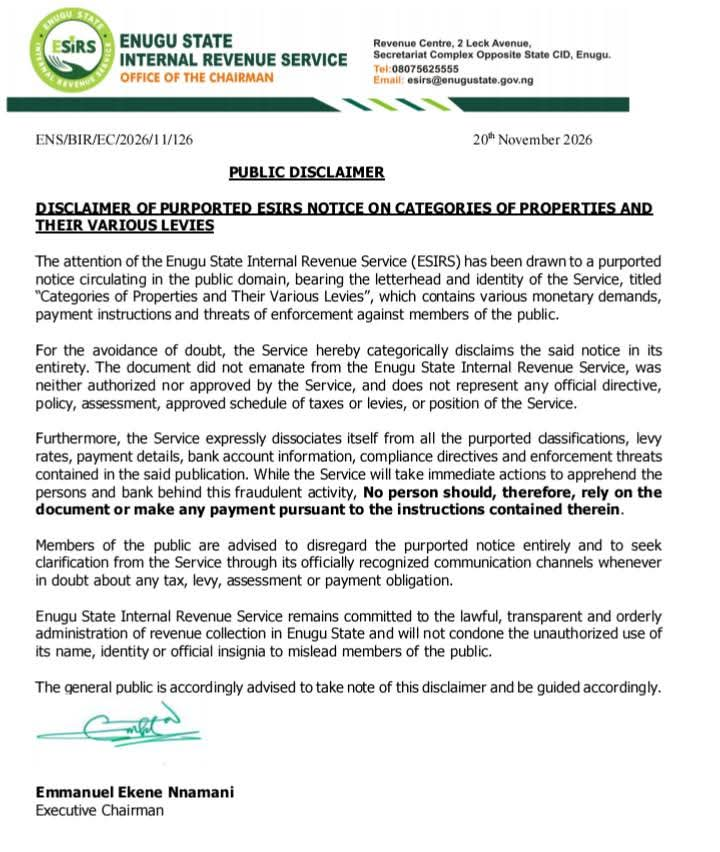
Clarifying its position, the revenue agency rejected the entire publication. It stressed that nobody should treat its contents as an official government directive or revenue policy.
ESIRS specifically distanced itself from the property classifications, levy rates and payment instructions. It also rejected the bank account details, compliance directives and enforcement threats.
The agency explained that the document does not represent any official assessment or approved tax schedule. It also does not reflect any established position of the Service.
“For the avoidance of doubt, the Service hereby categorically disclaims the said notice in its entirety,” the statement read.
The clarification follows recent public discussions about taxation and revenue administration in Enugu. ESIRS recently addressed tax exemptions under Nigeria’s new tax laws in its explanation of protections for low-income earners.
Meanwhile, the state’s revenue figures have attracted public attention. The latest NBS figures on Enugu’s tax revenue-to-IGR ratio provides further context for the ongoing discussions.
Residents Warned Against Making Payments
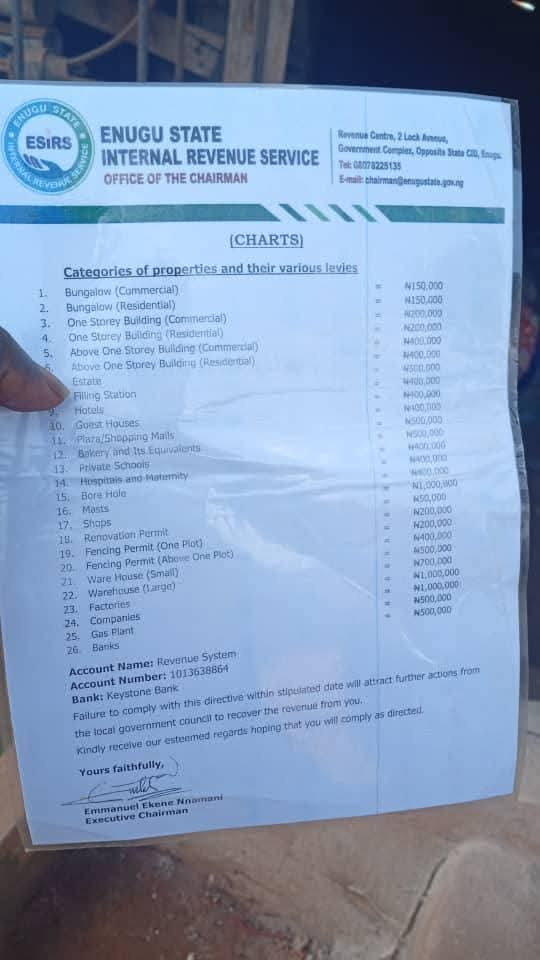
ESIRS warned residents, property owners and other members of the public against relying on the purported notice. It also advised them not to make payments based on its instructions.
The agency cautioned that anyone who follows the document could fall victim to fraudulent activity. It particularly highlighted the purported bank account details and financial demands.
“No person should, therefore, rely on the document or make any payment pursuant to the instructions contained therein,” the disclaimer stated.
Furthermore, ESIRS urged residents to disregard the publication entirely. It advised them to seek clarification through its recognised communication channels whenever they have questions about taxes, levies or assessments.
The warning comes amid wider conversations about revenue collection and government charges. ESIRS Chairman Emmanuel Nnamani previously clarified the revised payment structure for commercial tricycle operators following the state government’s Keke e-ticket reduction.
The state government has also addressed public concerns about transport-related collections. It previously denied reports of a tax protest by transport operators.
ESIRS Moves Against Those Behind Fake Notice
Meanwhile, the revenue agency said it would take immediate steps to apprehend those responsible for circulating the purported notice.
It warned against the unauthorised use of its name, identity or official insignia. According to the Service, such actions could mislead residents and create confusion around revenue administration.
ESIRS described the development as an attempt to undermine public confidence in its operations. It also reiterated its commitment to lawful and transparent revenue collection.
The agency’s position comes as Enugu continues to pursue reforms in its revenue administration. The state government has highlighted fiscal reforms and development initiatives aimed at strengthening public institutions and accountability.
Governor Peter Mbah’s administration has also identified revenue automation as part of its wider economic strategy. The government outlined several reforms in its development scorecard and economic growth agenda.
Service Reaffirms Commitment to Transparent Revenue Administration
ESIRS assured residents that legitimate revenue collection would continue under approved policies and procedures. It maintained that the Service would follow due process in all its operations.
The agency urged the public to remain vigilant against unofficial publications. It specifically warned residents about documents that claim to introduce new taxes, property levies or payment obligations.
It also advised residents to verify every revenue-related demand directly with the Service before making payments. This is particularly important when demands contain unfamiliar bank details or threats of enforcement.
Property-related charges and housing regulations have also featured in recent state policy discussions. The Enugu State House of Assembly recently passed a tenancy bill proposing limits on agency fees and rent increases.
The November 20 disclaimer was signed by Nnamani in his capacity as Executive Chairman of the Enugu State Internal Revenue Service.