
News
CBN redesigns Naira to take control of currency in circulation

• Redesign to displace Naira hoarders • 200, 500 1000 notes affected
The Central Bank Governor, Godwin Emefiele, has said that the apex bank would redesign the country’s currency.

Emefiele, who announced this at a press briefing in Abuja, this afternoon, said that the exercise would affect the the highest denominations: 200, 500, 1000 notes.

He said that the action was taken in order to take control of the currency in circulation.

According to him, the bulk of the nation’s currency notes were outside bank vaults and that the CBN would not allow the situation to continue.
Mr. Emefiele said that the new notes will be released for public use on December 15, 2022.
He also said that the old notes and the new notes would circulate together until January 31, 2023 when the old notes would cease to be legal tender.
Gov Emefiele said that there have been persisting concerns with the management of current series of banknotes, and currency in circulation, particularly those outside the banking system in thecountry.
He said, “As you all may be aware, currency management is a key function of the Central Bank of Nigeria, as enshrined in Section 2 (b) of the CBN Act 2007. Indeed, the integrity of a local legal tender, the efficiency of its supply, as well as its efficacy in the conduct of monetary policy are some of the hallmarks of a great Central Bank.
“In recent times, however, currency management has faced several daunting challenges that have continued to grow in scale and sophistication with attendant and unintended consequences for the integrity of both the CBN and the country.”
The challenges he said included hoarding of banknotes by members of the public, with statistics showing that over 80 percent of currency in circulation was outside the vaults of commercial banks.
He added that the worsening shortage of clean and fit banknotes with attendant negative perception of the CBN and increased risk to financial stability as well as, increasing ease and risk of counterfeiting evidenced by several security reports were reasons for redesigning the notes.
He said that recent development in photographic technology and advancements in printing devices have made counterfeiting relatively easier and that in recent years, the CBN has recorded significantly higher rates of counterfeiting especially at the higher denominations of N500 and N1,000 banknotes.
The CBN boss noted that although global best practice was for central banks to redesign, produce and circulate new local legal tender every 5–8 years, the Naira has not been redesigned in the last 20 years.
He said, “On the basis of these trends, problems, and facts, and in line with Sections 19, Subsections a and b of the CBN Act 2007, the Management of the CBN sought and obtained the approval of President Muhammadu Buhari to redesign, produce, and circulate new series of banknotes at N200, N500, and N1,000 levels.
“In line with this approval, we have finalized arrangements for the new currency to begin circulation from December 15, 2022. The new and existing currencies shall remain legal tender and circulate together until January 31, 2023 when the existing currencies shall seize to be legal tender.
“Accordingly, all Deposit Money Banks currently holding the existing denominations of the currency may begin returning these notes back to the CBN effective immediately. The newly designed currency will be released to the banks in the order of First-come-First-serve basis.
“Customers of banks are enjoined to begin paying into their bank accounts the existing currency to enable them withdraw the new banknotes once circulation begins in mid-December 2022. All banks are therefore expected to keep open, their currency processing centers from Monday to Saturday so as to accommodate all cash that will be returned by their customers.
“For the purpose of this transition from existing to new notes, bank charges for cash deposits are hereby suspended with immediate effect. Therefore, DMBs are to note that no bank customer shall bear any charges for cash returned/paid into their accounts.
“Members of the public are to please note that the present notes remain legal tender and should not be rejected as a means of exchange for purchase of goods and services.”
The governor said that his team was mindful of those in rural areas and that facilities would be provided for them where bank accounts could be opened for them or their old notes exchanged for the new ones.
He added that the action would also raised its stake in addressing the challenge of inflation.
Reminded that the current regulation allows only N150, 000 free cash deposit, he said that even if a customer wanted to deposit N 1 billion, the person would be allowed to do so.
Mr. Emefiele assured that the CBN would continue to monitor both the financial system in particular, and the economy in general, and always act in good faith for the achievement of the Bank’s objectives and the betterment of the country.
There has been claims even by top government officials that some unscrupulous members of the society were hoarding large volumes of currency notes in warehouse, farms, septic tanks.
Very dirty and smelly Naira notes have been in circulation, especially since political activities heightened across the country.



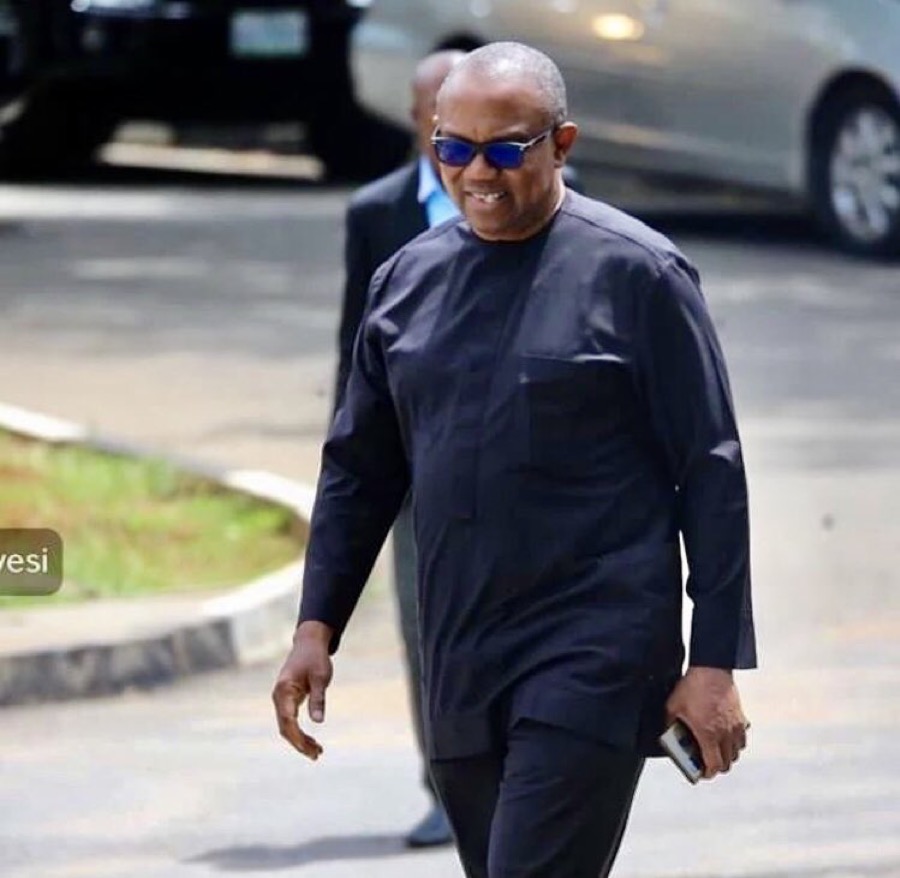
The presidential candidate of the Nigeria Democratic Congress (NDC), Peter Obi, has expressed concern over the worsening security situation in Nigeria, saying he enjoys greater freedom to move around in the United Kingdom than in his home country.
Obi made the remarks while speaking at the Global Peter Obi Supporters Summit in Abuja.
He recalled his experience living in the UK, where he shared a neighbourhood with the Mayor of London and could freely walk on the streets or travel by train without security concerns.
According to him, the situation is markedly different in Nigeria, where even stepping out of his home for a routine jog has become a security concern.
“I lived in the UK, and on the same street where I lived, I shared the neighbourhood with the Mayor of London. We walked on the streets and took the train together,” he said.
The former Anambra State governor lamented that he could no longer enjoy the same freedom in Nigeria, despite living in Ikoyi, one of Lagos State’s affluent neighbourhoods.
He also recalled his younger days in Lagos during the 1980s and 1990s, when he could walk to church without fear of being attacked.
Obi questioned how Nigeria had deteriorated to a point where citizens could no longer safely take walks outside their homes.
He said his experience highlighted the growing insecurity across the country and the challenges Nigerians face in their daily lives.
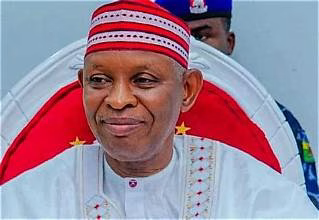
Kano State Governor, Abba Kabir Yusuf, has provided further details about his marital crisis, recounting how his relationship with his wife, Zainab Musa Kwankwaso, became strained.
In an interview with the BBC Hausa Service, Yusuf spoke at length about the circumstances surrounding the breakdown of his marriage to Zainab, a niece of former Kano State Governor and National Democratic Congress (NDC) vice-presidential candidate, Rabiu Musa Kwankwaso.
The governor had earlier made some remarks about the crisis on Monday during a meeting with pensioners at the Kano State Government House.
“Matters concerning the family are extremely difficult,” Yusuf said.
“This woman, Zainab, is his (Kwankwaso’s) niece. He arranged her marriage, but that marriage did not last long. Later, by God’s arrangement, we met and got married about 20 years ago, and we have children together.
“Many things happened, to the extent that her belongings were moved out of my house and she was taken away from my home. Throughout all this, I remained patient and did not say anything.”
Yusuf further disclosed that he had assured their children that their mother would eventually return home.
However, he said he was taken aback when he discovered that his wife had instituted legal proceedings against him in Abuja rather than Kano.
“Suddenly, I was shocked to find that she had taken me to court, and not just any court, but one in Abuja, not Kano,” he said.
The governor described the development as unpleasant.
Although he declined to publicly disclose the full circumstances surrounding his wife’s departure from their matrimonial home, he insisted that he had witnesses and detailed knowledge of how the incident happened.
According to him, the matter should not have generated so much controversy, noting that similar situations were not unusual.
Explaining why he decided to speak publicly about the crisis, Yusuf said he was not the person who introduced politics into the matter.
“I was not the one who politicised the matter. If something like this happened to you, would you be happy?” he asked.
“Imagine your family’s belongings being moved out without your knowledge, your wife being taken away from your home without your knowledge, and being taken to another man’s house without your knowledge, only for you to suddenly discover that she is the one who has taken you to court.”
The governor, however, said efforts were ongoing to resolve the disagreement, expressing optimism that the matter could still be settled amicably.
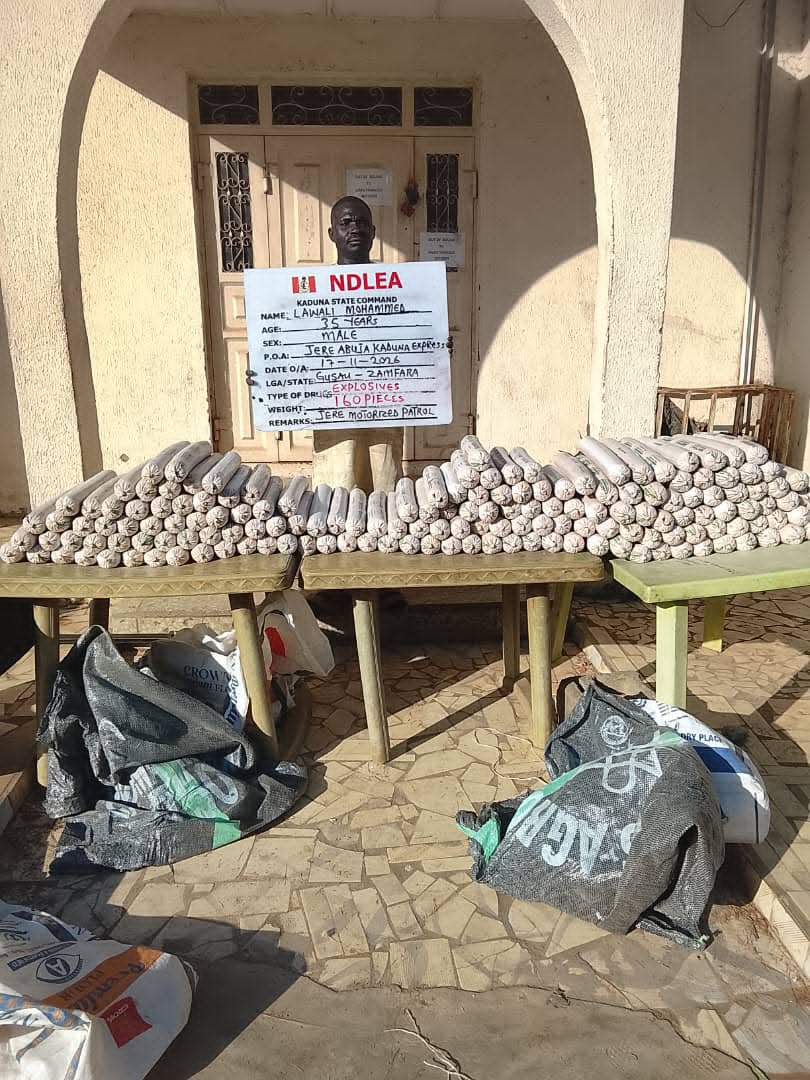
The National Drug Law Enforcement Agency (NDLEA) has intercepted 160 pieces of explosives being transported to Zamfara State and seized over 6.6 tonnes of cannabis in separate operations across several states.
The operations, conducted in Kaduna, Ogun, Osun, Ondo, Edo, Katsina, Abia and Rivers states, also led to the arrest of several suspects, including a woman found with locally made firearms and live ammunition in Ogun State.
According to a statement issued on Sunday by the NDLEA Director of Media and Advocacy, Femi Babafemi, operatives intercepted the explosives along the Abuja-Kaduna Expressway at Jere on November 17.
A 35-year-old suspect, Lawali Muhammad, was arrested while conveying the explosives, while the alleged recipient, 30-year-old Aliyu Mohammed, was apprehended in a follow-up operation in Gusau, Zamfara State, on the same day.
In a separate operation along the Jere axis of the expressway, operatives arrested two suspects, Yusuf Magaji and 32-year-old Buhari Yusuf, with 6,900 tablets of tramadol, 20,000 tablets of diazepam and 25,000 tablets of Exol-5.
Similarly, NDLEA operatives stationed along the Zaria-Kano Expressway at Gwargwaje recovered 627,500 capsules of tramadol weighing 21.50 kilogrammes from a Hummer bus. The driver reportedly abandoned the vehicle and fled upon sighting the operatives.
In Osun State, a 43-year-old man, Francis Oduke, was arrested along the Ikire-Ibadan Expressway with 359 bags of skunk weighing 4,627.7 kilogrammes.
The illicit substance was concealed beneath a load of granite in a truck in an apparent attempt to evade security checks.
In neighbouring Ondo State, operatives intercepted another truck conveying 93 bags of cannabis weighing 1,045 kilogrammes and allegedly destined for Kano State.
The vehicle was intercepted along the Zango-Ado Expressway in Akure on November 16, following intelligence gathering and surveillance.
Four suspects, identified as Adamu Yerima, 19; Mohammed Mohammed, 19; Nura Mohammed, 25; and Usman Mohammed, were arrested in connection with the seizure.
Meanwhile, in Ogun State, a woman, Esther Ogundipe, was arrested on November 19 during a raid on a drug joint at Eleweron, Abeokuta, where operatives recovered two locally made firearms and five live cartridges.
Two other female suspects, Balikis Ogunbiyi and Omobola Ajani, were also arrested during a separate operation in Ilaro with 7.4 grammes of cocaine, 638 grammes of cannabis and 5.9 grammes of methamphetamine.
The agency also reported additional seizures and arrests in Edo, Katsina, Abia and Rivers states.
In Edo State, a 48-year-old man, Emmanuel Eze, was arrested in Aduwawa community, Benin City, with 156 kilogrammes of cannabis, while operatives in Katsina State arrested 39-year-old Abbas Bello with 72 kilogrammes of cannabis concealed in the boot of his Honda Accord car.
In Abia State, operatives recovered two kilogrammes of cannabis from a concealed compartment beneath ceramic floor tiles in a shop belonging to a 25-year-old woman, Oluebube Innocent, at Amankwa Street, Obingwa Local Government Area.
Also, a 46-year-old physically challenged man, Peter Sunday, was arrested with 300 grammes of cannabis during a raid at Eneka in Rivers State.
Beyond its enforcement operations, the NDLEA said its commands sustained public awareness campaigns under its War Against Drug Abuse (WADA) initiative in schools, worship centres and communities.
The activities included sensitisation lectures in Lagos, Kebbi and Enugu states, as well as an advocacy visit by the Ondo State Command to the Deji of Akure, Oba Aladetoyinbo Ogunlade Adelusi.
The NDLEA Chairman and Chief Executive Officer, Brig. Gen. Mohamed Buba Marwa (Rtd), commended officers of the Kaduna, Ogun, Osun, Ondo, Edo, Katsina, Abia and Rivers commands for their efforts.
He urged personnel nationwide to sustain the fight against drug trafficking while maintaining a balance between reducing the supply of illicit substances and tackling drug demand through sustained public enlightenment campaigns.
-
 News3 days ago
Gunmen Machete Football Legend Segun Odegbami in Abeokuta Home Attack
-
News3 days ago
2027: Obi Urges Nigerians to ‘Sacrifice One Day for Nigeria to Be Good Again’
-
Editorial3 days ago
FAKE DRUGS: Nigeria’s Deadly Trade in Human Lives Must End
-
News1 day ago
Pomp, Pageantry as 37th NAFEST Opens in Enugu; Mbah Champions Cultural Economy
-
Politics3 days ago
Umeh Apologises to Anambra People for Supporting Soludo’s Emergence as Governor
-
News2 days ago
2027: ‘I’ll Defeat Natasha Without Spending a Dime,’ Yahaya Bello Boasts, Calls Dino Melaye Noise Maker
-
Editorial1 day ago
Fake Drugs: NAFDAC Seeks Death Penalty as Counterfeit Products Flood Nigerian Markets
-
News2 days ago
Abductions: 640 Nigerians Still in Captivity as Families Cry Out Over Government Silence