The Federal Government is considering diverting heavy-duty vehicles and trucks to the Second Niger Bridge as part of measures to ease persistent traffic gridlock on the First Niger Bridge.
The Anambra State Federal Controller of Works, Timothy Emenike, disclosed this in an interview with our correspondent on Tuesday, saying the government might install barriers at both ends of the First Niger Bridge to prevent heavy-duty trucks from accessing it.
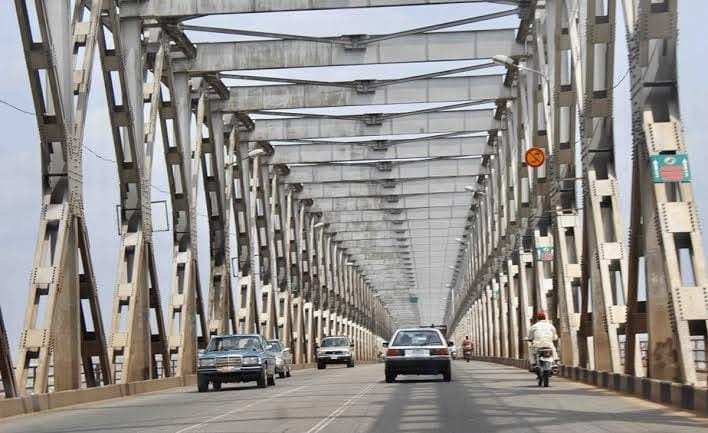
The development follows another weekend of severe traffic gridlock on the bridge linking Onitsha, Anambra State, and Asaba, Delta State, with motorists and commuters reportedly stranded for several hours.

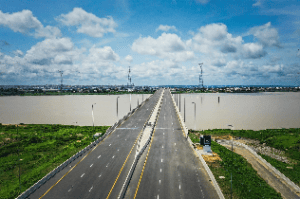
Second River Niger Bridge
The traffic congestion has persisted since the bridge was reopened on October 15, following its temporary closure on September 7, 2026.
The bridge was initially shut after the Minister of Works, Dave Umahi, during an on-the-spot inspection, discovered extensive structural vandalism, including missing bolts, severed steel components and damaged expansion-joint steelwork.
Following its reopening, new road demarcations and concrete median barriers were installed, effectively narrowing the available lanes.
However, motorists have complained that the new arrangements have created difficulties for vehicles, particularly heavy-duty trucks and trailers, which frequently break down or become trapped within the narrowed lanes, obstructing traffic.
They said the situation becomes particularly challenging whenever a vehicle develops a mechanical fault, as the limited space makes it difficult for other motorists to manoeuvre around it.
The resulting blockages have reportedly left commuters stranded for hours, triggering widespread complaints and criticism of the newly installed concrete dividers.
Speaking on the recurring gridlock, Emenike said the proposed diversion of heavy-duty vehicles to the Second Niger Bridge would free up space on the First Niger Bridge and improve traffic flow.
He, however, urged motorists, particularly truck drivers, to ensure that vehicles developing mechanical faults were moved to positions where they would not obstruct other road users.
He said: “The gridlock on the First Niger Bridge is noted, and the ministry is exploring a lot of measures to ensure ease of traffic, especially as we approach the Yuletide season. This gridlock can be prevented if motorists are intentional.
“A vehicle does not just develop a problem on the road; before a problem occurs, it does not just stop the vehicle automatically. If a vehicle is in motion and a problem happens, at least the driver can narrowly clear the vehicle properly to allow other vehicles to move without blocking them. But our people don’t clear off the road whenever they notice a fault on their vehicle while driving.
“Those road demarcations were done to ensure ease of movement, and before we did them, we tested and ensured that two vehicles could pass at a time. The problem is that some drivers park intentionally and obstruct others’ movement whenever their vehicle breaks down.
“We know that a heavy-duty truck and a small vehicle can pass on one lane of the First Niger Bridge at the same time. But two heavy-duty vehicles cannot pass at the same time on the bridge.
“That is why the ministry is considering diverting the heavy-duty trucks to the Second Niger Bridge, which is wide enough to accommodate them.
“So, for now, we are carrying out a lot of measures, and one of the things we are considering is to divert heavy-duty trucks to the Second Niger Bridge, which is wide enough to accommodate as many vehicles as possible.
“The Second Niger Bridge is wide enough to accommodate all of them, but we don’t know why that place is underutilised.”
Meanwhile, motorists and drivers have expressed divergent opinions over the new demarcations, with some blaming the concrete barriers for worsening traffic congestion.
A driver, who identified himself as Emeka, said the new arrangement had made it difficult for motorists to navigate around vehicles that break down on the bridge.
“Since the installation of the concrete demarcations, whenever a car, bus or truck breaks down or stalls, it completely blocks that single lane, triggering severe traffic standstills.
“As it is, a single lane cannot accommodate two vehicles at a time, and that is where the problem lies. Whenever a vehicle, especially a heavy-duty vehicle, breaks down, other vehicles are left stranded as no other vehicle can pass through.
“The ministry promised to provide towing vans at both ends of the bridge for the easy removal of broken-down vehicles, but till date, that has not been done. Each time a vehicle breaks down, other vehicles are left stranded for several hours until a solution is found,” he said.
A truck driver, Sanni, blamed the situation partly on the inability of some drivers to adapt to the new road design, urging them to ensure their vehicles were in good condition before using the bridge.
“It is unfortunate that my colleagues still find it difficult to adapt to the new design on the bridge. I urge them to always ensure their vehicles are in order before plying the road to avoid breakdowns.
“Whenever a heavy-duty vehicle breaks down, it takes over the space on the single lane and prevents other vehicles from passing. However, everything boils down to the authorities. They should provide towing vans at both ends of the bridge for the easy removal of broken-down vehicles,” he said.
However, a civil servant, who identified herself as Amaka, described the new demarcation as a positive development intended to discourage reckless driving, particularly among commercial motorists.
She said the arrangement had nevertheless contributed to traffic congestion because of frequent vehicle breakdowns.
“The demarcation is a good development intended to ward off bad driving habits, especially from commercial drivers. But as it is, it has been creating gridlock for motorists due to frequent vehicle breakdowns.
“In order not to make it a situation of solving one problem and, at the same time, creating multiple problems, a barrier should be placed at both ends of the bridge to prevent heavy-duty trucks from plying it,” she said.