News
Court sentences BRT driver to death for murdering his passenger, Bamise


A Lagos High Court at Tafawa Balewa Square on Friday, sentenced a Bus Rapid Transit (BRT) driver, Andrew Ominikoron, to death by hanging for the murder of his passenger, Oluwabamise Ayanwola.
Ominikoron was arraigned for rape ad murder of a 22-year-old fashion designer, Ayanwola, who boarded his BRT bus on Feb. 26, 2022.

Justice Sherifat Sonaike found Ominikoron guilty of murder and attempted rape of Anyawola.
She also found the convict guilty of raping Nneka Udezulu and sexually assaulting Dr Victoria Anosike, who had boarded his bus on separate occasions.
Sonaike said: “On count one, which is offence of raping Nneka Udezulu, Ominikoron, is sentenced to life imprisonment.

“For count three, attempted rape of Anyawola, you are sentenced to 14 years imprisonment.
“For count five, offence of sexual assault on Dr Victoria Anosike, you are sentenced to three years imprisonment.
“On count four, which is the offence of murder of Oluwabamise Ayanwola; having been found guilty of murder, a capital offence pursuant to Section 301 of the Administrative of Criminal Justice Law, the defendant is hereby sentenced to death.
“You will be hanged by the neck until you be dead. May God have mercy on your soul,”she held.
The judge held that the prosecution proved its case beyond reasonable doubt.
According to her, the prosecution through its witnesses proved that the act of the defendant (Ominikoron) caused the death of the deceased (Anyawola).
She said that the voice recording of the deceased which she sent to her friend while inside the defendant’s bus would be admitted as a dying declaration.
The judge said that the deceased voice recording was made when she felt she was in an eminent danger due to the behaviour of the defendant.
She also said that Anyawola’s voice recording and the pieces of evidence given by the prosecution witnesses on the habit of the defendant in picking up unsuspecting passengers in a lonely area and sexually molesting them, even with threat and force, showed that the defendant was a serial rapist.
“All the circumstantial evidence coupled with the defendant’s refusal to report the matter to his office and his running away to a remote village before his arrest, shows a guilty mind.
“I find the ingredient of murder established beyond all reasonable doubt,”Sonaike held.
The judge said that the defendant lied all through his defence.
She said that the fact that the defendant said he regretted the death of Anyawola was to play sentiment to the court.
Sonaike said: “the fact that the defendant committed these offences within three months interval shows that maybe there are more victims who because of shame failed to come forward.
“The defendant used his employment to rape unsuspecting passengers. This is an unforgivable crime.
“This case is an eye opener. There is need for government to overhaul the recruitment standard so that parents will be assured when their young girl board a vehicle”.
The News Agency of Nigeria (NAN) reports that the prosecution called nine witnesses, while Ominikoron was a sole witness for the defence.
The Lagos State Government had charged him with a five-count bordering on conspiracy, rape, attempted rape and murder, to which he pleaded not guilty.
He was arraigned on March 22, 2022, for the rape and murder of his 22-year-old passenger, on Feb. 26, 2022, at the Lekki-Ajah Expressway.
The prosecution also said that the defendant also raped one Nneka Udezulu and sexually assaulted one Dr Victoria Anosike along Ikorodu Mile 12 axis of Lagos State.
The prosecution said that the offences committed contravened Sections 411, 223, 260, and 165 of the Criminal Law of Lagos State, 2015.
NAN











At least 98 police officers were killed in various incidents across 21 states between January and October 2026, according to data compiled by Daily Trust.
The figures, gathered from media reports and incidents confirmed by police authorities, show that the casualties resulted from attacks by bandits, gunmen and terrorists, as well as road accidents and shootings involving fellow police officers.
Yobe State recorded the highest number of casualties, with 17 officers killed, followed by Zamfara and Kebbi states, which recorded 14 deaths each.
Katsina recorded five deaths, while Borno and Taraba states recorded four each. Rivers, Sokoto, Plateau, Enugu, Lagos and Imo recorded three deaths each.
Oyo, Anambra, Abia, Kaduna and Kogi states recorded two deaths each, while Adamawa, Kano and Niger recorded one death each.
A breakdown of the figures showed that bandits were responsible for 35 deaths, gunmen accounted for 29, while Boko Haram terrorists killed 22 officers. Two officers were also killed by Lakurawa terrorists.
Other fatalities included three officers allegedly shot dead by fellow policemen, four killed in road incidents involving accidents and hit-and-run drivers, one killed by kidnappers, one by hoodlums and another by thugs.
Deadly Attacks in Kebbi, Yobe
One of the deadliest attacks occurred in Kebbi State, where 10 police officers were killed during a gun battle with bandits around the Rafin Makuku axis of Sakaba Local Government Area on August 10.
According to the police, the incident occurred at about 9:25 a.m. on Monday, August 10, 2026, when operatives intercepted suspected bandits moving between Zamfara and Kebbi states.
The police said 17 suspected bandits were neutralised during the encounter, while four motorcycles belonging to the attackers were destroyed.
In Yobe State, 17 police officers were reportedly killed during an attack on the Nigerian Army Special Forces School in Buni Yadi on May 16.
The officers were undergoing specialised operational training at the facility when militants launched a coordinated assault from multiple directions.
“The officers, who were undergoing specialised operational training at the institution, lost their lives when the militants launched a coordinated attack on the facility from multiple directions,” the then police spokesman, DCP Anthony Okon Placid, said in a statement.
He added that several soldiers were also killed in the attack but did not disclose the number of military casualties.
Four Policemen Killed in Benue Attack
Benue State also recorded multiple attacks, including the killing of four police officers during a gun battle with armed men in Ayilamo community, Logo Local Government Area, on September 10.
The Benue State Police Command said the officers engaged the attackers and repelled the assault, forcing the gunmen to retreat into the surrounding forest.
“The operatives stood firm in defence of the community and successfully repelled the attack, forcing the criminal elements to retreat into the surrounding forest with heavy casualties in the early hours of 11th September 2026,” the command said in a statement.
The slain officers were identified as Paul Ina, Mohammed Yusuf, Oge Ikechukwu and Edeh Andrew.
According to the police, their bodies were recovered from surrounding bushes during subsequent search-and-rescue operations.
Seven civilians were also killed in the attack. Their bodies were recovered and deposited in a mortuary, the command added.
Policemen Killed by Colleagues
Beyond attacks by criminal groups, the data also highlighted cases of police officers allegedly killing their colleagues.
In January, Inspector Sani Malumfashi was reportedly shot dead by a fellow police officer at Intels, Onne, in Rivers State.
Similarly, in October, Corporal Amos Yusuf allegedly shot and killed his colleague, Corporal Grace Onimisi, at their residence in Asco Camp, Ajaokuta, Kogi State, before taking his own life.
The incidents highlight the various security challenges confronting the Nigeria Police Force, with officers losing their lives not only in confrontations with armed groups but also in road incidents and cases of violence involving fellow personnel.
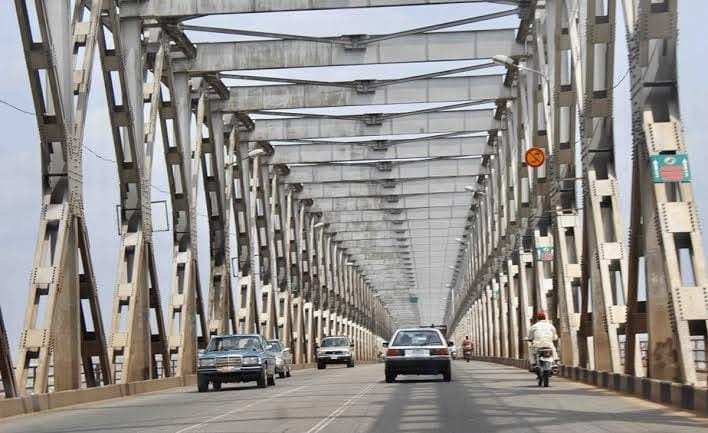
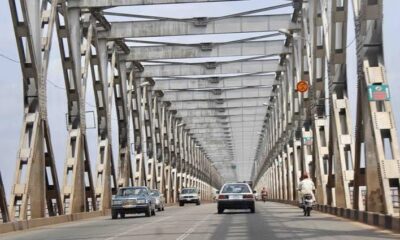
The Federal Government is considering diverting heavy-duty vehicles and trucks to the Second Niger Bridge as part of measures to ease persistent traffic gridlock on the First Niger Bridge.
The Anambra State Federal Controller of Works, Timothy Emenike, disclosed this in an interview with our correspondent on Tuesday, saying the government might install barriers at both ends of the First Niger Bridge to prevent heavy-duty trucks from accessing it.
The development follows another weekend of severe traffic gridlock on the bridge linking Onitsha, Anambra State, and Asaba, Delta State, with motorists and commuters reportedly stranded for several hours.
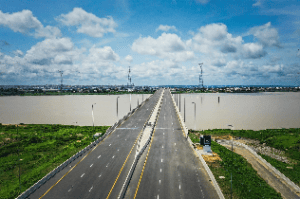
Second River Niger Bridge
The traffic congestion has persisted since the bridge was reopened on October 15, following its temporary closure on September 7, 2026.
The bridge was initially shut after the Minister of Works, Dave Umahi, during an on-the-spot inspection, discovered extensive structural vandalism, including missing bolts, severed steel components and damaged expansion-joint steelwork.
Following its reopening, new road demarcations and concrete median barriers were installed, effectively narrowing the available lanes.
However, motorists have complained that the new arrangements have created difficulties for vehicles, particularly heavy-duty trucks and trailers, which frequently break down or become trapped within the narrowed lanes, obstructing traffic.
They said the situation becomes particularly challenging whenever a vehicle develops a mechanical fault, as the limited space makes it difficult for other motorists to manoeuvre around it.
The resulting blockages have reportedly left commuters stranded for hours, triggering widespread complaints and criticism of the newly installed concrete dividers.
Speaking on the recurring gridlock, Emenike said the proposed diversion of heavy-duty vehicles to the Second Niger Bridge would free up space on the First Niger Bridge and improve traffic flow.
He, however, urged motorists, particularly truck drivers, to ensure that vehicles developing mechanical faults were moved to positions where they would not obstruct other road users.
He said: “The gridlock on the First Niger Bridge is noted, and the ministry is exploring a lot of measures to ensure ease of traffic, especially as we approach the Yuletide season. This gridlock can be prevented if motorists are intentional.
“A vehicle does not just develop a problem on the road; before a problem occurs, it does not just stop the vehicle automatically. If a vehicle is in motion and a problem happens, at least the driver can narrowly clear the vehicle properly to allow other vehicles to move without blocking them. But our people don’t clear off the road whenever they notice a fault on their vehicle while driving.
“Those road demarcations were done to ensure ease of movement, and before we did them, we tested and ensured that two vehicles could pass at a time. The problem is that some drivers park intentionally and obstruct others’ movement whenever their vehicle breaks down.
“We know that a heavy-duty truck and a small vehicle can pass on one lane of the First Niger Bridge at the same time. But two heavy-duty vehicles cannot pass at the same time on the bridge.
“That is why the ministry is considering diverting the heavy-duty trucks to the Second Niger Bridge, which is wide enough to accommodate them.
“So, for now, we are carrying out a lot of measures, and one of the things we are considering is to divert heavy-duty trucks to the Second Niger Bridge, which is wide enough to accommodate as many vehicles as possible.
“The Second Niger Bridge is wide enough to accommodate all of them, but we don’t know why that place is underutilised.”
Meanwhile, motorists and drivers have expressed divergent opinions over the new demarcations, with some blaming the concrete barriers for worsening traffic congestion.
A driver, who identified himself as Emeka, said the new arrangement had made it difficult for motorists to navigate around vehicles that break down on the bridge.
“Since the installation of the concrete demarcations, whenever a car, bus or truck breaks down or stalls, it completely blocks that single lane, triggering severe traffic standstills.
“As it is, a single lane cannot accommodate two vehicles at a time, and that is where the problem lies. Whenever a vehicle, especially a heavy-duty vehicle, breaks down, other vehicles are left stranded as no other vehicle can pass through.
“The ministry promised to provide towing vans at both ends of the bridge for the easy removal of broken-down vehicles, but till date, that has not been done. Each time a vehicle breaks down, other vehicles are left stranded for several hours until a solution is found,” he said.
A truck driver, Sanni, blamed the situation partly on the inability of some drivers to adapt to the new road design, urging them to ensure their vehicles were in good condition before using the bridge.
“It is unfortunate that my colleagues still find it difficult to adapt to the new design on the bridge. I urge them to always ensure their vehicles are in order before plying the road to avoid breakdowns.
“Whenever a heavy-duty vehicle breaks down, it takes over the space on the single lane and prevents other vehicles from passing. However, everything boils down to the authorities. They should provide towing vans at both ends of the bridge for the easy removal of broken-down vehicles,” he said.
However, a civil servant, who identified herself as Amaka, described the new demarcation as a positive development intended to discourage reckless driving, particularly among commercial motorists.
She said the arrangement had nevertheless contributed to traffic congestion because of frequent vehicle breakdowns.
“The demarcation is a good development intended to ward off bad driving habits, especially from commercial drivers. But as it is, it has been creating gridlock for motorists due to frequent vehicle breakdowns.
“In order not to make it a situation of solving one problem and, at the same time, creating multiple problems, a barrier should be placed at both ends of the bridge to prevent heavy-duty trucks from plying it,” she said.
• Abia, FCT, Bayelsa top states with highest tax contributions to IGR
Enugu State recorded the lowest tax revenue-to-Internally Generated Revenue (IGR) ratio among the 36 states and the Federal Capital Territory in 2025, according to figures from the National Bureau of Statistics (NBS), as reported by StatiSense.
Data published on StatiSense’s verified X handle showed that Enugu generated N51.52 billion in tax revenue, representing 12.67 per cent of its total IGR of N406.7 billion in 2025. The remaining revenue came from non-tax sources.
The figures indicate that taxation accounted for a relatively small proportion of Enugu State’s total internally generated revenue, with income from other sources making up the bulk of its earnings.
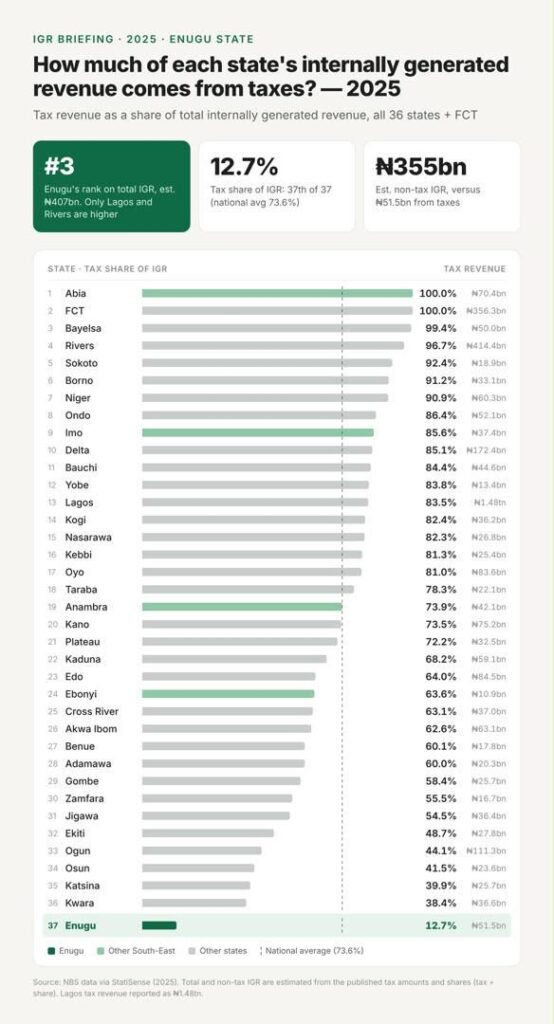
This comes after the NBS earlier ranked Enugu among the leading states in IGR growth, placing it third nationally, behind Lagos and Rivers states.
In the breakdown of tax contributions to IGR, Abia State ranked first, with 100 per cent of its N70.41 billion IGR coming from tax revenue.
The Federal Capital Territory (FCT) also recorded a 100 per cent tax contribution to its N356.34 billion IGR, according to the figures.
Bayelsa ranked third with 99.39 per cent, followed by Rivers with 96.72 per cent and Sokoto with 92.44 per cent, completing the top five states with the highest tax-to-IGR ratios.
Apart from Enugu, other states with relatively low tax contributions to their IGR included Kwara (38.42 per cent), Katsina (39.93 per cent), Osun (41.53 per cent) and Ogun (44.10 per cent).
The figures come amid public debate over the revenue policies of Governor Peter Mbah’s administration, which has repeatedly dismissed allegations of overtaxation in the state.
Speaking at a recent town hall meeting in Enugu, which was televised live by some national television stations, Mbah attributed the allegations to opposition narratives and resistance from individuals who benefited from the irregularities and sharp practices that characterised the state’s revenue collection system before his administration introduced reforms.
The governor maintained that the growth in Enugu’s IGR was driven by improved revenue collection, the deployment of technology to block leakages, economic diversification and the activation of previously dormant government assets, rather than increased taxes.
He also argued that taxation falls under the Exclusive Legislative List of the Constitution, noting that states do not have the authority to independently determine or increase federal tax rates such as Personal Income Tax, Company Income Tax, Value Added Tax and Withholding Tax.
According to him, his administration’s strategy has been to expand the tax net by bringing more eligible individuals and businesses into the system, rather than increasing existing tax rates.
“This is one falsehood that has been so peddled that it’s even beginning to take a semblance of a truth.
“Meanwhile, overtaxation does not exist, and I think those who think we may be taxing more are essentially looking at the sort of growth we have recorded in our IGR.
“Because they couldn’t have imagined such growth happening within the period it happened, they felt perhaps the only justification is that we have burdened the people of Enugu to realise that. But that’s far from the truth,” he said.
Explaining the measures responsible for the increase in revenue, Mbah said the government had eliminated cash-based revenue collection on its behalf to improve transparency and accountability.
“So, what did we do to grow our IGR? First of all, we plugged all the leakages. We ensured that nobody makes payments in cash on behalf of the state government.
“But, importantly, we have so far activated a whole lot of our dormant assets. We now earn quite a lot from those assets, and we built new ones,” he stated.
The governor listed the Hotel Presidential, Enugu United Palm Products Limited, Nigergas, Nike Lake Resort and the International Conference Centre, among others, as government assets his administration had recovered, completed or resuscitated and subsequently optimised for revenue generation.
He also identified newly established revenue-generating ventures, including Enugu Air, as part of the administration’s strategy to diversify the state’s income sources.
Mbah acknowledged, however, that the contribution of tax revenue to the state’s IGR was expected to increase as economic activities expanded and more businesses became operational.
The governor further said some payments made by residents for government services were often wrongly classified as taxes.
He cited payments for the processing of Certificates of Occupancy (C-of-O) and waste disposal services provided by the Enugu State Waste Management Authority (ESWAMA), explaining that such charges were payments for services rather than taxes.
He said the administration had also consolidated several charges and service costs to reduce the financial burden on residents and businesses.
“How much did we say they should pay? N36,000 annually for businesses. And that includes business premises and other rates and services. So, it’s N100 per day.
“We also had the complaints about people going to the market, I’m sure maybe from the local governments, to collect money. I made an announcement to stop that; that nobody should collect N100 or N200 from our market women,” he explained.
-
 News2 days ago
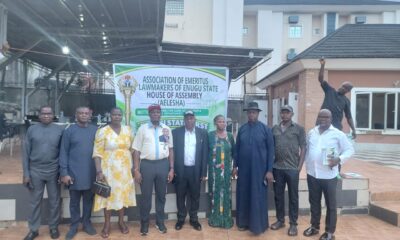
Former Enugu Lawmakers Endorse Mbah for Second Term, Back APC Candidates
-
News21 hours ago
Forgery Trial: NYSC Disowns Nnaji’s Certificate, Identifies Four Discrepancies
-
News2 days ago
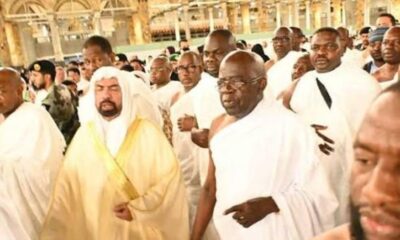
Power Belongs To Allah, He Can Take It From Me And Give Another Person, Tinubu Says During Mecca Visit
-
Editorial2 days ago
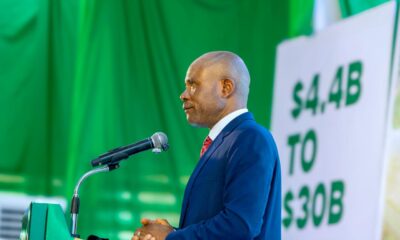
MANIFESTO: Mbah Presents Governance Scorecard, Highlights Enugu’s Progress, Sets $30bn Economic Growth Target
-
News20 hours ago
NDC Spokesperson Dismisses Concerns Over Peter Obi’s Health, Attributes Condition to Exhaustion
-
News3 days ago
ADC Accuses Tinubu of Failing to Deliver on 2023 Electricity Pledge
-
News23 hours ago
Police Rescue Seven Officers, Recover Five Bodies After Deadly Bandit Ambush in Zamfara
-
News2 days ago
OK Movement USA Reaffirms Independence, Clarifies Relationship with Nigerian Structure