
News
New York Times: A female senator faces down a ‘classic abuse of power’ in Nigeria

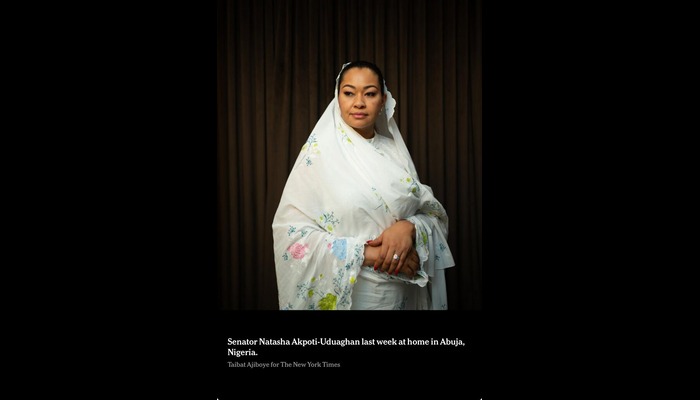
When Nigeria’s third most powerful politician was accused of sexual harassment on national television this year, a fierce backlash ensued — against his accuser.
Natasha Akpoti-Uduaghan, one of four women in Nigeria’s 109-seat Senate, was suspended for six months without pay in February. She said the suspension was punishment for speaking out against Godswill Akpabio, the president of the Nigerian Senate.

Then, angry voters in her constituency in central Nigeria began campaigning to have her removed.

The ordeal has highlighted what women in Nigeria say is the sexism faced by female politicians in their country, and the risks of speaking out in a nation where few women hold political power.

Nigeria is Africa’s most populous nation and sub-Saharan Africa’s second largest economy, but it has the lowest representation of women in Parliament on the continent. It ranks in the bottom five globally.
Through a written response sent by a lawyer, Akpabio denied Akpoti-Uduaghan’s accusations, and he declined an interview request, citing continuing legal proceedings.
“It’s a first at that level in Nigeria,” Obiageli Ezekwesili, a former Nigerian minister of education, said of the accusation against such a high-ranking official. “But it’s a classic abuse of power, where a woman is denied the right to be heard out,” she added.
Akpoti-Uduaghan, 45, who was elected in 2023, said that Akpabio made sexual advances in December of that year when she and her husband visited Akpabio’s home. Akpabio squeezed her hand and told her, “I will make an opportunity for us to come here and have a good moment,” she said.
Akpoti-Uduaghan said that Akpabio later invited her to a hotel and made lewd remarks in the Senate building, including, “‘You can enjoy a lot of benefits if you make me happy.’”
In an interview with The New York Times, Ms. Akpoti-Uduaghan said she kept rejecting the advances, but did not talk about them or file a legal complaint.
“The moment you speak out on sexual harassment, you’re guilty,” she said. Throughout her two senatorial campaigns in 2018 and 2022, Ms. Akpoti-Uduaghan faced repeated online harassment and accusations that she was a prostitute. Such accusations are commonly leveled against women in Nigerian politics.
“We are made to bear it, to see it as part of life,” she added.
Ms. Akpoti-Uduaghan said that last year, she began avoiding the Senate cafeteria and other areas of the building where she might run into Mr. Akpabio, just to escape his sexual advances.
In February, Ms. Akpoti-Uduaghan said that her seat had been moved to a remote corner of the Senate without her consent, and that she was not told why. She came out with her accusations against Mr. Akpabio on Nigerian television later that month.
Days after she went public, the Senate’s ethics committee suspended Ms. Akpoti-Uduaghan for six months, accusing her of unruly behavior during a dispute over the new seating arrangement. It also dismissed a sexual harassment petition she filed against Mr. Akpabio, citing a rule that prohibits victims from filing their own complaints. (The petition must be filed by someone else on the victim’s behalf.)
Since the suspension, Ms. Akpoti-Uduaghan has received no public support from her three female peers. Mr. Akpabio’s wife has filed a defamation lawsuit.
“Women are part of the same patronage system as men are in Nigerian politics,” said Ayomide Ladipo, a Nigerian analyst. “Speaking out against a powerful man with lots of resources and political clout makes you risk being blacklisted or victimized.”
Mr. Akpabio, 62, is a close ally of Bola Ahmed Tinubu, the president of Nigeria and leader of the governing All Progressives Congress. Ms. Akpoti-Uduaghan is a member of the opposition People’s Democratic Party.
Another female public official, Joy Nunieh, accused Mr. Akpabio of sexual harassment in 2020. Nigeria’s former vice president, Atiku Abubakar, an opponent of Mr. Akpabio, said he had a “habit of abusing women.”
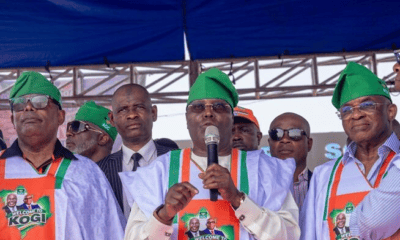
Thousands of supporters rallied on Tuesday when Ms. Akpoti-Uduaghan made an impromptu visit to her district in Kogi Central. But even in Kogi Central, nearly half of all registered voters signed a petition last week calling for her removal, just short of the 50 percent threshold needed to force her out.
No major political party has ever nominated a woman as a presidential candidate in Nigeria. The share of female lawmakers is under 10 percent, according to Invictus Africa, a nonprofit.
Other economic powerhouses on the continent have greater representation of women in politics. In Kenya, a quarter of lawmakers are women. That rate reaches 40 percent in Senegal, and nearly 50 percent in South Africa. Rwanda has the world’s highest rate of female lawmakers, at 61 percent.
All have implemented quota systems in some capacity. Nigeria has not.
“Men make you feel like sitting in the Senate is a privilege,” Ms. Akpoti-Uduaghan said. “I’ve earned my seat. A hostile environment to women sets our democracy back.”
New York Times













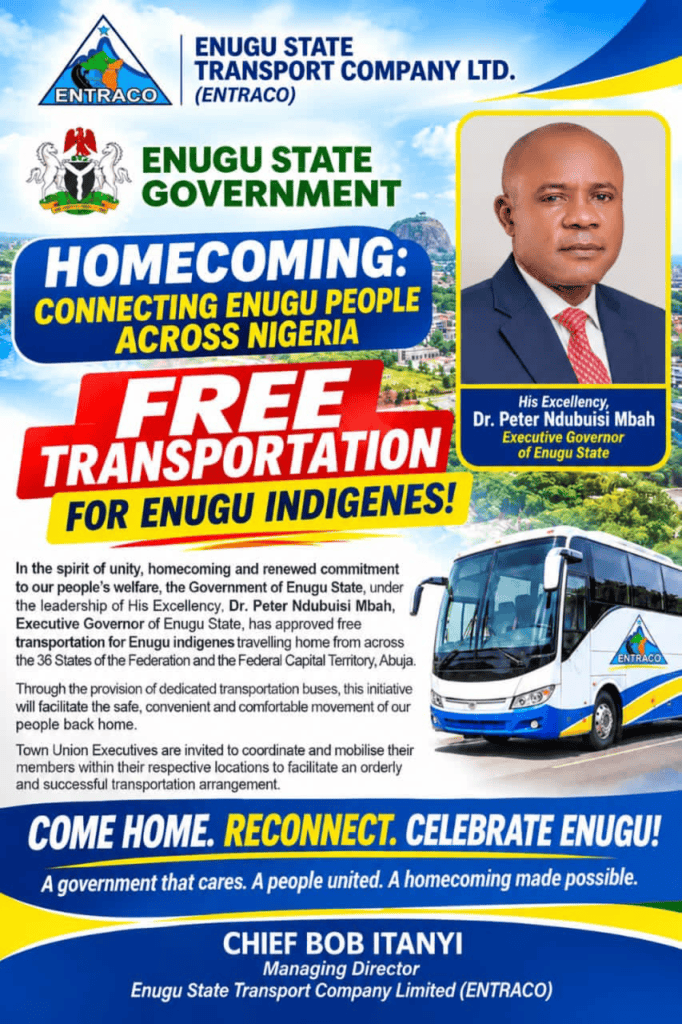
The Enugu State Government has approved free transportation for indigenes living outside the state to enable them to travel home and celebrate the Christmas and New Year festivities with their families.
The initiative, approved by Governor Peter Mbah, is aimed at easing the financial burden associated with festive-season travels and encouraging greater participation in the annual homecoming tradition among Enugu people.
For many indigenes living in different parts of the country, returning home for Christmas is a cherished tradition marked by family reunions, reconnecting with their roots and celebrating the bonds of communal living.
However, the rising cost of transportation during the festive season has often made the journey difficult for many families.
The government’s intervention is expected to make this year’s celebrations different by providing free transportation for eligible Enugu indigenes residing outside the state.
The programme will be coordinated through diaspora town union leaderships across the country, which will serve as grassroots mobilisation channels and facilitate the identification and registration of interested beneficiaries within their respective communities.
An indigene of the state, Mr Felix Obiekwe, described the initiative as more than a transportation intervention, saying it reflected a government that recognises the importance of family reunions and remains connected to its people, irrespective of where they reside.
He said: “It is also a practical expression of a government that recognises the importance of family reunion and understands the emotional significance of homecoming.
“I say this because the practice of annual homecoming has remained a cherished tradition among Enugu people, and this direct government support has made this year’s initiative particularly remarkable.”
Another respondent, Obinna Onyishi, commended Governor Mbah for approving the scheme, describing it as a compassionate initiative that brings government closer to the people while strengthening their bonds of identity, unity and belonging.
According to him, the programme reinforces the governor’s vision of an Enugu State where every son and daughter, irrespective of their place of residence, remains an important stakeholder in the state’s collective development.
Other respondents who spoke with our correspondents also expressed appreciation to the governor for the initiative, noting that it would make this year’s Christmas homecoming more accessible and memorable for many families.
The programme is being coordinated by the Enugu State Transport Company (ENTRACO), under the leadership of its Managing Director, Chief Bob Itanyi.
The beneficiaries have been advised to contact the executives of their respective town unions in their states of residence for information, mobilisation and registration.
Enugu indigenes living in Lagos, Abuja, Port Harcourt, Kano, Kaduna, Ibadan, Benin, Jos and other parts of the country are particularly encouraged to reach out to their town union leaderships to participate in the programme.
The initiative is expected to ease the cost of festive travel, encourage homecoming and strengthen the connection between Enugu indigenes in the diaspora and their communities.

The National Chairman of the All Progressives Congress (APC), Professor Nentawe Goshwe Yilwatda, has expressed sadness over a fatal road accident in Zamfara State that reportedly claimed the lives of more than 10 party members.
The victims were said to be returning to Gummi Local Government Area after attending the APC governorship campaign flag-off in Talata-Mafara when the accident occurred.
Yilwatda, in a condolence message issued on Monday by his Special Adviser on Media and Information Strategy, Abimbola Tooki, described the incident as a painful loss to the party and the entire Zamfara State.
He extended his condolences to the Zamfara State Governor, the government and people of the state, the APC leadership and members, as well as the families and loved ones of the deceased.
The APC chairman described the victims as committed party members whose enthusiasm and participation in the democratic process would not be forgotten.
He stressed that no political activity or engagement should come at the expense of human life.
Yilwatda also commended the Zamfara State Government for suspending its scheduled governorship campaign rally in Maru Local Government Area in honour of the victims, describing the decision as a demonstration of compassion, solidarity and respect for human life.
He further sympathised with those injured in the accident and prayed for their speedy and complete recovery.
The national chairman urged APC members and residents of the state to remain calm and united in the face of the tragedy, while calling on them to support and comfort the bereaved families.
He prayed that Almighty Allah forgives the shortcomings of the deceased, grants them Aljannatul Firdaus and gives their families and the entire APC family the strength to bear the loss.
“At this difficult moment, our thoughts and prayers are with the bereaved families and the people of Zamfara State. We mourn this loss as one family, and we pray that Almighty Allah grants eternal rest to the departed and comfort to all those affected,” Yilwatda said.
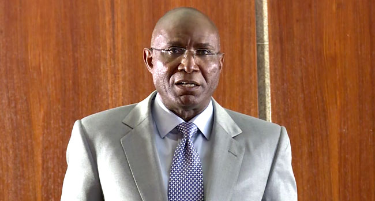
The Federal High Court sitting in Warri, Delta State, on Tuesday reportedly nullified the nomination of former Deputy President of the Senate, Senator Ovie Omo-Agege, as the Nigeria Democratic Congress (NDC) candidate for Delta Central Senatorial District in the 2027 general elections over alleged non-compliance with the provisions of the Electoral Act.
The court, presided over by Justice Hyeladzira Ajiya Nganjiwa, ordered the Independent National Electoral Commission (INEC) to remove Omo-Agege’s name from its list of candidates for the election and restrained him from parading himself as the NDC senatorial candidate.
In a further setback for the party, the court held that the statutory period for conducting fresh primaries to nominate another candidate had elapsed, noting that the Electoral Act prescribes a timeline of 180 days before the general elections.
The judgment followed a suit instituted by Prof. Alexander Osondu Akpodiete, marked FHC/WR/CS/120/2026, challenging the validity of Omo-Agege’s nomination on grounds bordering on his resignation from the All Progressives Congress (APC), membership of the NDC and eligibility to participate in the party’s senatorial primary.
Delivering the judgment, Justice Nganjiwa dismissed all five preliminary objections raised by Omo-Agege, the NDC and INEC challenging the competence of the suit before proceeding to determine the substantive issues.
The court held that the NDC failed to comply with the mandatory provisions of the Electoral Act concerning the submission of its membership register to INEC ahead of its primary election.
Specifically, Justice Nganjiwa found that Omo-Agege’s name was not contained in the NDC membership register submitted to INEC at least 21 days before the party conducted its primary election.
The judge also held that the NDC failed to provide credible evidence showing that the membership register was subsequently updated and submitted to INEC within the statutory period preceding the primary.
Relying on INEC’s revised electoral timetable, the court further noted that Omo-Agege participated in the APC senatorial primary held on May 18, 2026, which, according to the judge, established that he was still a member of the APC at the material time.
Justice Nganjiwa maintained that only persons whose names appeared in a political party’s membership register, in accordance with the provisions of the Electoral Act, were eligible to participate in its primary elections.
On the admissibility of a previously withdrawn affidavit, the court held that a party was entitled to withdraw an affidavit already filed in a proceeding. It added that once withdrawn, such an affidavit ceased to form part of the court’s records and could no longer be relied upon in determining the matter.
The judge stressed that a valid nomination could not be based on a process that failed to satisfy statutory requirements, adding that INEC could not include a candidate on the ballot where the political party failed to comply with the Electoral Act in nominating the individual.
Consequently, the court invalidated Omo-Agege’s nomination, directed INEC to remove his name from its list of candidates and restrained him from presenting himself as the NDC candidate for Delta Central Senatorial District in the forthcoming general elections.
The judgment marks a significant development in the political contest for the Delta Central senatorial seat and raises questions about the NDC’s prospects of fielding a candidate for the constituency in the 2027 general elections.
-
 News1 day ago
INEC selects 520 polling units for mock election in Enugu
-
News3 days ago
Pomp, Pageantry as 37th NAFEST Opens in Enugu; Mbah Champions Cultural Economy
-
Editorial3 days ago
Fake Drugs: NAFDAC Seeks Death Penalty as Counterfeit Products Flood Nigerian Markets
-
News3 days ago
Police Take Over Fountain of Life Church as Jimmy Odukoya’s Leadership Crisis Deepens
-
News3 days ago
South-East Policy and Impact Conference to chart pathway from economic reforms to regional prosperity
-
News3 days ago
2027 Elections: Controversy Trails Inauguration of 200-Man Security Outfit by Umahi’s Son
-
Politics1 day ago
BREAKING: 2027: Tinubu woos Lagos-based Igbos, seeks support for re-election
-
News2 days ago
How My Wife Was Taken Away From My Home – Gov. Abba Yusuf