• Abia, FCT, Bayelsa top states with highest tax contributions to IGR
Enugu State recorded the lowest tax revenue-to-Internally Generated Revenue (IGR) ratio among the 36 states and the Federal Capital Territory in 2025, according to figures from the National Bureau of Statistics (NBS), as reported by StatiSense.
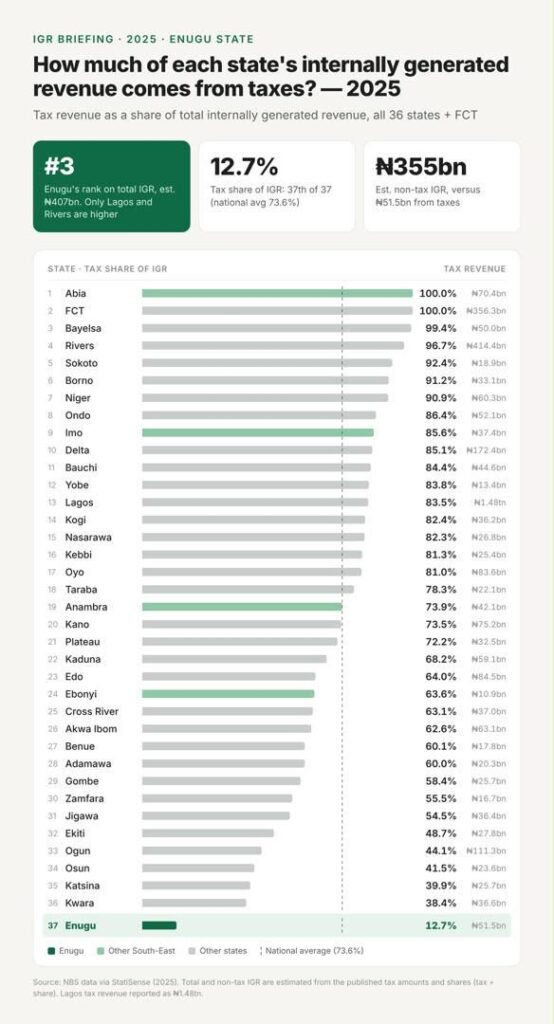
Data published on StatiSense’s verified X handle showed that Enugu generated N51.52 billion in tax revenue, representing 12.67 per cent of its total IGR of N406.7 billion in 2025. The remaining revenue came from non-tax sources.
The figures indicate that taxation accounted for a relatively small proportion of Enugu State’s total internally generated revenue, with income from other sources making up the bulk of its earnings.

This comes after the NBS earlier ranked Enugu among the leading states in IGR growth, placing it third nationally, behind Lagos and Rivers states.
In the breakdown of tax contributions to IGR, Abia State ranked first, with 100 per cent of its N70.41 billion IGR coming from tax revenue.
The Federal Capital Territory (FCT) also recorded a 100 per cent tax contribution to its N356.34 billion IGR, according to the figures.
Bayelsa ranked third with 99.39 per cent, followed by Rivers with 96.72 per cent and Sokoto with 92.44 per cent, completing the top five states with the highest tax-to-IGR ratios.
Apart from Enugu, other states with relatively low tax contributions to their IGR included Kwara (38.42 per cent), Katsina (39.93 per cent), Osun (41.53 per cent) and Ogun (44.10 per cent).
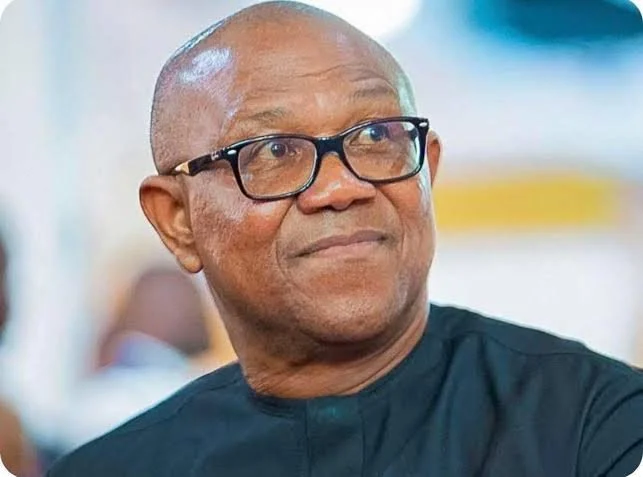
The figures come amid public debate over the revenue policies of Governor Peter Mbah’s administration, which has repeatedly dismissed allegations of overtaxation in the state.
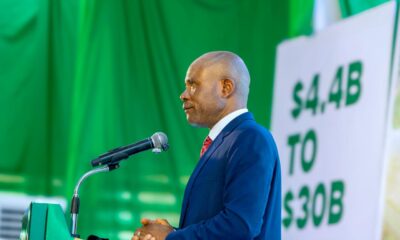
Speaking at a recent town hall meeting in Enugu, which was televised live by some national television stations, Mbah attributed the allegations to opposition narratives and resistance from individuals who benefited from the irregularities and sharp practices that characterised the state’s revenue collection system before his administration introduced reforms.
The governor maintained that the growth in Enugu’s IGR was driven by improved revenue collection, the deployment of technology to block leakages, economic diversification and the activation of previously dormant government assets, rather than increased taxes.
He also argued that taxation falls under the Exclusive Legislative List of the Constitution, noting that states do not have the authority to independently determine or increase federal tax rates such as Personal Income Tax, Company Income Tax, Value Added Tax and Withholding Tax.
According to him, his administration’s strategy has been to expand the tax net by bringing more eligible individuals and businesses into the system, rather than increasing existing tax rates.
“This is one falsehood that has been so peddled that it’s even beginning to take a semblance of a truth.
“Meanwhile, overtaxation does not exist, and I think those who think we may be taxing more are essentially looking at the sort of growth we have recorded in our IGR.
“Because they couldn’t have imagined such growth happening within the period it happened, they felt perhaps the only justification is that we have burdened the people of Enugu to realise that. But that’s far from the truth,” he said.
Explaining the measures responsible for the increase in revenue, Mbah said the government had eliminated cash-based revenue collection on its behalf to improve transparency and accountability.
“So, what did we do to grow our IGR? First of all, we plugged all the leakages. We ensured that nobody makes payments in cash on behalf of the state government.
“But, importantly, we have so far activated a whole lot of our dormant assets. We now earn quite a lot from those assets, and we built new ones,” he stated.
The governor listed the Hotel Presidential, Enugu United Palm Products Limited, Nigergas, Nike Lake Resort and the International Conference Centre, among others, as government assets his administration had recovered, completed or resuscitated and subsequently optimised for revenue generation.
He also identified newly established revenue-generating ventures, including Enugu Air, as part of the administration’s strategy to diversify the state’s income sources.
Mbah acknowledged, however, that the contribution of tax revenue to the state’s IGR was expected to increase as economic activities expanded and more businesses became operational.
The governor further said some payments made by residents for government services were often wrongly classified as taxes.
He cited payments for the processing of Certificates of Occupancy (C-of-O) and waste disposal services provided by the Enugu State Waste Management Authority (ESWAMA), explaining that such charges were payments for services rather than taxes.
He said the administration had also consolidated several charges and service costs to reduce the financial burden on residents and businesses.
“How much did we say they should pay? N36,000 annually for businesses. And that includes business premises and other rates and services. So, it’s N100 per day.
“We also had the complaints about people going to the market, I’m sure maybe from the local governments, to collect money. I made an announcement to stop that; that nobody should collect N100 or N200 from our market women,” he explained.